
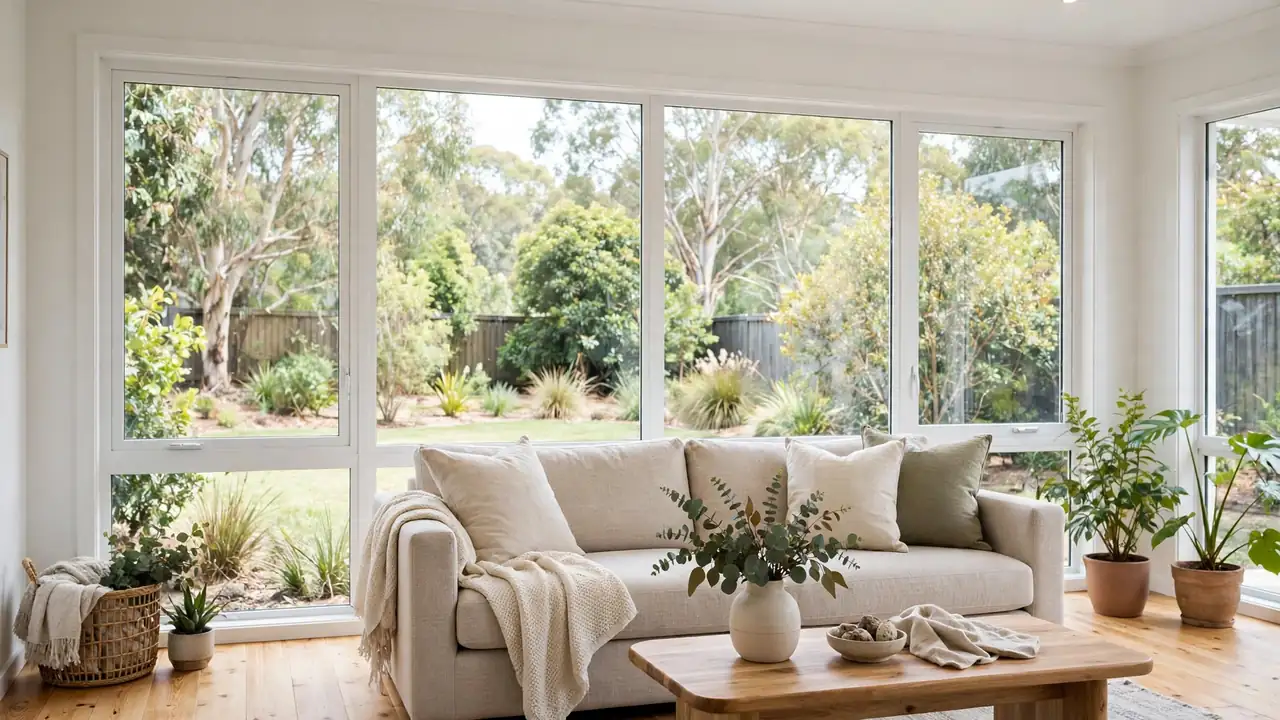
The double glazing cost Australia homeowners pay in 2026 depends on one choice more than any other: whether you keep the frame you have or replace the whole window. Retrofitting new double-glazed glass into sound existing frames costs about $1,000 to $1,300 per medium window. A full replacement with new frames runs $1,600 to $3,200 per window, depending on the frame material. In fact, a whole house of ten windows lands anywhere from $9,500 to $32,000, and the gap between those two totals is mostly the frames, not the glass.
Double Glazing Cost Australia: The Short Answer
For a standard aluminium double-glazed window, plan on $700 to $1,600 fully installed, or $350 to $800 supply-only. Thermally broken aluminium runs $1,100 to $2,500 per opening installed, uPVC $800 to $1,800, and architectural timber $1,200 to $3,000 or more. Those are Smiro’s 2026 figures. In short, they line up with the other published guides once you match the scope: supply-only, supply and install, or glass-only retrofit. The per-window figure is the one to compare. But check the window size behind it. Most guides price a medium window of about 1.2 by 1.2 metres or 1.8 square metres. A large sliding door is a different job entirely.
Double Glazing Cost Australia per Window by Frame Material
Overall, the frame is the price ladder. In other words, glass is roughly the same in every window; the frame decides the total, the thermal performance and the maintenance bill that follows.
| Frame material | Per window installed | Supply-only, per m² | What you get |
|---|---|---|---|
| Standard aluminium | $700–$1,600 | $350–$800 | Slim sightlines, strong, cheapest full replacement |
| Thermally broken aluminium | $1,100–$2,500 | $550–$950 | Polyamide break cuts heat conduction; 7-star NatHERS help |
| uPVC | $800–$1,800 | $400–$700 | Best native insulation; bulkier frames, fewer dark colours |
| Architectural timber | $1,200–$3,000+ | $850–$1,400+ | Natural thermal performance; needs repainting or oiling |
In practice, the spread inside each band comes from size, glazing specification and access. A fixed picture window is the cheapest shape, with no hinges, rollers or locks. It runs $300 to $500 per square metre supply-only. An opening window with Low-E glass and argon fill sits higher. An upper-storey window adds $150 to $600 for access. Old-window removal is usually included. If it is charged separately, expect $50 to $200 per window. The guides disagree most on uPVC. There, the band runs from $800 to $3,000 per window depending on the size and the supplier. So a uPVC quote at the top of the range deserves a second quote before you accept it.

Worked Budgets: Retrofitting Ten Windows vs Replacing Them
The same house — ten medium windows of about 1.8 square metres each — priced four ways, using RenoPlace’s 2026 whole-house figures.
Budget 1: Retrofit the glass only — $9,500 to $13,000
First, keep the frames and replace the glass with sealed double-glazed units. At $1,000 to $1,300 per medium window, ten windows cost $9,500 to $13,000. This only works if the frames are sound, square and deep enough to take the thicker unit. It leaves you with the old frame’s thermal performance. A standard aluminium frame still conducts heat even with good glass. It is the right call when the frames are in good shape and the budget is tight.
Budget 2: New aluminium windows — $16,500 to $22,000
Full replacement with new double-glazed aluminium windows runs $1,600 to $2,200 per medium window, or $16,500 to $22,000 for ten. You get new frames, new seals, new hardware and a proper flashing detail around each opening. Standard aluminium is the dominant choice in Australian construction for a reason: slim sightlines, structural strength and powder-coated finishes that stand up to coastal air. Its weakness is conduction — bare aluminium is a thermal bridge, which is why the next budget exists.
Budget 3: New uPVC windows — $19,000 to $25,500
For example, at $1,800 to $2,500 per medium window, ten uPVC windows cost $19,000 to $25,500. uPVC insulates without a thermal break, so the frame itself performs well. The windows are quiet, because the sealed unit and the chunky frame cut street noise noticeably. On the other hand, the trade-offs are bulkier sightlines, internal steel reinforcement on large openings, and fewer dark exterior colour options. For a bedroom facing a busy road, the noise benefit alone can justify the premium over standard aluminium.
Budget 4: New timber windows — $23,500 to $32,000
Finally, timber is the dearest option at $2,400 to $3,200 per medium window, or $23,500 to $32,000 for ten. Solid timber insulates naturally and suits heritage homes and high-end builds, but it needs sanding, painting or oiling every few years to stop warping and rot. Thermally broken aluminium, at $1,100 to $2,500 per window, is the usual middle path for a new build chasing a 7-star NatHERS rating. The polyamide break adds $200 to $350 per square metre over standard aluminium. It does most of what timber does for thermal performance, with none of the maintenance.
Double Glazing Cost Australia: Retrofit vs New Build
A new build is cheaper per window than a retrofit, because the windows go in before the plaster and the trims, with no removal and no making good. Olco’s 2026 guide puts a complete double-glazed package for a 3 to 4 bedroom home at $12,500 to $26,250 supply-only. Fully installed, the same package runs $22,000 to $45,000, for 10 to 15 openings totalling 25 to 35 square metres. In a renovation, the same glass costs more: each opening needs the old window out, the reveal repaired, new flashing and new architraves, and the making good is where the labour goes.
Secondary glazing — a second pane fitted inside the existing window — is the budget alternative at $450 to $1,200 per window. It is not true double glazing, but it cuts draughts and noise where the frame cannot take a sealed unit, and it suits heritage windows that cannot be replaced. If you are replacing windows as part of a bigger job, our window replacement cost guide prices the full job, frames included, and the energy-efficient home design guide shows where glazing sits in the whole-house picture.
Double Glazing Cost Australia: Does It Pay for Itself?
However, the energy case is real and slow. Your Home, the Australian Government guide, notes that up to 40 per cent of a home’s heating energy can be lost through windows. Halving a window’s U-value halves the heat loss through it. The U-value is the measure of how readily a window conducts heat. A double-glazed unit with argon fill and a low-E coating can cut heating and cooling bills. The saving is roughly 15 per cent a year on some estimates. That holds in a thermally broken or uPVC frame. On a $2,000 annual heating and cooling bill, that is $300 a year. A $10,000 retrofit premium takes a very long time to repay. So do not buy double glazing on energy savings alone.
The payoff that arrives on day one is comfort and quiet. No cold draught comes off the glass in winter, and no condensation runs down the panes. Street noise is cut to a murmur. In Victoria, the Victorian Energy Upgrades rebate pays about $210 per 10 square metres of glazing, roughly $30 per window — worth claiming, but small against a $20,000 job. In the end, the honest way to judge it is as a comfort and resale upgrade with an energy bonus, not as an investment with a payback date.

What Quotes Usually Leave Out
For instance, double glazing quotes look simple until the extras arrive. Check for these lines before you compare totals.
- Removal and disposal: usually included, but $50 to $200 per window if charged separately.
- Flashing and waterproofing: the perimeter seal around each new frame. Skipping it is how leaks start, and it is rarely a separate line.
- Reveals, trims and making good: new architraves and plaster repairs inside, and render or cladding repairs outside.
- Upper-storey access: $150 to $600 per window for scaffolding or ladder access.
- Low-E and argon upgrades: Low-E coating adds $100 to $300 per window on aluminium if it is not already included; uPVC usually includes it.
- Sliding doors: a two-panel aluminium double-glazed sliding door runs $2,500 to $4,500, and $3,500 to $6,000 in uPVC — price them separately, never at the window rate.
- Fly screens and security screens: rarely in the window quote, and a full-house set can add thousands.
Before you sign, ask each supplier the same questions in writing. What is the U-value and solar heat gain coefficient of the whole window, not just the glass? Are Low-E and argon included, and what does the warranty cover on the sealed unit? A failed seal shows as fog between the panes. It is the most common double glazing complaint. The Australian Government’s Your Home glazing guide explains U-values and solar heat gain in plain language, and it is worth reading before you sign. For Melbourne homes, the best windows in Melbourne guide covers local suppliers and what suits the city’s cold winters.
Frequently Asked Questions
How much does double glazing cost per window in Australia?
A standard aluminium double-glazed window costs $700 to $1,600 fully installed in 2026. Thermally broken aluminium runs $1,100 to $2,500, uPVC $800 to $1,800, and timber $1,200 to $3,000 or more per window. Retrofitting glass into existing frames costs about $1,000 to $1,300 per medium window, and a fixed picture window is the cheapest shape.
How much does it cost to double glaze a whole house?
Double glazing ten medium windows costs $9,500 to $13,000 as a glass-only retrofit, $16,500 to $22,000 with new aluminium windows, $19,000 to $25,500 with new uPVC windows, and $23,500 to $32,000 with new timber windows. A complete package for a 3 to 4 bedroom home runs $22,000 to $45,000 fully installed, including doors.
Is double glazing worth it in Australia?
Yes for comfort, noise and condensation, and as a slow energy saving. Up to 40 per cent of a home’s heating energy can be lost through windows, and good double glazing can cut heating and cooling bills by roughly 15 per cent a year. The comfort payoff — no cold draughts, no condensation, much less street noise — arrives on day one, while the energy payback takes many years.
Can you retrofit double glazing into existing frames?
Yes, if the frames are sound, square and deep enough to take the thicker sealed unit. Retrofit glass costs $600 to $1,200 per standard window, or about $1,000 to $1,300 per medium window. It keeps the old frame’s thermal performance, so a standard aluminium frame still conducts heat. Secondary glazing at $450 to $1,200 per window is the alternative where the frame cannot take a sealed unit.
What is the cheapest way to double glaze a home?
Retrofitting glass into sound existing frames is cheapest at $9,500 to $13,000 for ten windows. Secondary glazing is cheaper per window at $450 to $1,200, but it is not true double glazing. For full replacements, standard aluminium is the cheapest frame at $700 to $1,600 per window installed. Claim the Victorian Energy Upgrades rebate of about $30 per window if you are in Victoria.
In summary, start with the frames you have, price the glass and the frames separately, and get the U-value of the whole window in writing. The right double glazing is the one that fits your frames, your street and your winters — not the dearest one in the brochure.