
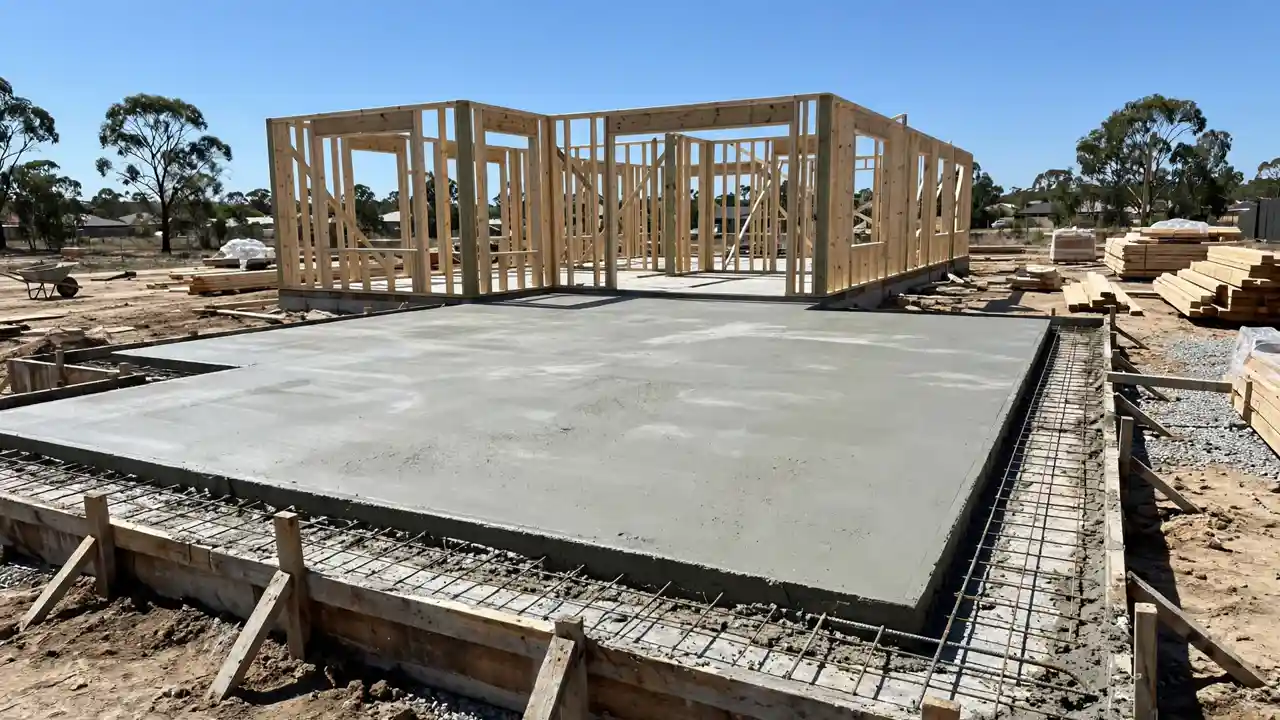
In 2026, concrete slab cost for a house in Australia usually runs $110 to $170 per square metre. That covers supply and laying, including GST, for a waffle pod slab on a standard site. A shed, garage or carport slab is cheaper at $90 to $140 per square metre. Difficult soil or a sloping block can push a house slab to $200 per square metre or more. Those rates cover the slab itself. Around them sits a second layer. Soil testing, engineering, site cuts and termite protection can add several thousand dollars. This guide prices both layers and decodes the site class that decides which slab you need. It works through three real budgets.
Concrete Slab Cost: The Short Answer
First, for a single-storey house of 200 square metres, budget $22,000 to $34,000 for the slab. That is $110 to $170 per square metre. Second, a large 300 square metre house runs $33,000 to $51,000. A 6 by 9 metre shed slab of 54 square metres costs roughly $4,900 to $7,600. Those figures cover formwork, reinforcement, concrete, pumping and finishing. The soil test, the engineer’s design, the site cut and termite protection sit outside them. The builder prices those separately. Once the builder prices the slab, the rest of the build follows the same logic. See the duplex build cost guide for a two-home example. On a house, the slab is usually part of the builder’s contract rather than a separate job. Ask for the slab as its own line before you sign.
What a Slab Price Actually Covers
A per-square-metre slab rate is a bundle, and the bundle is fairly consistent across Australian concreters. It covers the formwork, the steel reinforcement, the ready-mix concrete, and the pump or barrow work to place it. The screeding and finishing leaves a level surface. For a house slab it also covers the thickened edge beams. On a waffle pod slab, it covers the polystyrene pods that form the voids. Factory-built homes change the slab maths, because the modules arrive finished. Our modular home cost guide prices the whole package. What it does not cover is everything that happens before the formwork goes in. That includes everything the engineer specifies because of your soil.
Concreters also price the concrete itself by the cubic metre, and the two figures have to reconcile. Ready-mix concrete in Australian capital cities generally costs about $300 to $380 per cubic metre including GST in 2026. Standard mixes run 20 to 32 MPa. A 100mm slab uses 0.1 cubic metres per square metre. So the concrete alone is roughly $30 to $38 per square metre. Waffle pod slabs can be cost-effective on flat sites because the voids use less concrete and less labour. YourHome, the Australian Government’s sustainable housing guide, explains why.
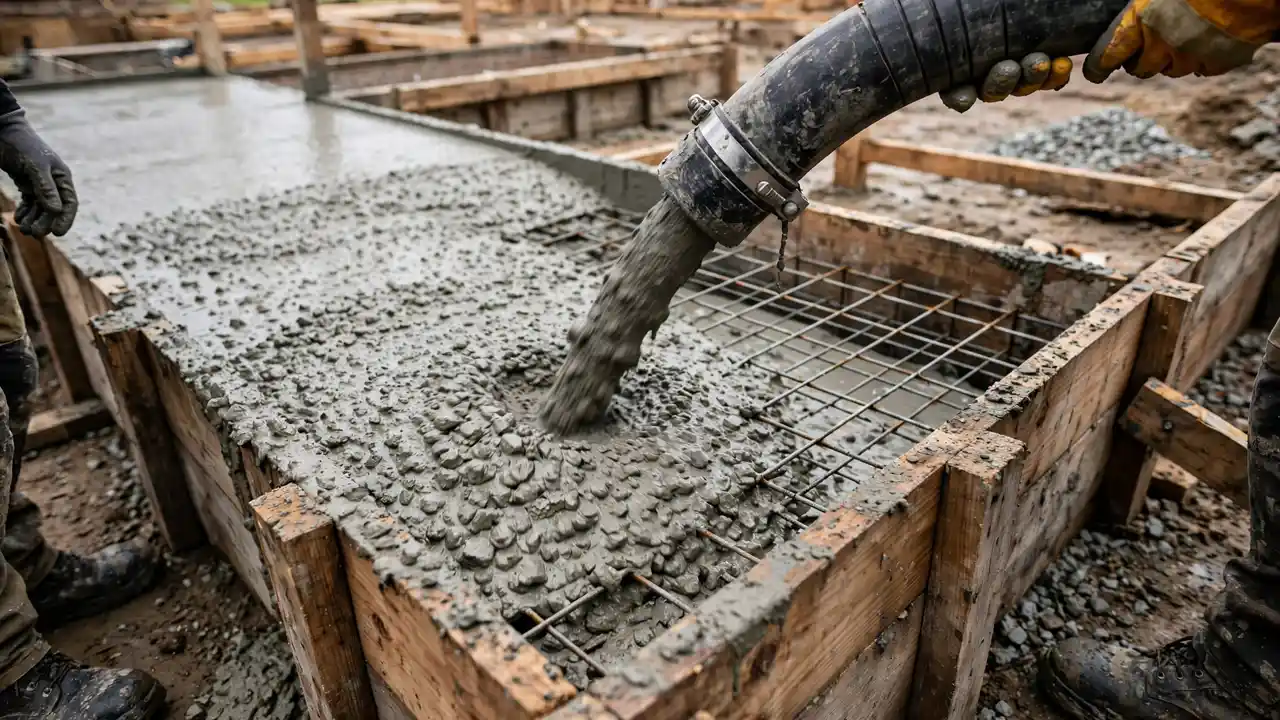
Concrete Slab Cost by Slab Type
Overall, the table below brings the 2026 published rates together by slab type. The headline band is the reconciled figure; the right-hand column says when each type is used.
| Slab type | Typical price per m² (incl. GST) | Typical use |
|---|---|---|
| Shed, garage or carport slab | $90 to $140 | Thickened edges, often pad footings |
| House slab, waffle pod (M class) | $110 to $170 | Most new homes on A, S and M class sites |
| House slab, raft (conventional) | $120 to $180 | Heavier loads, more reactive soil |
| House slab, difficult site | $170 to $200+ | Sloping blocks, H class soil, piers |
| Plain patio or alfresco slab | $85 to $130 | Light loads, falls away from the house |
Other guides quote lower figures, and the gap is usually about what each one counts. Yellow Pages puts a standard slab at $75 to $110 per square metre for materials. Meanwhile, What The Damage’s November 2026 re-verification across more than 90 sources puts a plain slab at $75 to $150. Its typical figure is $110. ServiceTasker quotes $75 to $110. CivilCraft puts plain 100mm concrete at $100 to $130 and reinforced concrete at $120 to $160. The lower figures are materials-heavy or plain-slab rates. The Yakka band of $110 to $170 is the supplied-and-laid figure for an engineered waffle pod.
The Site-Class Decoder
The single biggest driver of building slab cost is not the size of the house. A geotechnical engineer sets the site class after a soil test under AS 2870. That is the Australian standard for residential slabs and footings. The class describes how far the ground is likely to move. A quote given before the soil test is a guess.
| Site class | What the ground does | Usual slab | Cost effect |
|---|---|---|---|
| A | Barely moves (rock, sand) | Standard waffle pod or raft | Base rate |
| S | Slightly reactive clay | Waffle pod, standard design | Base rate |
| M | Moderately reactive clay | Waffle pod, stiffened ribs | Base rate, sometimes +5% |
| H1 / H2 | Highly reactive clay | Stiffened raft, deeper beams | Often +15% to +40% |
| P | Problem site (fill, mine subsidence, soft soil) | Engineered slab, often piers | Can double the slab budget |
Two consequences follow. First, the site class is why two neighbours can pay very different slab prices for identical houses. One sits on Class S clay and the other on Class H2. The second slab needs deeper beams and more steel. Second, a sloping block compounds the class. Yakka Labour notes that difficult soil, sloping blocks and small extension slabs can push the rate up. It can reach $200 per square metre or more. A slope needs a site cut, retaining, and sometimes piers.
State-by-State Prices
Meanwhile, labour rates, concrete prices and soil conditions move the rate between cities. The table below uses the 2026 city figures from ServiceTasker and Yakka Labour.
| City | Standard slab per m² | House slab per m² | Local factor |
|---|---|---|---|
| Sydney | $90 to $150 | $125 to $190 | High labour, reactive clay in the west |
| Melbourne | $85 to $130 | $115 to $175 | Reactive clay in the west and north |
| Brisbane | $75 to $110 | $110 to $165 | Generally kinder soils, lower labour |
| Perth | $70 to $100 | $105 to $155 | Sandy soils, lowest slab rates |
| Adelaide | $80 to $120 | $110 to $165 | Reactive clay in the foothills |
The pattern is consistent. Sydney is the dearest and Perth is the cheapest. The gap is about $20 to $35 per square metre on a house slab. That is $4,000 to $7,000 on a 200 square metre house. What The Damage’s November 2026 re-verification found concreting up 5.4 per cent year on year. So a quote from early 2025 is already stale.
Three Worked Budgets
So concrete slab cost is easier to judge when you see the arithmetic. These three budgets use the reconciled band. The cost of a slab is the area times the rate, plus the site costs outside the rate.
Shed slab, 6 by 9 metres (54 m²), Brisbane, flat block. At $90 to $140 per square metre, the slab is $4,860 to $7,560. Also, add a soil test if the shed needs approval, and a pump if the truck cannot reach the pad. A realistic all-in figure is $5,500 to $8,500.
Single-storey house, 200 m², Melbourne, M class site. At $110 to $170 per square metre, the slab is $22,000 to $34,000. Then add the soil test, engineering and site cut, plus termite protection. A realistic all-in figure for the slab stage is $26,000 to $40,000.
Large single-storey house, 300 m², Sydney, H1 class site. At $110 to $170 per square metre the slab is $33,000 to $51,000. But an H1 site needs a stiffened raft. So budget the top half of the range. Allow 15 to 40 per cent more for the deeper beams and extra steel. A realistic all-in figure is $45,000 to $65,000 including the site works.
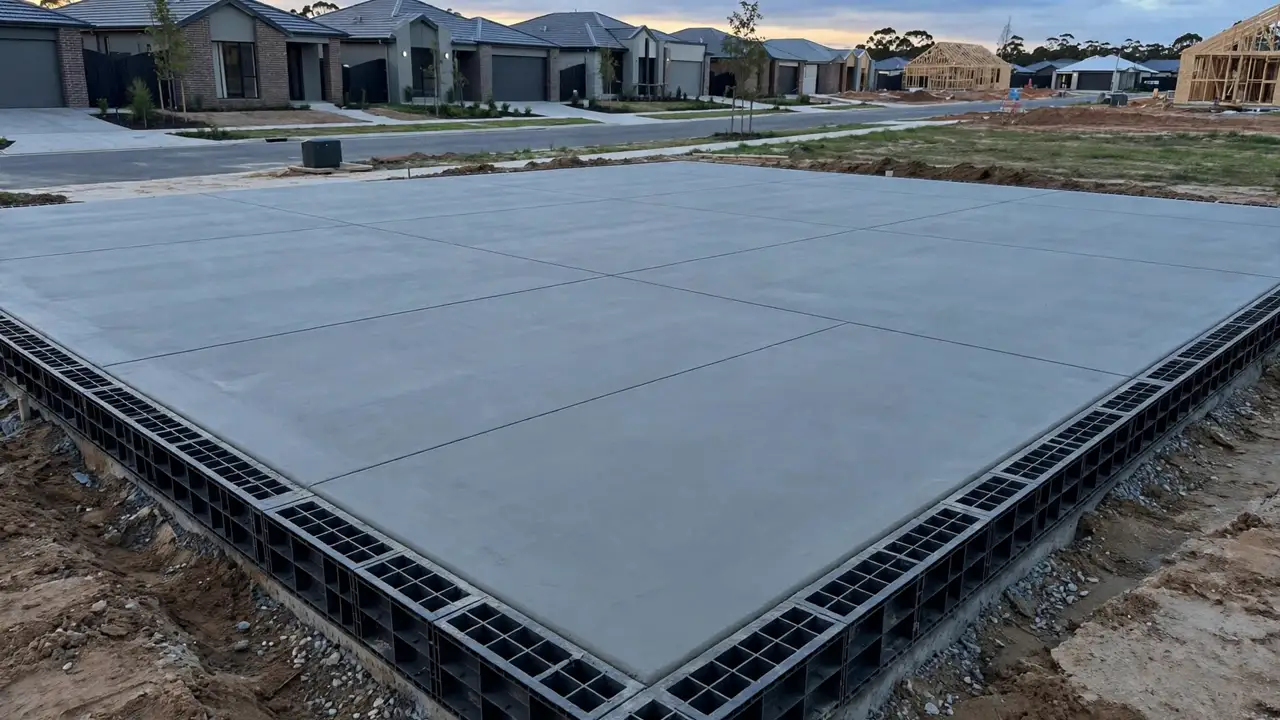
Inside the Rate vs Outside It
So the cost for concrete slab work is only comparable when every quote carries the same inclusions.
| Item | Usually inside the per-m² rate? | Typical extra if outside |
|---|---|---|
| Formwork, reinforcement, concrete, pump, finishing | Yes | — |
| Soil test and site classification | No | $500 to $1,500 (guide figure) |
| Engineer’s slab design | No | Priced per job, varies widely |
| Site cut and excavation | No | $300 to $700 for a small cut (guide figure) |
| Termite protection (perimeter + collars) | No | Several hundred to over $1,000 |
| Vapour barrier under the slab | Usually yes | Check it is named in the quote |
| Plumbing rough-in before the pour | No | Plumber’s rate, before the slab |
| Piers to firm ground | No | Priced per pier on problem sites |
| Removal of an existing slab | No | $30 to $100 per m² |
The plumbing line catches first-time builders. Pipes that pass through the slab have to go in before the pour, in exactly the right spot. Moving them afterwards means cutting concrete. The vapour barrier matters just as much. A polyethylene membrane under the slab stops moisture rising from the soil into the house. So if a quote does not name the membrane, ask whether the quote includes it.
Slab Thickness and Concrete Strength
Most residential slabs are 100mm thick, and garages and heavy-use areas need 150mm or more. Thickness is not a choice you make on price. The engineer sets it from the loads and the site class. A thinner slab on a reactive site will crack. Engineers specify strength in megapascals. Standard residential mixes run 20 to 32 MPa.
So volume is the check that catches quoting errors. A 200 square metre slab at 100mm needs 20 cubic metres of concrete before edge beams. So at $300 to $380 per cubic metre, the concrete alone is $6,000 to $7,600 plus the beams. If a quote’s total is barely above the concrete cost, the labour, steel and formwork have been under-priced.
How Long a Slab Takes, and When It Can Be Built On
Foundations, including the slab, usually take one to two weeks from site cut to cured slab. The pour itself is a day: the crew places the concrete, screeds it level, and finishes the surface. Then the slab cures, and curing is not drying — concrete gains strength as the cement hydrates, which takes days. So a slab loaded too early can crack or settle.
Weather decides the pour day more than the calendar does. Heavy rain can delay a pour. Hot wind can dry the surface too fast. That is why concreters cure slabs with water or a curing compound. If your builder proposes pouring in a heatwave without a curing plan, ask about it. A kit home still needs the same slab and curing time. Also see the kit home cost guide for the full budget.
Red Flags in a Slab Quote
No soil test, no site class, no engineer design: that price is not a quote for your block. It is a price for a flat Class S block that may not exist. A quote that names no concrete strength, no thickness and no reinforcement lets the builder build three different ways. You will get the cheapest way. Also, a quote that omits the vapour barrier, the termite protection or the plumbing rough-in will grow by variations. Variations on a slab are the most expensive kind because they surface after the concrete has set.
Finally, a price far below the band usually means a thinner slab. Under $70 per square metre for a house slab, expect no engineering, or concrete below the specified strength. The cheapest slab is the one poured once, to the engineer’s design, on a tested site. The only fair way to compare concrete slab cost is on the same specification.
Frequently Asked Questions
How much does a concrete slab cost per square metre in Australia?
In 2026, a house slab usually runs $110 to $170 per square metre including GST, and a shed, garage or carport slab runs $90 to $140. Difficult soil or a sloping block can push a house slab to $200 per square metre or more, and the soil test, engineering and site cut sit outside those rates.
What does a house slab cost in total?
A 200 square metre single-storey house usually costs $22,000 to $34,000 for the slab itself, and $26,000 to $40,000 all in once the soil test, engineering, site cut and termite protection are added.
What is the cheapest type of concrete slab?
A plain shed or patio slab is the cheapest, at $85 to $140 per square metre depending on the job. A waffle pod house slab is the cheapest engineered house slab on a flat site, because the pods use less concrete and labour than a solid raft.
How thick should a house slab be?
Most residential slabs are 100mm thick, with garages and heavy-use areas at 150mm or more. The engineer sets the thickness from the loads and the site class.
How long does it take to pour a concrete slab?
The pour itself takes a day. The full foundation stage, from site cut to a cured slab, usually takes one to two weeks, and the frame starts about a week after the pour.
Do I need a soil test before a concrete slab?
Yes. The soil test sets the site class under AS 2870, and the site class decides the slab design. A slab priced without a soil test is a guess, and a reactive site can add 15 to 40 per cent to the budget.