
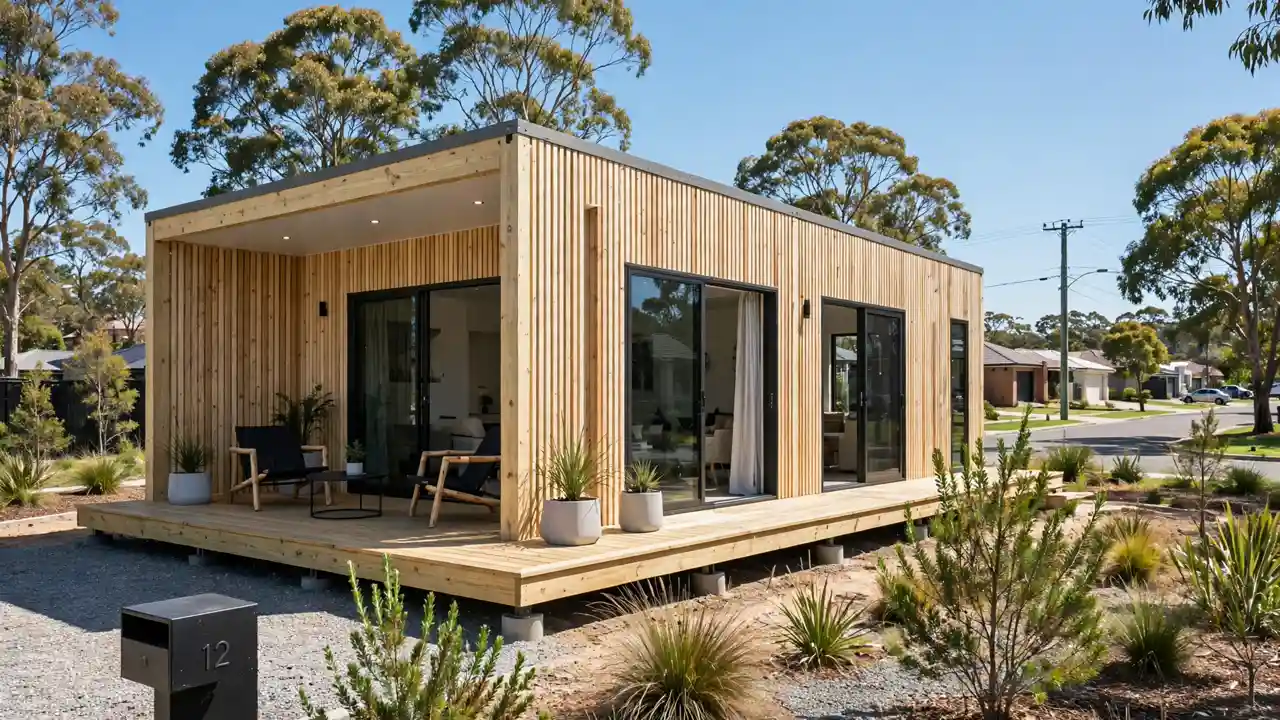
If you are weighing up a factory-built house, here is what modular home cost australia buyers actually pay in 2026: a finished modular home typically runs $2,500–$4,600 per square metre, with completed totals from about $300,000 for a small home to $700,000–$1,000,000+ for large custom designs. The catch is that the advertised price is rarely the finished price — delivery, crane, footings, connections and approvals all sit on top.
This guide breaks down every part of the bill using 2026 published Australian prices.
modular home cost australia: The 2026 Snapshot
The 2026 consensus across published builder guides, installers and quote marketplaces:
- Finished modular home: roughly $2,500–$4,600/m² (Hipages ~$2,500–$3,000; Prefabulous NSW $3,000–$3,500 standard, $3,800–$5,000 custom; Built by Modify SA $3,800–$4,600).
- Completed totals: small homes from about $300,000; a typical 3-bedroom family home $400,000–$550,000; large custom designs $700,000–$1,000,000+.
- Kit-only prices (a different product): from about $19,200 for a 1-bedroom kit to about $119,600+ for a 4-bedroom kit — materials only.
- On top of the factory price: delivery and crane $10,000–$80,000+; footings $20,000–$100,000+; services and connections $15,000–$100,000+; approvals and consultants $10,000–$50,000+.
The advertised home price is roughly half to two-thirds of the finished project — so only compare itemised quotes with identical inclusions.
Kit-Only vs Turnkey: The Price Gap That Catches Buyers Out
Most confusion around modular pricing comes from two different products sharing one name: a kit home is a box of materials, while a turnkey modular home is a finished house, delivered and connected.
Kit prices look startlingly cheap because they are. Owner Builder Club’s 2026 round-up lists 1-bedroom kits from $19,200, 2-bedroom from $31,500, 3-bedroom from $65,450 and 4-bedroom from $119,600 — materials only. Modtruss publishes live prices with two tiers per model: its Studio 20 (about 20 m²) starts at $29,700 lock-up or $44,500 full kit; the Family 120 (about 120 m², 3 bed, 2 bath) is $104,900 lock-up or $162,900 full kit.
Turnkey prices tell a different story. Anchor Homes, a Victorian modular builder, puts small modular homes from $300,000+, family-sized homes from $500,000+, and large custom designs at $700,000–$1,000,000+. Ask one question of any number you see online: is this the kit, the factory price, or the finished house on my block?
Modular Home Cost Per Square Metre in Australia
Per-square-metre rates are the most useful way to compare modular home cost australia quotes — but only when the scope matches. A $2,500/m² rate excluding delivery and footings is not cheaper than a $3,800/m² rate that includes them.
| Source (2026) | Per-m² rate | Scope |
|---|---|---|
| Hipages | ~$2,500–$3,000/m² | General guide |
| Prefabulous (NSW) | $3,000–$3,500 standard; $3,800–$5,000 custom | Fully installed, flat soil, within 300 km of Wagga Wagga |
| Built by Modify (SA) | $3,800–$4,600/m² | Base price; some builders advertise from ~$2,300/m² |
| Livit (QLD) | ~$2,500 basic; $3,500+ custom family | Turnkey, Brisbane |
The spread is wide — $2,300 to $5,000 per square metre — because builders quote different scopes. Modular rates also overlap heavily with conventional building: a project home can run $1,300–$1,900/m² and a custom site-built home from around $2,400/m². Treat any per-metre figure as a starting point, never as a quote.
Modular Home Cost by Size: What Each Bedroom Count Really Costs
Bedroom count is the quickest way to sanity-check a modular quote. These 2026 ranges from aggregator Prefab Home Kit and corroborating builder guides are finished-home estimates, not kit prices:
| Home size | Finished estimate (2026) | Kit-only starting price |
|---|---|---|
| 1 bedroom | $90,000–$160,000 | From ~$19,200 |
| 2 bedroom | $150,000–$240,000 | From ~$31,500 |
| 3 bedroom | $230,000–$380,000 | From ~$65,450 |
| 4 bedroom | $350,000–$550,000+ | From ~$119,600 |
Built by Modify’s model snapshots agree: a 1-module 36 m² home runs $95,000–$125,000, a 2-module 96 m² home $240,000–$280,000, and a 2-module 112 m² home $265,000–$295,000.
Modular construction is also the quiet way many Australians add a second dwelling. A modular granny flat typically lands at $180,000–$270,000 fully installed in NSW, and compact modular granny flats start from around $107,000 before site works. If you are weighing that option, our granny flat cost guide breaks down the same install and approval costs for a backyard build. Always ask for the floor area next to the bedroom count — a “3-bedroom” modular can be 90 m² or 140 m².
The Install Bill: Delivery, Crane and Site Works
This is the part of modular home cost australia no builder puts in the headline. Your modules are built in a factory, then trucked to your block, craned onto footings, bolted together, sealed and connected — and every step of that journey costs money.
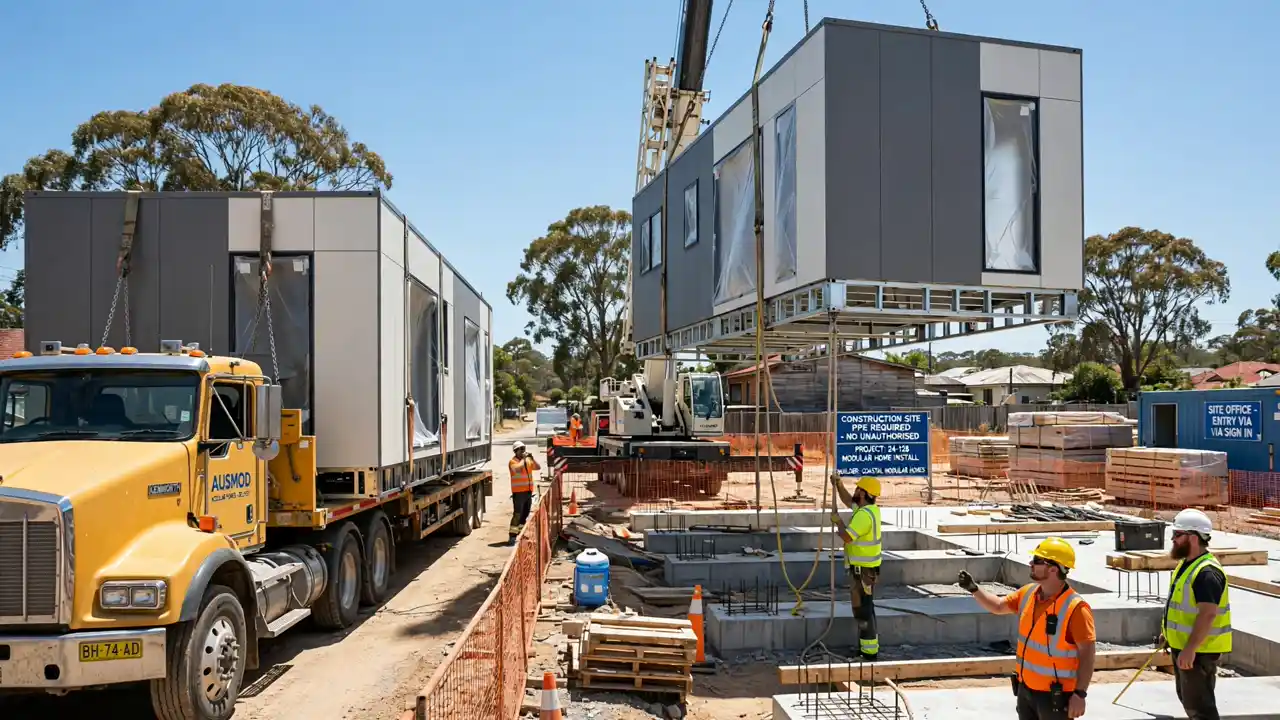
Big Small Haus, a Queensland installer, is the only source that prices the install as its own line: most installs in South East Queensland land between $59,000 and $140,000 including GST, on top of the price of the home. Its breakdown runs like this: certification and approvals about $25,000 as an owner builder or about $35,000 with a licensed builder; footings $800–$1,200 per pier; delivery and crane $8,000–$38,000; plumbing and drainage about $16,000, or about $32,000 with on-site wastewater instead of sewer.
Site conditions are the biggest variable of all. Guiding Expert budgets footings at $20,000–$100,000+, services at $15,000–$100,000+, and external works — driveway, decks, retaining, fencing, landscaping, drainage — at $20,000–$150,000+. Built by Modify warns that a block with more than about 2 metres of fall can add up to $30,600, and a very steep site can lift the total project cost by 30–50%.
State-by-State: NSW, Queensland, Victoria and Beyond
- New South Wales: Prefabulous (Wagga Wagga) quotes standard modular at $3,000–$3,500/m² and custom at $3,800–$5,000/m², with a typical 3-bedroom home around $300,000–$400,000 fully installed — assuming delivery within 300 km on flat Class M soil.
- Queensland: Livit (Brisbane) puts turnkey modular at around $2,500/m² basic, rising past $3,500/m² for custom family configurations. Big Small Haus prices the SEQ install at $59,000–$140,000 on top of the home.
- WA, NT and Tasmania: EcoPrestige supplies Victoria, WA, NT and Tasmania at about $2,300/m² supply (steel modules, 7-star NatHERS, full fit-out), with containerised modules and ocean freight included. WA has a dedicated modular pathway through Keystart, with a low-deposit Modular Home Loan. No source gives a WA, NT or Tasmanian per-metre total — so this guide does not invent one.
Are Modular Homes Cheaper Than Traditional Houses?
They can be — on the build component, under favourable conditions. One 2026 Australian property analysis estimates potential savings of roughly 5–15% on the build component, but not necessarily on the entire project, because the land, the install, the connections and the approvals cost the same either way.
The savings come from the factory: materials bought in bulk, no weather delays, no trades standing around waiting for each other, and far less waste. The costs that eat into those savings are unique to modular — transport, crane hire, and access. On a flat block near the factory, modular usually wins; on a steep, remote or bushfire-rated block, the install premium can swallow the factory saving.
It is also worth comparing modular against the other way of getting more house: extending what you already own. A modular build means new land costs, new connections and a full approval process; an extension keeps your existing land, services and address. Our house extension cost guide runs the same per-metre maths for building out or up — for many families, extending is the cheaper way to gain the extra bedroom, while modular makes most sense when the land is new or speed matters most.
What the Money Buys: Finishes, Layouts and Liveability
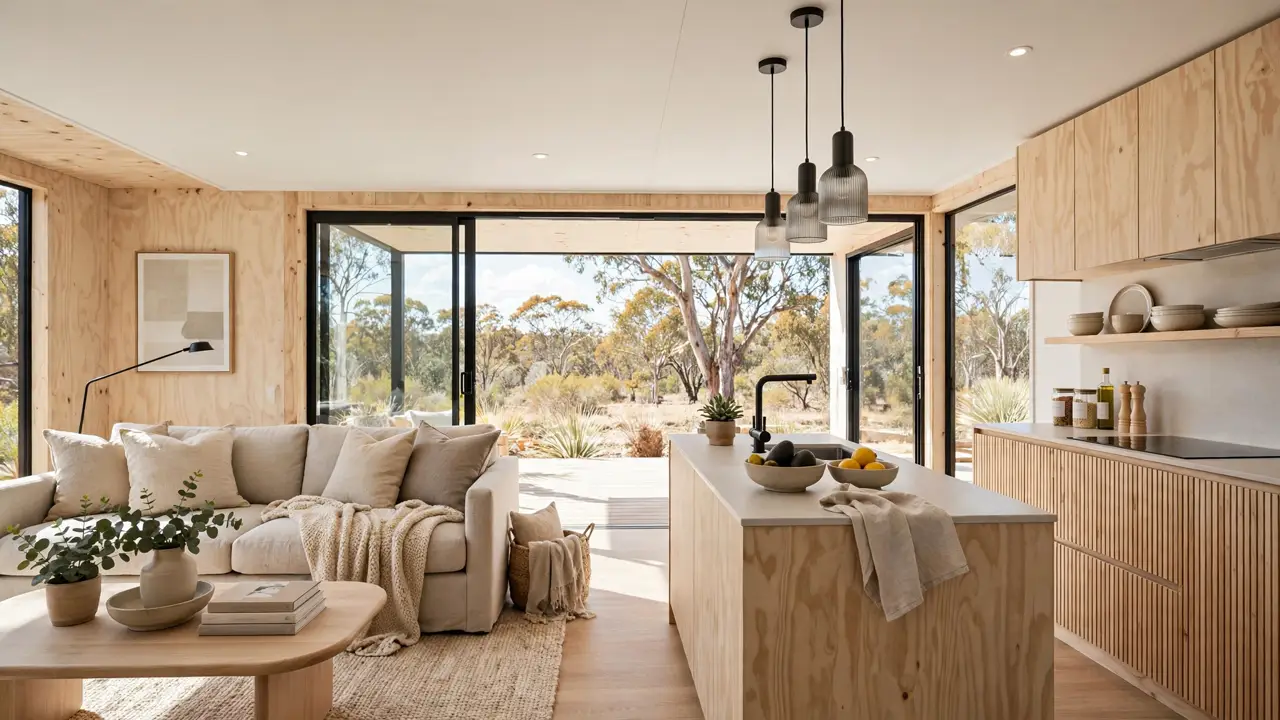
Here is where a design blog can say what builders will not: for all the talk about modular home cost australia, a modular home is only as good as its finishes and its floor plan, and those are exactly where the price tiers show. The cheapest modular homes are honest boxes — small windows, standard laminate, basic fittings — while $700,000+ custom designs buy cathedral ceilings, full-height glazing, stone benchtops and proper storage.
Financing and Valuation: The Part Nobody Prices
This is the section no ranking cost guide covers, and it is the one that can stop a modular build cold. Banks approach modular housing cautiously, because traditional valuation models treat the land and the dwelling as one asset — while for a modular home, the land purchase and the unit purchase are not viewed the same way. CPA Australia’s explainer on modular housing puts it plainly: valuation risk is a major hurdle.
The practical consequences are real. Borrowers often need larger deposits or higher credit scores, and the home must be permanently affixed to a foundation — a prefab on rented land is disqualified from mortgages altogether. Commonwealth Bank now allows funding during off-site construction, but only up to 80% of the build contract price with an assessed manufacturer — and as little as 60% otherwise. That gap can be tens of thousands of dollars of deposit you did not budget for.
Before you sign a build contract, do three things. First, ask your lender whether the manufacturer is on their assessed list — and get the answer in writing. Second, ask the builder whether they offer milestone-based drawdowns verified by an independent certifier, and whether they will sign a tripartite agreement with the manufacturer. Third, if you are in Western Australia, ask about the Keystart Modular Home Loan pathway, which offers a low-deposit route and lets the First Home Owner Grant count toward the deposit. For a plain-English explanation of the valuation problem, CPA Australia’s modular housing explainer is the clearest authoritative read on it.
How to Compare Modular Home Quotes Like-for-Like
Modular quotes are only comparable when they cover the same things. Use this checklist before you sign anything:
- Ask for the scope in writing: kit, factory-only, or fully installed turnkey? If the quote does not say, it is not a quote — it is an advertisement.
- Demand the install as a line item: transport, crane, footings, assembly, connections and approvals, each priced separately. Big Small Haus’s SEQ install of $59,000–$140,000 is a useful yardstick.
- Ask about the block: soil class, slope, bushfire rating (BAL), flood and wind. A BAL assessment is required in bushfire-prone areas, and higher BAL ratings mean upgraded cladding and glazing.
- Budget a contingency: Built by Modify suggests 15–25% for complex projects, 10–15% for well-planned builds, 5–10% where variables are minimal.
- Get the NatHERS rating and the inclusions list: decks, carports, driveways and window coverings are often excluded — price them before you compare totals.
Finally, treat the builder like any other major purchase. Check their licence, their insurance, and their completed homes — not just their renders. If you are comparing modular against a conventional custom build as well, our guide on how to choose a custom home builder covers the vetting questions that apply to both.
modular home cost australia: Frequently Asked Questions
How much does a modular home cost per square metre in Australia?
A finished modular home typically costs around $2,500–$4,600 per square metre in 2026: Hipages puts modular at about $2,500–$3,000, Prefabulous (NSW) quotes $3,000–$3,500 standard and $3,800–$5,000 custom, and Built by Modify (SA) gives $3,800–$4,600. Always check the scope — a low rate excluding delivery, crane and footings is not cheaper than a higher rate that includes them.
Are modular homes cheaper than traditional houses?
They can be on the build component, under favourable conditions. One 2026 Australian property analysis estimates potential savings of roughly 5–15% on the build component, but not necessarily on the entire project, because land, install, connections and approvals cost the same either way. On a flat block near the factory, modular usually wins; on a steep, remote or bushfire-rated block, the install premium can swallow the factory saving.
How much do kit homes cost in Australia?
Kit homes cost from about $20,000–$30,000 for a one- or two-room kit to $200,000–$300,000+ for a large family design, before footings, assembly, connections and approvals. Owner Builder Club’s 2026 round-up lists 1-bedroom kits from $19,200 and 4-bedroom kits from $119,600; Modtruss publishes live prices from $29,700 for a lock-up studio kit to $162,900 for a full-kit family home.
Do kit homes require council approval?
Yes. Every kit home needs a building approval, and some blocks need council planning approval as well. Flood, bushfire and wind conditions should be dealt with at the planning stage, before you order the kit. In Queensland, an owner-builder permit is needed for work over $11,000, and plumbing, drainage and electrical work must be done by licensed trades.
Can I build a house for 300k in Australia?
Yes, it is possible under $300,000, particularly with panel or prefabricated homes — several builders offer affordable customisable designs within this budget. A small modular home starts from about $300,000 finished, and simple starter homes start from around $153,000 before site works. The realistic path is a small footprint (one or two bedrooms, about 36–48 m²), a flat block near the factory, and standard finishes.
How is the total cost of a modular building calculated?
The total is the factory price plus everything it takes to put the home on your block and connect it: delivery and crane ($10,000–$80,000+), footings and foundations ($20,000–$100,000+), services and connections ($15,000–$100,000+), approvals and consultants ($10,000–$50,000+), and external works such as driveways, decks and retaining ($20,000–$150,000+). In South East Queensland the install alone commonly lands at $59,000–$140,000 on top of the home.