
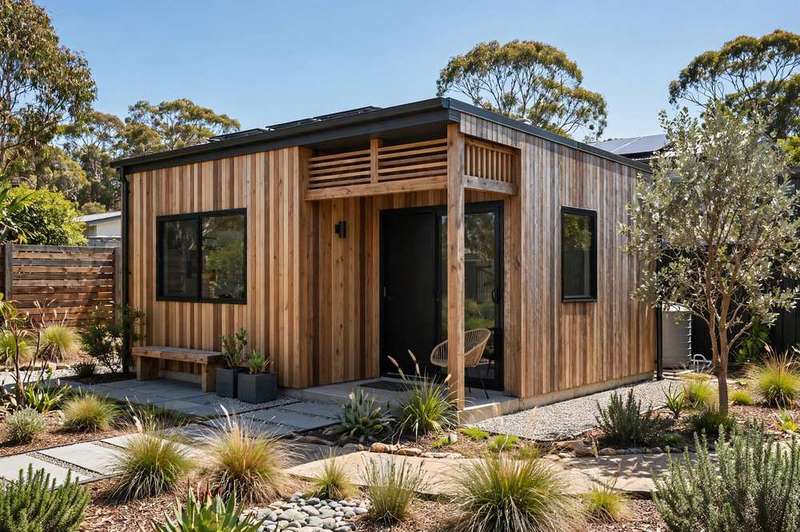
If you’re weighing up the granny flat cost in Australia right now, you’re not alone — second dwellings are one of the most searched renovation topics in the country. Whether it’s for an ageing parent, an adult child saving for their own place, or a rental income stream, a granny flat can be a smart use of the backyard. But prices in 2026 are higher than they were a few years ago, and the gap between the cheapest and dearest builds is enormous. A basic one-bedroom prefab can land under $100,000, while a custom architect-designed two-bedder in Sydney can push past $400,000. This guide breaks down what a granny flat actually costs in 2026, what drives the price, how the numbers differ between Sydney, Melbourne and Brisbane, and how to keep your budget under control.
How much does a granny flat cost in Australia in 2026?
Most turnkey granny flats built in Australia in 2026 cost somewhere between $97,000 and $400,000, with the majority of standard two-bedroom builds landing in the $150,000–$250,000 band. Industry pricing generally falls into three tiers:
| Build tier | Cost per m² | Total cost (60 m² example) | What you typically get |
| Builder-grade | $2,500 – $3,500 | $150,000 – $220,000 | Standard plan, laminate finishes, electric cooking, single split-system air conditioning |
| Mid-range | $3,500 – $4,500 | $200,000 – $280,000 | Stone benchtops, better fixtures, double glazing, ducted or multi-zone air conditioning |
| Premium / custom | $4,500 – $6,000+ | $280,000 – $400,000+ | Architect design, high-end finishes, energy-efficient construction, sometimes two storeys |
Looking at it by bedroom count — which is how most builders quote — the 2026 picture looks like this:
- Studio / 1-bedroom (30–45 m²): $80,000 – $140,000 turnkey
- 2-bedroom (55–60 m²): $130,000 – $210,000 turnkey
- 3-bedroom (70–90 m²): $150,000 – $250,000+ turnkey
- Prefab or kit (supply only): from roughly $25,000 for a frame kit; $50,000–$90,000 for a delivered modular unit
Keep in mind these are industry ranges, not quotes. Two properties with the same floor plan can price out very differently once site access, soil conditions and council requirements are factored in. If you’re planning a broader project, our 2026 renovation cost guide puts granny flats in context alongside extensions and full renovations.
What’s usually included — and what isn’t
A true “turnkey” price should deliver a liveable, approved dwelling you can hand keys over for. That normally covers the slab or footings, framing, roofing, external cladding, plumbing, electrical, kitchen, bathroom, floor coverings, painting, fixtures and fittings, plus the certifier’s final occupation sign-off.
What often sits outside the headline build price:
- Council approval fees, certifier fees and BASIX/energy compliance reports ($3,000–$10,000+)
- Service connections — power, water, sewer and stormwater tie-ins ($5,000–$25,000 depending on distance to existing mains)
- Demolition of existing sheds or structures, and tree removal
- Retaining walls, fences and driveways
- Landscaping and any deck or pergola shown in the brochure renders
- Soil tests and engineering reports
When comparing quotes, ask every builder for an itemised inclusions list. The quotes that look cheapest on paper are frequently the ones with the most exclusions. A builder who quotes $1,800 per square metre but prices the kitchen, bathroom and sewer connection separately isn’t actually cheaper — they’re just quoting differently.
Factors affecting granny flat cost
Site conditions and access
This is the single biggest wildcard. A flat, clear backyard with easy truck access keeps costs predictable. Sloping blocks, tight side access, rock, reactive clay soils or poor drainage push the price up fast — extra excavation, retaining walls and engineered footings can add $10,000–$40,000 before a single wall goes up. If your block is difficult to access, crane hire and restricted working hours add up too.
Utility connections
A granny flat needs its own connections to power, water, sewer and stormwater — or shared connections negotiated with the main dwelling, depending on your state. Long runs to the street mains, upgrades to an old switchboard, or a sewer that needs rerouting around the new slab are among the most common sources of budget shock. Budget generously here if your existing services are old.
Design complexity and finishes
Every extra corner, roofline change and custom detail adds labour. A simple rectangular plan on a slab with a gable roof is the cheapest thing to build. Brick veneer costs more than lightweight cladding; raked ceilings, custom joinery, stone benchtops and premium tapware all move you up the tiers. Nothing wrong with wanting a nice flat — just know exactly which choices are driving the price.
Approvals and compliance
Approval fees, surveys, energy rating reports, bushfire or flood overlays, heritage considerations and developer contributions vary wildly by council. In NSW, most granny flats can be approved as complying development without a full development application, provided they meet the standards in the State Environmental Planning Policy (Housing) 2021 — the NSW Planning Portal sets out the requirements. Other states have their own pathways, and each comes with its own fees and timelines.
Granny flat cost by city
Sydney
Sydney sits at the top of the range for granny flat builds. Higher labour rates, expensive tipping and disposal fees, and tighter site access in established suburbs all push costs up. A standard two-bedroom turnkey build in Sydney typically lands around $180,000–$280,000, with premium custom designs heading well past $350,000. Approval fees and council contributions tend to be higher here than elsewhere, so allow $5,000–$12,000 for the approval pathway alone. The offset: Sydney rental yields for granny flats are among the strongest in the country, which helps the numbers stack up for investors.
Melbourne
Melbourne builds generally come in a little below Sydney. A two-bedroom granny flat in Melbourne typically costs $160,000–$250,000 turnkey, with builder-grade one-bedders from around $110,000. Victoria’s planning rules differ from NSW — secondary dwellings are assessed under local planning schemes, so timelines and fees vary by council. Soil conditions across Melbourne’s growth corridors can add site costs, particularly on reactive clay. Labour availability has been tighter in recent years, so builder lead times are worth locking in early.
Brisbane
Brisbane is where the budget end of the market is most visible. Turnkey one-bedroom builds in the $97,000–$140,000 range and two-bedders around $130,000–$185,000 are commonly quoted, and modular or container-based options delivered from local factories can land all-in around $105,000–$130,000 for a straightforward block. That said, Brisbane now records some of the highest all-construction per-square-metre rates in the country, and flood overlays in parts of the city can trigger extra engineering and compliance costs. Get a proper site assessment before committing to a budget figure.
Money-saving tips for your granny flat
- Choose a standard plan. Custom designs cost more to draw, engineer and build. Most granny flat specialists have a catalogue of proven plans that already meet planning rules — pick one that suits your block rather than starting from scratch.
- Keep the footprint simple. Rectangles are cheap; L-shapes, courtyards and complex rooflines are not. Every corner costs money in framing, roofing and cladding.
- Compare like with like. Get at least three itemised quotes with identical inclusions lists. If one is dramatically cheaper, something has been excluded — find out what.
- Consider modular or prefab. Factory-built granny flats can be 10–16 weeks from order to delivery versus 6–12+ months for a traditional site build, and the fixed factory price removes a lot of on-site variation. Just confirm the approval pathway works the same in your state.
- Spend on what matters, save on what doesn’t. Put money into the things that are hard to change later — insulation, waterproofing, quality windows, a good hot water system — and be more restrained on cosmetic finishes that can be upgraded down the track.
- Sort services early. Get your plumber and electrician to assess connection points before you sign a build contract. Surprise service runs are one of the most common causes of mid-build budget blowouts.
- Check approval pathway costs upfront. Whether it’s complying development in NSW or a planning permit in Victoria, know the fees, reports and likely timelines before you budget. Our free renovation cost calculators can help you model the numbers.
Is a granny flat worth the cost?
For many owners, yes — but run the numbers for your situation rather than assuming. A $180,000 granny flat renting at $450 a week grosses around $23,400 a year before costs, which is a far better yield than most investment properties on a capital-outlay basis. But yields vary by suburb, some councils restrict or complicate separate rental of secondary dwellings, and valuers don’t always credit the full build cost in the property’s valuation. Factor in ongoing costs too — insurance, maintenance, and any extra council rates or water charges the second dwelling attracts. Talk to a local property manager about realistic rents and a local valuer or buyer’s agent about how granny flats are treated in your market before you commit.
Granny flat cost FAQs
How much does a granny flat cost to build in Australia in 2026?
Most turnkey granny flats cost between $97,000 and $400,000 in 2026, with standard two-bedroom builds typically landing in the $150,000–$250,000 range. One-bedroom builds start around $80,000–$140,000, and premium custom designs can exceed $400,000. Final price depends on size, site conditions, finishes and your city.
What is the average granny flat cost per square metre?
In 2026, per-square-metre rates generally sit between $1,800 and $4,900 depending on specification — from basic prefab kits at the low end to high-spec brick veneer at the top. Per-square-metre rates for granny flats are almost always higher than for a full-sized house, because fixed costs like the kitchen, bathroom and service connections are spread across a much smaller floor area.
Do I need council approval to build a granny flat?
Yes. In NSW, most granny flats can be approved as complying development (faster than a full development application) if they meet the State Environmental Planning Policy (Housing) 2021 standards — including a maximum 60 m² floor area and a minimum 450 m² lot. Other states use their own planning pathways, so check with your local council or a private certifier early.
How long does it take to build a granny flat?
A traditional site-built granny flat typically takes 6–12+ months from signing a contract to handover, including approvals. Modular or prefab granny flats are faster — usually 10–16 weeks from factory order to delivery — though you still need to allow time for site works, connections and certification.
Does a granny flat add value to my property?
Usually, but not always dollar-for-dollar. A well-built, compliant granny flat adds rental income potential and appeals to multi-generational buyers, which supports value. However, valuers may not credit the full build cost, and overcapitalising in a suburb with soft rents is a real risk. Get local rental and valuation advice before building for investment purposes.