
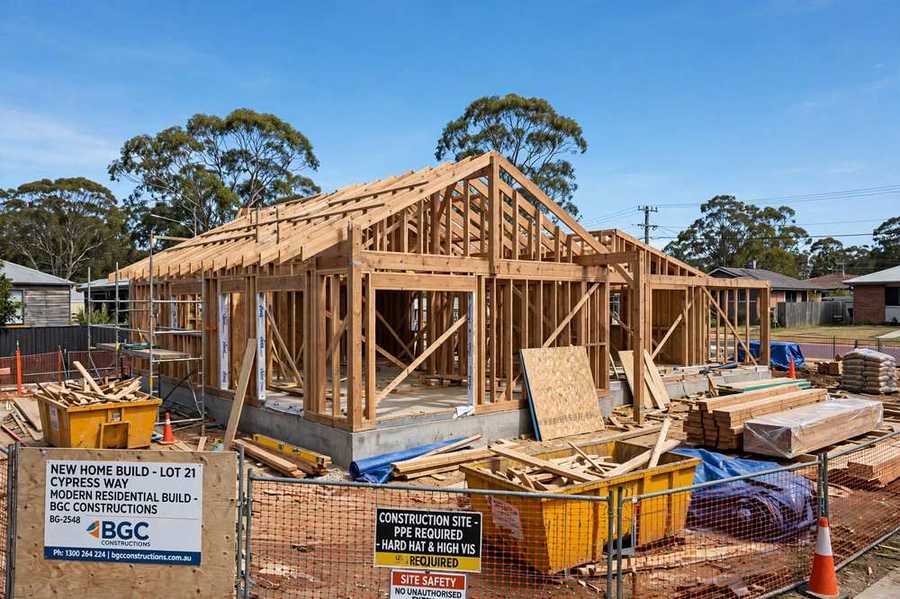
When the house you’ve outgrown sits on a block you love, the knockdown rebuild cost in Australia becomes the number that decides everything. Tearing down an ageing home and building fresh on the same land is increasingly common in Sydney, Melbourne and Brisbane — but it’s a serious financial commitment, and the all-in figure is much bigger than the build price builders advertise. In 2026, most knockdown rebuild projects land somewhere between $350,000 and $900,000+ once demolition, approvals, site works and the new build are all counted. This guide breaks down where that money goes, the per-square-metre rates behind it, how costs differ by city, the hidden expenses that catch people out, and how to keep the budget under control.
How much does a knockdown rebuild cost in Australia in 2026?
A knockdown rebuild (KDR) has two distinct cost halves: getting rid of the old house, and building the new one. Industry data for 2026 puts the total all-in project cost at roughly $350,000 to $800,000+ nationally, with Melbourne and Sydney projects more commonly quoted at $450,000 to $900,000+ depending on house size, specification and site conditions.
Here’s a realistic component breakdown for a typical medium-spec single-storey rebuild:
| Cost component | Typical 2026 range | Notes |
| Demolition | $15,000 – $50,000 | Single-storey brick or fibro at the lower end; double-storey or difficult access at the top |
| Asbestos removal (if required) | $5,000 – $28,000 | Licensed removal needed for most pre-1990 homes |
| Design, survey & engineering | $8,000 – $25,000 | Geotechnical report, survey, structural design, BASIX/energy reports |
| Council approvals & contributions | $5,000 – $30,000 | CDC/DA fees, Section 7.11/7.12 contributions in NSW |
| New home construction (180 m²) | $395,000 – $675,000 | $2,195–$3,750 per m² depending on spec |
| Site works (rock, retaining, fill) | $10,000 – $80,000+ | Highly site-dependent |
| External works (driveway, fencing, landscaping) | $25,000 – $90,000 | Often underestimated |
| Temporary accommodation (12–18 months) | $20,000 – $50,000+ | Rent elsewhere while you build |
| Contingency (10–15%) | Varies | Industry-standard buffer — do not skip it |
One Sydney builder’s May 2026 pricing, based on Rawlinson construction data and 30 recent KDR jobs, puts a standard 4-bedroom double-storey rebuild (260 m², medium spec) at $650,000–$842,000 all-in, and a premium 300 m² version at $925,000–$1,177,000. Those are real-world, all-in numbers — a useful reality check against base build prices that exclude half the items above.
Construction cost per square metre in 2026
The new-build half of a KDR is usually priced per square metre of living area. 2026 industry ranges look roughly like this:
| Specification level | Cost per m² | What it means |
| Budget / volume builder | $1,900 – $2,400 | Standard plans, laminate benchtops, basic fixtures |
| Medium / brick veneer | $2,195 – $3,375 | Stone benchtops, quality tiles, better electrical package |
| High spec | $3,075 – $3,900 | Premium finishes, upgraded insulation and flooring |
| Prestige / custom architect | $4,500 – $5,000+ | Architectural detail, custom joinery, smart-home integration |
These are broad industry ranges — your actual rate depends on your block, design, finishes and builder. Always get a fixed-price quote from a licensed builder, and check it covers the full scope rather than just the dwelling.
For context on how construction costs have moved, the Australian Bureau of Statistics tracks building activity and dwelling data — including knock-down rebuild approvals — and industry bodies like the Housing Industry Association regularly report on the cost pressures facing new home building. Building costs are up more than 50% since 2019, so quotes from a few years ago are no guide at all.
Hidden costs most KDR budgets miss
The build contract is only part of the story. These are the costs that most commonly blow out a knockdown rebuild budget:
- Asbestos. If your house was built before 1990, assume asbestos is present until a survey says otherwise — in cladding, eaves, fences or pipe lagging. Licensed removal and disposal typically adds $5,000–$28,000. Get an asbestos survey done before you finalise your budget; it’s one of the cheapest ways to avoid a nasty surprise.
- Site works. Rock excavation, retaining walls, fill and engineered footings for reactive clay can add $10,000–$80,000+. Sloping or heavily treed blocks are the usual culprits.
- Existing services. Sewer, water and stormwater connections often need part-replacement because the old runs don’t suit the new floor plan. Allow $4,000–$14,000 beyond a standard new-build connection allowance.
- Tipping fees. Demolition waste disposal costs have risen sharply — Sydney tipping fees moved up around 12% in the year to mid-2026. Multiple skips on a KDR can add $3,000–$7,000 versus a vacant-block build.
- Council contributions. Section 7.11/7.12 contributions in NSW can add $15,000–$30,000. Other states have their own infrastructure charges.
- Temporary accommodation. Most families rent for 12–18 months during a KDR. At $400–$600+ a week, that’s $20,000–$50,000+ many budgets understate or forget entirely.
- Tree removal and arborist reports. Established trees in old yards often need arborist reports and protected-zone setbacks during demolition. Allow $2,000–$8,000.
- Get the asbestos survey first. A few hundred dollars for a survey before you budget can save tens of thousands in surprises. Never let demolition start without one on a pre-1990 home.
- Choose a volume-builder design if you can. Custom architect designs cost more to draw, engineer and build. A well-chosen project-home plan on your block can save $100,000+ versus bespoke — and fixed-price contracts are standard.
- Lock your specification early. Mid-build upgrades are where budgets die. Choose your finishes before the contract is signed and resist changes once construction starts.
- Get three fixed-price quotes. Make sure each builder is quoting the same scope — slab type, site works allowance, external works. The cheapest quote with the most exclusions is rarely the cheapest build.
- Time your demolition well. Demolition contractors are often quieter in winter; you may negotiate a better rate outside peak periods.
- Keep the design efficient. Every square metre costs $2,000–$4,000+. A well-designed 220 m² home beats a poorly designed 260 m² one — and costs $100,000+ less to build.
- Budget accommodation honestly. Price 18 months of rent, not 12. Builds run late more often than early, and scrambling for short-term rentals at the end is expensive. Our free renovation calculators can help you model the full project cost including rent.
Factors affecting knockdown rebuild cost
Soil, slope and site access
A flat block with good access is the cheapest KDR scenario. Slope means cut and fill, retaining walls and stepped footings. Reactive clay — common across much of Melbourne and parts of Sydney and Brisbane — means engineered footings and soil testing. Tight access in established suburbs slows demolition and delivery, and every restricted-access day costs money.
Age and condition of the existing house
The older the house, the more likely the demolition half of the budget blows out. Asbestos is the headline risk, but old houses also hide lead paint, underground fuel tanks, termite damage that complicates safe demolition sequencing, and services in places no plan shows. A thorough pre-demolition inspection pays for itself.
Design size and specification
Size is the biggest lever on the build half of the budget — every extra 10 m² at $2,500 per m² is $25,000. Double-storey adds scaffolding, structural steel and more complex roofing. And specification moves the per-square-metre rate more than most people expect: the jump from medium to high spec can add $200,000+ on a 250 m² home. Decide your spec level honestly before you start, not halfway through.
Approvals pathway and planning controls
In NSW, a complying development certificate (CDC) is faster and cheaper than a full development application (DA). But not every block qualifies for CDC; heritage overlays, flood or bushfire zones, and certain zoning controls push you into the DA pathway with longer timelines. Each state has its own system, so get planning advice for your specific block early.
Knockdown rebuild cost by city
Sydney
Sydney is the most expensive KDR market in Australia — typically 10–20% above other capitals. All-in project costs for a standard 4-bedroom double-storey rebuild generally run $480,000–$900,000+, with premium builds in blue-chip suburbs pushing well past $1 million. Demolition of a single-storey home in Western Sydney runs $10,000–$15,000, but asbestos removal ($8,000–$20,000) is common in the pre-1990 housing stock that dominates KDR suburbs. The trade-off: Sydney land values make KDRs financially compelling — when the land is worth $1.5 million, spending $700,000 on a brand-new home on it is often rational.
Melbourne
Melbourne KDRs typically land between $450,000 and $900,000+ all-in. Demolition runs $18,000–$45,000, asbestos removal $3,000–$20,000+, and new construction $420,000–$780,000+ for standard to mid-range builds. Construction rates of $2,100–$3,900 per m² are the current industry range, with premium custom homes reaching $5,000 per m² or more. Melbourne’s reactive clay soils are a notable cost driver — engineered footings are common and should be budgeted from day one. Allow 12–24 months all up including approvals.
Brisbane
Brisbane KDRs generally sit a little below Sydney — think $400,000–$800,000 all-in for a standard project. Labour and some material costs run lower than the southern capitals, though Brisbane now records some of the highest all-construction per-square-metre rates nationally, and the gap is narrowing. Flood overlays affect many established Brisbane suburbs and can trigger additional engineering, floor-height requirements and compliance costs. On the plus side, Queensland’s generally flatter terrain and good site access in many suburbs keep demolition and site works more predictable than in hillier markets.
Knockdown rebuild vs renovation: a quick comparison
It’s worth asking whether a KDR is even the right call. A major whole-home renovation in 2026 typically costs $220,000–$450,000, or $280,000–$600,000 with a rear extension. A KDR is usually the better choice when the old home’s layout, structure or hidden defects would eat most of a renovation budget anyway — particularly with widespread asbestos or structural problems. Renovation wins when the existing home has character worth keeping or the structure is sound. A KDR also delivers a fixed-price contract on a clean site and a new home built to current 7-star energy standards, which is hard to achieve with a renovation. For a detailed look at renovation-side numbers, see our 2026 renovation cost guide.
Money-saving tips for a knockdown rebuild
Knockdown rebuild FAQs
How much does a knockdown rebuild cost in Australia in 2026?
Most knockdown rebuild projects cost between $350,000 and $900,000+ all-in in 2026, covering demolition, approvals, site works and new construction. A standard 4-bedroom double-storey rebuild in Sydney typically lands around $650,000–$842,000 all-in, while Melbourne projects commonly range from $450,000 to $900,000+.
How much does demolition alone cost?
Demolition of a standard single-storey home typically costs $10,000–$22,000, rising to $18,000–$45,000 for larger or double-storey homes or difficult-access sites. If asbestos is present — common in pre-1990 homes — add $5,000–$28,000 for licensed removal and disposal.
How long does a knockdown rebuild take?
Allow 12–24 months from start to finish, including design, approvals, demolition and construction. Approvals alone can take 2–6 months depending on whether you qualify for a fast-track complying development pathway or need a full development application. Construction itself typically runs 8–14 months for a standard home.
Is a knockdown rebuild cheaper than renovating?
Not usually in absolute dollars — a KDR ($350,000–$900,000+) costs more than a major renovation ($220,000–$600,000). But a KDR can offer better value when the old home has structural problems, widespread asbestos or a layout that can’t be fixed economically. You also get a fixed-price contract, a clean site and a new home built to current energy standards.
Can I live on the property during a knockdown rebuild?
No — not during demolition or construction. Most families rent elsewhere for 12–18 months, which typically costs $20,000–$50,000+ and should be in your budget from the start. Some owners stay with family to save, but factor the real cost of alternative accommodation into your decision either way.