
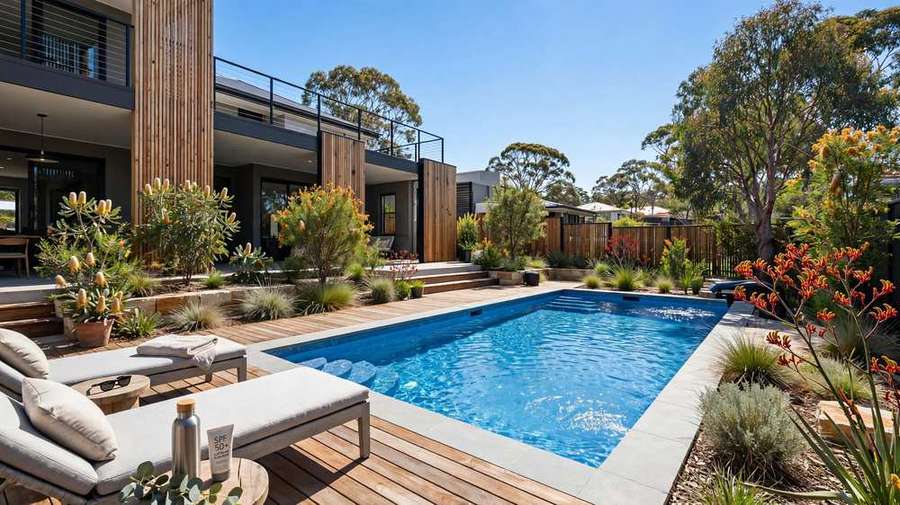
There are two kinds of people in Australia: those who reckon a backyard pool was the best money they ever spent, and those who call it a concrete hole you throw cash into. If you’re weighing one up, you want numbers, not philosophy: does a pool add value to your home, australia-wide, that buyers will actually pay extra for — or is it lifestyle money you’ll never see again?
The honest answer to “does a pool add value to your home australia” is: usually yes, but rarely dollar for dollar. In the right suburb and climate, a well-kept inground pool can add tens of thousands to your sale price. In the wrong setting — a tiny yard swallowed by concrete, or a pool that’s seen better days — it becomes the thing buyers quietly subtract in their heads.
Below: real 2026 installation costs, what the data says about value added, how the maths shifts between Brisbane and Melbourne, and the running costs most pool quotes leave out.
The Short Answer: Yes — With Some Big Ifs
A pool is one of the few renovations where the answer genuinely starts with “it depends”. Kitchens and bathrooms add value almost everywhere; a pool only adds value where buyers want one. Four things decide: climate (more swim months means buyers pay more), suburb price point (mid-to-upper brackets expect a pool; cheaper areas see only the maintenance bill), block size (a pool that leaves a usable yard is an asset; one that eats the backyard is a liability), and condition (sparkling and compliant sells the dream; green and cracked sells a repair bill).
Get those four right and a pool is a genuine value-adder. Get them wrong and Sydney valuer Belinda Botzolis’s warning applies: “it will add value to your home, but it might not exceed the cost to put it in the ground.”
How Much Value Does a Pool Actually Add?
There’s no single national figure — anyone who quotes you one is guessing. But the available data tells a consistent story:
- Industry estimates suggest a well-maintained inground pool can add $10,000 to over $100,000 to a property’s value, depending on the home, the suburb and the pool itself.
- The commonly cited rule of thumb: a pool returns roughly 30% to 50% of its construction cost at resale — on a $60,000 build, around $18,000 to $30,000 back, the higher end in pool-hungry Queensland and Western Australia.
- HouseLogic, a US home-advice source often quoted in this debate, puts the uplift at up to 7% — on a $900,000 property, that’s up to $63,000.
- Domain reports “swimming pool” is consistently the top search term on its listings site, with a 2023 piece noting up to $200,000 added in high-end Sydney markets — an outlier showing the ceiling.
- Melbourne buyer’s advocate data (Secret Agent) found 10% to 16% uplifts in the inner east and south east, the lowest expected uplift around $140,000.
- Ray White analysis, reported via Property Update, found a pool generally adds at least what it costs to build in suburbs where pools are in demand.
- Realestate.com.au, drawing on PropTrack data, reports pools have topped buyer search terms for years, with star features like pools “often” adding up to $100,000 in value.
- A Swimart survey found 90% of pool owners believed their pool added at least $30,000 — but as a self-reported survey of people who’d already paid, treat that as optimistic.
The pattern is clear: in Australia’s climate, a pool is more likely to add value than not. Just don’t bank on getting every dollar back.
What Does a Pool Cost in Australia in 2026?
Treat these as planning ranges for a typical metro build — quotes vary by site access, soil, size and finish. Heating, glass fencing, paving and landscaping are usually extra.
| Pool type | Typical size | Installed cost (2026) | Indicative value it may add at resale |
| Fibreglass inground | 7m x 3.5m | $35,000–$65,000 | $18,000–$40,000 |
| Concrete inground | 8m x 4m | $60,000–$120,000+ | $25,000–$60,000 |
| Vinyl-lined inground | 7m x 3.5m | $40,000–$65,000 | $15,000–$35,000 |
| Plunge pool | 4m x 2m | $20,000–$50,000 | $10,000–$30,000 |
| Above-ground | 5m x 3m | $5,000–$15,000 | Little to none |
The resale column applies the commonly cited 30–50% cost-recovery range — illustrative, not a promise. The cheaper the build, the closer it comes to washing its face: fibreglass usually lands nearest (mid-range cost, strong appeal, low upkeep), while concrete rarely recovers its full build cost outside top-end markets. Above-ground pools add almost nothing — buyers treat them as temporary.
Stacking this against other big-ticket projects? Our renovation costs guide for 2026 puts pools alongside kitchens, bathrooms and extensions so you can see where the money works hardest.
What Buyers Pay Extra For — and What They Don’t
Not all pools are equal in a buyer’s eyes. Here’s the honest split.
What adds value
- An inground pool in good nick. Clean water, sound coping, working equipment. Presentation does more for buyer impressions than the shell underneath.
- A pool that fits the property. Right size for the block, with room left for a lawn or entertaining area — not a concrete bathtub with a house attached.
- Quality surrounds. Decking, shade and outdoor dining space sell the resort-at-home feeling that commands a premium.
- Compliance sorted. A current pool safety certificate and compliant fencing remove a major buyer objection — compulsory at sale in NSW and Queensland.
- Low-maintenance setups. Fibreglass shells, salt chlorinators and pool covers signal lower running costs — exactly what nervous buyers ask about.
What doesn’t — or actively hurts
- A pool that dominates the block. If it leaves no usable yard, families walk away — one Sydney valuer notes such pools can actually cause a property to lose value.
- Tired or non-compliant pools. Faded surfaces, cracked coping and dodgy fencing don’t read as “character” — they read as a $15,000 repair bill before you can even swim.
- Above-ground pools. Cheap to install, but buyers treat them as removable. They add effectively nothing to the sale price.
- Pools in the wrong suburb. If no other house in the street has one, yours won’t reset the market — it just costs the most to run.
- Over-capitalising. A $120,000 resort build on a $700,000 house is money you won’t see again — match the pool to the suburb, not your imagination.
Does the Answer Change by City?
Yes — more than most people expect. Climate and local buyer culture do a lot of the heavy lifting.
Sydney
Sydney offers the biggest premiums and the biggest risks. In prestige suburbs, serious outdoor living is expected — Domain reports up to $200,000 added in high-end markets. But build costs are the country’s highest, and small blocks get swallowed fast. Inner-city plunge pools do well; a full-size concrete pool crammed onto 300sqm in the inner west is a harder sell.
Melbourne
Melbourne is the great debate. Buyer’s advocate data shows 10–16% uplifts in the inner east and south east, and Ray White analysis suggests pools return at least their build cost in pool-friendly suburbs. But many owners swim only a few months a year, which makes some buyers hesitate. Heated pools do better here — they stretch the season — and in bayside and eastern suburbs a quality pool is close to expected at the top end.
Brisbane
Brisbane is arguably Australia’s best pool market: subtropical climate, genuine year-round use, and Queensland consistently ranks among the strongest-return states. Ray White data from Burleigh Waters estimated pools added about $50,000 to sale prices there. Just keep the mandatory pool safety certificate current — Queensland requires renewal every two years.
Perth
Perth pairs long, hot, dry summers with a strong outdoor-entertaining culture, and WA rates alongside Queensland for returns. Buyers here use their pools hard, so condition matters — a tired pool reads as years of deferred maintenance in harsh sun. Pool covers play well with local buyers.
The Ongoing Costs Nobody Puts in the Quote
The part quotes skip: Finder’s 2026 figures put running a standard backyard pool at $1,200 to $2,500 a year — professional servicing or heating can push it past $5,000.
- Electricity (pump and filtration): $200–$1,200 a year. The pump is the biggest energy drain; a variable-speed model can roughly halve it.
- Chemicals: $200–$600 a year.
- Water top-ups: $50–$150 a year — more in hot, dry areas.
- Professional servicing: $900–$1,800 a year if you’d rather not do it yourself.
- Concrete resurfacing: every 10–15 years, around $6,000–$15,000.
- Vinyl liner replacement: every 5–10 years, roughly $3,000–$6,000.
- Insurance: tell your insurer about the pool — premiums can rise, and an undeclared pool can complicate a claim.
- Compliance inspections: every state requires compliant pool barriers, and NSW, Queensland and Victoria have mandatory inspection regimes. Budget for inspections and rectification work.
Over 20 years the gap gets stark: industry comparisons put a mid-size fibreglass pool’s lifetime cost around $55,000–$76,000 including upkeep, versus $105,000–$130,000+ for concrete once resurfacing is factored in. The quote is only the entry fee — run the full project through a renovation budgeting tool so the lifetime cost sits next to everything else you’re planning.
Tips Before You Dig
- Ask local agents first. Two or three agents who sell in your suburb will tell you in five minutes whether a pool helps or hinders at your price point — free research worth more than any national statistic.
- Size it to the block. If the plan leaves nowhere for kids to kick a ball or adults to sit outside the pool, shrink the pool.
- Budget the whole lifecycle. Add 20 years of running costs to the quote before you decide.
- Sort fencing and compliance from day one. Certification paperwork is compulsory at sale in NSW and Queensland; a non-compliant pool is a settlement-day problem.
- Think about who’s buying. Young families want safe, easy-care pools. Downsizers may see only maintenance.
- Present it properly at sale. Clean, clear water in the listing photos and tidy surrounds shift buyer perception more than the shell material.
- Match the spend to the suburb. A mid-range fibreglass pool with great landscaping beats an over-the-top concrete build on resale in almost every non-prestige suburb.
If a pool is part of a bigger backyard vision, take our interior design style quiz — the pool area should feel like it belongs to the same home as the living room.
Frequently Asked Questions
Does a pool add value to a home in Australia?
Usually, yes. Industry estimates suggest a well-kept inground pool can add $10,000 to over $100,000, with around 30–50% of the build cost typically recovered at resale. Climate, suburb, block size and condition decide where you land.
How much does it cost to build a pool in Australia in 2026?
A fibreglass inground pool typically costs $35,000–$65,000 installed; concrete $60,000–$120,000+; vinyl-lined $40,000–$65,000; plunge pools $20,000–$50,000; above-ground $5,000–$15,000. Heating, fencing, paving and landscaping are usually extra.
Will I get my money back when I sell?
Rarely in full. Most estimates put recovery at 30–50% of the build cost, higher in warm markets like Brisbane and Perth and in prestige suburbs where buyers expect a pool. Cheaper builds like fibreglass come closest to washing their face.
Are pools worth it in cooler cities like Melbourne?
They can be. Buyer’s advocate data shows 10–16% uplifts in the inner east and south east, and heated pools extend the season. But enthusiasm is softer than in Brisbane or Perth — match the investment to the suburb and ask local agents first.
Can a pool reduce my home’s value?
Yes, in some cases. A pool that swallows the whole backyard, a tired or non-compliant pool signalling big repair bills, or a pool in a suburb where buyers don’t want one can all count against the sale price. Condition and fit matter as much as the pool itself.