
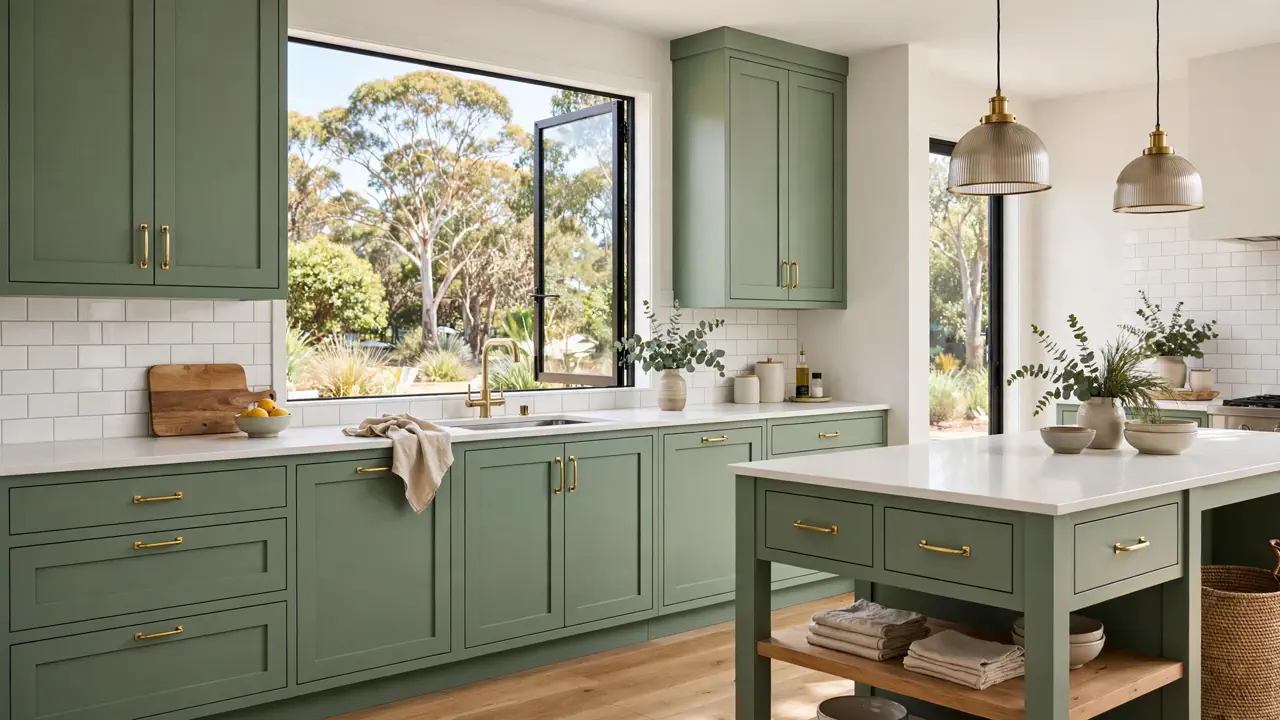
If your kitchen still works but looks tired, painting the cabinets is the cheapest honest way to change the room. The kitchen cabinet painting cost australia homeowners actually pay in 2026 sits well below a full renovation — but the range is wide, and quotes will look nothing alike unless you know what sits behind them. This guide prices the job properly: professional repaint, two-pack respray, per-door rates, DIY materials, and three worked budgets.
Two terms get mixed up in quotes. “Repainting” usually means a brush-and-roll or sprayed water-based enamel applied on site; “respraying” usually means a two-pack (2PAC) polyurethane finish, with doors removed and sprayed off site in a booth. Different jobs, different prices — most quote confusion comes from comparing one against the other.
kitchen cabinet painting cost australia: The 2026 Snapshot
For a standard Australian kitchen, a professional cabinet repaint costs $2,000–$5,000 — the national benchmark published by PaintAccess. Melbourne specialist Newline Painting reports $2,500–$7,000 for 2026, the top end reserved for larger kitchens, heritage joinery and premium finishes.
Perth runs higher: Joyce Kitchens prices a sprayed enamel repaint at $4,500–$9,000+ for a standard 10–14 door kitchen, and a two-pack respray at $6,500–$12,000+. Freight, fewer specialist finishers and higher trade rates all push Perth up — local specialists run $55–$95+ per hour.
| Job type | 2026 price |
|---|---|
| Professional repaint | $2,000–$5,000 |
| Melbourne specialist repaint | $2,500–$7,000 |
| Perth spray-enamel repaint | $4,500–$9,000+ |
| Two-pack respray | $6,500–$12,000+ |
| New doors only | $6,500–$15,000+ |
| DIY materials | From ~$170 |
That table is the short answer to kitchen cabinet painting cost australia in 2026. Compare it with the alternative: a full kitchen renovation averages $20,000–$45,000, and a cosmetic refresh pairing refacing with painting runs $8,400–$21,000 in Melbourne. Painting costs roughly a tenth of a full renovation — the first thing worth pricing when the layout still works.
What a Professional Repaint Costs, Door by Door
Most painters do not price by room size, but by the surfaces needing preparation and coating: doors, drawer fronts, end panels, kickboards and exposed carcass. A one-wall apartment kitchen with 10–16 fronts is a far smaller job than a U-shaped family kitchen with an island, a pantry bank and 30+ fronts.
Perth resurfacing firm YYFC publishes a per-piece menu: standard doors $130 each, pantry doors $200–$250 each, drawers $60–$100 each, cladding $150 per square metre, kickboards and trim $60 per linear metre. Count your own doors and drawers and you have a rough sense of where a quote should land before anyone visits.
Marketplace jobs show the same pattern. Recent Airtasker tasks from September 2026 include a full 2PAC spray in Brisbane at $1,500, a Campsie respray of 15 doors, 3 panels and 3 drawers at $1,500, and a Southport respray at $1,000. Small Sydney jobs list at $565–$855. These are task-priced jobs, not full-service quotes — treat them as the floor of the market, not the typical price.
What the per-door price buys is mostly labour: doors come off and get labelled, grease and silicone are cleaned off, surfaces are sanded or deglossed, chips and old handle holes are filled, edges are sealed, then primer and topcoat go on with drying time between coats. If a quote looks far cheaper than the rest, the shortcut is almost always in the prep, the coating system, or the time allowed for curing.
Two-Pack Respray vs a Standard Repaint
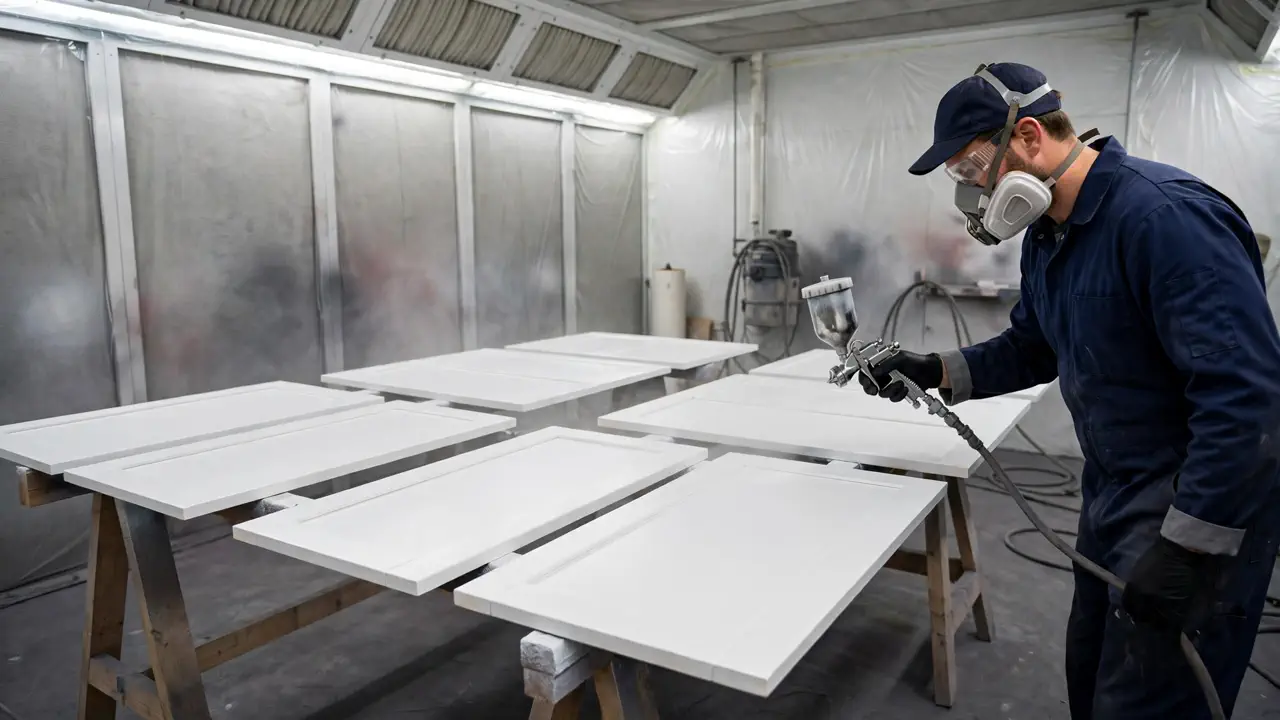
Two-pack is the finish most people picture when they say “respray”: doors and drawer fronts go to a workshop and are sprayed with two-part polyurethane in a booth, giving the smooth, hard, factory-style surface you see on new two-pack kitchens. It is also the dearer job — Joyce Kitchens puts it at $6,500–$12,000+ for a standard kitchen, against $4,500–$9,000+ for a sprayed enamel repaint.
A standard repaint is usually done on site with a water-based enamel, brushed and rolled or sprayed in place. It costs less — no transport, no booth time, less handling — but the finish shows more texture and needs longer to harden in a lived-in kitchen. For a rental, a quick sale, or a kitchen you plan to replace within a few years, it is often the right call.
Which one you need comes down to use. A busy family kitchen with steam, grease and daily handling around the handles will wear a two-pack finish better and clean up more easily. A low-traffic kitchen or a butler’s pantry will be fine with a good enamel system. If you are comparing kitchen cabinet painting cost australia quotes and one sits far below the rest, check which system it names — an enamel job quoted against a two-pack respray is not a comparison.
One more distinction matters: a respray does not fix damaged joinery. Swollen MDF around the dishwasher, delaminating vinyl wrap, or doors that no longer close square will still be damaged underneath a new coat of paint. If the doors themselves are the problem, new fronts are the honest answer — $6,500–$15,000+ in Perth pricing — and painting is the wrong spend.
DIY Cabinet Painting: The Real Cost
Doing it yourself is genuinely cheap on materials. Dulux lists its Renovation Range Cabinet Doors topcoat from $86.90 and the matching Primer from $82.50 — roughly $170 for the two, before rollers, brushes, sandpaper and sugar soap. One 4-litre tin covers about 48 square metres at 12m² per litre, more than enough for most kitchens with two coats.
The cost is not the problem with DIY. The time is. A proper job means removing every door and drawer, labelling each one, degreasing with sugar soap, sanding, filling old handle holes, priming, and applying two topcoats with the right recoat times — Dulux specifies a 4-hour dry time for its primer coat alone. Most DIYers underestimate the prep by days, not hours, and the finish fails exactly where the prep was rushed: around handles, edges and the sink cabinet.
Dulux is blunt about the one rule that matters: all grease, silicone and dirt must be removed and primer applied to a clean surface, or the paint will peel and flake. Kitchens coat their cabinets in aerosolised oil for years, and no topcoat bonds to it. If you DIY, spend the first day cleaning and the second sanding — the painting itself is the quick part.
Dulux publishes a dedicated guide for its Renovation Range Cabinet Doors system, including surfaces and recoat times. Read it before you buy anything.
Paint, Replace or Reface: The Honest Maths
Painting only wins if the cabinets are worth keeping. Here is how the options stack up for a standard Australian kitchen in 2026.
| Option | Cost |
|---|---|
| Paint / respray | $2,000–$12,000 |
| Reface (new doors) | $8,400–$21,000 |
| New flat-pack kitchen | $5,000–$15,000+ installed |
| Full renovation | $20,000–$45,000 |
Refacing — new doors on the existing carcasses — costs 40–60% less than full replacement, and a Melbourne cosmetic refresh pairing refacing with painting typically runs $8,400–$21,000. It makes sense when the door style is the problem: heavy routed profiles, damaged vinyl wrap, or a colour no paint will rescue. If the boxes are the problem, refacing spends money on the wrong half of the kitchen.
If the boxes are failing, the next cheapest step is usually a flat-pack kitchen rather than custom joinery. Our guide to flat-pack kitchen cost in Australia prices the supply-and-install maths for IKEA and Kaboodle kitchens — for many kitchens, a flat-pack replacement lands in the same range as a premium two-pack respray, with new carcasses, new hardware and a warranty included.
And if the whole room needs rethinking — layout, benchtop, appliances — painting is a delaying tactic, not a solution. A full kitchen renovation starts around $20,000, and the paint job you do now will be stripped out with the old cabinets. Put the $2,000–$5,000 toward the renovation deposit instead.
Three Worked Budgets
Small apartment kitchen — $2,000–$3,000 professional, or ~$200 DIY. One-wall or galley layout, 10–16 fronts, flat laminate doors in sound condition. A brush-and-roll enamel repaint on site. DIY needs one tin of topcoat, one of primer, and a weekend plus a day for curing.
Family kitchen, sprayed enamel — $4,500–$7,000 professional. L-shaped or U-shaped, 20–30 fronts, island bench, pantry bank, visible end panels. Doors removed and sprayed, carcasses done on site, two-pack-style prep, water-based enamel topcoat. Allow a week with the kitchen partly out of action, and budget for new handles.
Large kitchen, two-pack respray — $8,000–$12,000+ professional. Big family or heritage kitchen, 30+ fronts, detailed or routed profiles, island with appliance panels, integrated fridge fronts. Doors off to a booth, full prep including hand sanding, colour change from dark timber to white. Add a splashback refresh at the same time if the old tiles clash — it is the cheapest moment, while the room is already masked and out of use.
How to Read a Cabinet Painting Quote
A good quote reads like a scope of works, not a single number — it is what makes the kitchen cabinet painting cost australia total transparent. It should list what is being removed, what is being painted, the prep steps, the primer and topcoat products by name, whether spraying is on site or off site, and what is not included. If any of that is missing, you cannot compare it with another quote.
Watch for the costs often left out: hardware removal and refitting, filling old handle holes, masking benchtops, floors and appliances, transport to and from a spray booth, and the curing window — doors should not go back on until the finish is hard enough to handle, which can mean several days without a working kitchen. A quote that promises the whole job in two days has skipped the curing time or the prep.
Colour changes move the price more than people expect: dark timber to white, or gloss to matte, usually needs an extra coat, and old colours can ghost through a light topcoat. Ask how many coats are included and what happens if the old colour shows through — the answer should be in the quote, not discovered on the last day.
Finally, check the painter like any tradesperson: recent photos of cabinet work specifically, a written warranty on the finish, and a clear statement of what happens if it peels or chips in the first year. Cabinet painting is a specialist job — a general house painter who has never sprayed two-pack is not the same trade.
What Pushes the Price Up
Four things move a quote more than anything else. Condition comes first: grease around the cooktop, flaking coatings, swollen MDF near the sink and dishwasher, and nicotine or moisture staining all add prep hours. Profile is second: flat doors spray fast, while routed, Shaker or heritage profiles need hand sanding and more coats.
Surface type is third. Timber veneer is straightforward when stable and clean; laminate and melamine need the right bonding primer and disciplined cure times — get the primer wrong and the paint peels in sheets. Previously painted kitchens are the least predictable, because the new finish is only as strong as the coating underneath.
Access and staging is fourth. Apartment kitchens with lift access, tight parking and a kitchen that must stay partly in use cost more in labour than the same doors in an empty house, and off-site spraying adds transport and handling. None of this shows in a per-door rate, which is why two quotes for the same kitchen can sit thousands apart and both be honest.
kitchen cabinet painting cost australia: Frequently Asked Questions
How much does it cost to paint kitchen cabinets in Australia?
A professional repaint costs $2,000–$5,000, according to PaintAccess. Melbourne specialists quote $2,500–$7,000, and a Perth two-pack respray runs $6,500–$12,000+. DIY materials cost from about $170.
Is it cheaper to paint or replace kitchen cabinets?
Painting is far cheaper: a professional repaint costs $2,000–$5,000, while a full kitchen renovation averages $20,000–$45,000. Painting wins when the boxes are sound and the layout works. If the boxes are failing or the layout needs to change, replacement is the honest answer.
How long do painted kitchen cabinets last?
A properly prepared two-pack finish lasts 10–15 years in a family kitchen; a brush-and-roll enamel repaint typically lasts 5–10 years. Longevity depends almost entirely on preparation — degreasing, sanding, priming and curing — rather than the paint brand.
Can you paint laminate kitchen cabinets?
Yes, if prepared correctly. Degrease the surface, lightly sand or degloss it, and prime with a bonding primer made for slick surfaces, such as the Dulux Renovation Range Primer. Skipping the primer is the most common reason laminate paint jobs peel.
Is it worth painting kitchen cabinets before selling?
Usually yes, if the kitchen is dated but functional — a $2,000–$5,000 repaint can lift the whole room in listing photos. Less worthwhile if the benchtop, splashback and appliances are also tired — then the painted cabinets only highlight the rest.
Should I DIY or hire a professional to paint my kitchen cabinets?
DIY suits small kitchens, flat doors and patient owners — materials cost from about $170. Hire a professional for two-pack finishes, routed or heritage profiles, or laminate needing a bonding primer.