
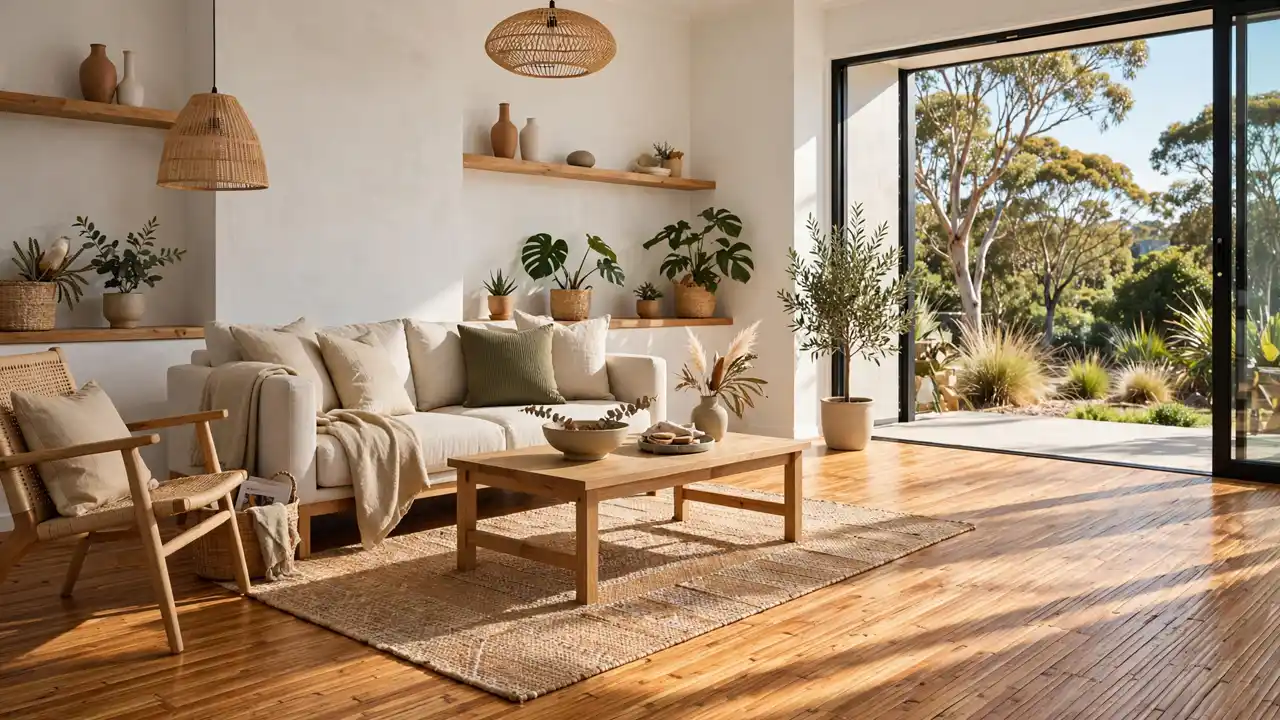
Bamboo flooring has moved from a niche eco choice to a genuine mainstream option in Australian homes, and the bamboo flooring cost australia homeowners pay in 2026 is a big part of the reason. For a quality strand-woven floor, professionally installed, expect $80–$180 per square metre — below engineered timber, above hybrid and vinyl. This guide prices the whole job: supply, installation, hidden extras, and three worked room budgets.
One thing to settle first: bamboo is not timber but a grass, cut into strands, glued and pressed into boards — and that explains almost everything about how it behaves and where it should not go.
bamboo flooring cost australia: The 2026 Snapshot
For a standard Australian home, quality strand-woven bamboo installed by a professional costs $80–$180 per square metre — the range published by Three Birds Renovations in their 2026 flooring cost guide.
| Job type | 2026 price |
|---|---|
| Budget bamboo, installed | From ~$75/m² |
| Standard strand-woven, installed | $80–$120/m² |
| Premium / water-resistant, installed | $100–$180/m² |
| Supply only (boards) | $50–$120/m² |
| Installation only (labour) | $30–$50/m² |
| Underlay | $5–$15/m² |
That table is the short answer to bamboo flooring cost australia in 2026. For comparison: engineered timber runs $100–$250+ per square metre installed, solid timber $150–$350+, and hybrid $50–$120+.
What Bamboo Flooring Actually Is (and Isn’t)
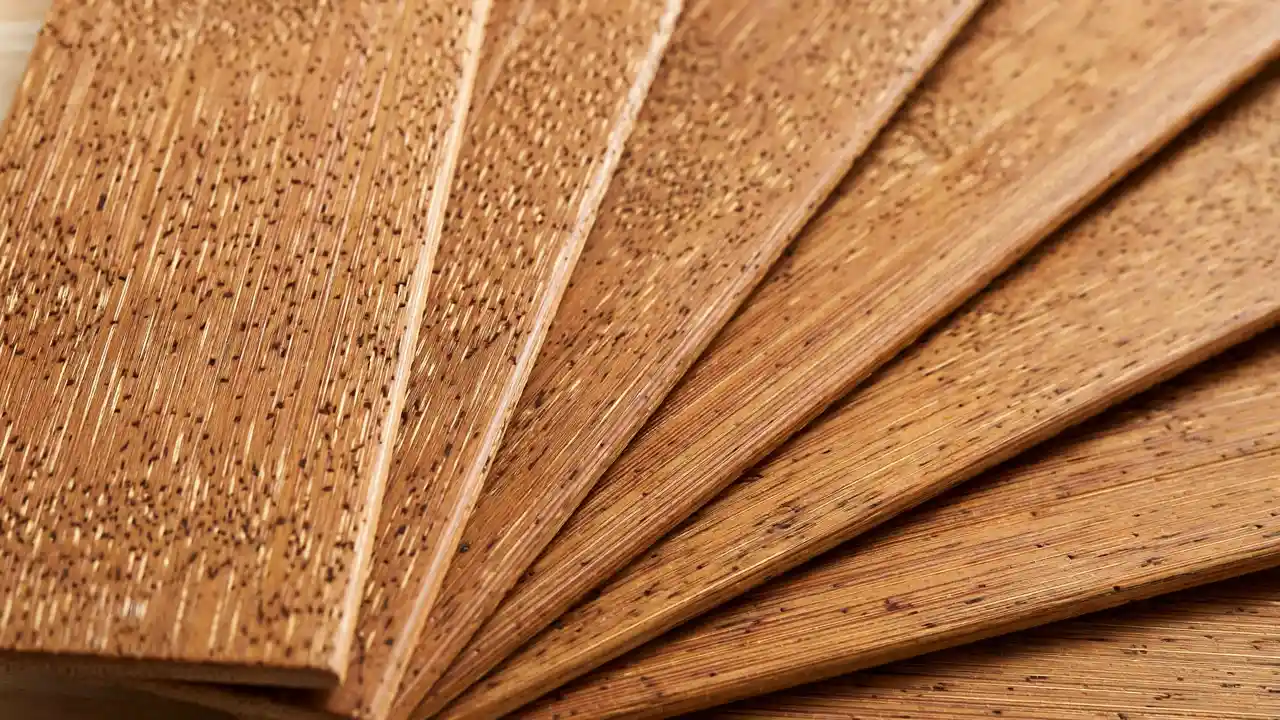
Bamboo flooring is made from moso bamboo, a fast-growing grass rather than a tree. The Australian Timber Flooring Association states it plainly: bamboo is not a timber but a grass, and the most common form of bamboo flooring is strand woven. To make it, bamboo is cut into strands, coated with adhesive, and pressed under heat into a beam, then cut into boards.
Three ways bamboo boards are made, and the price follows the method. Strand-woven is the dense, hard one — shredded fibres compressed under heat, which is why it rates 15+ on the Janka hardness scale, harder than most hardwoods. Horizontal and vertical bamboo are flattened strips glued edge to edge; softer, they show the bamboo nodes and wear faster. FloorVenue stopped selling them — they simply do not perform as well as strand-woven.
Two properties catch first-time buyers out. First, the coating is designed not to be sanded and recoated, unlike solid timber floors. The factory finish is harder than a site-applied timber coating, good for daily wear, but a scratched floor cannot be sanded back to new — the boards are replaced, not refinished. Second, bamboo moves with humidity: ATFA notes floated bamboo floors move mostly in board width, more than engineered or laminate floated floors.
Bamboo Flooring Prices by Type
Most Australian bamboo quotes are for strand-woven boards. Sydney retailer FloorVenue prices strand-woven bamboo from $80 per square metre, quality boards around $100, and water-resistant bamboo — the premium tier — at $100–$120 per square metre. Melbourne installer Royal Flooring starts strand-woven jobs at around $75 per square metre supplied and installed, with density, coating, stairs and moisture work able to push a project to $105–$145+.
| Bamboo type | Supply only | Installed |
|---|---|---|
| Budget bamboo (basic strand-woven) | $50–$80/m² | $75–$90/m² |
| Standard strand-woven | $80–$100/m² | $80–$120/m² |
| Premium / water-resistant strand-woven | $100–$120/m² | $100–$180/m² |
The spread comes down to board thickness, width, the coating system, and the brand behind the warranty. A cheap board with a thin wear layer and a short warranty is not the same product as a $100 board from a brand that has been in Australian stores for a decade.
Water-resistant bamboo deserves a sentence of its own: the name misleads people. It is a premium strand-woven board with a more water-tolerant core and sealed edges, priced at $100–$120 per square metre for supply. It handles spills far better than standard bamboo, but it is not waterproof and not a wet-area floor — Royal Flooring says bamboo is not their first recommendation for bathrooms or laundries, and builder Berstan Homes says the same about kitchens and bathrooms. If your floor will see regular standing water, the honest answer is hybrid or vinyl, not a dearer bamboo board.
Supply vs Installation: Where the Money Goes
A bamboo flooring quote has two big parts and a tail of small ones. Supply runs $50–$120 per square metre depending on type and quality, with Premium Floors, Australia’s largest timber-look wholesaler, putting bamboo supply at $60–$90 per square metre. Installation runs $30–$50 per square metre, according to Yellow Pages’ 2026 floating-floor guide, with Sydney installers quoting $30–$40 and hipages putting timber installation at $40–$80 per square metre. Underlay adds $5–$15 per square metre.
The small lines are where quotes diverge. Australian retailer DIY Floorboards puts the average installed price at $80–$90 per square metre, covering preparation, underlay, skirting work and laying — a reminder that a bare labour rate is not the whole job. The extras are the same as on any flooring quote: floor removal and disposal at $10–$30 per square metre, subfloor levelling at $25–$70+ per square metre, and a moisture barrier at $5–$12 per square metre. On a concrete slab, the moisture barrier is not optional — it is cheap insurance against boards that cup and lift. Small rooms cost more per square metre: the call-out and cutting are the same, but the area is smaller.
Bamboo Flooring Cost by Room: Three Worked Budgets
These budgets use the sourced 2026 ranges above, assuming a concrete slab in good condition, no floor removal, and standard strand-woven boards.
Bedroom, 12m². Mid-range strand-woven at $90 per square metre installed comes to $1,080 plus underlay ($120) — around $1,200 total.
Living and dining, 40m². At $100 per square metre installed, boards and laying come to $4,000, plus underlay and trims of roughly $400–$600 — around $4,400–$4,600 total. Royal Flooring’s estimator prices a 35-square-metre job at $3,400–$4,050 all in — roughly $97–$116 per square metre.
Whole home, 100m². Premium water-resistant boards at $110 per square metre installed come to $11,000, plus underlay, trims, stair nosings and a moisture barrier of roughly $1,000–$2,000 — around $12,000–$13,000 total. At this scale, get the subfloor level checked before anyone quotes — levelling 100 square metres is the biggest blowout risk in the job.
Bamboo vs Engineered Timber vs Hybrid: The Cost Comparison
Bamboo is usually compared with engineered timber — they look similar and sit in the same rooms. The price gap is real: bamboo at $80–$180+ per square metre installed against engineered timber at $100–$250+ per square metre installed, using Three Birds Renovations’ 2026 comparison. Bamboo is also harder — strand-woven rates 15+ on the Janka scale — so it dents less under heels and furniture. The trade-off is refinishing: engineered timber can be sanded and recoated a limited number of times; bamboo’s factory coating cannot. If you want a floor you can refresh in ten years, engineered timber earns its premium.
| Flooring type | Installed cost |
|---|---|
| Bamboo (strand-woven) | $80–$180+/m² |
| Engineered timber | $100–$250+/m² |
| Solid timber | $150–$350+/m² |
| Hybrid flooring | $50–$120+/m² |
| Vinyl planks | $50–$100+/m² |
| Laminate | $40–$90+/m² |
| Polished concrete | $80–$180+/m² |
Against hybrid, bamboo is a look and feel choice, not a price choice — hybrid is cheaper and waterproof, bamboo feels like real wood underfoot. Against polished concrete in the same $80–$180+ band, the choice is comfort: concrete is cold and hard, bamboo is warm and forgiving. If you want the hardest possible floor and do not mind cold underfoot, compare the polished concrete floor cost before deciding.
DIY Bamboo Flooring: The Real Cost
Most bamboo flooring uses a click-lock floating system, which makes it DIY-friendly. FloorVenue notes all bamboo floors use a click-lock system, installed without glue or nails, and DIY is a genuine option if you follow the manufacturer’s procedures closely. Doing it yourself changes the bamboo flooring cost australia equation by $30–$50 per square metre — $1,200–$2,000 on a 40-square-metre living area.
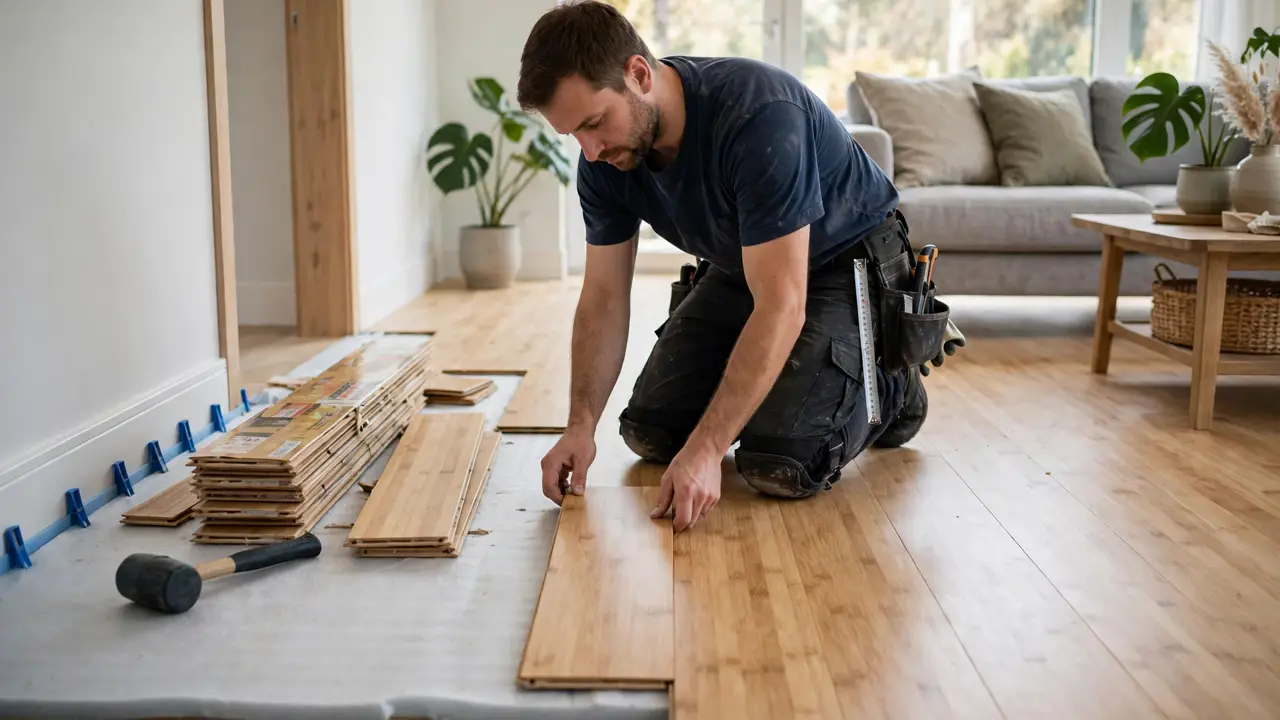
The cost of DIY is the tools and the time, not the boards. The expensive mistakes are in the preparation: an unlevel subfloor, a skipped moisture barrier, no expansion gap at the skirting. Bamboo moves with humidity more than engineered timber or laminate, so the gap is what stops the floor buckling in summer.
How to Read a Bamboo Flooring Quote
A comparable bamboo flooring quote has seven lines — miss one and you are comparing guesses, not quotes. The lines are: the board, named by type (strand-woven), thickness and brand; the underlay; the installation method; subfloor preparation and levelling; the moisture barrier; skirting, trims and stair nosings; and removal and disposal of the old floor.
Before you sign anything, read the ATFA’s consumer information on bamboo floors — the Australian Timber Flooring Association’s owner-expectations sheet for engineered, laminate and bamboo floors, covering what a finished floor should reasonably look like and how much seasonal movement to expect.
Three checks separate a good quote from a cheap one. First, does it name the board type? A quote that just says “bamboo flooring” could be horizontal boards at half the price. Second, does it include the moisture barrier and levelling, or will those appear as variations later? Third, is it supply-and-install or supply-only? A $60 supply-only quote looks cheaper than an $85 installed quote until you add labour and underlay. Compare installed totals, not headline rates — that is the one rule that keeps bamboo flooring cost australia comparisons honest.
While the room is empty and the skirting is off, a repaint is the cheapest companion job you will ever get — check the house painting cost in Australia before you book the floor, and the room comes back finished rather than half finished.
bamboo flooring cost australia: 7 Mistakes That Blow the Budget
1. Buying horizontal or vertical bamboo to save money. Cheaper and softer, it shows wear sooner — the saving disappears when a dented board needs replacing.
2. Laying bamboo in a wet room. Bathrooms, laundries and uncovered entries are not bamboo rooms — a swollen floor is a replacement.
3. Skipping the moisture barrier on a slab. A $5–$12 per square metre barrier is the cheapest insurance in the job — without it, damp cups the boards.
4. Ignoring subfloor levelling. Bamboo shows every dip as a hollow sound and a flexing board — levelling at $25–$70+ per square metre is painful to pay for, and far more painful to pay for twice.
5. Ordering no spare boards. Buy a spare box or two for cuts and future repairs — colours and batches change.
6. Comparing a supply-only quote with an installed quote. The gap is $30–$50 per square metre of labour plus underlay — enough to make the “cheaper” quote the dearer job.
7. Expecting to sand it back later. Bamboo’s factory coating is not designed to be sanded and recoated — if you want a refreshable floor, engineered timber is the honest choice.
Bamboo flooring earns its place in Australian homes: it is hard, renewable, and costs less than the timber it resembles. Priced properly — $80–$180 per square metre installed for quality strand-woven — it is one of the fairest deals in flooring. Get the type right, keep it dry, and compare installed totals. And if you are renovating to sell, weigh the floor against the rest of the room first — our guide to does interior painting add value works through the same maths for paint.
How much does bamboo flooring cost in Australia?
In 2026, quality strand-woven bamboo flooring costs $80–$180 per square metre installed in Australia. Budget jobs start from around $75 per square metre, while premium or water-resistant boards reach $100–$180. Supply-only prices run $50–$120 per square metre, and installation adds $30–$50 per square metre.
Is bamboo flooring cheaper than engineered timber?
Yes. Bamboo flooring typically costs $80–$180 per square metre installed, while engineered timber runs $100–$250+ per square metre installed. Bamboo is also harder underfoot — strand-woven bamboo rates 15+ on the Janka scale — but unlike engineered timber it cannot be sanded and recoated, so the saving comes with a trade-off.
Is bamboo flooring waterproof?
No. Bamboo is not waterproof, and it is not recommended for bathrooms or laundries. Water-resistant boards cost $100–$120 per square metre and handle spills better, but standing water and steam can still move the boards. For wet rooms, hybrid or vinyl flooring is the safer choice.
Can you install bamboo flooring yourself?
Yes. Most bamboo flooring uses a click-lock floating system that is DIY-friendly if you follow the manufacturer’s installation procedures closely. Doing it yourself saves the $30–$50 per square metre labour cost, but subfloor preparation, moisture barriers and skirting work still need care.
Does bamboo flooring scratch easily?
Strand-woven bamboo is among the hardest flooring surfaces, rating 15+ on the Janka hardness scale, so it resists dents better than most timber. It can still scratch — pet claws, grit and dragged furniture mark the coating — and unlike solid timber the coating is not designed to be sanded and recoated, so deep scratches are permanent.
Does bamboo flooring add value to a home?
No flooring guarantees a resale uplift. What buyers pay for is a floor in good condition that suits the home — and a well-chosen bamboo floor does that as well as timber at a lower cost. If you are renovating to sell, weigh the floor against the rest of the room before spending on premium boards.