
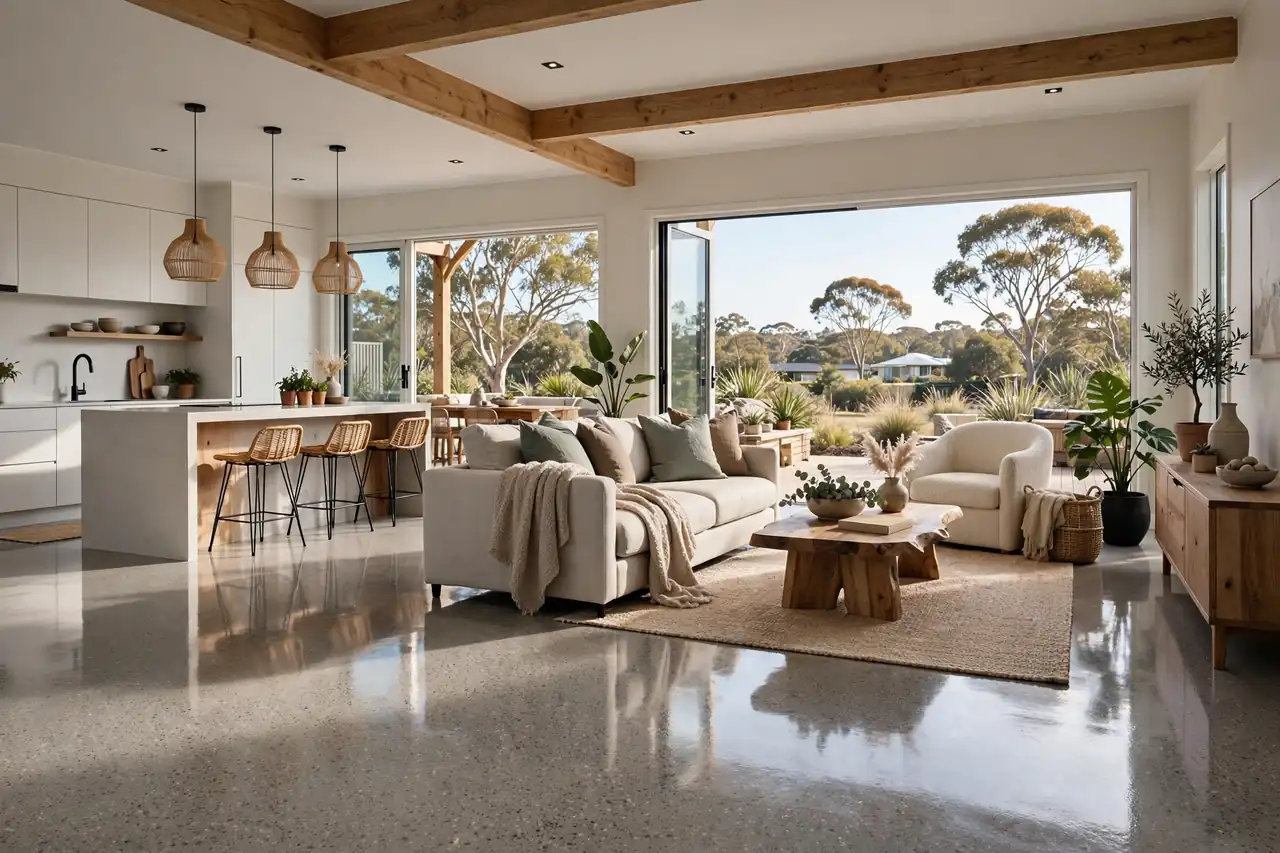
Polished concrete floor cost in Australia sits at one of the widest price bands of any flooring option in 2026 — anywhere from around $50 per square metre to more than $250 per square metre depending on the finish and the slab you’re starting with. That range is exactly why this guide exists: 2026 per-m² prices verified against five Australian sources, the three finishes that set your bill, five worked project budgets, and the questions that stop you overpaying.
If you’re weighing polished concrete against the alternatives, our guide to the best flooring for Australian homes puts every option side by side — concrete included.
How much does polished concrete cost in Australia in 2026?
The honest answer first: most Australian homeowners polishing an existing slab pay $60–$170 per square metre, with a typical mid-range result landing around $110/m² (whatsthedamage.com.au, concreting prices verified October 2026). Pouring a brand-new slab and polishing it is a different job entirely — expect $160–$260 per square metre (typical $210/m²).
The finish-by-finish picture in 2026:
| Finish | Typical 2026 range (per m²) | Sources |
|---|---|---|
| Grind & seal | $50–$100 | hipages ($50); Yellow Pages ($60–$70); Perth contractors ($95–$135) |
| Honed concrete | $75–$120 | hipages ($75); Yellow Pages ($80–$90) |
| Mechanically polished (existing slab) | $100–$210 | Yellow Pages ($100–$120); whatsthedamage (up to $170); Perth (2026): $170–$210 |
| New slab poured + mechanical polish | $160–$260 | whatsthedamage (typical $210) |
The reason the band is so wide is simple: “polished concrete” covers three genuinely different jobs, sold at three different prices. Let’s unpack them.
The three finishes that set your price
Grind & seal — the budget route
Grind & seal is exactly what it sounds like. The contractor grinds your slab back with a coarse diamond tool, then rolls on a clear topical sealer — usually acrylic or polyurethane. You’re not polishing to a shine; you’re getting a flat, sealed concrete floor with a satin look. At $50–$100/m² it’s the cheapest honest way into the concrete-floor look, and it’s the finish most often used in garages, rumpus rooms and covered outdoor areas.
The trade-off: that topical sealer is a coating, not part of the concrete. It wears — high-traffic areas need resealing every few years, and it can scratch and scuff. Factor the reseal into your budget, because a cheap floor that needs recoating quickly stops being cheap.
Honed concrete — the middle ground
Honing takes the slab further through the grinding process (typically to around 400 grit) and then seals it, giving a smooth, matte, stone-like surface. It suits bathrooms, laundries and alfresco areas where you want slip resistance without the industrial gloss. At $75–$120/m² it sits between the other two on price — more machine time than grind & seal, less than a full mechanical polish — with a similar resealing rhythm.
Mechanically polished concrete — the real thing
This is the finish you see in design magazines: the slab is progressively ground and polished through finer and finer diamond grits — commonly 800, 1500, and for a mirror finish 3000 — with a chemical densifier/hardener applied mid-process. The densifier reacts with the concrete to make it harder and less porous, so the shine comes from the stone itself rather than a coating sitting on top.
It’s the most durable and most expensive of the three: $100–$210/m² for an existing slab in 2026. Grit level moves the needle — stepping from an 800-grit sheen to 1500 grit adds about $15/m², and a 3000-grit mirror roughly $30/m² (2026 Perth contractor pricing). For most living areas, 800 or 1500 grit is the sweet spot: beautiful depth, lower cost, and slightly better slip behaviour than full mirror.
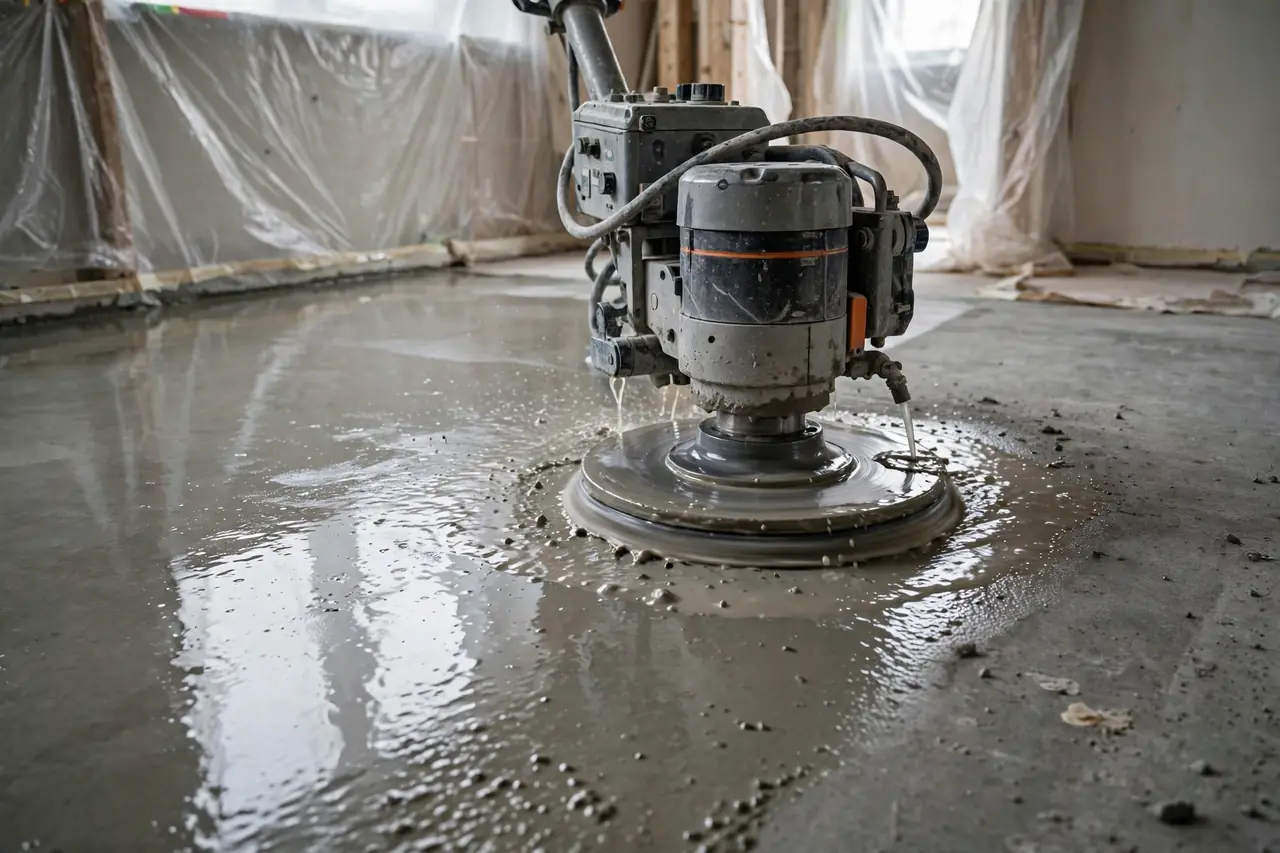
Polished concrete cost per square metre: five worked examples
Ranges are useful; budgets are better. Five realistic 2026 project sizes at mid-to-upper mechanical-polish pricing (the finish most homeowners want in living areas). Each assumes an existing slab in reasonable condition — add $20–$40/m² for retrofit prep if yours needs grinding back from carpet glue, tile beds or paint.
| Project | Area | Realistic 2026 budget |
|---|---|---|
| Laundry or entry makeover | 20 m² | $2,000–$3,500 |
| Kitchen or open-plan zone | 50 m² | $5,000–$10,500 |
| Open-plan living (Perth benchmark) | 100 m² | $11,000–$21,000 |
| Whole-home, single level | 150 m² | $16,500–$31,500 |
| New build: slab pour + polish | 150 m² | $24,000–$39,000 |
Two things to know about those numbers: small jobs pay premium per-m² rates (same heavy equipment to mobilise), and big continuous floors get cheaper per metre than fragmented rooms.
New builds deserve a special note. If you’re building and want polished concrete, tell your builder and concreter before the frame goes up. A slab poured to a polished-floor spec saves serious grinding time, and getting the polishing crew in before the frame is built removes detail work around walls — both lower the bill.
What drives your quote up or down
Seven factors separate the $60/m² jobs from the $210/m² ones. Run through them before you call for quotes, because half of them are things you can influence.
1. Condition of your existing slab. The single biggest variable. A clean, flat, crack-free slab is the dream starting point. Crack repairs run $50–$200 per crack (2026 Perth pricing), and grinding out old tile beds, carpet glue or epoxy coatings adds $20–$40/m² before polishing even starts.
2. Aggregate exposure. Light exposure (a “cream” finish — mostly cement paste, few stones showing) is the fastest and cheapest. Medium and heavy exposure cut deeper to reveal the stone in the mix, adding a day or two of machine time. Decide whether you want the speckled stone look before you get quotes.
3. Final grit level. As noted above, 800 grit is the standard sheen; 1500 adds depth (about +$15/m²) and 3000 delivers mirror (+$30/m²). Honest advice: 800–1500 grit is where 90% of homes land.
4. Area size and layout. Under 50 m², expect premium per-m² rates; over 100 m² of continuous floor, the rate drops. Fragmented rooms cost more per metre than open plan.
5. Colour and decorative treatments. Integral colour, stains, dyes and saw-cut patterns (large tile-look grid cuts are popular) all add labour and materials. A plain polish is always the cheapest version of itself.
6. Your city. Perth’s 2026 contractor pricing ($170–$210/m² mechanical) sits noticeably above national aggregator averages ($100–$120/m²) — local labour markets differ, and contractors quote real jobs while directories quote averages. Always weight local contractor quotes above national figures.
7. Timing in your build. Polishing before walls go up (new builds) or as the very first trade in a renovation keeps detail work — and cost — down. Our guide to concrete grinding and polishing timing covers when to bring the grinders in.
Mechanical polish vs grind & seal vs honed: which finish is right for you?
| Grind & seal | Honed | Mechanical polish | |
|---|---|---|---|
| Look | Satin, flat | Matte, stone-like | Glossy, reflective |
| 2026 cost | $50–$100/m² | $75–$120/m² | $100–$210/m² |
| Durability | Sealer wears; reseal every 2–5 years | Sealer wears; similar cycle | Hardened concrete; decades with basic care |
| Best for | Garages, rumpus, covered outdoors | Bathrooms, laundries, alfresco | Open-plan living, kitchens, retail-style spaces |
| Slip behaviour | Good (low sheen) | Good (matte) | Can be slippery when wet — ask about anti-slip options |
Wet areas and anywhere bare feet meet water lean honed; high-visibility living areas justify mechanical polish; garages and utility spaces rarely need more than grind & seal.
Polished concrete vs epoxy, tiles and timber: the 2026 cost picture
Vs tiles: tiles mean buying the tile plus paying for laying on top of the material cost, so a mid-range tile floor often lands in the same total band as a mechanical polish — but the polish has no grout lines to stain and no tiles to crack. Where tiles win is design flexibility and easier spot-repair of a single damaged tile.
Vs timber and hybrid flooring: timber and quality hybrid floors carry real material cost per square metre before installation even starts — and timber needs refinishing every 7–10 years at $40–$80/m² (Brisbane trade figures, 2026). If you’re weighing the options, our hybrid flooring vs laminate comparison breaks down the timber-look alternatives in detail.
Vs epoxy: epoxy is polished concrete’s closest rival on industrial-chic looks and the default choice for many garages. But it’s a coating system — it can chip, peel and yellow with UV exposure. Mechanical polish is the concrete itself, so there’s no coating to fail.
The lifetime argument: this is where concrete pulls ahead. A mechanically polished floor doesn’t need refinishing on a cycle the way timber does, and there’s no carpet to replace every decade (carpet replacement runs $30–$60/m² each time in high-traffic homes, per 2026 Brisbane trade data). Over 15–20 years, it’s among the lowest total-cost-of-ownership floors you can buy — provided you paid for a proper mechanical polish, not a cheap seal.
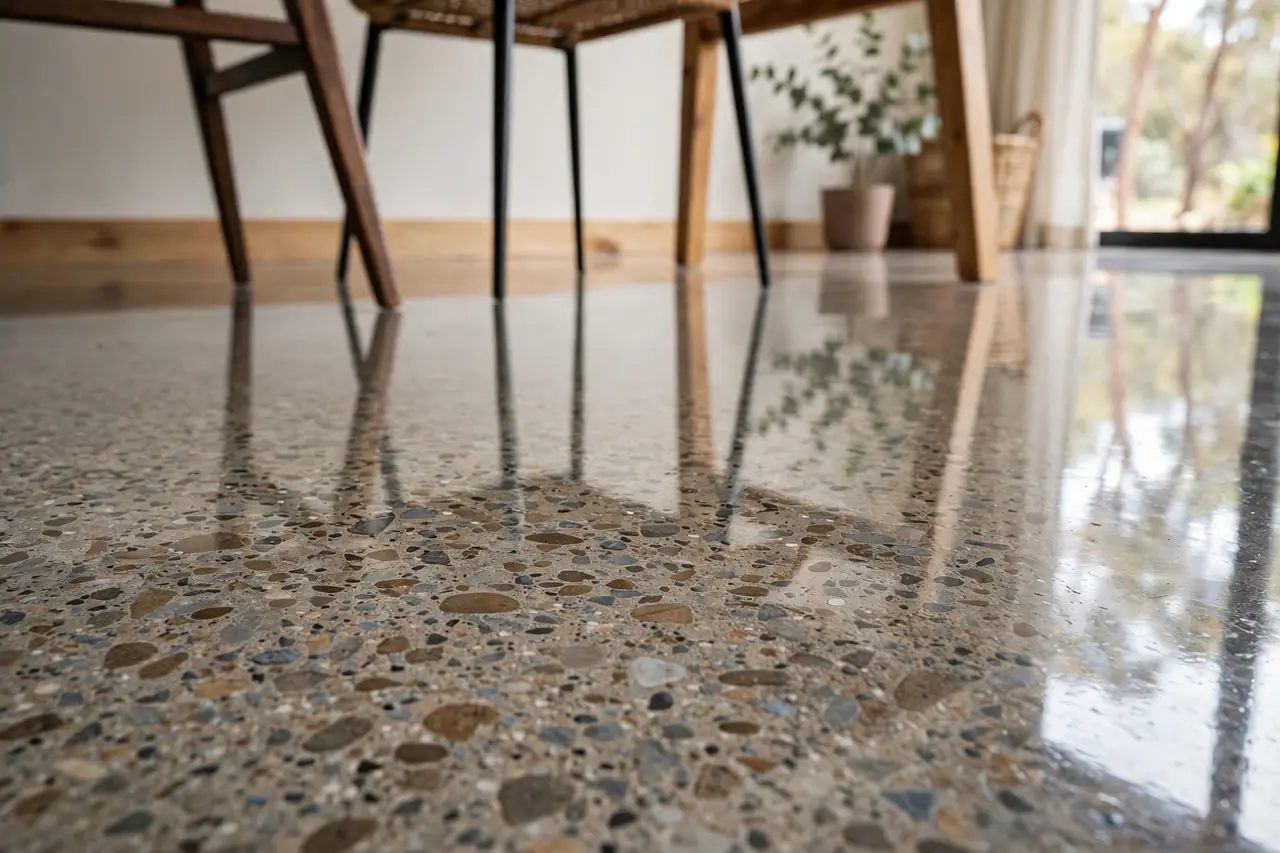
New slab + polish vs polishing an existing slab
Polishing what you have is always the cheaper path: $100–$210/m² against $160–$260/m² for pour-plus-polish. But not every existing slab is polishable — extensive cracking, serious level issues, or old coatings that won’t grind back cleanly can push prep costs so high the saving evaporates.
For new builds and extensions, the maths flips in concrete’s favour: you’re pouring a slab anyway, so the marginal cost is just the polishing component. Tell your concreter it’s destined for polishing before they pour — mix design, finishing technique and curing all affect the final result.
One honest caveat that rarely makes the sales brochures: concrete cracks. Hairline shrinkage cracks are normal and most can be filled and polished over — but if the idea of any visible cracking bothers you, concrete may not be your floor. Ask every contractor how they handle cracks before you sign, not after the grinder reveals them.
Getting quotes: five questions and three red flags
Get three quotes minimum, all for the same finish — a grind & seal quote and a mechanical polish quote will differ by 2x and tell you nothing. Ask each contractor:
- What finish and final grit are you quoting? Get it in writing: “mechanical polish to 1500 grit”, not just “polished concrete”.
- What aggregate exposure does the price assume? Cream, medium or heavy — and what happens to the price if the slab reveals differently once grinding starts?
- What prep is included? Crack repairs, glue and coating removal, levelling — itemised, not “as required”.
- What’s the slip rating? Ask for the P-rating under AS 4586, especially in entries, kitchens and anywhere water lands.
- What’s the maintenance and warranty? Reseal intervals for sealed finishes, what voids the warranty, and who honours it.
Red flags: a quote dramatically below the ranges above (corners are being cut — usually prep or grit steps); no finish specification in writing; and a large upfront deposit demanded for a job that’s mostly labour on your own slab.
For the technical background on what proper concrete work involves, the Cement Concrete & Aggregates Australia (CCAA) publishes Australia’s authoritative guides to concrete construction — worth a skim before you sign anything.
Polished concrete cost FAQs
Can you polish an existing concrete slab?
Usually, yes — most slabs in Australian homes from the 1980s onward can be polished, and it’s far cheaper than pouring new ($100–$210/m² for mechanical polish in 2026). The exceptions are structural cracking, severe level problems, or coatings that won’t grind back. A reputable contractor inspects and tests before quoting.
Is polished concrete slippery?
It can be — especially a high-gloss finish when wet, which is why entries and wet areas often go honed instead. Ask your contractor for the finished floor’s P-rating under AS 4586; anti-slip treatments and lower-grit finishes exist for exactly this reason. Dry polished concrete in normal living areas is no more slippery than tiles.
How long do polished concrete floors last?
Decades, not years. A mechanically polished floor with a densifier has the shine in the concrete itself, so there’s nothing to peel or wear through under normal residential use. Sealed finishes (grind & seal, honed) are different: the topical sealer typically needs reapplication every 2–5 years in high-traffic areas.
Can I polish concrete myself?
DIY grind-and-seal kits exist and suit a garage if you’re handy, but mechanical polishing needs industrial grinders, dust extraction and experience reading a slab — the gear hire plus the learning curve usually erase the saving, and mistakes (over-grinding, swirl marks, burnt patches) are permanent. For living areas, hire a specialist.
Does polished concrete crack?
Hairline shrinkage cracks are normal and most can be filled before polishing so they’re barely visible. What polishing can’t fix is structural movement — if your slab is still moving, cracks will return, which is why the pre-quote inspection matters.
Is polished concrete cold underfoot?
Concrete has high thermal mass: it feels cool in summer (a genuine plus in Australian climates) and can feel cold in winter on a south-facing slab. It’s fully compatible with in-slab hydronic heating, and rugs do the rest — many homeowners in cooler states simply rug their polished living areas in winter.
The bottom line: budget $100–$170/m² for a proper mechanical polish on a decent existing slab, less for grind & seal or honed finishes, and $160–$260/m² if you’re pouring new. Get the finish in writing, inspect the slab before anyone quotes, and remember the cheapest quote in this trade is usually the most expensive floor.