
A new shower screen is one of those bathroom buys that looks simple until you start shopping. One quote says $800, another says $3,000, and both claim to be for the same job. If you are trying to pin down the real shower screen cost Australia homeowners pay in 2026, this guide lays out 2026 pricing by screen type, what installation actually adds, the glass-thickness rules your installer must follow, and three worked budgets so you can spot an inflated quote when you see one.
Shower Screen Cost Australia: The Quick 2026 Answer
Nationally, a supplied-and-installed shower screen in Australia runs from around $300 for a basic framed screen up to $3,500+ for a custom frameless design. Most homeowners land somewhere in the middle. Here is the honest breakdown before we get into the detail:
| Screen type | Supply only | Supply + install | Best for |
|---|---|---|---|
| Framed (pivot or sliding) | $250–$800 | $500–$1,000 | Tight budgets, rental refreshes |
| Semi-frameless | $300–$1,300 | $650–$2,500 | The sweet spot for most renos |
| Frameless | $360–$2,000+ | $900–$3,500+ | Designer look, bigger budgets |
| Walk-in panel (fixed glass) | $300–$800 | $600–$1,500 | Open, minimal showers |
Those bands come from a spread of 2026 Australian sources — Perth supply retailers, Gold Coast and Sydney installers, trade cost guides and October 2026 retail spot-checks at Bunnings and Beaumont Tiles. Expect your city to nudge you up or down: Sydney and Perth typically sit at the higher end, regional areas at the lower. It is the clearest shower screen cost Australia picture you will get without calling three installers yourself.
Framed Shower Screens: $300–$800
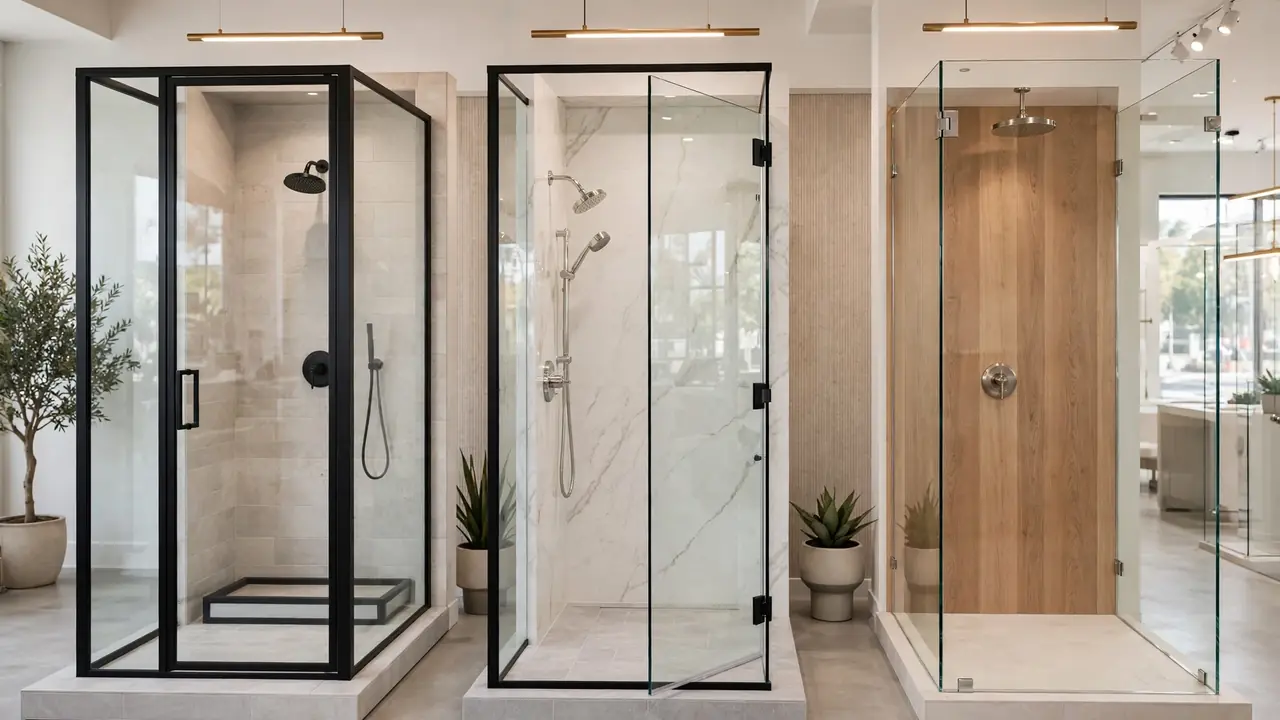
Framed screens are the workhorses of Australian bathrooms. The glass panels sit in an aluminium frame around every edge, which means the glass itself can be thinner — typically 4–6mm — and cheaper to make. Retail entry-level framed screens start around $199–$409 at Bunnings and Beaumont Tiles (October 2026 prices, product only), and one installer guide puts framed screens at $250–$500 before labour.
Installed, a standard framed pivot or sliding screen usually lands between $500 and $1,000 all in. They are the easiest to fit, the most forgiving of out-of-square walls, and they contain water better than frameless designs because the frame channels drips back into the shower. The trade-off is looks and cleaning: frames collect soap scum in corners and crevices, and they can date a bathroom faster than frameless glass.
Where framed screens make sense: rental properties, quick bathroom refreshes, and secondary bathrooms where you want the money to go elsewhere — like a nicer vanity. If that is your plan, it is worth browsing bathroom vanity ideas that lift the whole room while keeping the screen budget low.
Semi-Frameless Screens: $650–$2,500
Semi-frameless is the middle ground that most renovators actually buy. The door glass is frameless (or near it), while the fixed panels sit in slim aluminium channels. One Australian supplier puts semi-frameless screens at $650–$1,300 installed for standard sizes; a Gold Coast installer quotes from $1,100 supply and install in 2026, with the range stretching to $2,500 for larger configurations.
You get most of the frameless look — open sightlines, less visual clutter — without the frameless price. Cleaning is easier than fully framed because there are fewer channels to scrub, and the framed sections give the whole assembly rigidity, which matters in older homes where walls are rarely perfectly plumb. Semi-frameless uses 6mm toughened glass as a minimum, which keeps panel prices down compared with the 10mm glass a true frameless screen demands.
For a main family bathroom or an ensuite where you want a contemporary feel on a realistic budget, this is usually where the smart money goes.
Frameless Screens: $900–$3,500+
This is the look on every Pinterest board: uninterrupted sheets of glass held by discreet brackets or minimal channels. The catch is that the glass has to do all the structural work, so it is 10mm thick (sometimes 12mm) and heavy — one 900mm-wide panel can weigh over 20kg. That thickness, the weight, and the precision hardware are why frameless costs what it does.
Real 2026 numbers: a Sydney installer quotes $900–$1,700 supply and install for common frameless hinged setups; a Melbourne cost guide puts frameless at $840–$2,625 with $1,575 typical; a Gold Coast installer starts frameless at $1,600 installed, rising to around $2,100 for a standard 900×900mm and $2,800 for fluted 10mm glass. Custom frameless — angled returns, wall-to-wall spans, special finishes — runs $1,800–$3,500+.
What you are paying for beyond the glass: precision hinges and clamps (cheap ones sag within a couple of years), exact site measure, and careful installation. A frameless panel has no frame to hide a crooked wall, so the installer shims and packs everything to the millimetre. That labour is the difference between a screen that looks perfect for a decade and one that leaks from day one — and it is the line most often hidden inside a lump-sum shower screen cost Australia quote.
Shower Screen Cost Australia: Installation Labour, DIY Rules & Old Screen Removal
Here is where quotes diverge most across the shower screen cost Australia market. Understanding the labour component protects you from the vague “$2,500 supply and install” line that tells you nothing about what is included.
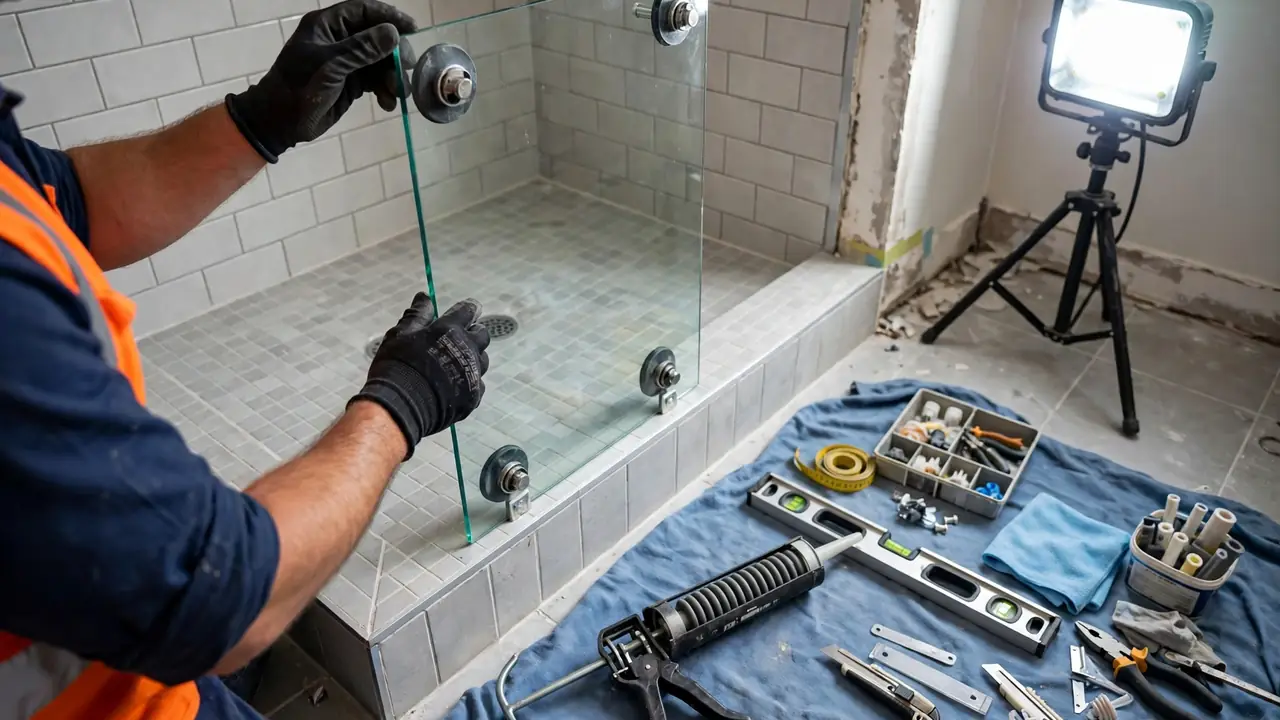
Professional installation rates. Shower screen installers typically charge $45–$85 per hour, and a standard install takes 2–4 hours. Trade guides put installation at $200–$400 for a straightforward two-panel frameless screen, up to $400+ for large three-panel sliders, and one supplier quotes $250–$800 depending on complexity. Frameless costs more to fit than framed because the panels are heavier and alignment is unforgiving.
Supply-only vs supply-and-install. Buying the screen yourself and hiring a handyman can save money: one Perth retailer sells complete screens from $760 supply-only, with a handyman fit adding roughly $200–$400. But measure twice, because glass cut to the wrong size is scrap. Most full-service installers include free measure, custom manufacture, installation and a warranty (typically two years) in their quoted price — for many people that certainty is worth the premium.
DIY rules — read this before you try. Installing your own screen is only sensible for a like-for-like replacement: the same screen type, in the same footprint, with the existing waterproofing membrane intact and compliant. You will need a diamond hole saw, a proper level, a silicone gun, and a helper to manage the glass. It is off-limits for new bathrooms, hobless showers, any change of screen type or size, or any situation where you suspect a leak. As one installer guide puts it bluntly: cracking one tile or breaking one panel erases every dollar you saved.
Old screen removal. Replacing rather than fitting fresh? Removal and disposal of the old screen is usually included in a full-service quote — confirm it in writing. With supply-only purchases, removal is your problem (or your handyman’s). The wildcard is what is behind the old screen: if the waterproofing is degraded, a new screen fitted over it traps water and accelerates damage. Our ensuite renovation cost guide explains where the screen sits in a full wet-area budget, because this is exactly how a “$1,200 screen job” becomes a “$6,000 shower rebuild”.
6 Things That Quietly Inflate Your Quote
Two quotes for the “same” frameless screen can differ by $1,000. These are the levers behind that gap — know them before you sign.
1. Glass thickness: 6mm vs 10mm
Thicker glass costs more to buy, cut, toughen and install. Semi-frameless screens get away with 6mm because the frame supports the panel; frameless needs 10mm for rigidity. One step up in thickness typically adds 20–40% to the glass component alone.
2. Size and configuration
A single fixed walk-in panel is the cheapest frameless option. Add a hinged door and the price jumps. Add a return panel, an angled corner, or a wall-to-wall span and you are into custom manufacture — $2,800–$3,500+ territory.
3. Hardware finish
Chrome is standard and cheapest. Matte black, brushed brass, brushed nickel and gunmetal are all premium finishes, typically adding 10–25% to the hardware cost. Match them to your tapware — mismatched finishes are the giveaway of a rushed reno.
4. Textured, fluted or tinted glass
Fluted (reeded) glass is the 2026 trend everyone asks for, and it carries a real premium: around $2,800 for a frameless screen in 10mm fluted glass on the Gold Coast versus ~$1,600 in clear. Frosted and tinted options sit between the two.
5. Custom vs standard sizes
Off-the-shelf screens in standard openings (900×900mm, 1000×1000mm) are dramatically cheaper than made-to-measure. If your opening is an odd size, ask whether a standard screen with a filler panel can work before accepting a custom quote.
6. The waterproofing behind it
The most expensive surprise is not the screen at all. If the membrane behind the old screen has failed, regulations (and common sense) require the wet area to be re-waterproofed before the new screen goes in. That is a separate trade and a separate bill — and any quote that ignores it is a quote you should question.
Glass Thickness Rules: AS 1288 in Plain English
Australian law does not leave shower screen glass to chance. The National Construction Code requires all shower screens to comply with AS 1288 (selection and installation of glass in buildings) and AS/NZS 2208 (safety glazing materials). In plain terms:
- Every shower screen must be Grade A safety glass — toughened or laminated. When it breaks, it shatters into small blunt granules, not jagged shards.
- Minimum thickness for framed screens: 4mm toughened glass.
- Minimum thickness for semi-frameless and frameless screens: 6mm — but industry best practice is 10mm for true frameless, because 6mm flexes too much without frame support.
- Every compliant panel carries a permanent compliance stamp (usually etched in a corner). Ask to see it at handover — reputable installers expect this.
NSW Fair Trading also warns that toughened glass can occasionally fail spontaneously from nickel sulphide inclusions — rare, but heat-soaked glass reduces the risk to near zero on premium jobs. Their toughened glass safety standards page is the authoritative reference if you want the full detail.
Three Worked Budgets: What Real Australians Pay
1. The budget refresh — ~$600–$900. Supply-only framed screen ($250–$400 from a hardware store) plus a handyman install ($200–$400). Same footprint, intact waterproofing. Sensible for rentals and pre-sale spruce-ups.
2. The mid-range ensuite — ~$1,400–$2,200. Semi-frameless screen from a specialist supplier, professionally measured and installed (~$1,100–$1,600), plus a modest allowance for new silicone and a hardware finish upgrade. This is the sweet spot most renovators describe as money well spent.
3. The designer bathroom — ~$2,500–$4,500. Custom 10mm frameless screen ($1,800–$3,500), premium hardware finish, possibly fluted glass. Factor in the tiling it deserves — a frameless screen bolted to tired 1990s tiles is a wasted opportunity. If you are choosing tiles too, our bathroom tile ideas guide covers materials and costs for the surface your screen will mount to.
Shower Screen Cost FAQs
How much does a shower screen cost in Australia?
A shower screen in Australia costs $300–$3,500+ supplied and installed in 2026. Framed screens run $500–$1,000 installed, semi-frameless $650–$2,500, and frameless $900–$3,500+ depending on glass thickness, size and hardware finish.
How much more is frameless than framed?
Roughly double to triple. A framed screen installed is typically $500–$1,000; a comparable frameless screen is $900–$1,700+ for standard sizes. The gap comes from 10mm glass, heavier-duty hardware and more precise installation — plus frameless screens are almost always custom-made rather than off-the-shelf.
How much does it cost to install a shower screen?
Installation alone typically costs $200–$400 for a standard screen, up to $800 for complex or custom jobs. Installers charge $45–$85 per hour and most jobs take 2–4 hours. Old screen removal is usually included in a full-service quote — get it in writing.
Can I install a shower screen myself?
Only as a like-for-like replacement in the same footprint with intact waterproofing. You will need diamond hole saws, a proper level and a helper, and one cracked tile erases the saving. For new bathrooms, hobless showers or any change of screen type, professional installation is the only sensible option.
How long does a shower screen last?
A quality screen lasts 15–25 years. What fails first is rarely the glass — it is the hardware (hinges, rollers, seals) and the silicone. Choosing decent hardware and re-siliconing every 5–7 years is what separates a screen that lasts from one that leaks at year eight.
What thickness should shower screen glass be?
Australian Standards require a minimum of 4mm for framed screens and 6mm for semi-frameless and frameless screens. In practice, choose 6mm for semi-frameless and 10mm for true frameless — the extra rigidity is what keeps a frameless panel stable for decades.
Bottom line: the shower screen cost Australia homeowners should budget in 2026 is $300–$3,500+ depending on type, with installation and glass thickness doing most of the work on the final number. Get three itemised quotes, check the compliance stamp on the glass, and never let a new screen go over suspect waterproofing.