
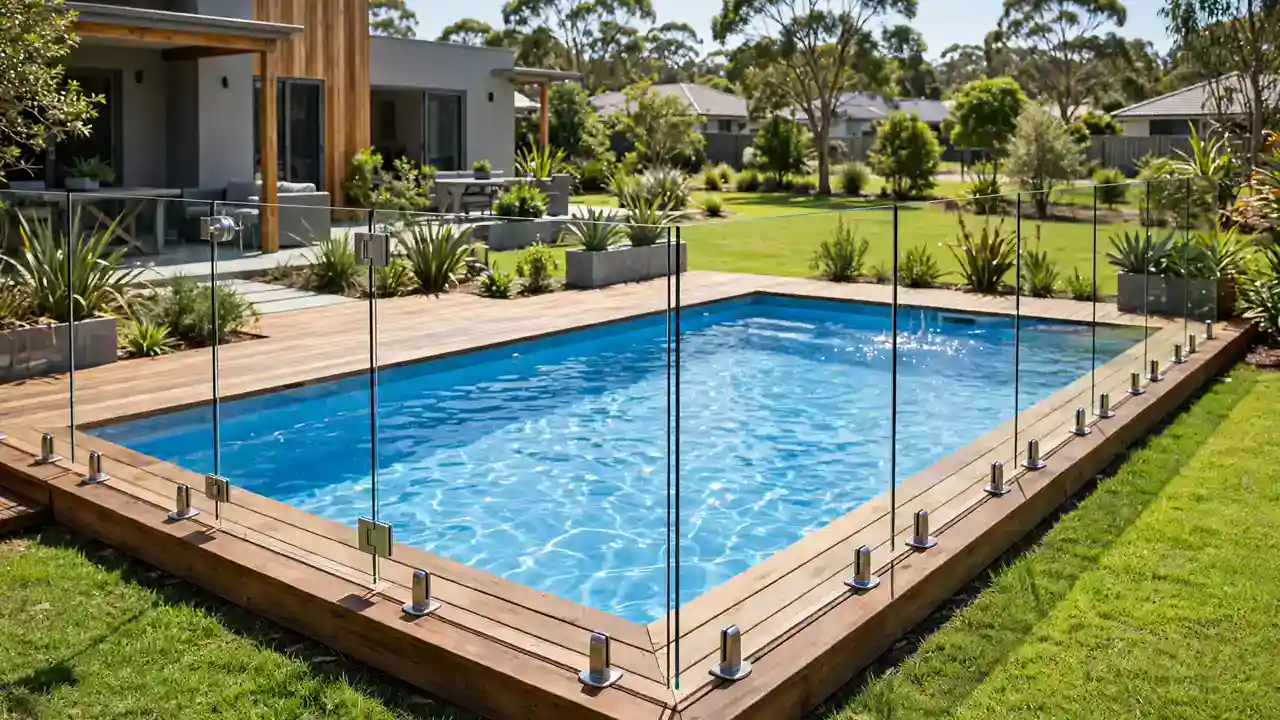
A pool fence is the one part of a backyard pool you cannot choose to skip. Every Australian pool needs a compliant safety barrier, and the pool fence cost australia homeowners pay in 2026 runs from around $100 per metre for aluminium to $600 per metre for frameless glass — before the gate and the inspection. This guide prices the whole job.
One thing to settle first: a pool fence is a legal instrument, not a landscaping choice. The barrier has to meet Australian Standard AS 1926.1, and an inspector has to sign it off in writing before the pool can legally be used.
pool fence cost australia: The 2026 Snapshot
A compliant fence installed by a professional costs $100–$600 per metre. Aluminium sits at the cheap end, frameless glass at the dear end, and the gate and certification add $400–$950 as fixed lines.
| Job type | 2026 price |
|---|---|
| Aluminium tubular, installed | $100–$250/m |
| Semi-frameless glass, installed | $200–$430/m |
| Frameless glass, installed | $275–$600/m |
| Timber slat, installed | $200–$350/m |
| Mesh / removable, material only | $20–$40/m |
| Self-closing gate, installed | $230–$600 |
| Certification / inspection | $150–$350 |
| Typical total job | $3,000–$7,000 |
That table is the short answer to pool fence cost australia in 2026. The rest of this guide explains why the range is so wide and where the hidden lines sit.
Why a Pool Fence Costs What It Does
A pool fence is priced like a safety product, not like a garden fence, because it is built to a standard and inspected against it. The barrier must be at least 1.2 metres high, with no gap bigger than 100 mm at the bottom or between bars. A 900 mm non-climbable zone has to be kept clear around it — no pot plants, barbecues or chairs a child could climb on. If a boundary fence forms part of the barrier, it has to be 1.8 metres high.
Those rules are what separate a $100-per-metre aluminium pool fence from a $100-per-metre garden fence: powder-coated panels, posts set to hold their height, and a gate that closes and latches itself every time. A fence that fails the measurements is a rebuild.
The other cost driver is the ground it stands on. A fence on flat concrete is a fast job; a fence on a slope or rock needs stepped panels, longer posts or core drilling. On a sloping block, price the retaining first: our guide to retaining wall cost in Australia works through what a slope does to a backyard budget.
Pool Fence Prices by Material
Aluminium tubular is the workhorse of Australian pool fencing and the cheapest compliant option. Installed prices run $100–$250 per metre, with a typical figure around $165–$185 — the range published by Queensland pool builders and the whatsthedamage city guides for 2026. Flat-top aluminium is the default: vertical pickets, powder-coated black or white, light and rust-proof.
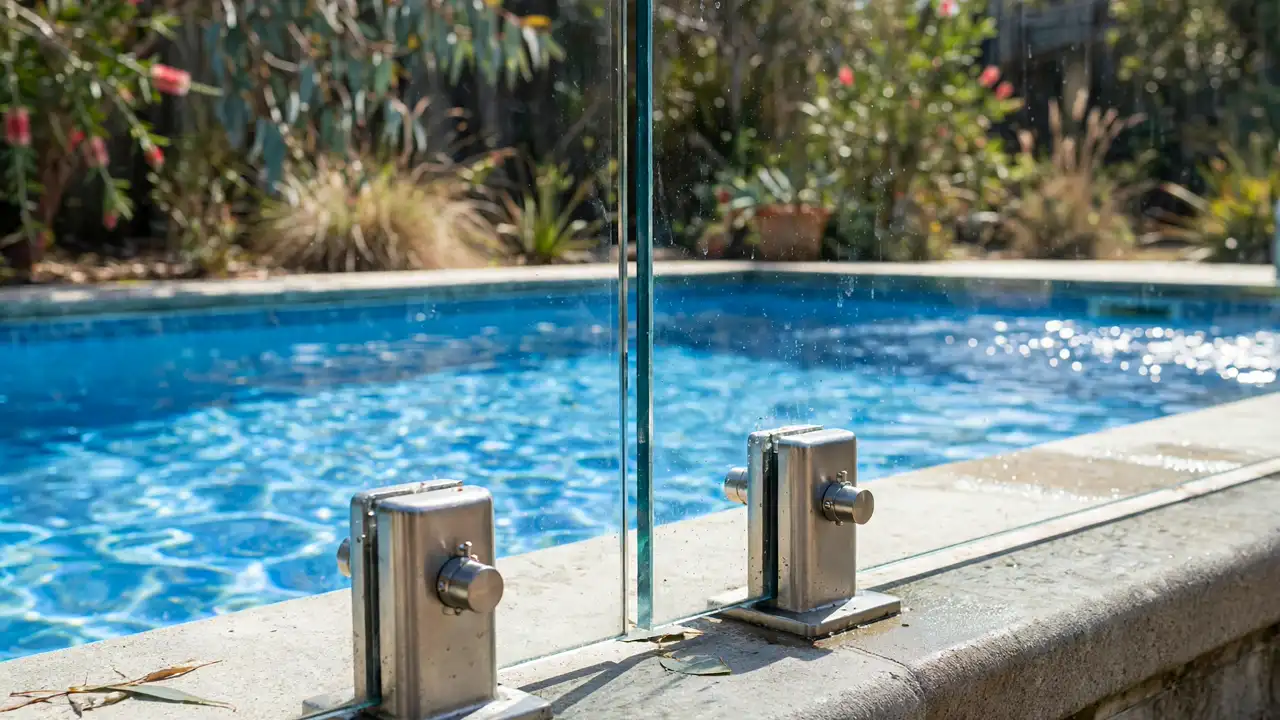
Glass is where the money goes. Semi-frameless glass — panels held by posts — costs $200–$430 per metre installed, with a typical figure around $300. Frameless glass — 12 mm toughened panels held by stainless spigots, no posts — costs $275–$600 per metre installed, with a typical figure around $430–$460. At the premium end, coastal jobs with marine-grade 316 stainless hardware reach $840–$900 per metre.
| Material | Installed cost | Typical |
|---|---|---|
| Aluminium tubular | $100–$250/m | $165–$185/m |
| Semi-frameless glass | $200–$430/m | $300/m |
| Frameless glass | $275–$600/m | $430–$460/m |
| Timber slat | $200–$350/m | $275/m |
| Mesh / removable | $20–$40/m material | $30/m |
Timber slat fencing sits in the middle at $200–$350 per metre installed, but it is the weakest choice around a pool: it needs regular sealing, and horizontal slats can be climbable if the spacing is wrong. Mesh fencing at $20–$40 per metre for the material is a temporary barrier, not a permanent fence. The honest summary is the one Queensland pool builders give: glass buys the view, metal buys compliance for the least money — and plenty of yards use both.
The Gate: The Small Line That Fails Inspections
The gate is the most inspected part of a pool fence and the part most often left off a quote. A compliant gate has to swing outwards, away from the pool, close by itself from any open position, and latch by itself. The latch has to sit at least 1.5 metres above the ground if it is on the outside of the gate, or be shielded from a small child. A gate that swings the wrong way, or one that needs a push to close, fails the inspection.
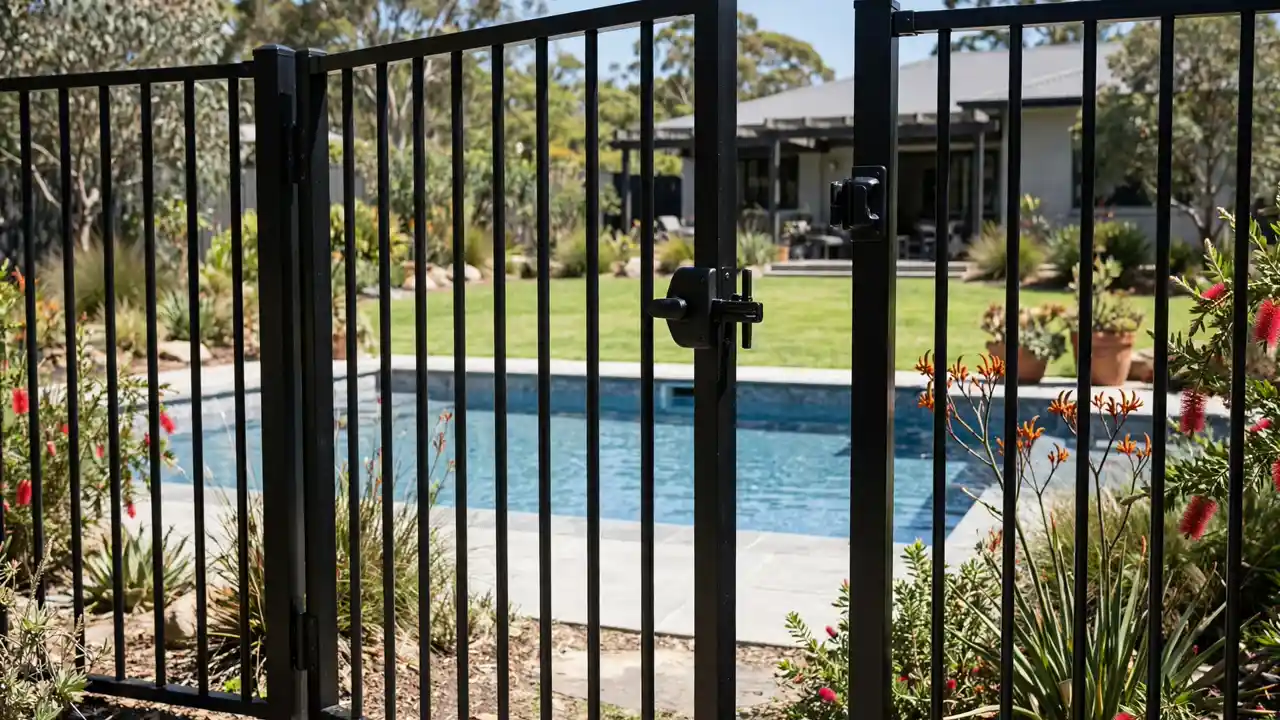
Budget $230–$600 installed for a standard self-closing, self-latching gate (Adelaide fencing guide, 2026). A frameless glass gate costs more — the panel is heavier and the hardware is marine-grade stainless. Real 2026 Airtasker jobs show the spread: a compliant pool gate built for $400 labour-only in Frankston, against a full 13-metre glass fence with gate for $4,000 in Point Cook. If your quote has no gate line at all, it is not a complete quote.
Certification and Council: The Lines Nobody Quotes
A pool fence is only compliant when an inspector says so in writing. Certification costs $150–$350, according to the 2026 pool-kit guides. In Queensland, only a QBCC-licensed pool safety inspector can issue the Form 23 pool safety certificate, and failing to register a pool can attract fines above $2,300. Victoria requires council registration and recurring inspection; in New South Wales a certificate of compliance lasts three years.
Read the rules for your own state before you book anything: the NSW Government’s pool owner obligations page sets out the measurements and the registration rules in plain language. Council approval and certification together run $800–$2,000 as a planning allowance for a new pool, according to the 2026 pool-kit guides — and none of it is optional.
Pool Fence Cost by Job: Three Worked Budgets
These budgets use the sourced 2026 ranges above, assuming flat ground and good access. Gate and certification are included in every one.
Small spa pool, 10 metres of fence. Aluminium tubular at $165 per metre comes to $1,650, plus a standard gate at $400 and certification at $250 — around $2,300 all in.
Standard family pool, 18 metres of fence. Aluminium at $185 per metre comes to $3,330, plus gate $450 and certification $250 — around $4,000 all in. The same 18 metres in frameless glass at $450 per metre comes to $8,100, plus glass gate $600 and certification $250 — around $8,950 all in.
Premium view pool, 20 metres of frameless glass. Frameless glass at $500 per metre comes to $10,000, plus a glass gate at $800, certification at $300 and roughly $500 for core-drilling into stone coping — around $11,600 all in. Price it alongside the pool itself — our guide to swimming pool cost in Australia prices the pool the fence protects.
Glass vs Aluminium: The Honest Comparison
The choice between glass and aluminium is a choice between a view and a price. Glass keeps the sightline from the house to the water. Aluminium is lighter, cheaper, faster to install and easier to repair: a bent picket is a $50 part, a chipped glass panel is a $300 panel plus a call-out.
| Factor | Aluminium tubular | Frameless glass |
|---|---|---|
| Installed cost | $100–$250/m | $275–$600/m |
| Typical total, 18 m | ~$4,000 | ~$8,950 |
| View from the house | Broken by pickets | Uninterrupted |
| Maintenance | Wipe the powder coat | Regular glass cleaning |
| Repairs | Cheap parts | Dear panels |
Glass needs cleaning to stay looking sharp — water spots show on every panel, and a dirty glass fence looks worse than a clean aluminium one. If the budget only stretches to one premium choice, spend it on the side of the pool you look at from the living room, and run aluminium everywhere else. And think about the ground the fence stands on: the surface around a pool gets wet every day, so check our guide to artificial grass cost in Australia before you choose a poolside surface that turns to mud in winter.
DIY Pool Fencing: What You Can and Cannot Do
You can buy the panels and put them up yourself — aluminium kits are sold at hardware stores, and a handy owner can install a straight run in a weekend. Doing it yourself changes the pool fence cost australia equation by roughly $30–$50 per metre, or $500–$900 on an 18-metre run. What you cannot do is certify your own work: a licensed inspector must still sign the barrier off, and a DIY fence that fails on a measurement costs you the inspection fee plus the rebuild. In Victoria, the barrier has to be built by a registered builder, or by an owner-builder holding a certificate of consent. The jobs that suit DIY are straight runs on flat concrete; slopes, curves and core-drilled spigots are installer work.
How to Read a Pool Fence Quote
A comparable pool fence quote has seven lines — miss one and you are comparing guesses, not quotes. The lines are: the barrier, named by material and height; the gate, with self-closing hinges and a magnetic latch named by brand; the posts and fixings, including core drilling; removal and disposal of the old fence; the certification fee; the council or registration fee; and the warranty.
Three checks separate a good quote from a cheap one. First, does it name the glass thickness? A quote that just says “glass fencing” could be 8 mm panels or 12 mm panels at very different prices. Second, does it include the gate and the certification, or will those appear as variations later? Third, is it supply-and-install or supply-only? Compare installed totals, not headline rates — that is the one rule that keeps pool fence cost australia comparisons honest.
pool fence cost australia: 7 Mistakes That Blow the Budget
1. Quoting the fence without the gate and certification. The gate is $230–$600 and the certificate is $150–$350 — together they are up to $950 of a job that looked like $3,000.
2. Choosing horizontal slats to save money. Horizontal bars under 900 mm apart create a climbable surface and fail the standard.
3. Putting the fence on a slope without pricing the ground. Stepped panels, longer posts and core drilling can add 20–30% to a per-metre rate.
4. Specifying 8 mm glass to hit a price. Thinner glass is cheaper per panel and weaker in service — most suppliers recommend 12 mm.
5. Forgetting the non-climbable zone. A pot plant, a barbecue or a garden chair within 900 mm of the fence is a failed inspection.
6. Using a boundary fence as the barrier without the height. A 1.2-metre boundary fence is not a pool barrier — where the boundary forms part of it, it has to be 1.8 metres.
7. Skipping the inspection until the pool is full. The pool cannot legally be used until the barrier is certified — book the inspector before the water goes in.
A pool fence is the cheapest part of owning a pool and the one that matters most. Priced properly — $100–$250 per metre for aluminium, $275–$600 for frameless glass, plus a gate and a certificate — it is a straightforward job with no surprises, as long as the quote includes all of it. Get the material right, keep the 900 mm zone clear, and compare installed totals.
How much does pool fencing cost per metre in Australia?
In 2026, pool fencing costs $100–$250 per metre installed for aluminium tubular, $200–$430 for semi-frameless glass, and $275–$600 for frameless glass. A typical total job runs $3,000–$7,000, plus $230–$600 for a self-closing gate and $150–$350 for certification.
Is glass or aluminium pool fencing cheaper?
Aluminium is much cheaper. Flat-top aluminium costs around $165–$185 per metre installed, while frameless glass costs around $430–$460 — roughly two and a half times more for the same legal protection. Glass buys the view; aluminium buys compliance for the least money.
Do I need council approval for a pool fence?
The fence itself usually needs no separate council approval, but the barrier must be inspected and certified as compliant with AS 1926.1, and the pool must be registered — with the council in Victoria, and on the state register in Queensland. Allow $150–$350 for certification, and $800–$2,000 for council approval and certification together on a new pool.
How much does a pool fence gate cost?
A standard self-closing, self-latching pool gate costs $230–$600 installed in 2026. A frameless glass gate costs more, because the panel is heavier and the hinges are marine-grade stainless. The gate must swing outwards, close by itself, and latch with the release at least 1.5 metres above the ground.
Can I install a pool fence myself?
Yes, you can install the panels yourself, but you cannot certify your own work — a licensed inspector must still sign the barrier off, and in Victoria the barrier must be built by a registered builder or an owner-builder with a certificate of consent. DIY saves roughly $30–$50 per metre, but a failed inspection costs the fee plus the rebuild.
How much does pool fence certification cost?
Pool fence certification costs $150–$350 in 2026, depending on the state and the inspector. In Queensland only a QBCC-licensed pool safety inspector can issue the Form 23 certificate, and in New South Wales a certificate of compliance lasts three years.