
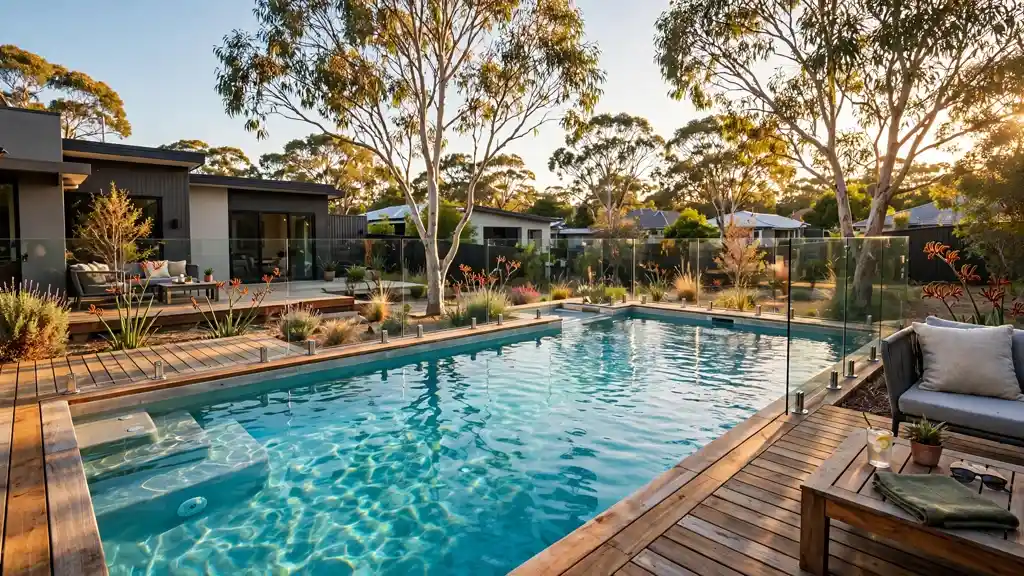
How much does a swimming pool cost in Australia in 2026? Most homeowners pay between $35,000 and $100,000 for a fully installed inground swimming pool — but that range hides a world of difference between a modest fibreglass shell dropped into an easy block and a custom concrete resort-style build with heating, glass fencing and landscaping. This guide breaks down swimming pool cost in Australia by pool type, then walks through the extras, running costs and quote traps that separate a realistic budget from a fantasy one.
One warning before we start: when a pool company advertises a pool for $15,000, they are almost always quoting the shell only — a fibreglass shell delivered to your property, nothing else. Excavation, crane hire, plumbing, electrical, filtration, coping, paving, fencing and council permits are all separate. Always compare total turnkey quotes, never shell prices.
Swimming Pool Cost in Australia at a Glance (2026)
Here is the quick answer. These are total installed costs — shell, excavation, filtration, plumbing, electrical, coping and standard pool fencing — based on 2026 Australian pricing guides. Heating, premium landscaping and water features are extra unless stated.
| Pool type | Typical size | Total installed cost (2026) |
|---|---|---|
| Above-ground (steel/resin frame) | 3–7 m round or oval | $2,000 – $12,000 |
| Plunge pool (inground) | 2.5 – 5 m | $15,000 – $60,000 |
| Vinyl liner (inground) | 6 – 12 m | $20,000 – $50,000 |
| Fibreglass (inground) | 5 – 12 m | $25,000 – $75,000 |
| Concrete (inground) | 6 – 15 m+ | $50,000 – $120,000+ |
| Concrete (custom / premium) | Any size | $100,000 – $250,000+ |
The sweet spot for Australian families is a fibreglass pool in the 7–9 m range, typically costing $40,000 to $60,000 fully installed. More than 3 million Aussies already have a backyard pool or spa, and the vast majority of new inground pools built each year are fibreglass or concrete.
Fibreglass Pool Cost Australia: $25,000 – $75,000
Fibreglass is the most popular inground choice in Australia — fast to install, smooth underfoot, and cheaper than concrete on almost every measure. For a standard family pool around 7–8 m with basic surrounds, expect $45,000 to $60,000 installed in 2026. Smaller 5–6 m shells on easy blocks can come in around $25,000–$35,000 turnkey, while large or high-spec fibreglass builds push toward $75,000.
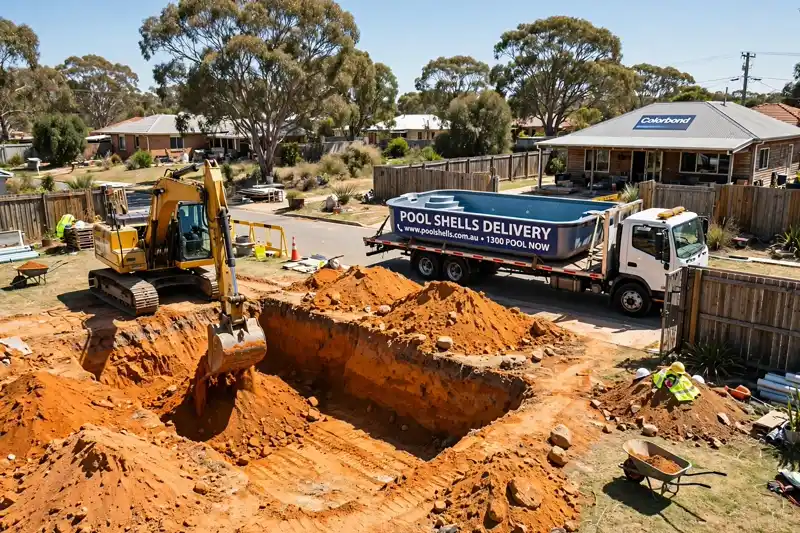
The reason fibreglass wins on price is simple: the shell is manufactured in a factory, delivered on a truck, craned into the hole and levelled. That wipes out weeks of on-site labour. A typical fibreglass install is swim-ready in 4–8 weeks, compared with 3–6 months for concrete. The non-porous gelcoat surface also means lower ongoing chemical and energy costs — bacteria and algae have nothing to grip onto, so the pump and filtration work less hard.
The trade-offs: you are choosing from a manufacturer’s catalogue of shapes and sizes (up to about 11–12 m), so if your block is an awkward shape or you want an infinity edge, wet deck or integrated spa, fibreglass may not fit. Factory colour choices are also fixed, though the range is far broader than it used to be.
Concrete Pool Cost Australia: $50,000 – $120,000+
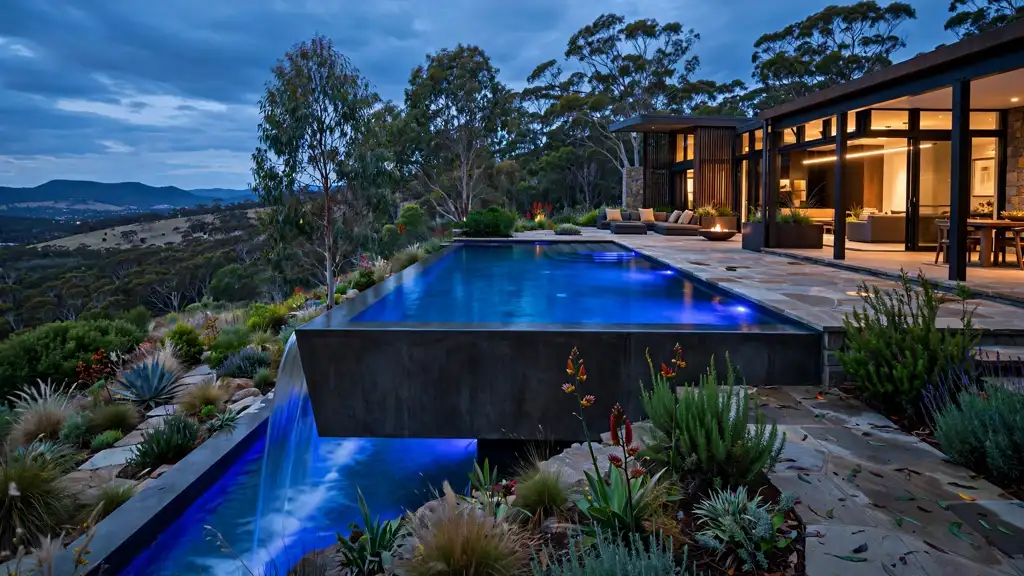
Concrete is the premium end of the market and the only option when the design is bespoke. A standard 7 m × 4 m inground concrete pool without heating or spa costs roughly $50,000–$65,000 in 2026, while a larger 9 m × 4 m pool with waterline tiling, a pebblecrete finish, heating and a robotic cleaner lands around $58,000–$78,000. Custom concrete builds with glass mosaic interiors, vanishing edges or architectural landscaping routinely pass $100,000–$250,000+, especially in Sydney and Melbourne where labour and site access costs are highest.
What are you paying for? Everything is built on site: steel reinforcement, formwork, shotcrete or poured concrete, curing, then the interior finish (tile, pebble or plaster). Each step is its own trade and day rate, and a 12–16 week build with inspections and site management simply costs more than a two-week fibreglass drop-in. Premium tiling alone can add $15,000–$35,000 over basic finishes.
The payoff is total design freedom: any shape, any depth, infinity edges, beach entries, swim-up bars, integrated spas — anything you can draw. A concrete shell also lasts 50+ years (versus 25–30 for fibreglass), though you will resurface it roughly every 15–25 years at $6,000–$15,000 a time. If you have the budget and the block demands custom work, concrete is the right call.
Vinyl Liner and Modular Pool Costs
Vinyl liner inground pools are the budget entry point to the inground world: $20,000–$50,000 installed. The upfront price is tempting, but the liner is a wear item — it typically needs replacing every 8–12 years at roughly $6,000–$7,000 a time, which erodes the saving over the pool’s life. Two or three liner replacements over 20 years can add $12,000–$21,000, making vinyl one of the more expensive options in lifetime terms.
Modular and kit pools sit in the middle: above-ground modular builds run up to $50,000 for permanent-look structures, while simple steel-frame kits start at a few thousand dollars. These suit renters, temporary setups, or families who want to test the pool lifestyle before committing to an inground build.
Above-Ground Pool Cost Australia: $2,000 – $12,000
The cheapest way into pool ownership is above ground. Basic steel-frame kits start around $2,000–$3,500, while better resin-frame models with sand filters and ladders run $5,000–$12,000. Installation is a weekend job rather than a construction project, and you skip excavation, council approvals (in most cases) and fencing complications.
The honest caveats: above-ground pools look temporary, add little to resale value, and still need the same chemical maintenance as any pool. They are a lifestyle purchase, not an investment. For small blocks or a trial run, though, they are hard to beat on value.
Plunge Pool Cost Australia: $15,000 – $60,000
Plunge pools — compact 2.5–5 m pools designed for cooling off rather than laps — have exploded in popularity on small Australian blocks. An inground fibreglass plunge pool typically costs $20,000–$60,000 installed, while simpler modular plunge setups start around $15,000.
They are the smart answer when a full-size pool won’t fit or the budget won’t stretch: same excavation, fencing and filtration requirements on a smaller scale, far lower water and heating bills, and they still deliver the backyard lifestyle. On a tight urban block, a well-designed plunge pool with good landscaping can look more considered than a cramped full-size pool. Many owners finish the pool surrounds with low-maintenance synthetic turf instead of real lawn — our artificial grass cost guide has the 2026 installed prices.
The Extras Nobody Puts in the Quote
This is where pool budgets blow out. The shell price gets you a hole with water in it; the project price is often 30–50% higher. Budget for these line items from day one:
- Pool fencing ($1,500 – $10,000+): childproof pool barriers are required by law in every Australian state. Basic aluminium fencing starts around $1,500–$3,000; frameless glass fencing — the look most people want — runs $5,000–$10,000+ depending on the perimeter.
- Council approvals and certification ($500 – $2,500): development approval or complying development, plus mandatory barrier inspections. Rules vary by state, so check with your local council early.
- Heating ($3,000 – $15,000): a heat pump extends your swim season by months in southern states. Solar heating is cheaper upfront but slower; gas is fast and expensive to run.
- Landscaping and surrounds ($5,000 – $30,000+): paving, decking, garden beds and screening turn a construction site into a backyard you actually want to sit in. See our landscaping cost guide for realistic 2026 figures — and if you are planning the full entertainer’s backyard, our outdoor kitchen cost guide pairs naturally with a pool project, as does a pergola over the entertaining area for shade.
- Soil and site surprises ($0 – $15,000+): hitting rock, a high water table or a natural spring during excavation can add thousands overnight. A soil test before you sign anything is the cheapest insurance in the whole project.
- Automation and extras ($1,000 – $8,000): salt chlorinators, robotic cleaners, LED lighting, pool covers and smart controls. A pool cover alone is worth it — it cuts evaporation, chemical use and heating bills.
The industry body, the Swimming Pool & Spa Association of Australia (SPASA), maintains a directory of licensed builders — always verify your builder’s credentials before anyone picks up a shovel.
What a Pool Really Costs to Run Every Year
The sticker price is one number; the number that actually counts is what the pool costs you over the years it sits in the backyard. As a rough guide for a mid-size family pool:
- Chemicals and consumables: $400 – $900 per year
- Electricity (pump and filtration): $300 – $800 per year — a variable-speed pump cuts this dramatically
- Water top-ups: $100 – $300 per year, less with a pool cover
- Professional servicing (optional): $65 – $165 per month if you outsource it
All up, budget $800–$2,000 a year for routine running costs, with concrete pools at the top end (more chemicals, more energy) and fibreglass at the bottom. Over 20 years, the maths is striking: a mid-size fibreglass pool costs roughly $55,000–$76,000 all-in, vinyl liner $47,000–$80,000, and concrete $105,000–$130,000+ once you include one resurface. The cheapest pool to buy is rarely the cheapest pool to own.
What Pushes Your Quote Up (or Down)
Two neighbours can get quotes $20,000 apart for the same pool. These are the levers:
- Site access: tight inner-city blocks need cranes, traffic control and hand-digging. A pool quoted at $45,000 in suburban Brisbane can cost $55,000+ in inner Sydney for the identical spec.
- Soil and slope: rock excavation, retaining walls and sloping blocks add serious money. Flat, sandy, easy-access blocks get the best prices.
- State and labour rates: Sydney and Melbourne sit 10–20% above Brisbane, Adelaide and Perth for equivalent builds.
- Finishes and features: glass mosaic tile, infinity edges, integrated spas and automation are where $60,000 quotes become $120,000 quotes.
- Builder margin and timing: get at least three itemised quotes, and ask what is explicitly excluded — the exclusions are where blowouts hide.
Is a Swimming Pool Worth the Money in Australia?
Financially, a pool is a lifestyle purchase first and an investment second. In the right suburb — family areas in warm climates where buyers expect a pool — a well-designed pool in proportion to the yard can add tens of thousands to your sale price. In cooler climates or on small blocks, you may not recover the build cost, and some buyers see a pool as a maintenance liability.
We have unpacked the full resale picture — which suburbs reward pools, when they hurt, and how to avoid overcapitalising — in our guide to whether a pool adds value to your home in Australia. Read it before you commit: the difference between a pool that pays and a pool that costs is almost entirely about matching the pool to the property and the buyer pool (pun intended).
Getting Pool Quotes That Don’t Blow Out
Three rules for the quoting stage:
- Demand itemised turnkey quotes. Every quote should list excavation, shell, plumbing, electrical, filtration, coping, paving, fencing, approvals and landscaping separately — with exclusions in writing. If a builder won’t itemise, walk away.
- Ask about the soil. Who pays if they hit rock? Get the soil test done before you sign, and make the contract clear on unforeseen ground conditions.
- Check the builder, not just the price. Use a licensed, insured builder — SPASA membership is a good signal — and talk to two recent clients. The cheapest quote is the most expensive one if the build goes wrong.
A pool is one of the biggest discretionary spends in Australian home renovation, and the gap between a $35,000 project and a $100,000 project is mostly decisions, not luck. Get the type right for your block, budget the extras honestly, and price the 20-year cost — not just the shell — before you sign.
Swimming Pool Cost FAQs
What is the cheapest inground pool to install in Australia?
A small fibreglass or modular plunge pool is usually the cheapest inground option, from around $15,000–$25,000 installed on an easy site. Vinyl liner pools can be cheaper upfront ($20,000+), but liner replacements every 8–12 years make them dearer over the pool’s life.
Is a fibreglass pool cheaper than a concrete pool?
Yes, on every measure. A mid-size fibreglass pool costs $45,000–$60,000 installed versus $75,000+ for concrete, installs in 4–8 weeks instead of 3–6 months, and costs roughly half as much to own over 20 years. Concrete wins on design freedom and lifespan (50+ years), not price.
How long does it take to install a swimming pool?
Fibreglass pools are typically swim-ready in 4–8 weeks from excavation. Concrete pools take 10–20 weeks (3–6 months) because everything is built and cured on site. Above-ground pools can be up in a weekend. Council approvals can add weeks on top, so start that process early.
Do I need council approval for a pool in Australia?
Yes, in almost all cases. Inground pools need development approval or a complying development certificate from your local council, and pool fencing must be inspected and certified as compliant with barrier standards. Budget $500–$2,500 for approvals and certification; rules vary by state.
How much does pool fencing cost in Australia?
Basic aluminium pool fencing costs $1,500–$3,000 for a standard perimeter; frameless glass fencing runs $5,000–$10,000+. Fencing is legally required — a pool cannot be filled until the barrier is certified compliant.
How much does it cost to run a pool each year in Australia?
Budget $800–$2,000 per year for chemicals, electricity, water and basic maintenance. Fibreglass pools sit at the low end, concrete at the high end. A pool cover and variable-speed pump are the two best investments for cutting running costs.