
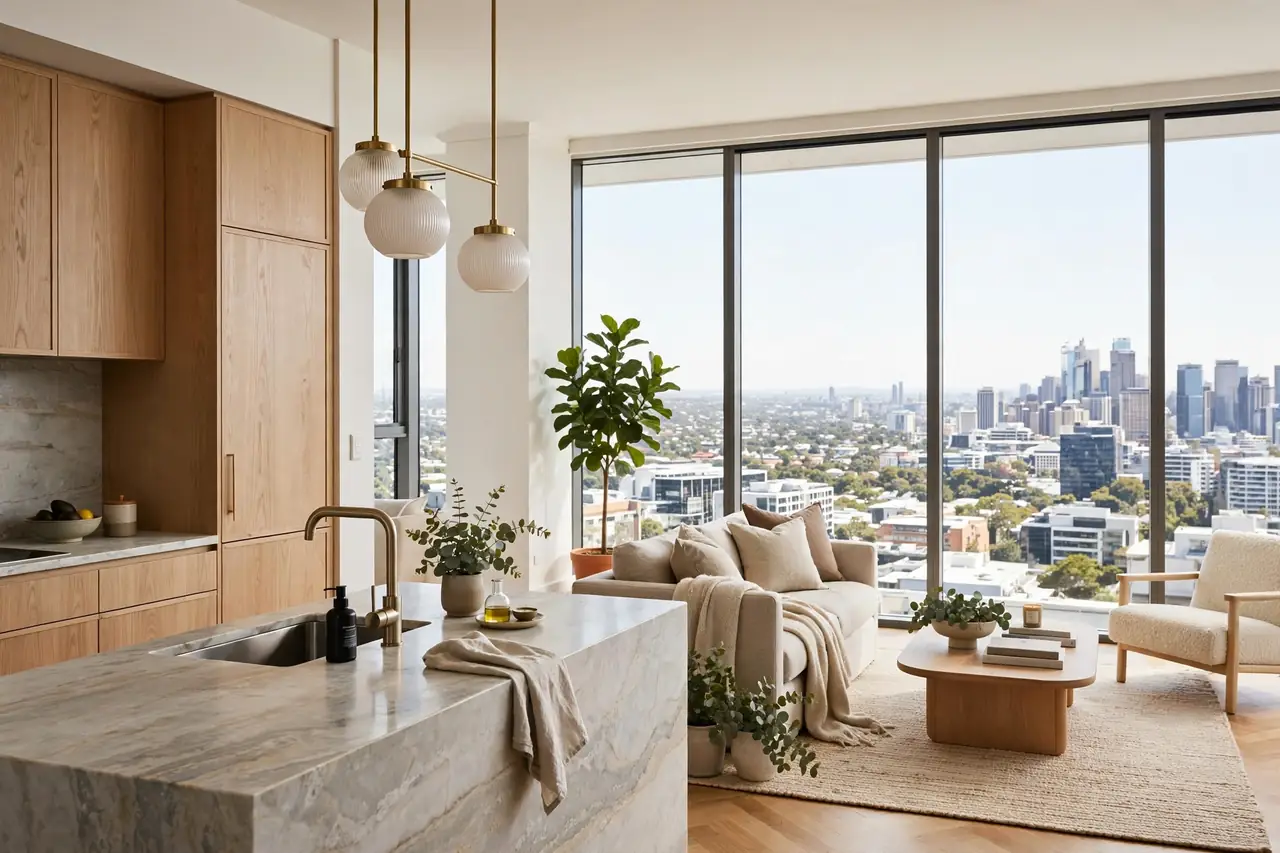
How much does an apartment renovation cost in Australia in 2026? For a full unit renovation, most Australians pay between $50,000 and $180,000 depending on the size of the apartment, the city, and how far the work goes — but the figure almost nobody budgets for is the strata bill. Before a single tile is laid, your owners corporation can charge application fees, by-law drafting costs and a refundable bond, and major works like bathroom waterproofing can take 6–12 weeks just to approve. This guide breaks down apartment renovation cost in Australia room by room, prices the strata process as a proper line item, and shows where to spend — and where to save — in 70–110 square metres.
A quick note on language: in NSW and Queensland real-estate speak, most people say unit; in design and interiors, apartment is the formal term. This guide uses both, because the costs are the same whichever word your suburb prefers.
Apartment Renovation Cost in Australia at a Glance (2026)
Here is the short answer, based on 2025–2026 Australian pricing guides from builders, the HIA and cost aggregators. These are installed, turnkey ranges — trades, materials and GST — for apartments and units (not freestanding houses, which run higher).
| Project | Typical cost (2026) | Notes |
|---|---|---|
| Kitchen renovation (mid-range) | $25,000 – $45,000 | HIA 2025 national median: $30,000–$35,000 |
| Bathroom renovation (standard) | $15,000 – $35,000 | $2,300–$4,600 per m²; HIA 2025 average: $26,747 |
| Full unit reno — basic | $50,000 – $70,000 | Cosmetic refresh: paint, floors, kitchen facelift |
| Full unit reno — mid-range | $70,000 – $100,000 | New kitchen + bathroom, flooring throughout |
| Full unit reno — high-end | $100,000 – $150,000+ | Premium finishes, layout changes, stone benchtops |
| Whole 1-bed / 2-bed / 3-bed (Sydney) | $85,000 / $110,000 / $140,000 | Starting prices from a Sydney apartment renovator |
| Strata approval (all-in) | $1,000 – $8,000+ | Application, by-law drafting, bond — see below |
Sydney sits at the top of every range: one Sydney builder quotes $60,000–$180,000 for a full apartment or unit renovation, while a Gold Coast builder’s tiers top out around $150,000+. The rest of this guide explains why the ranges are so wide — and the strata mechanics are the biggest reason of all.
The Strata Bill Nobody Budgets For: Approval Costs and Timelines
Renovating a freestanding house means dealing with council. Renovating an apartment means dealing with your owners corporation first — and in NSW, the Strata Schemes Management Act 2015 sorts renovations into three tiers that decide everything about cost and timing.
Cosmetic work needs no approval: internal painting, new carpet, hooks and nails, handrails, built-in wardrobes. Minor renovations — a kitchen refit that doesn’t move plumbing, new flooring, reconfiguring non-structural walls — need a general resolution at a general meeting, typically a 2–4 week process. Major works change waterproofing, the building’s structure or common property: bathroom renovations (waterproofing touches common property), moving a kitchen sink or cooktop, removing any structural wall. Major works need a special resolution and a registered by-law that makes you responsible for the ongoing maintenance of the work.
Here is what the approval itself costs in 2026, based on current NSW strata forms and practitioner guidance:
| Approval line item | Typical cost |
|---|---|
| Renovation application fee | ~$75 |
| By-law drafting (solicitor) | $800 – $2,500 |
| By-law registration (NSW Land Registry) | ~$550 |
| Strata manager processing fee | $150 – $500 |
| Building / structural engineer report | $1,500 – $4,000 |
| Common-property bond (refundable) | $1,000 – $5,000 |
| Council DA (if triggered) | $500 – $3,000+ |
All up, a major-works approval can add $2,000–$8,000+ before construction starts — and 6–12+ weeks of waiting if the next general meeting is months away. One Sydney apartment renovator puts it bluntly: the approval tier, not the finishes, is what sets the price of renovating an older Sydney unit. Budget the approval as its own line item, and start the paperwork before you sign a building contract. The NSW Government’s strata hub is the authoritative starting point for the rules in NSW; other states have their own strata legislation with similar tiers.
Bathrooms deserve special attention here: because re-waterproofing affects common property, a bathroom renovation is almost always classified as major work. If your plans include the bathroom, read our bathroom waterproofing cost guide alongside this one — it covers the AS 3740 rules your waterproofer must follow and the mistakes that fail inspections.
Room-by-Room Apartment Renovation Costs
Kitchen: $25,000 – $45,000 mid-range
The kitchen is where apartment money goes first, and the numbers are well documented. Hipages puts a mid-range kitchen renovation at $25,000–$45,000; the HIA’s 2025 Kitchens & Bathrooms Report puts the national median at $30,000–$35,000. In apartments specifically, keep the sink, cooktop and plumbing where they are and you stay in minor-works territory — move them, and you trigger major works, a by-law and thousands in extra cost for very little design gain. Flat-pack versus custom cabinetry is the other big lever: our kitchen renovation cost per square metre guide breaks down exactly what drives the per-m² rate.
Bathroom: $15,000 – $35,000 standard
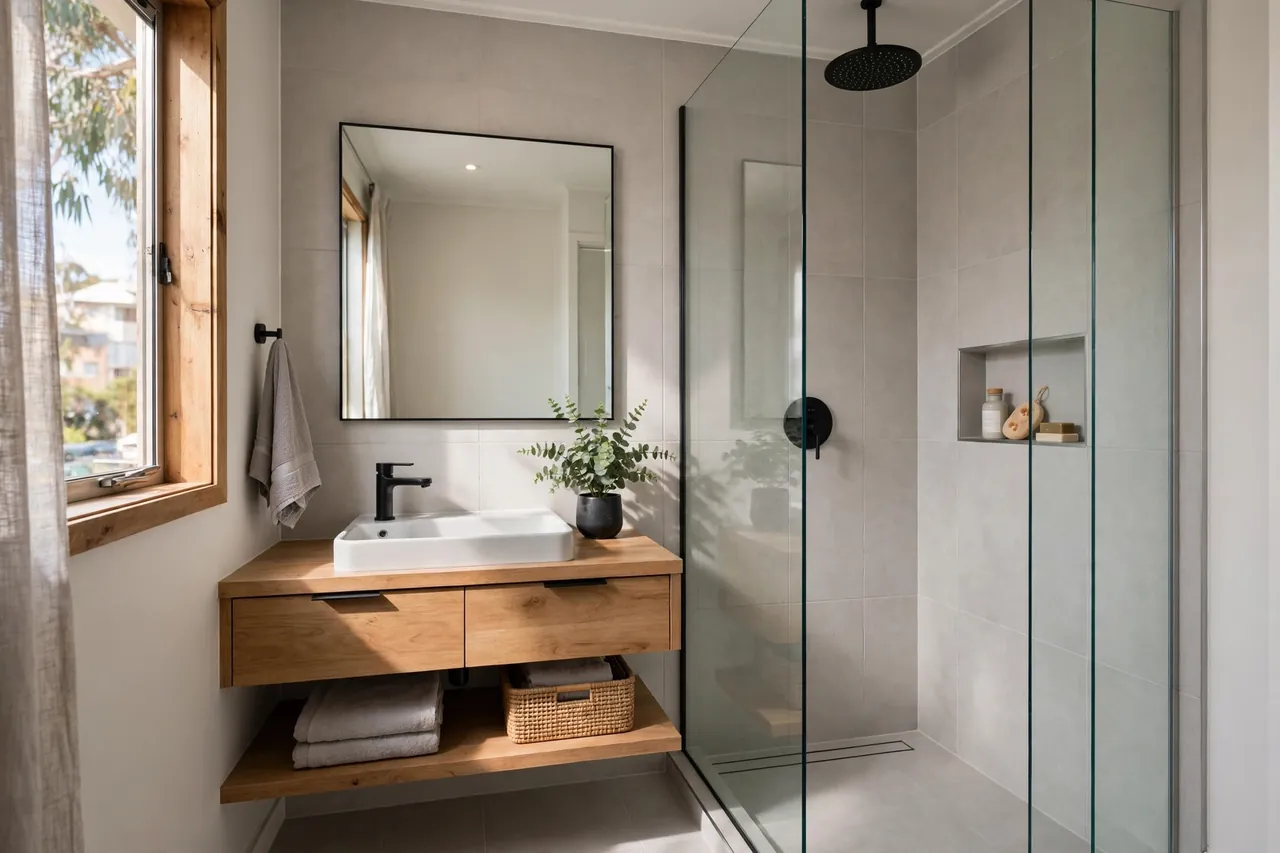
A standard apartment bathroom renovation lands between $15,000 and $35,000 (hipages), or roughly $2,300–$4,600 per square metre — small rooms, dense trades. The HIA’s 2025 average is $26,747. Budget bathrooms ($8,000–$15,000) keep the layout and refresh surfaces; premium apartment bathrooms ($35,000–$60,000+) add stone, wall-hung fixtures and custom joinery. Remember the strata rule: waterproofing makes this major work, so add the approval costs and timeline from the section above.
Whole-unit renovations by size
For a complete renovation — kitchen, bathroom, flooring, paint, lighting throughout — Sydney apartment renovator Fine Touch Group quotes starting prices of $85,000 for a 1-bedder, $110,000 for a 2-bedder and $140,000 for a 3-bedder (August 2026). A Gold Coast builder’s tiers are similar in structure: $50,000–$70,000 basic, $70,000–$100,000 mid-range, $100,000–$150,000+ high-end. A basic tier is a cosmetic refresh — paint, hybrid flooring over existing tiles, kitchen facelift with new doors and benchtop. Mid-range replaces the kitchen and bathroom properly. High-end means layout changes, stone, custom joinery and premium appliances.
Floors, paint and the finishing 20%
Don’t forget the costs that aren’t rooms: repainting a 2-bed unit runs a few thousand dollars; flooring throughout adds $8,000–$20,000 depending on material; lighting, window furnishings and door hardware quietly absorb another $5,000–$15,000. And keep a contingency: national renovation statistics show more than 60% of renovators overspend by 20–30%, and apartments — with strata surprises and concrete-slab constraints — are no exception. Hold 15–20% back.
What It Costs by City
Apartment renovation costs follow the same city ladder as house renovations. Current 2026 guidance from an architecture practice’s cost tables puts mid-range kitchens at $35,000–$60,000 in Sydney, $30,000–$50,000 in Melbourne, $28,000–$45,000 in Brisbane and Perth, and $25,000–$40,000 in Adelaide — and whole-unit renovations track the same roughly 30–40% Sydney premium. Labour rates, crane and site-access costs in dense CBD towers, and the sheer volume of major-works applications clogging Sydney strata managers all push the harbour city to the top. If you’re budgeting in Brisbane, Perth or Adelaide, take Sydney-published figures and shave 15–25% as a starting estimate — then get three itemised local quotes.
Small-Space Design: Where to Spend and Where to Save
Apartments punish bad layout decisions more than houses do — there’s nowhere for a mistake to hide. The design logic that protects your budget in 70–110m²:
Keep wet areas where they are. Moving a kitchen sink or bathroom plumbing in a concrete-slab apartment means core drilling, strata major-works approval and $5,000–$15,000 in plumbing and approval costs for a layout gain you’ll barely notice. Spend that money on the benchtop and tapware instead.
Spend on storage and light. Floor-to-ceiling joinery, a proper linen press and layered lighting (downlights + pendants + lamps) make small apartments feel twice their size. These are also the upgrades valuers and buyers actually notice.
Save on stone-look surfaces. Premium porcelain that mimics marble costs a fraction of the real thing, weighs less (your strata will thank you) and survives apartment life better. Save natural stone for one hero moment — the island benchtop — if at all.
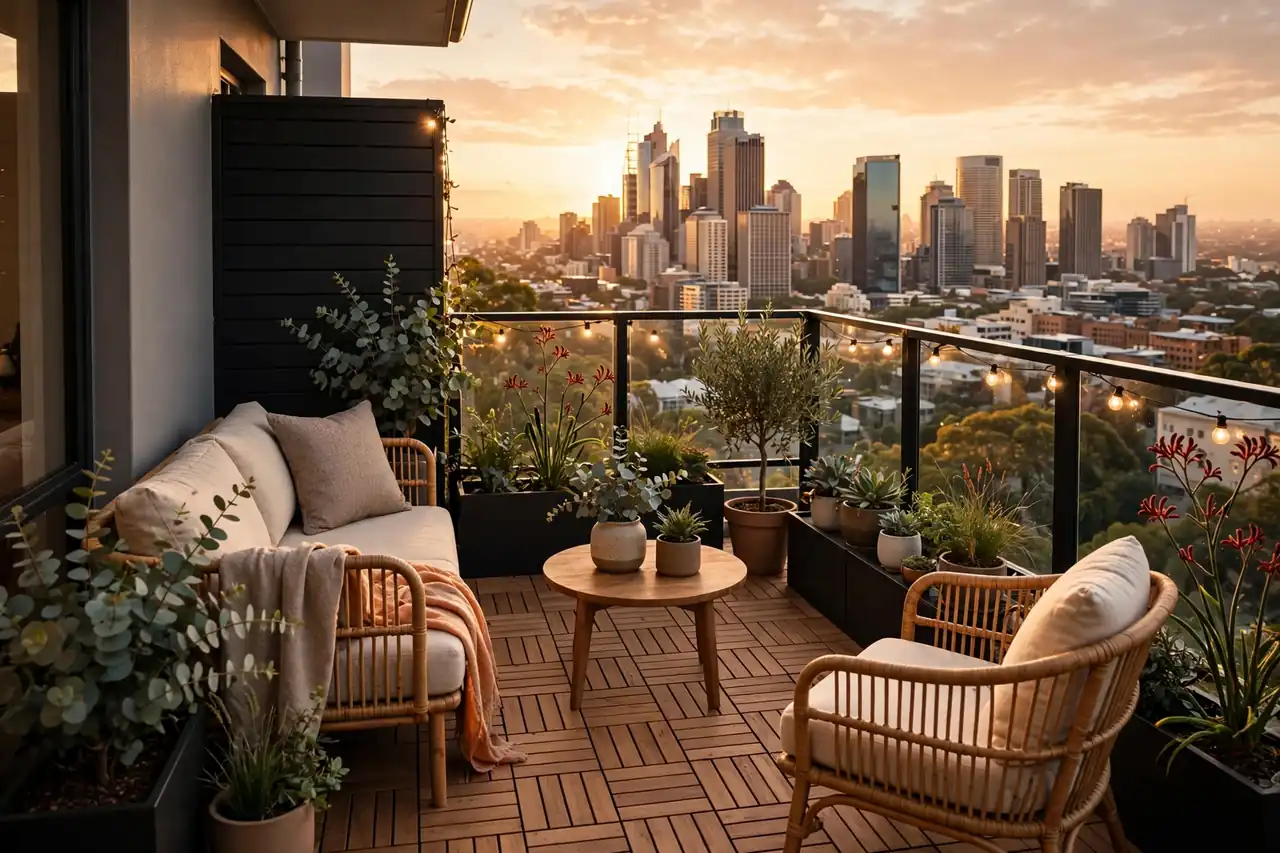
Claim the balcony. In a 90m² apartment, a 12m² balcony is 13% of your home. Weatherproof outdoor furniture, screening plants and proper lighting turn it into a genuine second living room for a few thousand dollars — our balcony design ideas for apartments show how far a small outdoor space can stretch.
The Overcapitalisation Rule: Don’t Spend More Than Your Unit Is Worth
Apartments have a value ceiling set by the building and the suburb — unlike houses, you can’t out-renovate the land value because there isn’t any. The rule Australian designers quote is to keep total renovation spend to 10–20% of the property’s value. On a $750,000 two-bedroom unit, that means capping the renovation at $75,000–$150,000 all-in, including the strata approval costs.
This is the maths that kills most apartment renovation dreams: a $140,000 high-end renovation on a $650,000 unit ($21.5%) will rarely return its cost at sale, because the buyer pool compares your unit against the unrenovated one two floors down. Renovate to the building’s standard, not above it — if every kitchen in the complex is laminate, stone benchtops won’t pay you back. Spend where the photos live (kitchen, bathroom, floors) and stop where the valuer stops caring.
The Logistics Bill: Working Hours, Lifts and Rubbish
Here’s the cost line no online calculator includes: your building’s rules. Most strata schemes restrict noisy work to weekday hours — commonly 7am–5pm or 8am–4pm, no weekends — which stretches the program and the labour bill. High-rises add lift bookings (often with a bond against damage), goods-lift scheduling windows, and waste removal: you can’t just skip-bin a 20th-floor bathroom, so demolition waste goes down in the lift, in booked slots, at extra cost.
Ask your building manager for the renovation pack before you get quotes, and send it to every builder quoting. A quote that assumes free all-day site access in a building that allows four noisy hours a day is a fantasy — the real program, and the real price, will be 20–30% longer. Good apartment renovators price this in; cheap ones discover it in week three and hand you a variation.
Apartment Renovation FAQs
How much does it cost to renovate an apartment in Australia?
A full apartment or unit renovation typically costs $50,000–$150,000+ in 2026, with Sydney ranging $60,000–$180,000. Room by room: a mid-range kitchen $25,000–$45,000, a standard bathroom $15,000–$35,000. Add $1,000–$8,000+ for strata approval costs on major works, plus a 15–20% contingency.
Do I need strata approval to renovate my kitchen or bathroom?
Almost always, yes — the question is which tier. A kitchen refit that keeps plumbing in place is usually minor work (general resolution, 2–4 weeks). A bathroom renovation is major work because waterproofing affects common property: it needs a special resolution and a registered by-law, taking 6–12+ weeks. Cosmetic work like painting needs no approval.
How much does strata approval cost?
Budget around $75 for the application, $800–$2,500 for by-law drafting, ~$550 for by-law registration, $150–$500 in strata manager fees, and a $1,000–$5,000 refundable common-property bond. If structural changes are involved, add $1,500–$4,000 for an engineer’s report.
How long does strata approval take?
Minor works: 2–4 weeks. Major works: 6–12+ weeks, because they need a special resolution passed at a general meeting — if the next meeting is four months away, the approval can outlast the build itself. Start paperwork before signing a building contract.
Can you knock down walls in an apartment?
Non-structural partition walls: usually yes, as minor or major work depending on the by-laws. Structural walls, columns and anything affecting waterproofing or common property: only with major-works approval, a special resolution, a registered by-law and engineer sign-off — and some buildings prohibit it outright. Never assume; check the strata plan first.
How do I avoid overcapitalising on a unit renovation?
Cap total spend — renovation plus strata approval costs — at 10–20% of the unit’s value, renovate to the building’s standard rather than above it, and put the money where sale photos live: kitchen, bathroom and floors. If the numbers don’t fit the rule, scale the scope, not the budget.