
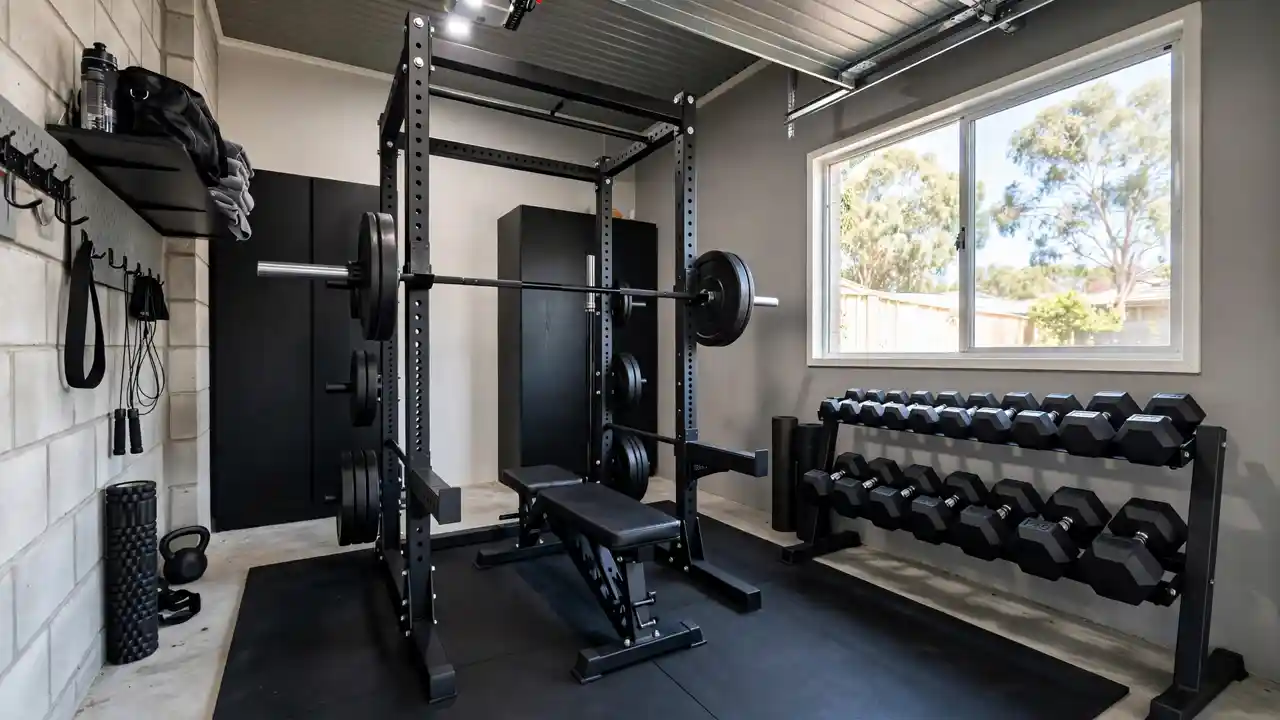
Overall, a home gym that gets used three times a week is not the one with the most gear. It is the one where the floor is right, the air moves, and the gear you use is within reach. The best home gym design ideas Australia has to offer in 2026 start from the room, not the catalogue. First, measure the space, mat the lift zone and sort the ventilation. Only then buy equipment. This guide covers garage, spare-room and outdoor layouts, the flooring maths and the 2026 costs from Australian gym suppliers.
Home Gym Design Ideas Australia in 2026: The Short Answer
Overall, for most Australian homes, the winning home gym is a single garage bay. Similarly, a spare room of 12 to 15 square metres works too. It needs rubber matting over the lift zone, a rack, a bench, dumbbells and a cardio option. For example, budget $500 to $1,000 for a starter corner. Allow $2,400 to $3,500 for a proper single-bay garage gym. A full garage fit-out runs $6,000 to $10,000. First, fix the floor and the air before buying equipment.
Pick the Room First: Garage, Spare Room or Outdoors
In fact, the garage is the best home gym spot in most Australian houses. It is separate from the living space and concrete-floored, with room to train beside a parked car. Alternatively, a spare room works too. Check the floor first, though: timber flexes under a loaded barbell. A dropped weight can crack tiles a concrete slab would shrug off.
Whatever room you pick, measure it twice. First, you need a clear 2 by 2 metre lift zone. Second, the ceiling must clear an overhead press at full extension. Third, the door must fit a rack. A standard rack needs about 2.1 metres. Under 2.4 metres, buy a folding wall-mounted rack.
Space Planning: The 2 by 2 Metre Rule
First, plan the gym around one square: the 2 by 2 metre lift zone. That square holds the rack, the bench and the plates. In short, only that square needs heavy floor protection. Everything else — the cardio corner, stretch area and storage wall — can sit on lighter flooring or bare concrete. Full-room rubber runs to about $1,300 for a single bay. By contrast, matting just the lift zone usually costs $300 to $500.
First, lay the room out in the order you train. Then put the rack and bench against the longest wall, plates on the rack, and dumbbells on a low rack. Place cardio in the corner with the best airflow. Leave a clear path from the door to the rack, and a metre behind the bench for spotting. Home gym design ideas Australia wide that ignore this square end up with gear spread across the room. As a result, the floor is protected in the wrong places.
Flooring: Rubber Where Weights Land, Foam Everywhere Else
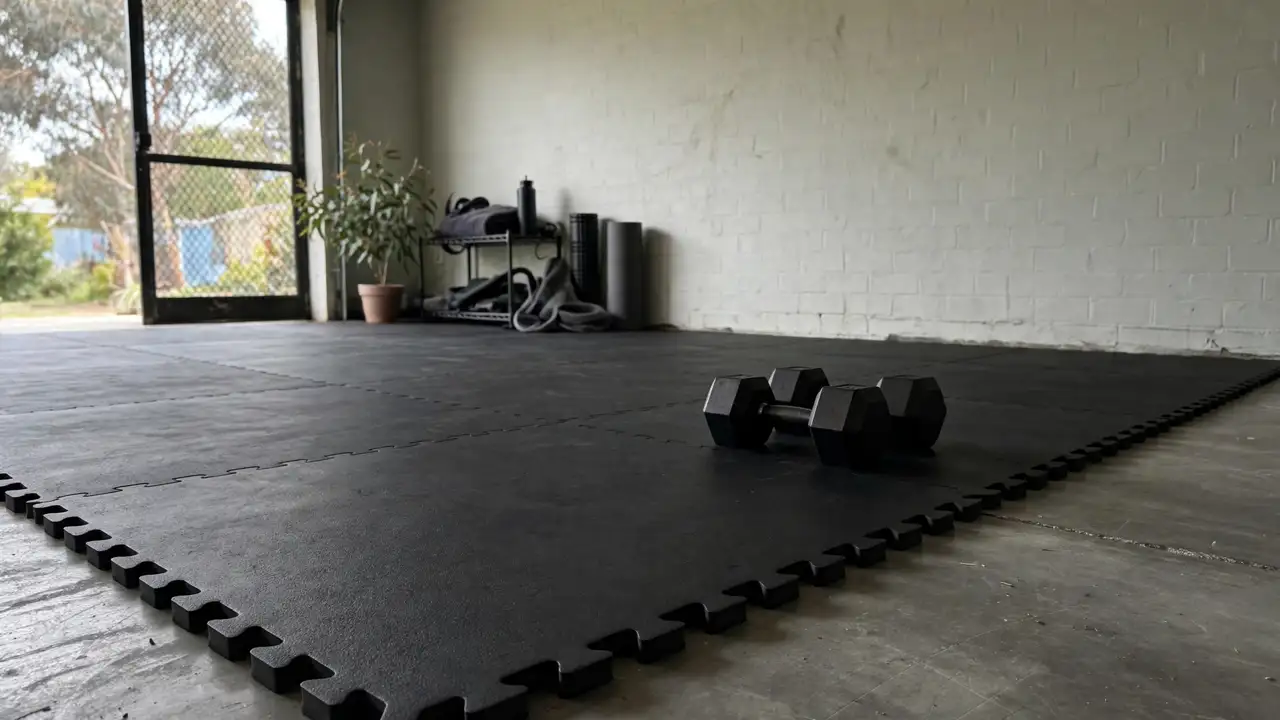
Overall, home gym flooring comes down to rubber mats, foam tiles, rubber rolls, stall mats, and doing nothing. For about nine in ten Australian home gyms, dense rubber is the right answer where weights land. Use cheaper foam tiles everywhere else.
Specifically, the numbers make the case. For example, recycled rubber mats of 15 to 20 millimetres run about $80 to $90 per square metre. They handle dropped weights, garage heat and moisture coming up through the slab. By contrast, EVA foam tiles run about $45 per square metre. However, they soften in heat and compress under anything heavier than a 10-kilogram dumbbell. Similarly, roll-out rubber runs $40 to $70 per square metre plus freight. A 100-kilogram roll is hard to handle and hard to move if you rent. For a typical garage corner, one or two 1 by 1 metre rubber mats under the weights will do. Then add foam tiles for cardio and stretching. Our epoxy garage floor cost guide covers the sealed-concrete option underneath. Our polished concrete floor guide prices the other common garage base.
Mirrors, Walls and Storage
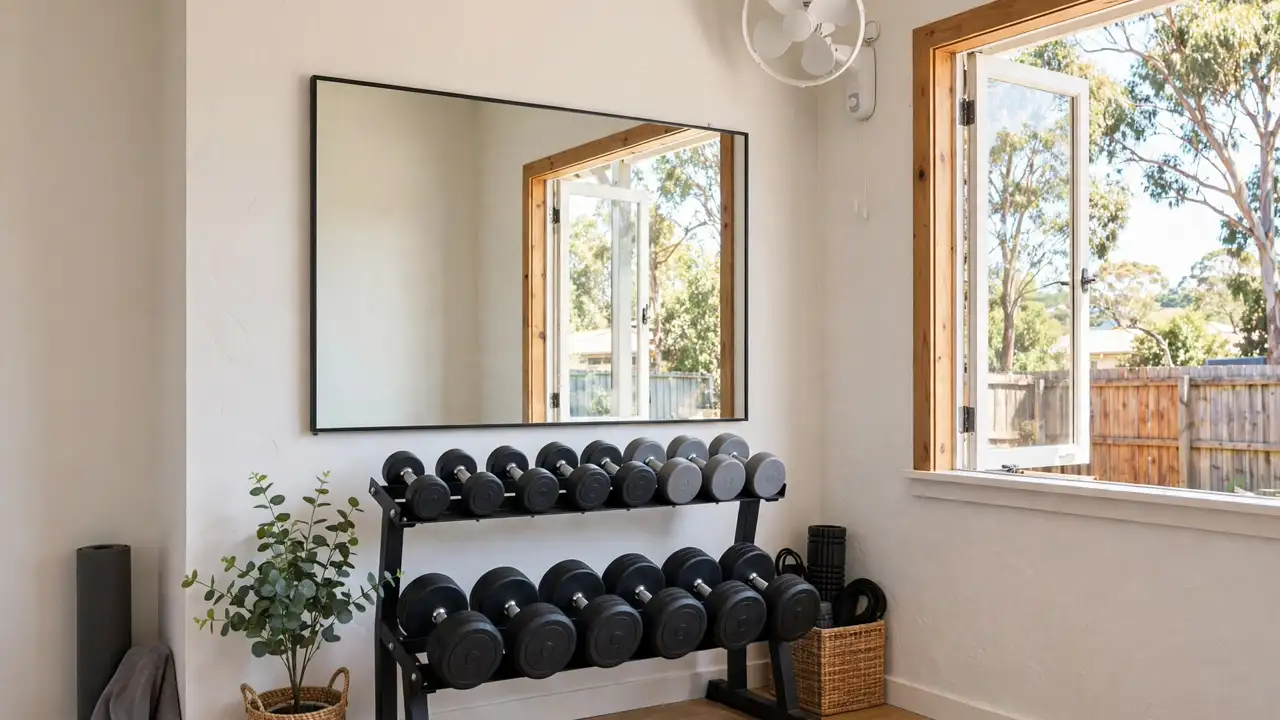
In fact, a mirror is a training tool, not decoration. It lets you check your form on every rep. First, mount one large frameless mirror on the wall facing the lift zone. Make it at least 1.8 metres wide, fixed to the studs, never glued to plasterboard. Keep the mirror out of the bar path. A barbell swung into a mirror ends the session and the mirror.
Storage keeps a small gym usable. Add plate pegs, a dumbbell rack, hooks for bands and ropes, and a shelf for towels and chalk. In fact, a wall fan beats a pedestal fan every time in a garage gym. It moves air across the lift zone without taking floor space, and it never gets knocked over.
Ventilation: The Part Most Home Gyms Forget
An uninsulated garage in Perth, Adelaide or western Sydney can sit above 40 degrees on a summer afternoon. Rubber gear handles that heat far better than bare steel. Even so, you still need air moving. YourHome warns that an airtight house with inadequate ventilation can lead to condensation and mould. Carbon dioxide above 1,000 to 2,000 parts per million brings drowsiness and poor concentration. In fact, home gym design ideas Australia wide that ignore ventilation fail by February, whatever the equipment cost. A gym needs fresh air in and stale air out, not a fan stirring the same hot air around.
The fix is layered. First, fit openable windows on opposite walls for cross-ventilation. Next, add an exhaust fan vented outside for humidity. Finally, fit a wall fan across the lift zone. In a sealed spare room, budget a small split-system air conditioner. It is the only option that actually lowers the temperature. The YourHome ventilation guide explains the difference between natural and mechanical ventilation. It shows why airtightness without ventilation causes condensation and mould.
Equipment: Buy in Order, Not All at Once
Overall, the equipment list for a home gym is short. However, the order matters more than the brands. First the rack: folding for a small room, full for a garage bay. For example, Australian retail puts a quality folding rack at $899 to $1,499. A 6-in-1 rack with Smith and cable costs $1,149 on sale. Second, an adjustable bench, not a flat one. Third, bar and plates. A 130-kilogram Olympic set bundled with a rack and bench runs about $1,940 on sale.
Fourth the dumbbells. In contrast, adjustable dumbbells beat a full fixed set in a small room. One pair replaces a rack of pairs. Australian retail puts fixed pairs at $65 to $399 each, depending on weight. Fifth, cardio: a skipping rope first, then a fan bike or rower. Buy the rack first, train for a month, then buy the next item based on what you miss.
What a Home Gym Costs in 2026
Overall, home gym prices look scattered. In fact, the sources are pricing different things: equipment-only tiers, curated packages, and flooring-only guides. Reconciled, they tell a consistent story. For example, Gym Plus puts a small set-up at $1,000 to $2,000. A medium set-up runs $3,000 to $5,000. A full-scale garage gym costs $6,000 to $10,000 or more. In contrast, Flex puts budget set-ups under $500. Mid-range runs $500 to $2,500. Premium starts at $2,500, equipment only. PeterMat’s flooring-only maths puts a mixed rubber-and-foam floor for a single bay at $300 to $500. That compares with about $1,300 for full-room rubber.
Why the gap? In short, Gym Plus prices curated packages with flooring and storage included. Flex prices equipment alone. The $12,429 REP bundle is a premium import package. In addition, freight to Perth and regional areas adds hundreds.
| Set-up | Typical range, 2026 | What it covers |
|---|---|---|
| Starter corner | $500–$1,000 | Mats, dumbbells, bands, pull-up bar |
| Single-bay garage gym | $2,400–$3,500 | Rack + bar + plates + bench, mixed flooring |
| Full garage fit-out | $6,000–$10,000 | Full rack, cable, dumbbells, cardio, flooring, storage |
| Premium import bundle | $12,000+ | Top-tier rack, adjustable dumbbells, air bike, bench |
Budget the electrician for extra power points and the freight on rubber rolls before the first purchase.
Home Gym Design Ideas Australia: 3 Worked Budgets
Three budgets built only from the sourced prices above.
Budget 1 — starter corner, $450–$900. For example, two dense rubber mats over the lift zone, a pair of adjustable dumbbells and resistance bands. Add a pull-up bar and a foam roller. This matches Flex’s under-$500 tier and Gym Plus’s small set-up, with room for a bench next.
Budget 2 — single-bay garage gym, $2,400–$3,500. For example, a folding power rack with a 130-kilogram Olympic set and bench at $1,940 on sale. Mixed rubber-and-foam flooring at $300 to $500. Allow $150 to $1,000 for a mirror, a wall fan and storage.
Budget 3 — full garage fit-out, $6,000–$10,000. Gym Plus’s full-scale garage gym tier covers a full rack, cable system, bumper plates and benches. Add dumbbells and conditioning equipment, with full flooring and storage. Cross-checked against Flex’s premium tier and the $12,429 REP import bundle.
Home Gym Mistakes That Cost Real Money
The most expensive mistake is buying a full fixed dumbbell set before knowing which weights you use. A 5 to 40 kilogram set costs $3,000 to $6,000 and fills a wall. The second is flooring the whole room in foam tiles, which compress under heavy weights and soften in garage heat. The third is no ventilation plan: a gym with no fresh air is a room you will avoid by February.
First, check the slab before the rack goes in. In fact, hairline cracks are normal. However, a rocking or ponding slab is not a gym floor until fixed. Check the ceiling height, the power points and the door width for the rack. Buy secondhand with your eyes open. Check the rack’s welds, the bar’s sleeves and the plates’ fit before paying. Our house renovation cost per square metre guide helps when the gym is part of a bigger renovation. As a result, the room’s share of the budget is priced honestly.
Frequently Asked Questions
How much does a home gym cost in Australia?
A starter corner costs $500 to $1,000, a proper single-bay garage gym costs $2,400 to $3,500, and a full garage fit-out costs $6,000 to $10,000 in 2026. The cheapest complete gym is a mat, dumbbells, bands and a pull-up bar for well under $500, while a premium import bundle can pass $12,000. Flooring, freight and electrical work sit on top of the equipment price.
What size room do I need for a home gym?
A clear 2 by 2 metre lift zone is the minimum, inside a room of 12 to 15 square metres for a full set-up. A single garage bay at about 15 square metres fits a rack, bench, plates and a cable machine. The ceiling needs to be at least 2.4 metres for an overhead press, and a standard power rack needs about 2.1 metres of height plus a metre of working space on each side.
What is the best flooring for a home gym?
Dense rubber mats of 15 to 20 millimetres where weights land, and cheaper EVA foam tiles everywhere else. Rubber runs about $80 to $90 per square metre and handles dropped weights, heat and moisture, while foam at about $45 per square metre is fine for cardio and stretching but compresses under anything heavier than a 10-kilogram dumbbell. Mat the lift zone only, not the whole room.
Is a garage a good place for a home gym?
Yes, it is the best spot in most Australian houses: the floor is concrete, noise stays out of the living space, and a single bay fits a full set-up. The two things to fix are heat and ventilation, because an uninsulated garage can sit above 40 degrees on a summer afternoon. Openable windows, an exhaust fan and a wall fan cover most garages, with a split-system air conditioner for a sealed room.
Should I buy a power rack or a folding rack?
Buy a folding rack if the room is small, the ceiling is under 2.4 metres, or the room still has to park a car. Buy a full power rack if you have a dedicated garage bay and want a cable machine and plate storage built in. Australian retail puts a quality folding rack at $899 to $1,499, and a 6-in-1 rack with Smith and cable at $1,149 on sale.
Can I build a home gym on a budget?
Yes. A rubber mat, two dumbbell pairs, resistance bands, a pull-up bar and a foam roller is a complete gym for well under $500, and every item handles concrete, heat and humidity better than fancier gear. Buy the rack first, train for a month, then buy the next item based on what you actually miss, and check the secondhand market in Sydney and Melbourne, where full used set-ups regularly list at half of retail.
Start with the room, not the catalogue. Measure the lift zone, mat it in rubber, get air moving, and buy the rack first. Home gym design ideas Australia wide only work when the floor and the air are fixed before the gear arrives.