
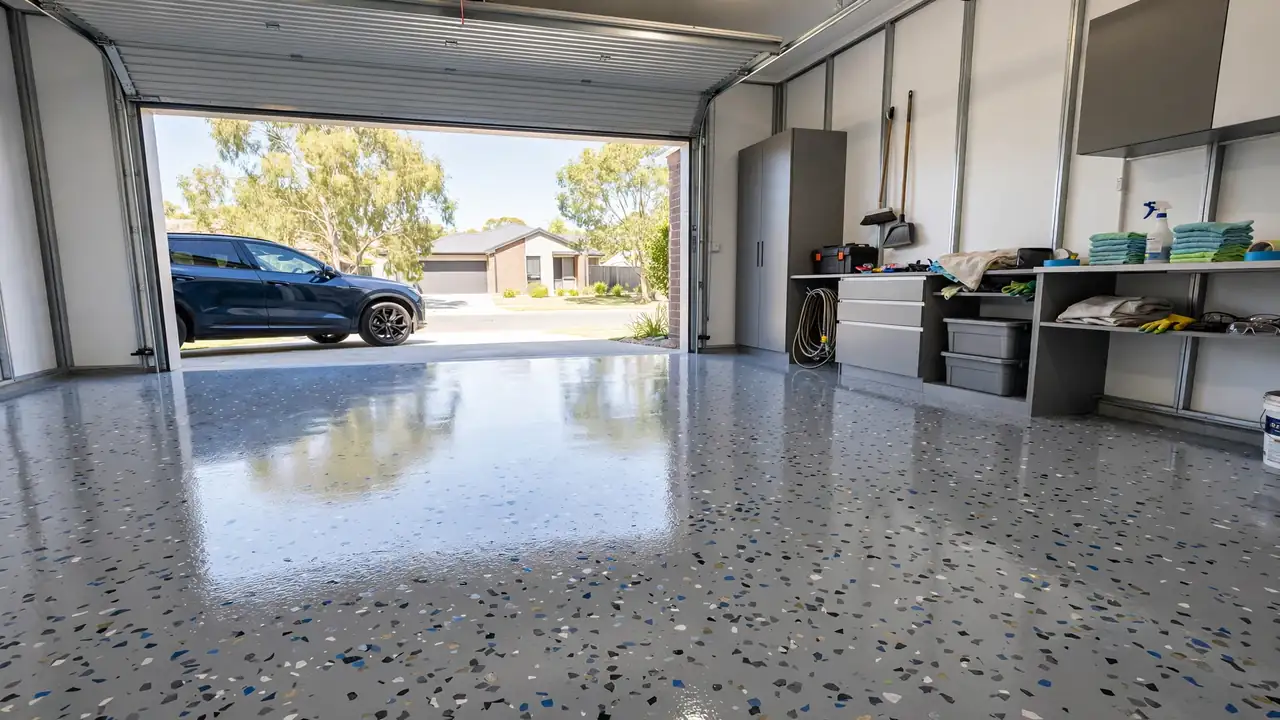
Get three quotes to epoxy the same garage and you can end up with three totals thousands of dollars apart — and all three can be honest. Epoxy garage floor cost australia figures online mix three different jobs: a paint-only two-coat job over sound concrete, a full job with grinding, repairs and a UV-stable topcoat, and a premium flake or metallic system. However, until you know which scope a figure covers, the rates look contradictory. Every figure in this guide comes from a named 2026 Australian source.
Epoxy Garage Floor Cost Australia at a Glance
For a standard Australian garage, plan on roughly $900 to $6,500 professionally installed, with most doubles between $1,800 and $3,500. Overall, the 2026 professional range runs from about $50 to $165 per square metre.
| System | Installed, per m² | Single garage (~18 m²) | Double garage (~36 m²) |
|---|---|---|---|
| Solid colour epoxy (2-coat) | $50–$80 | $900–$1,350 | $1,800–$2,700 |
| Flake / decorative epoxy | $65–$130 | $1,170–$1,620 | $2,340–$3,240 |
| Metallic / marble effect | $90–$165 | $1,620–$2,970 | $3,240–$5,940 |
| Polyaspartic system or topcoat | $75–$150 | $1,350–$1,980 | $2,700–$3,960 |
| DIY kit (materials only) | $15–$50 | $200–$500 | $450–$2,000 |
In fact, those bands are reconciled from the sources in this guide. Resin Masters, a South East Queensland installer, lists solid colour at $50 to $75 per square metre, flake at $65 to $90, metallic at $90 to $165 and polyaspartic at $75 to $110. All include grinding, primer, the full system, a UV-stable topcoat and GST. ServiceTasker puts the 2026 national average at $50 to $150 per square metre.
Why Quotes for the Same Garage Can Differ by Thousands
The single biggest reason is preparation. Hipages lists two coats over an already prepared surface at $30 to $35 per square metre — a price that assumes the floor needs almost nothing done to it. Add diamond grinding and a decorative finish and the same source puts it at $80 to $100 per square metre: the second price buys the grinding, primer and finish that make the coating stay down. In addition, slab condition is the second driver — oil, old coatings, or cracks are priced separately. Therefore, never compare quotes by the per-metre rate alone — ask for each line itemised.
Epoxy Garage Floor Cost Australia by Coating System
In fact, the coating system moves the price more than garage size does. Each system below is priced installed in 2026.
Water-based epoxy: $40–$60 per m²
The budget entry point. Guiding Expert’s 2026 guide prices water-based epoxy at $40 to $60 per square metre. The Quote Yard’s Queensland guide lists single-pack water-based epoxy at $35 to $60 installed, with a service life of three to seven years. Overall, it suits a light-use garage, but a budget single-coat system can need recoating in three to five years.
Solvent-based epoxy: $60–$85 per m²
A step up in hardness and chemical resistance. Guiding Expert prices solvent-based systems at $60 to $85 per square metre in 2026, rating them very good for workshops. The solvents smell stronger and need good ventilation while curing — but for a workshop garage with fuel and oil on the floor, this is the cheapest system that will stand up to it.
100% solids epoxy: $85–$110 per m²
The workhorse of professional garage floors. Guiding Expert puts 100% solids epoxy at $85 to $110 per square metre including preparation and standard flake options, built for high-traffic floors. With no water or solvent to evaporate, it builds a thicker film per coat — the choice for hot tyres, heavy toolboxes and chemical spills.
Flake and decorative systems: $65–$130 per m²
The most popular residential choice. Resin Masters lists seamless flake epoxy at $65 to $90 per square metre; ServiceTasker puts epoxy flake flooring at $80 to $120; The Quote Yard Queensland lists decorative flake systems at $80 to $130. Coloured vinyl chips are broadcast into the wet base coat, then locked under a clear topcoat. They hide dirt and add slip resistance.
Metallic and marble-effect epoxy: $90–$165 per m²
The premium decorative finish. Resin Masters prices metallic and marble-effect floors at $90 to $165 per square metre, and Guiding Expert puts luxury multi-layer decorative finishes at $120-plus per square metre. Metallic pigments swirled through the resin create a marble-like effect no two floors share. Application is slower and the result depends heavily on the installer’s skill.
Polyaspartic topcoat or full system: $75–$150 per m²
Polyaspartic solves epoxy’s two weak points: slow curing and yellowing in sunlight. Resin Masters prices polyaspartic at $75 to $110 per square metre, while The Quote Yard Queensland lists polyaspartic premium coatings at $90 to $150. A polyaspartic topcoat gives UV stability and cures in hours rather than days — the household can be back in the garage the same day. It is also the longest-lived option here, at 15 to 25 years.
Single vs Double Garage: What You Will Actually Pay
Garage size changes the total, but the per-metre rate usually falls as the floor gets bigger. HomeProsTips’ 2026 guide allows $100 to $150 per square metre for a smaller garage of 15 to 25 square metres. A typical double of 25 to 40 square metres runs $80 to $130. Larger floors over 40 square metres run $70 to $115. For a single garage of about 18 square metres, the sources agree on roughly $900 to $1,800. For a double of 36 to 40 square metres, Resin Masters quotes $1,800 to $2,700 for solid colour and $2,340 to $3,240 for flake, and ServiceTasker $2,200 to $3,500. Finally, watch for the minimum job charge — some contractors set a floor of $1,500 to $2,000 per job.
What Preparation Really Costs — and Why Skipping It Fails
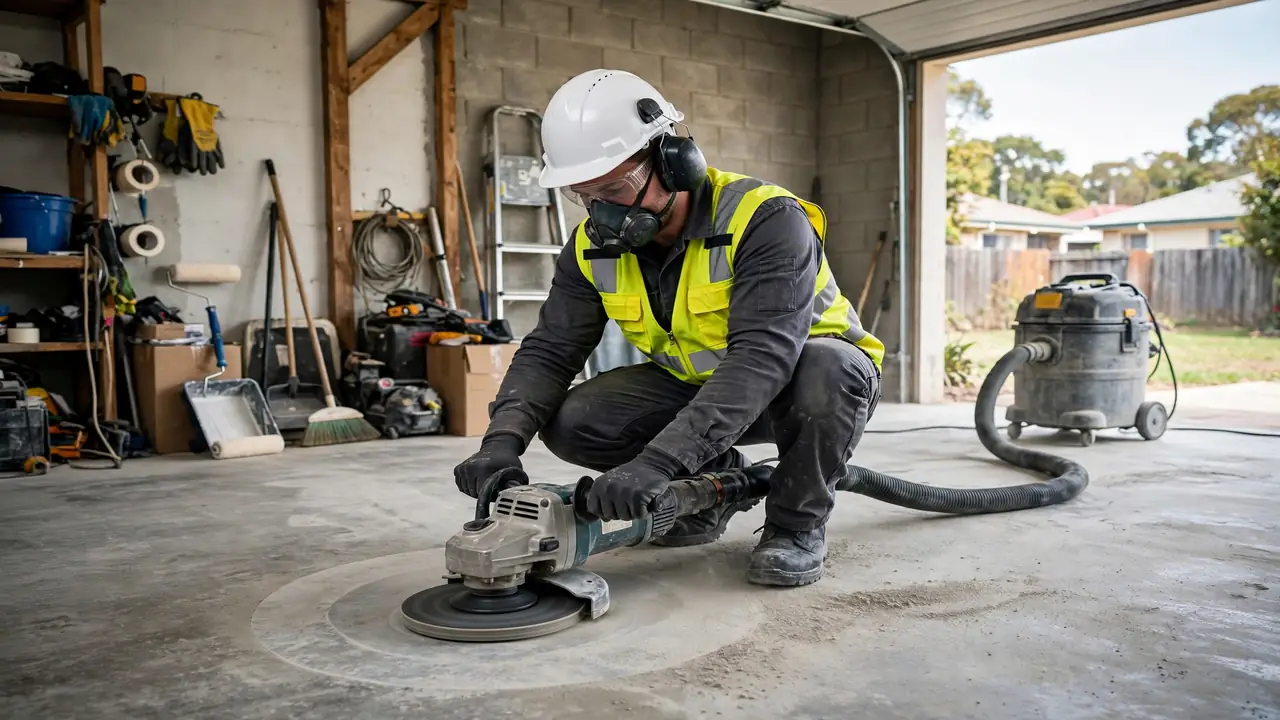
Preparation is where cheap epoxy jobs fail. The Quote Yard’s Queensland guide is blunt: diamond grinding or shot blasting is the professional standard, and minimal preparation or acid etching frequently produces coating failure within one to three years. A proper sequence has four steps: grinding so the primer can grip; moisture testing, since epoxy over a damp slab can bubble and peel; crack repair; and degreasing to remove oil and tyre residue. Prestige Flooring Epoxy puts preparation at $5 to $15 per square metre on top of the coating — $180 to $540 on a 36-square-metre double garage, the difference between a floor that lasts fifteen years and one that peels in eighteen months. As a result, if a quote is far below these ranges, check the preparation line first.
DIY vs Professional Epoxy: The Honest Comparison
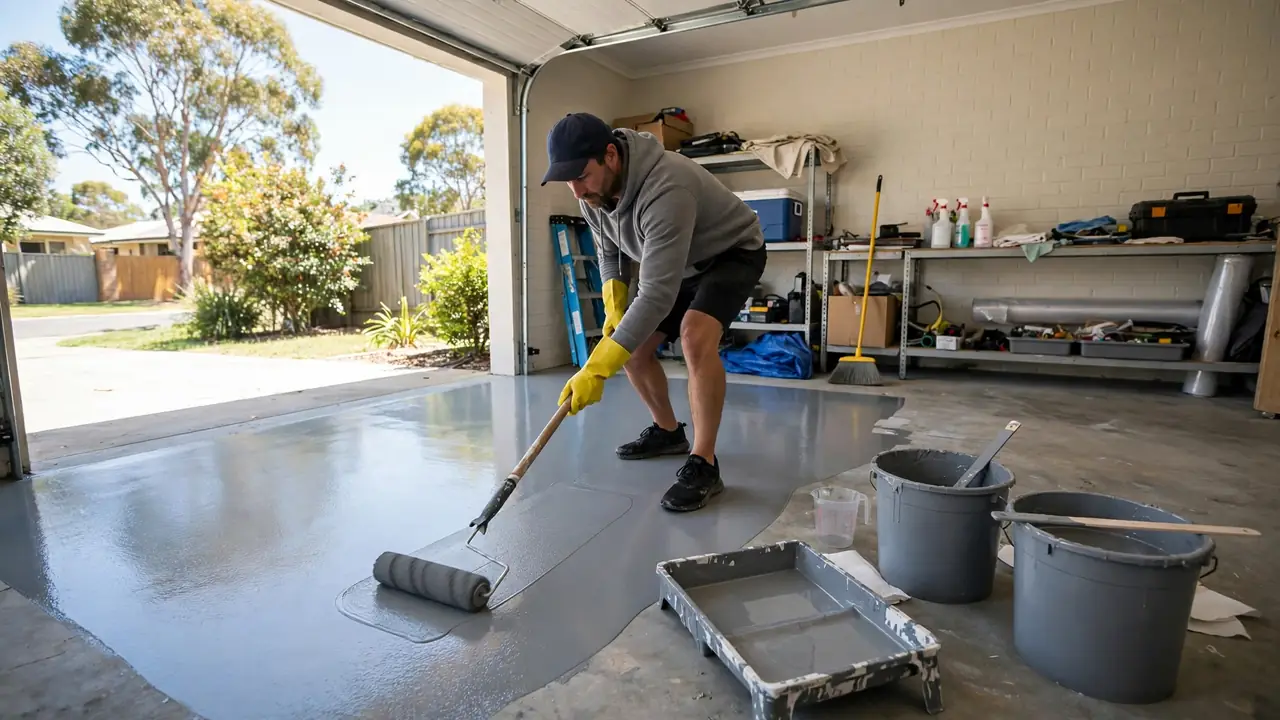
Doing it yourself is genuinely cheaper — and genuinely riskier. DIY kits advertise at $300 to $800 for a standard double garage, according to Resin Masters, A more recent check by WhatsTheDamage found Bunnings epoxy floor kits at about $170 to $380 in October 2026. Add $150 to $400 a day for grinder hire and two to four days of your time, against a $2,000 to $3,500 professional job — a saving of roughly 40 to 60 percent.
On results: The Quote Yard’s Western Australia guide puts DIY results at two to five years before recoating, against eight to fifteen years for professional work, and notes the cost per year is roughly comparable. Bunnings’ Dy-Mark guide says to let the floor cure for seven to ten days before heavy vehicle use; a professional crew finishes in two to three days, with full vehicle use at seven days. For example, DIY suits a small garage with a sound slab — not a damp slab, a cracked floor, or a workshop garage. A professional quote also includes a warranty, typically seven years with Resin Masters.
How Long Does an Epoxy Garage Floor Last?
Lifespan depends on the system and the preparation underneath it, not the brand on the tin. The Quote Yard’s Western Australia guide gives the clearest ladder. A budget single-coat system may need recoating at three to five years. A premium two-coat epoxy system in a typical residential garage can run ten to twenty years, and a polyaspartic system can run longer. Its Queensland guide agrees: seven to fifteen years for a two-pack system, ten to twenty years for a premium flake or metallic system, and fifteen to twenty-five years for polyaspartic. Three things shorten that life: sunlight yellows standard epoxy; hot tyres can lift a cheap coating; and moisture from below bubbles a coating from underneath. Finally, recoating is far cheaper than starting over — a fresh topcoat every decade keeps the floor looking new.
Epoxy vs Polished Concrete: Which Suits Your Garage?
In fact, epoxy and polished concrete are often priced together, but they are different products. Epoxy is a coating laid on top of the concrete — a film that seals the slab, hides stains, resists oil and chemicals, and comes in any colour or flake pattern you like. Polished concrete grinds and densifies the slab itself, so there is no film to peel, chip or yellow; the look is the concrete, refined. Our polished concrete floor cost guide covers that option in detail, with its own 2026 pricing. For example, choose epoxy for colour choice or a floor that hides a stained slab. Choose polished concrete if you want a finish that cannot peel, or if you prefer the natural concrete look. Damaged epoxy can be patched and recoated; polished concrete repairs mean regrinding.
Safety First: Epoxy Resin and Your Skin
Epoxy is a chemical product, and it deserves respect whether a professional applies it or you do. Safe Work Australia lists epoxy resins among the substances known to cause allergic contact dermatitis. An allergy, once developed, is likely to be lifelong — it can appear after many years of exposure, or after even a small amount of contact. Safety data sheets classify the uncured resin as a skin and eye irritant that may cause an allergic skin reaction. For a DIY job, that means nitrile gloves, a respirator with organic vapour filters, eye protection, long sleeves, and ventilation while the product cures. Read the safety data sheet before you open the tin. Safe Work Australia’s guide to work-related contact dermatitis explains the risks and warning signs in plain language.
How to Read an Epoxy Quote
Use this seven-line check on every quote.
- Measured area: square metres, measured on site.
- Preparation listed separately: grinding, moisture test, crack repair, degreasing.
- Full system specified: primer, base coat, flakes if any, topcoat.
- Topcoat named: standard epoxy or UV-stable polyaspartic.
- GST stated: whether the total includes GST.
- Cure time in writing: when you can walk on it, and when you can park on it.
- Warranty in writing: years, cover, and exclusions.
Finally, one last check costs nothing: ask for the address of a floor the installer finished more than a year ago, and go and look at it. For a bigger project, our garage conversion cost guide covers full conversions, and our guide to the best flooring for Australian homes compares the main options room by room.
Frequently Asked Questions
How much does epoxy garage floor cost in Australia?
A professional epoxy garage floor costs $50 to $165 per square metre installed in 2026, depending on the system and the state of your slab. A single garage of about 18 square metres runs roughly $900 to $1,800, and a double garage of 36 to 40 square metres runs roughly $1,800 to $3,500 for a solid-colour or flake system.
How much does it cost to epoxy a double garage floor?
A standard double garage of 36 to 40 square metres costs $1,800 to $2,700 for solid-colour epoxy and $2,340 to $3,240 for flake epoxy on Resin Masters’ 2026 pricing, while ServiceTasker puts the double-garage range at $2,200 to $3,500. Sydney prices run highest at $90 to $150 per square metre.
Can I epoxy my garage floor myself?
Yes. DIY epoxy kits cost about $170 to $380 at Bunnings, checked in October 2026, plus $150 to $400 a day to hire a diamond grinder. Allow two to four days for the job and seven to ten days of curing before heavy vehicle use. DIY floors typically last two to five years against eight to fifteen years for professional work.
How long does an epoxy garage floor last?
A premium two-coat epoxy system on a properly prepared slab lasts ten to twenty years in a typical residential garage. A polyaspartic system can last fifteen to twenty-five years, while a budget single-coat system may need recoating in three to five years. Sunlight, hot tyres and moisture from below shorten its life.
Is epoxy better than polished concrete for a garage?
It depends on what you want. Epoxy is a coating that seals the slab, hides stains, resists oil and chemicals, and comes in any colour or flake pattern. Polished concrete grinds and densifies the slab itself, so there is no film to peel, chip or yellow. Choose epoxy for colour choice and chemical resistance, and polished concrete if you want a finish that cannot peel.
Does epoxy flooring peel or yellow?
It can do both if the wrong system is used or the preparation is skipped. Peeling is usually caused by poor preparation, oil contamination or moisture rising through the slab. Yellowing happens when standard epoxy is exposed to direct sunlight; a UV-stable polyaspartic topcoat prevents it. A properly prepared floor with the right topcoat should do neither for many years.