
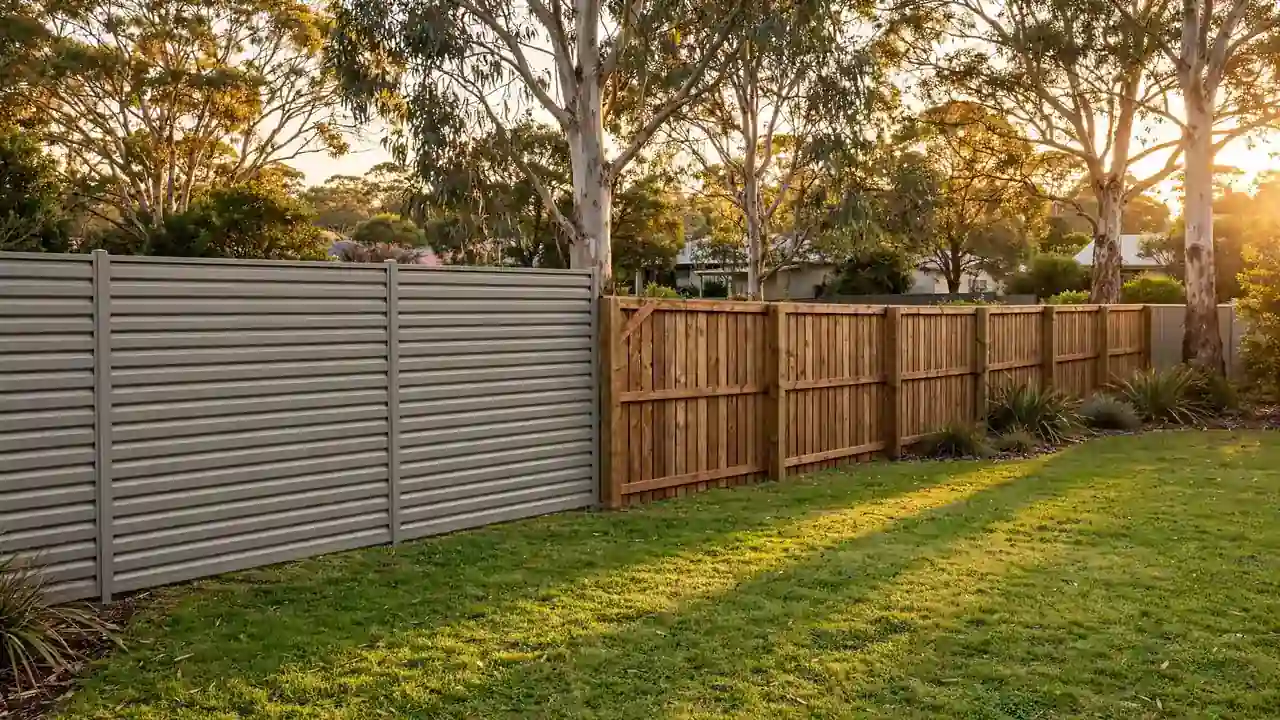
Three fencing contractors can price the same boundary thousands of dollars apart — and all three can be honest. Fence cost per metre australia figures online mix different jobs. For example, some cover supply-only panels, installed rates on flat ground, and full jobs with removal, gates and retaining. Until you know which scope a figure covers, the rates look like they contradict each other. Every figure below comes from a named 2026 Australian source, with the scope behind it.
Fence Cost Per Metre Australia at a Glance
For a standard 1.8-metre suburban dividing fence on flat, clear ground, installed and GST-inclusive, here are the 2026 bands:
| Fence material | Installed, per metre | Typical 30 m boundary |
|---|---|---|
| Treated pine paling | $75–$150 | $2,250–$4,500 |
| Hardwood paling | $80–$190 | $2,400–$5,700 |
| Colorbond steel | $75–$160 | $2,250–$4,800 |
| Aluminium slat | $150–$450 | $4,500–$13,500 |
| Rendered brick or block | $350–$1,000 | $10,500–$30,000 |
Those are reconciled bands, not single quotes. The cheapest honest rate is a basic PVC or chain-wire fence at roughly $40–$90 a metre (hipages). However, neither gives privacy. Everything here assumes a standard 1.8-metre height — taller fences cost more, and anything over 2 metres usually needs council approval.
Timber Paling Fence Cost Per Metre
Timber paling is still the budget standard for Australian backyards, and the 2026 sources agree closely on it. Hipages puts a treated pine paling fence at $75–$120 a metre installed. In addition, Yellow Pages’ 2026 guide gives $75–$125, and Project Price Point’s 2026 guide gives $75–$130. Fences R Us, updated in July 2026, is higher at $80–$160. Reconciled, budget $75–$150 a metre. The top of the band covers hardwood posts, capping and a stained finish.
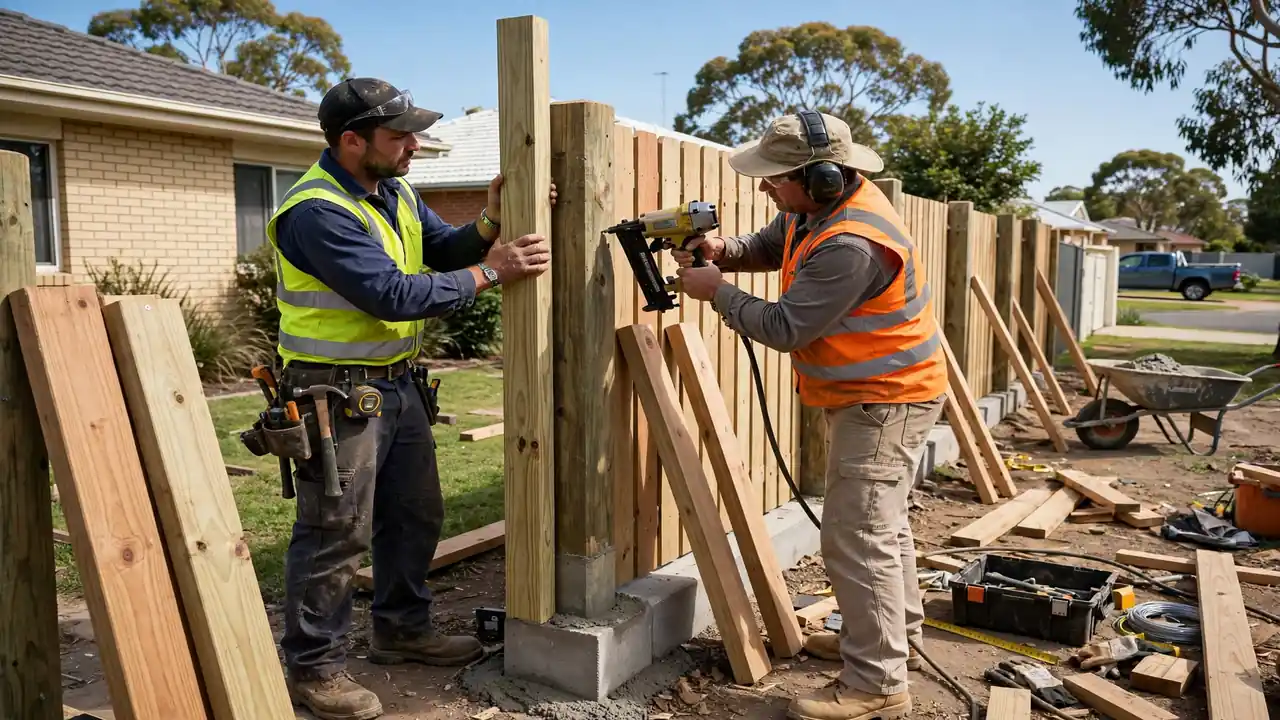
Hardwood paling costs more and lasts longer: hipages lists it at $80–$125 a metre, Project Price Point at $100–$190. Remember maintenance — pine needs staining or oiling every few years. Home Upkeep puts the 20-year cost of a 30-metre timber fence at $5,000–$8,000, against $3,000–$5,500 for the same length in Colorbond.
Colorbond Fence Cost Per Metre
Colorbond is the most common dividing fence in new Australian suburbs. Hipages puts Colorbond at $85–$100 a metre installed, Yellow Pages’ 2026 guide at $75–$120, and Airtasker’s 2026 data at $70–$130. Project Price Point’s 2026 guide gives $75–$160, noting most standard 1.8-metre jobs land around $100–$130. Reconciled: $75–$160 a metre nationally, most standard jobs at $100–$130.
City pricing runs higher than the national band. Synergy Fencing in Brisbane, publishing fresh rates in November 2026, quotes Colorbond at $160–$240 a metre for a standard 1.8-metre fence. In addition, it quotes $145–$215 at 1.5 metres and $190–$285 at 2.1 metres, installed. Home Upkeep puts Melbourne Colorbond at $95–$160 a metre. Compare a quote against the local band, not the national one. Colorbond’s selling point is that the per-metre rate is close to the whole cost: no painting, no staining, no rot.
Aluminium Slat and Tubular Fence Cost Per Metre
Aluminium slat fencing is the premium choice for front boundaries, where the fence is part of the street appeal rather than just a divider. The 2026 sources put it well above timber and Colorbond. For example, Project Price Point gives $150–$350 a metre installed, Fences R Us gives $200–$450, and What’s The Damage’s November 2026 Brisbane table gives $170–$400 with $270 typical. Reconciled, budget $150–$450 a metre, the top of the band covering tight slat gaps and custom colours. Ask the quote to state the slat size, gap and colour.
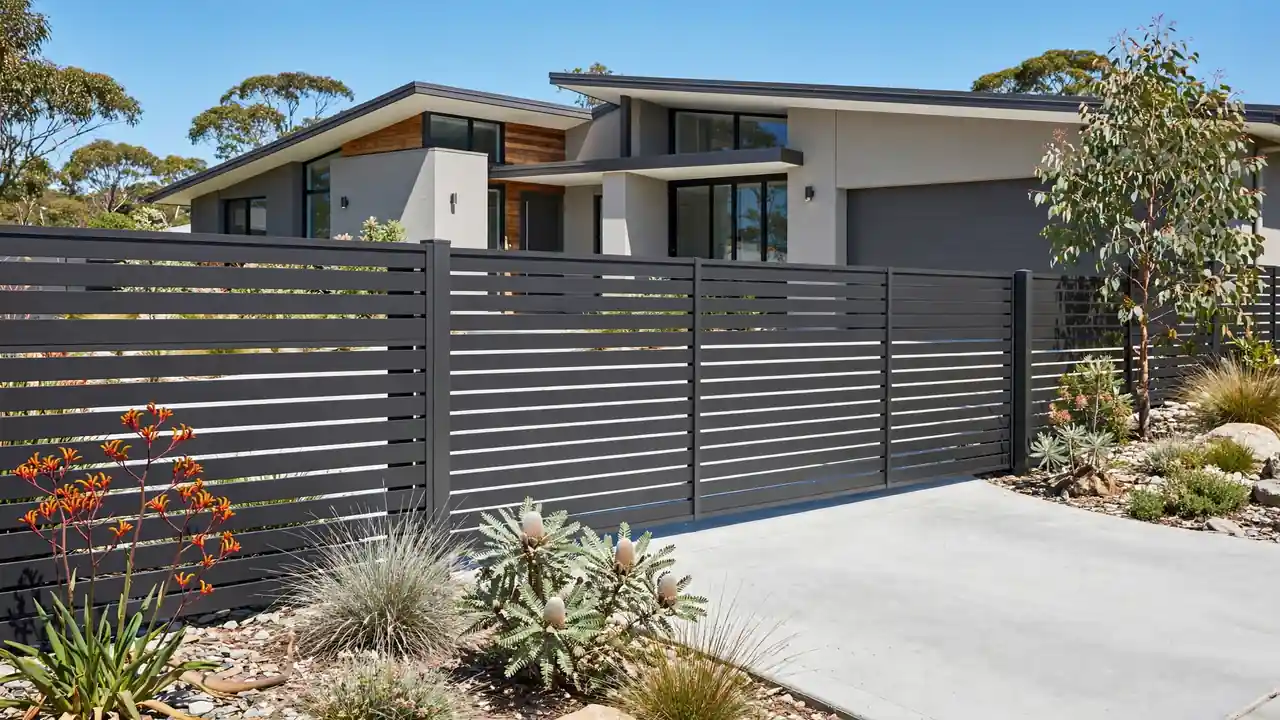
Tubular aluminium fencing — the vertical-bar style common around front yards — is cheaper than slat. However, the published ranges are the least consistent of any material: hipages lists aluminium fencing generally at $75–$85 a metre in one guide, while Airtasker’s 2026 data gives a very wide $392–$1,200 a metre. Treat $100–$250 a metre as a planning figure and insist on an itemised local quote. Glass pool fencing is a separate topic with its own compliance rules — see our fence installation cost guide for the broader installation picture.
Brick and Rendered Fence Cost Per Metre
A rendered brick or block fence costs like a small wall, because that is what it is. For example, it needs footing, blockwork, render and often a steel or aluminium infill above. Fences R Us puts rendered block or brick at $400–$900 a metre and up. Hipages lists a brick or block fence at $550–$800 a metre, and a rendered brick and steel fence at $750–$1,000. What’s The Damage’s November 2026 tables put a rendered brick or block fence at about 1.8 metres at $350–$880 a metre across Brisbane, Melbourne and Canberra. Reconciled, budget $350–$1,000 a metre.
The band is so wide because no two brick fences are the same job. Footings are the hidden cost. For example, reactive clay, rock or a high water table can all add excavation and engineering that a per-metre rate cannot show. If a brick fence quote looks surprisingly cheap, check whether it includes the footing, the render on both sides, and the capping.
What a 30-Metre Boundary Actually Costs
Most suburban blocks share a boundary of roughly 30 metres. These totals multiply the reconciled bands above, for a standard 1.8-metre fence on flat ground, before gates, removal or retaining:
| Material | Per metre | 30 m boundary |
|---|---|---|
| Treated pine paling | $75–$150 | $2,250–$4,500 |
| Colorbond steel | $75–$160 | $2,250–$4,800 |
| Hardwood paling | $80–$190 | $2,400–$5,700 |
| Aluminium slat | $150–$450 | $4,500–$13,500 |
| Rendered brick or block | $350–$1,000 | $10,500–$30,000 |
Gates, Removal and the Extras That Change the Total
A per-metre rate prices a straight run of fence. A gate is not just another metre of fence: it is hardware, a latch that has to last, and fitting time. What’s The Damage’s November 2026 city tables put a single pedestrian gate at $250–$880 installed and a manual double driveway gate at $800–$2,750, depending on the city. Hipages puts gate installation at an extra $250–$500.
Removing the old fence is a separate line on most quotes. Project Price Point puts removal at $12–$20 a metre. In addition, hipages gives $10–$25, and Home Improvement Hub gives $20–$45 including disposal. What’s The Damage’s November 2026 tables give $15–$50 a metre generally. For timber paling with disposal in Brisbane, they give $15–$45. A brick fence costs far more to demolish — $50–$120 a metre in Melbourne. A concrete plinth runs about $90–$140 a metre on top of the fence (Synergy Fencing). Fencing labour averages around $50 an hour (Yellow Pages 2026), which is why access matters. When you compare quotes, check that gates, removal, plinth and access are all present. The cheapest quote is often the one that left one of them out.
Sloping Sites and Retaining Walls
A slope changes a fencing job more than any other single factor. On a sloping block, contractors must step or rake the panels to follow the ground. As a result, the job takes longer and uses more material. Project Price Point puts the slope premium at 10–30% on top of the flat-ground rate. What’s The Damage’s city guides agree: sloping blocks add 15–30% in Brisbane and 20–40% in Melbourne.
Where the ground level differs meaningfully between your block and next door, you may need retaining before you can run a fence at all. A retaining wall is not a fence: it is structural and may need engineering and council approval. What’s The Damage’s November 2026 tables put a timber retaining wall at $150–$495 a metre across Brisbane, Melbourne and Canberra. Project Price Point’s cautionary tale: one Coffs Harbour homeowner’s $7,500 fence came with a $5,000 retaining wall attached. Ask each contractor to price retaining separately. Also ask whether engineering certification is included, since retaining over 500 mm often needs it. Our driveway cost guide covers the same slope surprises.
Dividing Fences: Who Pays, and the Rules in Each State
In New South Wales, the Dividing Fences Act 1991 sets the rules. Wollondilly Shire Council’s dividing-fences guide explains that an owner who wants a neighbour to contribute must first serve a Fencing Notice. In addition, owners should do no work until they reach agreement or receive an order — unless urgent work is needed, when owners share urgent repair costs equally even without a notice. If agreement is not reached within one month of the notice, either owner may apply to the Local Court or the Local Land Board. Owners share the cost of a sufficient fence, but if one owner wants a higher standard, that owner pays the difference — and if one owner damages the fence, that owner pays the whole restoration cost.
Queensland works the same way under the Neighbourhood Disputes (Dividing Fences and Trees) Act 2011. Similarly, adjoining owners generally contribute equally to a sufficient dividing fence — for residential land, roughly 0.5 to 1.8 metres high in a prescribed material. The formal step is a notice to contribute, with at least one written quotation attached. If there is no agreement within one month, either owner can apply to QCAT within two months of the notice. Victoria’s Fences Act follows the same shape. It requires equal sharing for a sufficient fence and a Fencing Notice with quotes. Then, the neighbour has 30 days to respond, and the Magistrates’ Court of Victoria decides if needed. In every state, councils and government authorities generally do not have to contribute, so a boundary with council land is your full cost.
Talk to your neighbour before anyone lifts a tool, put the proposal and quotes in writing, and serve the formal notice before work starts. Building first and asking for half the money afterwards is the single most common way to lose the contribution entirely.
Fence Cost Per Metre Australia: How to Read a Quote
A fencing quote is only comparable with another quote if both price the same scope, so read it line by line. A complete quote names the height, the material and colour, the post type, the rails or framing, the plinth, the number and width of gates, and whether the old fence comes out — that checklist comes from Fences R Us.
Get three quotes: Project Price Point notes that contractor pricing on identical fencing work commonly varies by 20–30%, which makes fencing one of the trades where three quotes genuinely pays. Compare them line by line rather than by the bottom number. Check whether GST is included, and budget a 10% contingency on top of the quoted total. Our timber deck cost guide uses the same per-metre approach for decking.
Frequently Asked Questions
What is the cheapest fence per metre in Australia?
A basic PVC or chain-wire fence is the cheapest option, at roughly $40–$90 a metre installed according to hipages. For a proper privacy fence, treated pine paling is the cheapest realistic choice at $75–$150 a metre installed, reconciled across hipages, Yellow Pages’ 2026 guide and Project Price Point’s 2026 guide.
How much does a Colorbond fence cost per metre?
Colorbond fencing costs $75–$160 a metre installed in Australia in 2026, reconciled across hipages ($85–$100), Yellow Pages’ 2026 guide ($75–$120), Airtasker’s 2026 data ($70–$130) and Project Price Point’s 2026 guide ($75–$160). Most standard 1.8-metre jobs land around $100–$130 a metre, while city contractor rates can run higher — Synergy Fencing in Brisbane quotes $160–$240 a metre for a standard 1.8-metre Colorbond fence.
How much does a 30-metre fence cost in Australia?
A standard 30-metre boundary fence costs $2,250–$4,500 in treated pine paling, $2,250–$4,800 in Colorbond steel, or $4,500–$13,500 in aluminium slat, installed on flat ground before gates, removal or retaining. Project Price Point’s 2026 guide gives the same picture, putting a typical 30-metre boundary run at $2,250–$5,700 for the common materials.
Do neighbours have to split the cost of a dividing fence?
Yes, in general. In every Australian state, adjoining owners usually share the cost of a sufficient dividing fence equally, but you must serve your state’s formal fencing notice and reach agreement — or get a tribunal order — before the work starts, or you can lose the right to recover your neighbour’s share. If you want a fence above the sufficient standard, you pay the difference yourself.
How much extra does a sloping block add to fence cost?
A sloping block typically adds 10–30% to the fence cost for stepped or raked panels, according to Project Price Point, with What’s The Damage’s city guides putting the premium at 15–30% in Brisbane and 20–40% in Melbourne. If the level difference needs a retaining wall as well, a timber retaining wall costs $150–$450 a metre on top of the fence.
What is not included in a per-metre fence price?
A per-metre fence price usually covers only the new fence on a clear, level site. Gates, old-fence removal and disposal, concrete plinths, retaining walls, rock excavation and council fees are generally separate lines — removal alone runs $10–$50 a metre, a single pedestrian gate $250–$880 installed, and a concrete plinth $60–$140 a metre. Always ask for an itemised quote that lists each of these separately.