
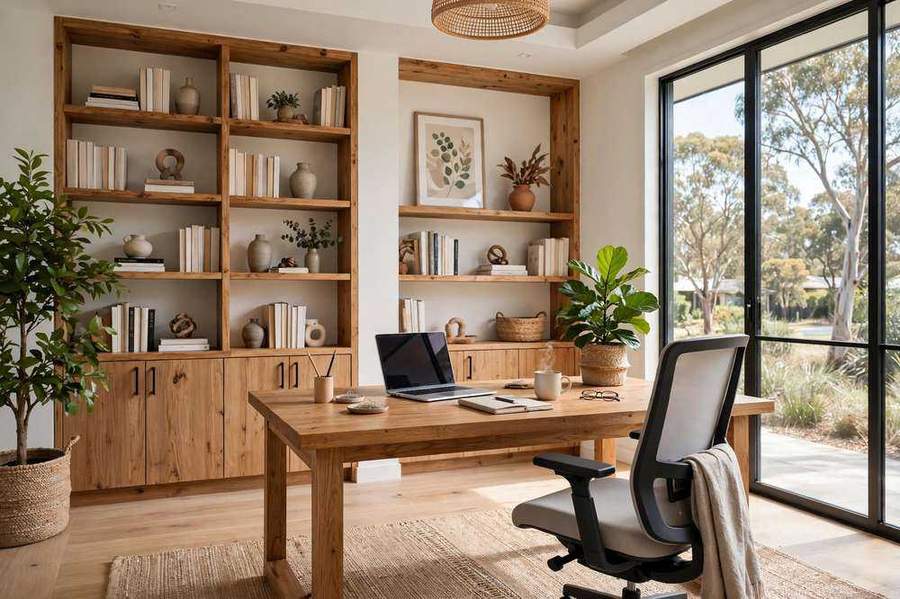
If you’re working from home in Australia, these home office renovation ideas Australia homeowners are actually using will help you design a space that’s comfortable, professional and built to last. Working from home isn’t going anywhere — around 37 percent of Australian workers now work from home at least part of the week — and the kitchen-table setup that got you through the early years probably isn’t cutting it anymore.
A purpose-built home office typically costs $5,000 to $15,000 depending on size, acoustic separation and built-in storage — far less for a smart refresh, more for a full garage conversion. This guide walks through ten ideas that work in real Australian homes — from apartments to four-bedroom houses — with honest cost ranges and practical details.
1. Convert the spare room properly — don’t just drop in a desk
The most common mistake is putting a desk in the spare bedroom and calling it an office. A real conversion means thinking about how you’ll actually use the room for eight or more hours a day.
Start with the desk position. Put it facing the window if you can — natural light on your face looks better on video calls and reduces the need for artificial light during the day. Leave at least 90cm of clearance behind your chair.
Add a rug if the floor is hard, and repaint in a calm, light colour — around $750 to $1,000 for a standard bedroom.
A sensible budget for a basic spare-room-to-office conversion lands around $6,000; a new-build office room with new walls, window and door can run near $16,000, based on quantity-surveyor breakdowns published by savings.com.au. Before you commit, it’s worth reading our renovation cost guide for 2026 so you can line your budget up against typical Australian rates.
2. Invest in a built-in desk and proper joinery
This is the single upgrade that separates a workspace from a desk in a room. Custom joinery gives you a desk at exactly the right height and depth, cable channels built in, and storage that fits the walls.
For a mid-range renovation, desk joinery typically costs $2,000 to $5,000 — usually a wall-length desk with drawers, a floating shelf and a storage tower. If your office needs to handle two people — common in couples who both work from home — budget $5,000 to $8,000 for a longer run with twin workstations.
Material choice matters in Australia’s climate. A timber-look laminate handles wear well and keeps costs down; solid timber looks wonderful but costs more and wants consistent indoor humidity. White or light oak finishes keep small rooms feeling open; darker stained timber suits larger rooms with good natural light.
Keep the desk depth at 70 to 80cm minimum if you use a monitor — 60cm feels cramped once a laptop, notebook and coffee mug are in play.
3. Treat the acoustics before you blame the microphone
Most call-quality problems are the room’s fault, not the headset’s.
The fixes are cheap and effective:
- A rug or carpet under the work zone — the single biggest acoustic improvement per dollar.
- A solid-core door instead of a hollow one — dramatically cuts hallway and street noise. Typically $300 to $600 supplied and installed.
- Soft furnishings — upholstered pinboards, bookshelves full of books, and even a bookcase behind your chair all break up echo.
- Acoustic panels on one or two walls — fabric-wrapped panels in a neutral tone cost around $50 to $120 each and double as design features.
For a full-room treatment you’re looking at $500 to $2,000, well within reach for most budgets. If you’re building a new room from scratch, $150 to $500 of acoustic insulation in the walls is money well spent.
4. Layer your lighting — don’t rely on one ceiling light
Eye strain is the quiet killer of home-office comfort. Most rooms have a single central light that’s too bright in the wrong place and useless at the desk.
A proper setup has three layers:
- Task lighting — an adjustable desk lamp (around 3000K) positioned to the side to avoid screen reflection.
- Ambient lighting — a soft overhead or floor lamp for general fill, ideally dimmable.
- Background lighting for video calls — a lamp or LED strip behind you at face level stops you looking like a silhouette.
- Floating shelves above the desk for reference books and decor — around $80 to $200 per shelf installed.
- A full-height cupboard or wardrobe conversion for files, printer and supplies you’ll only touch occasionally.
- Under-desk drawer units on castors for the things you need within arm’s reach.
- Four to six double power points around the desk and room, including one behind the desk at height for monitors.
- Structured data cabling — a wired ethernet connection to your router beats Wi-Fi for video calls, typically $200 to $400 per run.
- NBN entry point positioned near the desk so you’re not running cables across the house.
- USB-C and wireless charging points integrated into the desk or a bedside-style tower.
- A wall bed or quality sofa bed — wall beds cost $2,000 to $5,000 installed but give you back a full room’s worth of floor space.
- A fold-down wall desk or a slim console desk that reads as a hall table when guests arrive.
- A wardrobe split — half hanging space for guests, half shelving and filing for office life.
- A room divider or curtain on a ceiling track if the space is large enough to zone.
- Insulation — non-negotiable for Australian summers and winters; budget $2,000 to $5,000.
- Climate control — a split system, around $2,500 installed for the room size.
- Light — skylights or a new window where possible; otherwise generous layered lighting.
Lighting budgets for a home office typically run $500 to $2,000 including fixtures and installation. If you’re renovating properly, add a few extra power points and one switch near the desk — future you will be grateful.
5. Go vertical with storage
Desk surface is prime real estate — every item that can live on a wall or in a cupboard should. Vertical storage is especially valuable in smaller Australian homes and apartments where the office might only be 3 by 3 metres.
Practical options that work well:
Hidden storage keeps the room looking calm on camera and makes it easier to switch off mentally at the end of the day.
6. Build in the tech properly
Visible cables, one power point shared by four devices, and Wi-Fi that drops out mid-presentation are the hallmarks of an office that wasn’t renovated — it was occupied.
A proper tech fit-out includes:
Electrical and data work typically costs $1,000 to $3,000 for a home office, depending on how far your switchboard is and whether new circuits are needed.
7. Make it do double duty — the guest room office
Not everyone has a spare room to give up. The guest-bedroom-meets-office is one of the most practical home office renovation ideas in Australia, especially for two- and three-bedroom homes.
The trick is furniture that genuinely serves both roles:
8. Consider a garage or attic conversion for a quiet escape
If your house is full — kids, pets, partners on calls at the same time — converting a garage or attic into a proper office buys you acoustic and psychological separation that no spare room can match.
What a conversion needs:
A basic garage conversion starts around $15,000 to $20,000, while a full custom build with new walls, windows and insulation can push past $30,000. Check with your local council first — some areas treat garage conversions as a change of use and want approval.
9. Add nature and a real colour palette
Biophilic design — bringing natural elements into built spaces — has moved from trend to expectation, and it’s a natural fit for an Australian home office. You don’t need a living wall; you need a few considered touches.
Colour: soft neutrals with hints of blue or green keep the room calm and airy. Warm whites work with Australian light far better than cool greys, which can look cold under afternoon sun. One feature wall in a deeper tone — a eucalyptus green or warm clay — adds character without shrinking the room.
Plants: a couple of hardy indoor plants soften hard edges and improve the room’s feel — kentia palms, monstera and devil’s ivy all cope with typical office corners.
Materials: natural timber, stone accents and woven textures (a jute rug, linen curtains) ground the space.
If you’re not sure which palette suits your home, take our interior design style quiz — it takes a couple of minutes and will point you toward the colours and materials that suit your house.
10. Pick your budget tier — and spend where it shows
Here’s how the numbers usually break down for Australian home offices:
| Tier | What you get | Typical cost |
| Refresh | Paint, lighting, freestanding desk and chair, storage | $1,500 – $3,000 |
| Mid-range renovation | Custom joinery, electrical/data, flooring, acoustic treatment | $8,000 – $15,000 |
| Full conversion | New walls, windows, insulation, climate control (garage/attic) | $20,000 – $35,000+ |
Where to spend first if the budget is tight: the chair and the desk (you touch these all day), then lighting, then storage. Paint and decor are cheap force multipliers — a $300 tin of paint transforms a room faster than almost anything else.
One more thing worth knowing: if you work from home, the ATO’s fixed rate method lets you claim a set rate per hour for the 2025–26 income year for running expenses like internet, phone and electricity — plus separate deductions for office furniture decline in value. Keep records of your hours and speak to your accountant. Before you start spending, our renovation tools page has calculators that can help you sanity-check the budget against the scope you’re planning.
Frequently asked questions
How much does a home office renovation cost in Australia?
A mid-range home office renovation typically costs $8,000 to $15,000, covering custom desk joinery ($2,000 to $5,000), electrical and data work ($1,000 to $3,000), flooring ($1,000 to $3,000) and lighting ($500 to $2,000). A light refresh with paint, furniture and lighting can be done for $1,500 to $3,000, while a full garage or new-room conversion runs $15,000 to $35,000 or more.
Do I need council approval for a home office renovation?
Minor internal changes like painting, joinery and new power points don’t need approval. Structural work, new windows or a garage conversion may — check with your local council first.
What is the best desk position for a home office?
Side-on to a window is the sweet spot: you get natural light without screen glare, and you’re not backlit or silhouetted on video calls. Avoid sitting with your back directly to a bright window or with the window directly behind your monitor.
How can I reduce noise in my home office?
A rug or carpet under the work zone, a solid-core door, soft furnishings like bookshelves and upholstered pinboards, and fabric acoustic wall panels ($50 to $120 each) all make a real difference. For new rooms, acoustic insulation in the walls is a cheap upgrade during construction.
Can I claim home office renovation costs on tax?
You can’t generally claim the renovation itself, but you can claim running expenses — the ATO’s fixed rate method for 2025–26 lets you claim 70 cents per work hour for internet, phone and energy, plus separate deductions for the decline in value of office furniture and equipment. Keep records of your hours and speak to your accountant about your situation.