
$16,000 to $25,000. That is what a raked ceiling costs in a standard Australian living room in 2026. It runs roughly 20 to 30 per cent more than the same room with a flat ceiling. Even so, the premium buys the most dramatic change you can make to a room without adding floor space. The catch is the running cost. A raked ceiling has no roof cavity buffering the summer heat. So the insulation, the glazing and the ceiling fan matter as much as the slope itself. This guide to raked ceilings australia prices the feature three ways. It explains when it pays and when it punishes. And it gives you the three numbers that decide whether your rake will be comfortable or a heat trap.
Raked Ceilings Australia: The Short Answer
A raked ceiling follows the pitch of the roof instead of sitting flat. It rises from one wall to a higher opposite wall. In a new build, budget $16,000 to $25,000 for a living-room rake. Allow about $300 per square metre of floor area where the ceiling runs over 3.2 metres high. In an existing home, converting a flat ceiling to a rake costs more. The realistic range is $18,000 to $35,000 once structure, insulation and services are counted. That is because the roof framing has to be reworked. The rake earns its keep in open-plan living areas and extensions. There, the tall edge takes a band of highlight glazing and hot air escapes at the top.
What a Raked Ceiling Is — and What It Is Not
A raked ceiling is a single sloping plane. It rises from a low wall to a high wall. That is what separates it from its cousins. A vaulted or cathedral ceiling rises symmetrically to a central peak. A coffered ceiling is a flat ceiling with a recessed grid. And an exposed-rafter ceiling makes the structure itself the feature. The distinction matters because the costs are different. A rake needs a skillion or asymmetric roof form. Design the structure carrying it for the job from the first sketch, concealed rafters or exposed beams. The tall edge of a raked ceiling is where clerestory glazing lives. So the ceiling should follow the sun and the view. Rake up toward the north sun in the southern states, and toward the garden or the outlook everywhere else.
The 5 Rake Types Worth Knowing
Single-plane plasterboard. The clean, painted slope most project homes offer as an upgrade. Cheapest to build, easiest to insulate with high-density batts, and the best choice if the budget is tight.
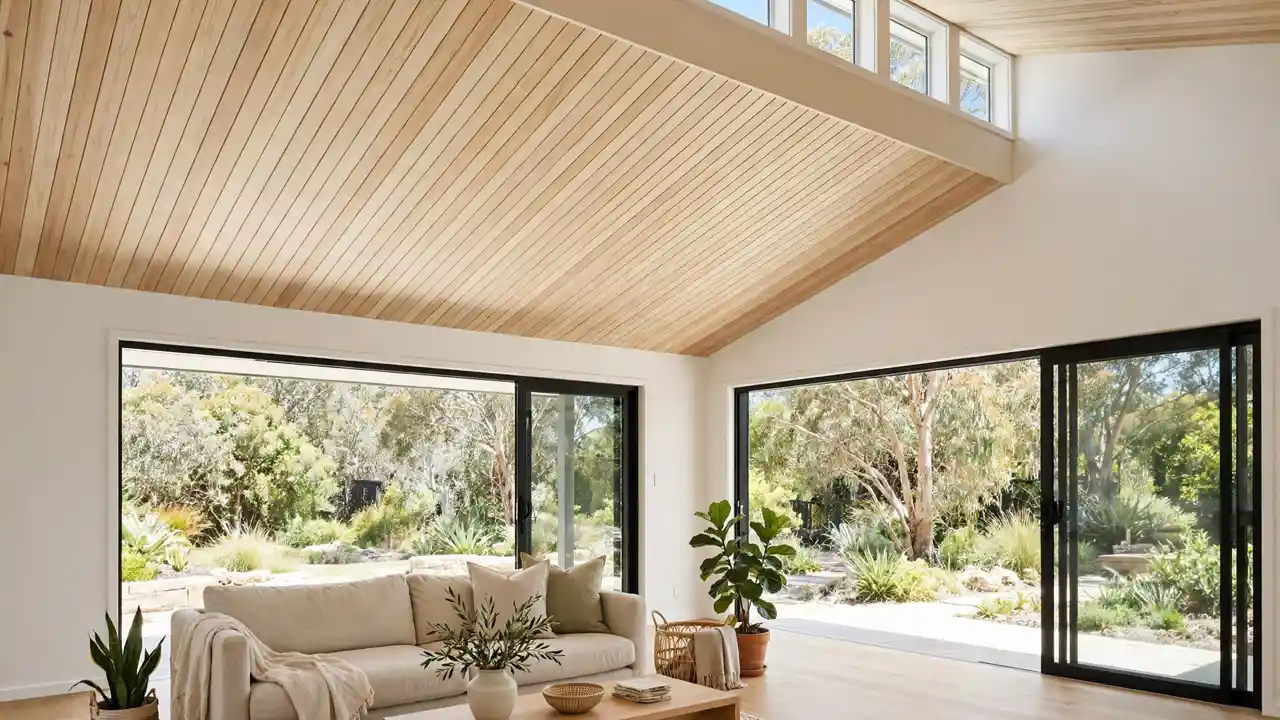
Timber-lined rake. Pale timber lining boards on the slope, sometimes with a clear finish. Warmer than plasterboard and the most photographed option in 2026
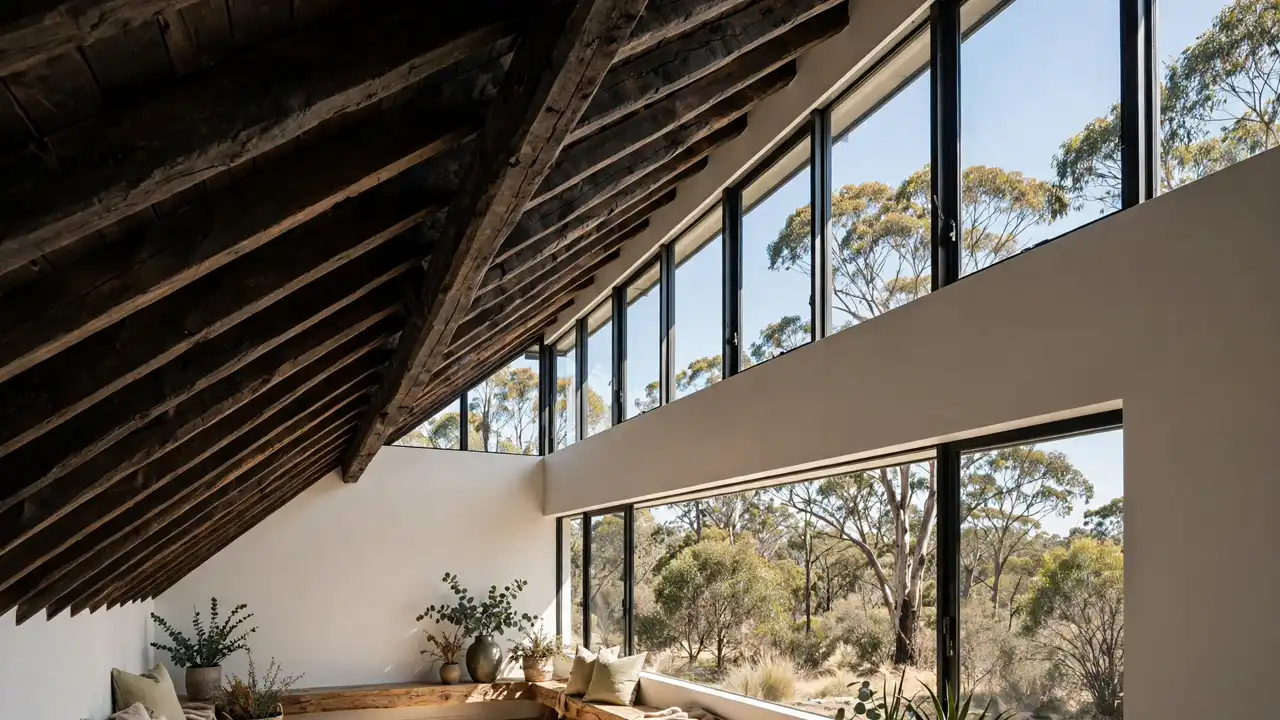
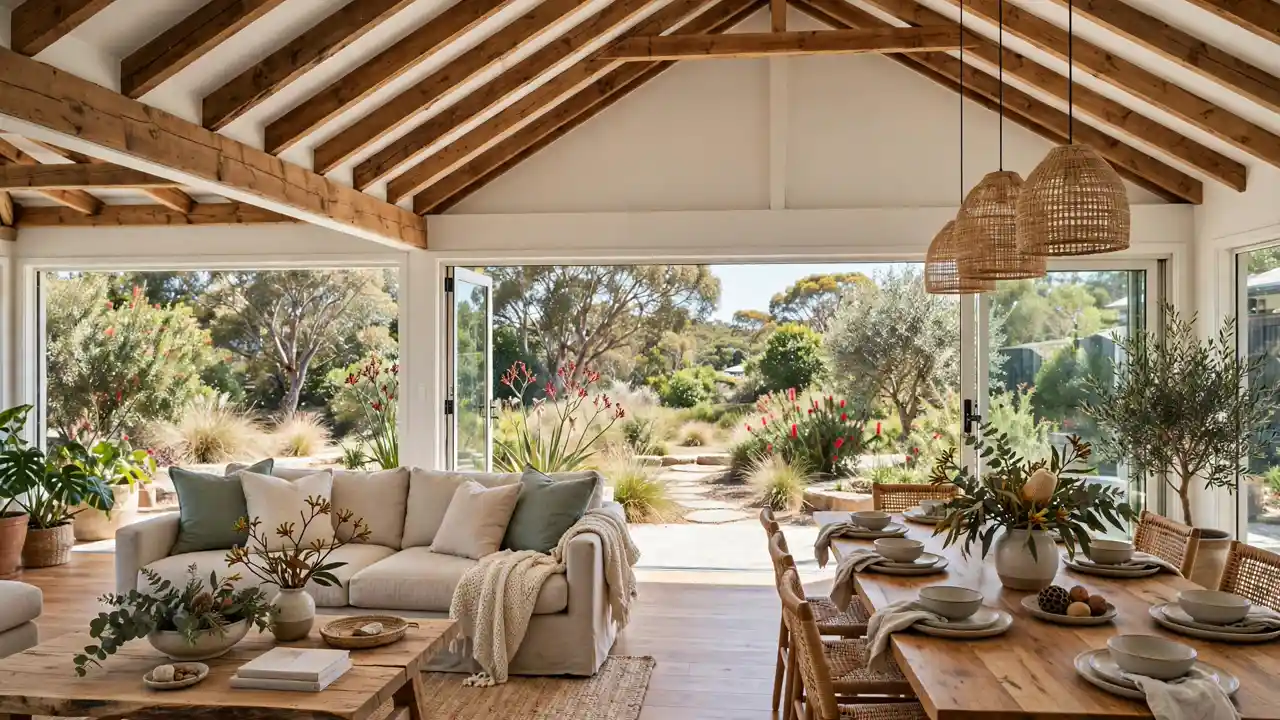
Exposed rafter or beam rake. The structure is the feature: dark or natural timber rafters running up the slope, with the lining between them. Striking, but the labour premium is the highest of the five.
Skillion roof rake. The whole roof is one slope, so the ceiling simply follows it. The simplest structural solution in a new build and the natural partner for a mono-pitch modern home.
Cathedral-adjacent double rake. Two slopes meeting at a ridge — strictly a vault, but sold as a rake by some builders. It costs the most and is the hardest to heat in winter.
What a Raked Ceiling Costs in 2026 — Reconciled From 3 Sources
Three sources quote the same job three different ways, and all three are right. Every raked ceilings australia quote should state which of the three it is. Is it the premium over flat, the allowance per square metre, or the whole-room total? ServiceTasker puts a raked ceiling at $16,000 to $25,000 for the room. It puts a vaulted ceiling at $16,000 to $28,000. ProCalc, a builder estimating tool, prices the premium differently. Ceilings up to 3.2 metres are included in standard pricing. Anything over 3.2 metres carries an allowance of about $300 per square metre of floor area. Nero Tapware puts the premium at 20 to 30 per cent over a standard ceiling.
For a 25-square-metre living room, those three methods converge. At $300 per square metre of floor area, the premium alone is $7,500. And 20 to 30 per cent on a $25,000–$35,000 ceiling and roof package is $5,000 to $10,500. That is the same order of magnitude as the $16,000 to $25,000 whole-room figure, framing, lining, insulation and finishing included. The lesson is to ask which number your builder is quoting. Is it the premium over flat, the allowance per square metre, or the whole-room total?
| Cost line | Indicative range, 2026 | Source |
|---|---|---|
| Raked ceiling, living room (whole room) | $16,000–$25,000 | ServiceTasker 2026 |
| Vaulted ceiling, living room (whole room) | $16,000–$28,000 | ServiceTasker 2026 |
| Premium over 3.2 m ceiling height | ~$300/m² floor area | ProCalc |
| Premium over a standard flat ceiling | 20–30% | Nero Tapware |
| Flat ceiling replacement, per m² | $25–$130 | Airtasker 2026 |
| Plasterboard lining, material only | $8–$15/m² | Airtasker 2026 |
| Timber lining, material only | $40–$90/m² | Airtasker 2026 |
| Retrofit conversion (flat to rake) | $18,000–$35,000 | Reconciled estimate |
Retrofit costs
The retrofit row is the one to read twice. Converting an existing flat ceiling means removing the ceiling and reworking trusses or rafters. Then relocate the wiring and ducting that runs through the joist cavity, and re-insulate and re-line. So bring in a structural engineer before any of it starts. If your home has trusses, get the engineer in before the builder, or the quote will be fiction.
3 Worked Rake Budgets
Budgets built only from the cited rates above. Floor area is the room’s floor, not the ceiling’s slope area. The slope is always larger than the floor. So per-square-metre-of-floor allowances understate the lining.
Budget 1 — New-build living room, 30 square metres, plasterboard rake. Whole-room rake at $16,000 to $25,000 covers framing, lining, insulation and finish. Add highlight glazing on the tall edge at $3,000 to $6,000. Add a ceiling fan at $500 to $1,200 installed. Total $19,500 to $32,200. The ProCalc cross-check: 30 square metres at $300 is a $9,000 premium over the flat-ceiling baseline. That sits inside the same range.
Budget 2 — New-build living room, 30 square metres, timber-lined rake with exposed beams. Take Budget 1 and add the timber lining premium. Timber lining runs $40 to $90 per square metre of slope area. Roughly 35 square metres of slope means $1,400 to $3,150 in material. Then add the exposed-beam labour premium. Builders put it at a further 10 to 15 per cent of the ceiling package. Total $23,000 to $38,000.
Budget 3 — Retrofit conversion, 20-square-metre living room, flat to rake. Demolition and removal: $1,500 to $3,000. Structural rework and engineer: $4,000 to $8,000. New lining and insulation: $5,000 to $9,000. Services relocation: $2,000 to $5,000. Finishing and paint: $2,500 to $5,000. Total $15,000 to $30,000 before glazing, and $18,000 to $35,000 with it
The Heating and Cooling Bill Nobody Quotes
A raked ceiling increases the volume of air in the room, and warm air rises. In winter the heat sits at the peak while the living zone stays cool. In summer the extra volume helps only if the hot air can escape. The Australian Government’s Your Home insulation guide states the physics plainly. Insulation slows heat flow, and the right total R-value depends on climate. But insulation alone is not enough. A raked section has no roof cavity buffering the summer heat above the ceiling lining. In South East Queensland, volume without an insulation and ventilation strategy is a heat trap.
Done well, a raked ceiling with high-level openable glazing becomes a passive ventilation engine. Hot air rises and escapes at the top, while cooler air is drawn through the room. Your Home also notes a big saving. Roof and ceiling insulation can save 45 per cent or more on heating and cooling costs. That is the single biggest lever on the running bill. The practical package is four items. First, fit high-density batts or rigid board without compression in the shallow rake cavity. Second, add a ceiling fan to push warm air back down in winter. Third, zone the air conditioning so it does not condition the peak. Fourth, fit openable highlight windows at the tall edge. Without the fan and the glazing, the rake costs more to run every year than it cost to build. That is the running-cost side of raked ceilings australia that no builder’s brochure prices.
Raked Ceilings by State: Where They Work and Where They Punish
Queensland, especially the south-east, is the best case for a rake. The stack effect cools the room for free in summer, and winter heating is a minor cost. By contrast, Victoria and Tasmania are the hardest case. The same volume that cools Brisbane punishes Melbourne in July, so the insulation and fan package is not optional. New South Wales sits in the middle. Sydney’s mild winters forgive the volume, but western Sydney’s 40-degree days demand the openable glazing. The state verdict is simple. It is the raked ceilings australia climate test in one line. A rake is a climate decision before it is a style decision. A builder who sells the same rake in Cairns and Hobart is selling a photograph, not a house.
Retrofit or New Build: The Decision Tree
Ask four questions in order. First, is the roof stick-framed with rafters, or trussed? Trusses usually mean no, or a much bigger bill. Second, is the room the main living space? If not, stop. The money is better spent elsewhere. Third, can the tall edge take openable glazing? If the high wall faces a neighbour’s fence at two metres, the rake gains volume and loses light. Fourth, can the services move? Wiring, ducting and downlights in the joist cavity all need a new home. In a home built before 1990, the electrician should also check for asbestos in the old ceiling materials. Do that before anything is disturbed. If any answer is no, keep the flat ceiling.
Our energy efficient home design guide covers the insulation and orientation decisions a rake depends on. Our energy efficient homes in Melbourne guide shows how the same choices play out in a cold climate. And our open plan living ideas guide shows where a rake earns its keep in an open-plan room.
5 Rake Mistakes to Avoid
A pitch under 5 degrees. Below 5 degrees the slope reads as a building error, not a feature.
Fixed glass at the tall edge. Highlight windows that do not open trap the hot air the rake was meant to release. Openable glazing is the difference between a ventilation engine and a greenhouse.
Compressed insulation. Batts squeezed into a shallow rake cavity lose R-value fast, and foil that touches electrical cables is a safety risk. The insulation must be specified for the cavity depth, not copied from a flat-ceiling spec.
Downlights in the slope. Recessed downlights in a raked ceiling are hard to aim, hard to clean, and they punch holes in the insulation. Pendant drops at different lengths, or a track on the low wall, light the room better.
Forgetting the fan. A ceiling fan is not a styling extra on a raked ceiling. It is the device that returns winter heat to the living zone. Budget it in Budget 1, not as an afterthought.
Frequently Asked Questions
How much does a raked ceiling cost in Australia?
A raked ceiling in a living room costs $16,000 to $25,000 in a new build in 2026, and a retrofit conversion of an existing flat ceiling costs $18,000 to $35,000.
Are raked ceilings more expensive than flat ceilings?
Yes. A raked ceiling costs 20 to 30 per cent more than a standard flat ceiling, and ceilings over 3.2 metres high carry an allowance of about $300 per square metre of floor area.
Do raked ceilings make a house hotter in summer?
They can, if the hot air has nowhere to go. With openable highlight glazing at the tall edge and good insulation, a raked ceiling vents hot air out and cools the room; without them it becomes a heat trap.
What is the minimum ceiling height in Australia?
The minimum ceiling height for a habitable room is 2.4 metres under the National Construction Code. Custom builders usually work to 2.7 metres as a baseline in living areas.
Can you convert a flat ceiling to a raked ceiling?
Sometimes. Homes with traditional stick-framed rafters are the best candidates; homes with prefabricated trusses are much harder and more expensive to convert, and a structural engineer must assess the roof first.
Do raked ceilings increase heating bills in winter?
Yes, unless the design compensates. Warm air rises to the peak, so a ceiling fan, zoned heating and insulation above the NCC minimum are needed to keep the living zone comfortable without high bills.
Rake the main living room. Rake it toward the sun and the view. And price the fan, the glazing and the insulation in the same budget as the slope. The raked ceilings australia homeowners love are the ones where the tall edge opens and the fan runs. There, the winter heat comes back down. They are not the ones where the slope is the only thing that was ever designed.