
$25,000 to $100,000. That is the 2026 cost to clad the front of a two-storey Australian home. It excludes scaffolding, removal of the old skin, and council fees. The material you pick drives almost all of the spread. Render over masonry can land at $65 to $95 per square metre installed. Natural stone cladding runs $250 to $500. This guide to facade design ideas australia prices nine styles the way a builder prices them. For each style, it lists the material, installed rate, lifespan, repaint cycle, and bushfire rating. The rating can rule a favourite out before you fall in love with it.
Facade Design Ideas Australia: The Short Answer
For most Australian homes in 2026, the smart money is a three-material facade in a 60/30/10 split. The main cladding takes 60 per cent. A contrasting secondary takes 30 per cent, and a texture accent takes 10 per cent. Render plus face brick plus timber-look battens is the combination Sydney luxury builders use most. It works just as well on a $600,000 project home as on a $2 million custom build. Budget $90 to $180 per square metre installed for fibre cement or composite systems. Acrylic render costs $65 to $95, while stone costs $250 to $500. A full-house reclad in Perth in 2026 runs $17,000 to $40,000. Before you choose anything, check two things. First, your bushfire attack level: it can ban timber weatherboard outright. Second, whether your council needs a development application for the change. DA fees run $200 to $1,000 or more.
The 9 Styles Australians Actually Build in 2026
Four styles dominate new builds, and five more cover almost every renovation. These are the facade design ideas australia homeowners ask builders about most. The difference between them is not taste alone. Each one carries a different material bill, a different repaint cycle, and a different bushfire story.
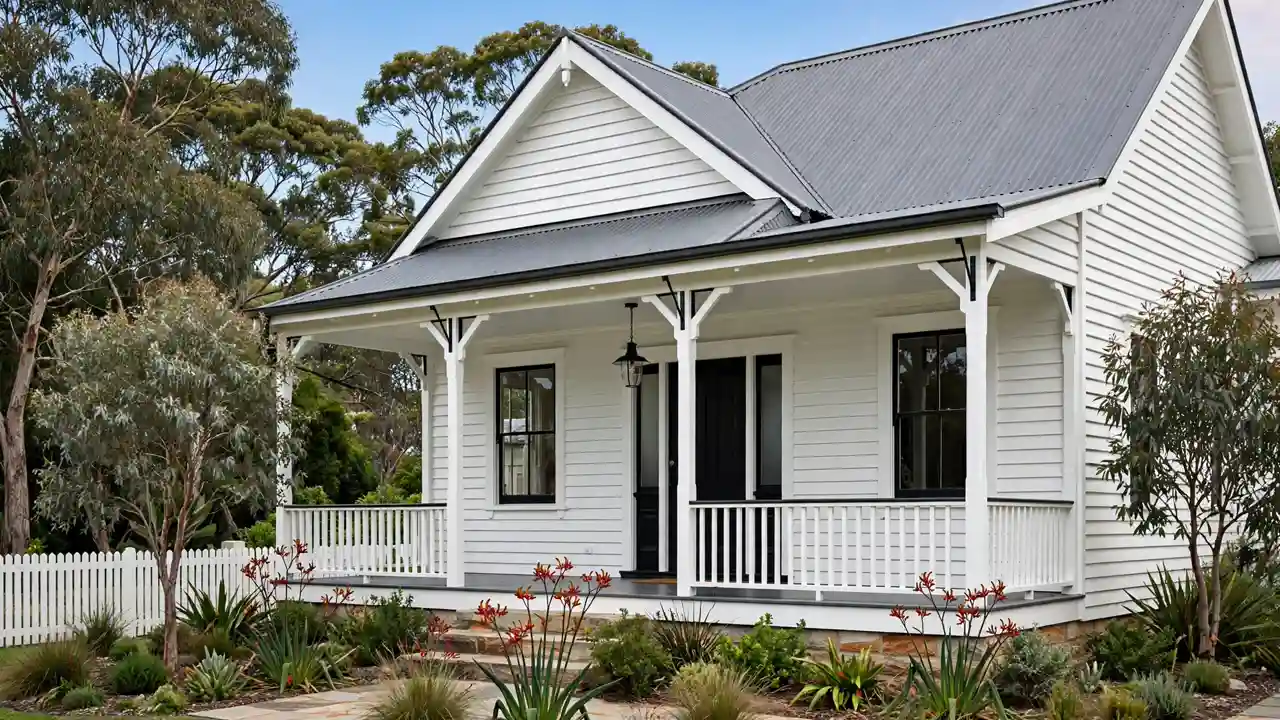
Hamptons. White or soft-grey weatherboard, a gabled roof, wide eaves, contrasting trim, columns on the verandah. It is still the most asked-for facade in Sydney’s northern suburbs and northern beaches. It suits two-storey homes best. Budget $90 to $320 per square metre installed for Scyon Linea or Stria, or $80 to $115 for Weathertex.
Coastal. Weatherboard or fibre cement in white and soft blue, generous glazing, a verandah that faces the breeze. Salt air punishes spotted gum battens. They silver fast and need oiling every 12 to 18 months. Fibre cement and standing-seam metal hold up far better. Budget $80 to $180 per square metre installed.
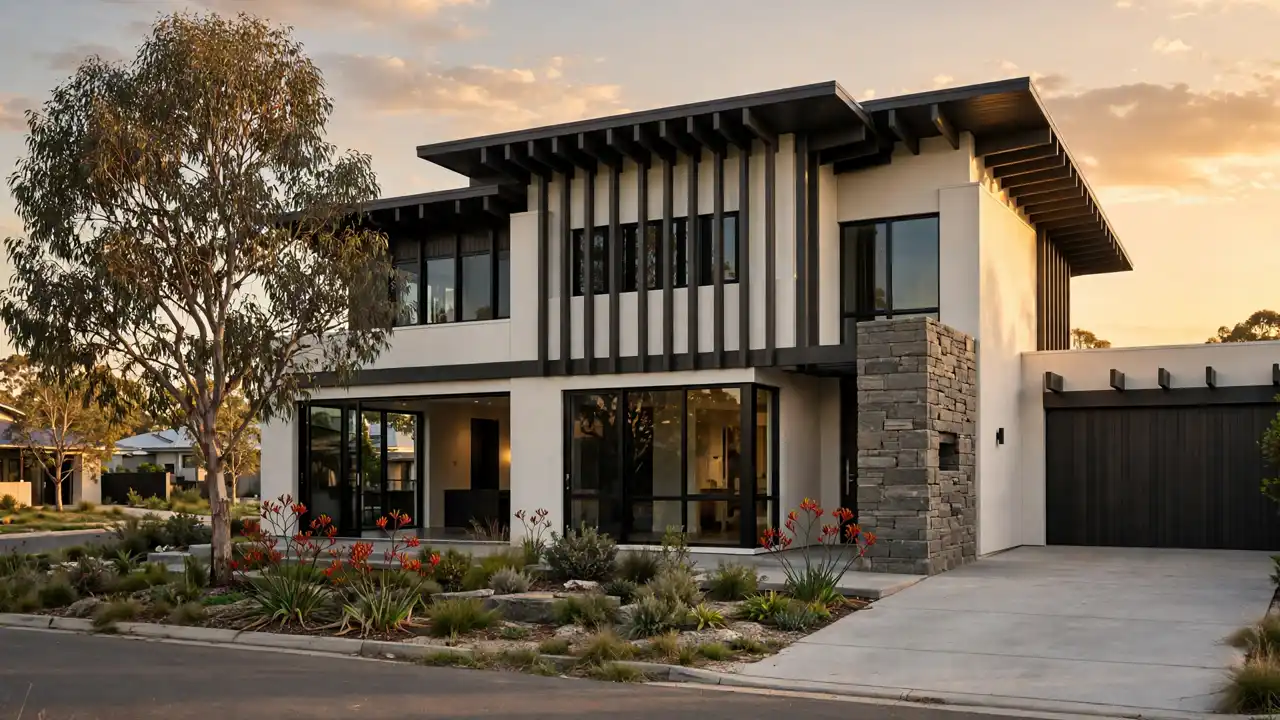
Contemporary. Rendered walls with a brick or stone feature panel, a pared-back palette, mixed materials on the front only. Budget $65 to $140 per square metre installed for the render and fibre cement bulk of it. Then add $250 to $500 per square metre for the stone feature panel itself.
Modern. Flat or skillion roof, monochromatic palette, geometric forms, big black-framed glazing. Standing-seam metal at $100 to $200 per square metre installed and acrylic render are the usual pair.
French provincial. Steep pitched roof, rendered walls in warm white, arched windows, ornamental mouldings.
Mid-century. Low-pitched roof, face brick, timber accents, horizontal lines.
Scandi / minimalist. Pale timber-look cladding, white render, black window frames, no ornament.
Country / farmhouse. Weathertex or corrugated metal, a wide verandah, a gable that faces the road.
Industrial. Standing-seam metal, face brick, black steel, raw concrete.
What Each Material Costs, Installed — Reconciled From 4 Sources
The numbers below disagree at first glance, and the disagreement is the lesson. James Hardie quotes Linea weatherboards at $88.15 per square metre and Axon cladding at $58.60. But those are product-only figures. They exclude building wrap, framing, paint, labour and wastage. RenoPerth’s 2026 installed rates for the same fibre cement family run $90 to $320. Instead, they include substrate, membrane, flashings and install. So compare installed to installed, or product to product, never one against the other.
| Material | Installed, $/m², 2026 | Lifespan | Repaint / upkeep | BAL |
|---|---|---|---|---|
| Acrylic render over masonry | $65–$95 | 25–30 years | Repaint 7–10 years | BAL-19 with substrate |
| Fibre cement (Linea / Stria / Axon) | $80–$150 | 25–50 years | Repaint 12–15 years | Up to BAL-29 / BAL-FZ |
| Weathertex | $80–$115 | 25+ years | Repaint | Check product rating |
| Face brick (premium range) | $90–$200 | 50+ years | Almost none | BAL-40 |
| Composite timber-look | $110–$160 | 25+ years | Wash only | Check product rating |
| Standing-seam metal | $100–$200 | 30–40+ years | Almost none | BAL-40 |
| Spotted gum timber battens | $150–$280 | 20–25 years | Oil every 12–18 months | Not BAL-29 |
| Charred timber (shou-sugi-ban) | $140–$210 | 30+ years | Oil every 5 years | Check product rating |
| Natural stone cladding | $250–$500 | 50+ years | Almost none | BAL-40 |
Two rows deserve a second look. Weatherboard cladding is sometimes quoted at $3.20 to $6.85 per square metre. That is a material-only figure for thin weatherboard from a HiPages breakdown. It excludes the install labour, which runs about $55 per hour. The Australian Government’s Your Home guide to cladding systems makes the same point from the other side. A cladding system is not just the outer skin. It is the framing, the pliable membrane and the insulation behind it, plus the ventilated cavity that drains water away. A quote that prices the boards and forgets the cavity is not a cheaper quote.
3 Worked Facade Budgets
The three budgets below turn facade design ideas australia into dollar figures. They use only the installed rates above. Facade area means wall area, not floor area. A single-storey home has roughly 120 square metres of facade wall. A two-storey home has roughly 200.
Budget 1 — Front-only refresh, 60 square metres, render and paint
Acrylic render at $65 to $95 per square metre gives $3,900 to $5,700 for the front wall. Then add scaffold at $1,500 to $3,000, plus paint. Total $6,000 to $10,000. This is the cheapest way to change a street presence. It is also the only budget here that usually avoids a DA.
Budget 2 — Full single-storey reclad, 120 square metres, fibre cement
Linea or Stria at $90 to $150 per square metre gives $10,800 to $18,000. Next, add removal of the old cladding at $2,000 to $5,000. Then membrane and flashings at $1,500 to $3,000, plus scaffold at $2,000 to $4,000. Total $16,000 to $30,000. That sits inside RenoPerth’s $17,000 to $40,000 full-reclad range for Perth. That is the independent check on the maths.
Budget 3 — Two-storey luxury facade, 200 square metres, 60/30/10
First, render covers 60 per cent: 120 square metres at $65 to $95 = $7,800 to $11,400. Second, face brick covers 30 per cent: 60 square metres at $90 to $200 = $5,400 to $12,000. Third, stone covers 10 per cent: 20 square metres at $250 to $500 = $5,000 to $10,000. Materials and install $18,200 to $33,400, plus scaffold, removal and detailing at $6,000 to $12,000. Total $25,000 to $45,000 at standard finish. Sydney luxury guides quote $25,000 to $100,000-plus for the same 200 square metres when the stone share grows. The 60/30/10 rule is not a style tip. Instead, it is a budget control. Move the stone from 10 per cent to 30 per cent and the same facade costs $15,000 more.
Bushfire Rules Can Veto Your Favourite Material
If the block is bushfire prone, the BAL rating decides the palette before taste does. BAL rules can ban timber weatherboard outright. Fibre cement systems reach BAL-FZ, the highest level. Meanwhile, face brick, standing-seam metal and stone are BAL-40 rated. Spotted gum battens are not BAL-29 compliant. So a Hamptons look on a BAL-29 block means fibre cement Linea boards instead of timber. Same shadow line, different material, no compliance fight. Check the BAL before the design is drawn, not after the quote arrives. A material swap at design stage costs nothing. But a swap after the DA is lodged costs the application. Your Home notes that cladding in bushfire-prone areas must meet the BAL for the site. Finally, the local council can confirm whether the property falls in a bushfire-prone area.
Council Approval: When a Facade Needs a DA
Repainting like-for-like never needs approval. But a reclad often does. A facade that changes the roofline, adds a gable, or alters the front setback almost always does. Council DA fees run $200 to $1,000 or more. Heritage conservation areas add controls on materials and colours. Those controls can veto a modern metal facade on a period street. The other approval trap is the street. A knockdown rebuild must sit comfortably in its street. Meanwhile, councils in some areas enforce streetscape character rules. Those rules limit how far a facade can depart from its neighbours.
How to Read a Facade Quote: 7 Exclusions That Double the Price
Most facade disputes are not about the cladding rate. That is why facade design ideas australia searches return such wildly different prices for the same house. Instead, the quotes are not pricing the same scope. Rather, they are about the lines missing from the quote.
Before you sign, check each of these seven items. Each one should be included or priced separately. First, scaffold and edge protection. Second, removal and disposal of the old cladding. Third, the pliable building membrane and ventilated cavity. Fourth, flashings, trims and corner accessories. Fifth, paint or finish coats. Sixth, window and door detailing, where most leaks start. Seventh, council DA fees. LastElegance’s cost guide warns that trims, membranes and stainless steel fixings are often costed separately or missed altogether. James Hardie’s own worked examples exclude building wrap, corner accessories, framing, paint, labour, wastage and window openings. A quote at $90 per square metre excludes membrane, scaffold and removal. Still, it costs more than a quote at $140 that includes them. So ask for the quote in the same seven lines from every builder. Then the comparison becomes honest.
5 Mistakes That Ruin a Good Facade
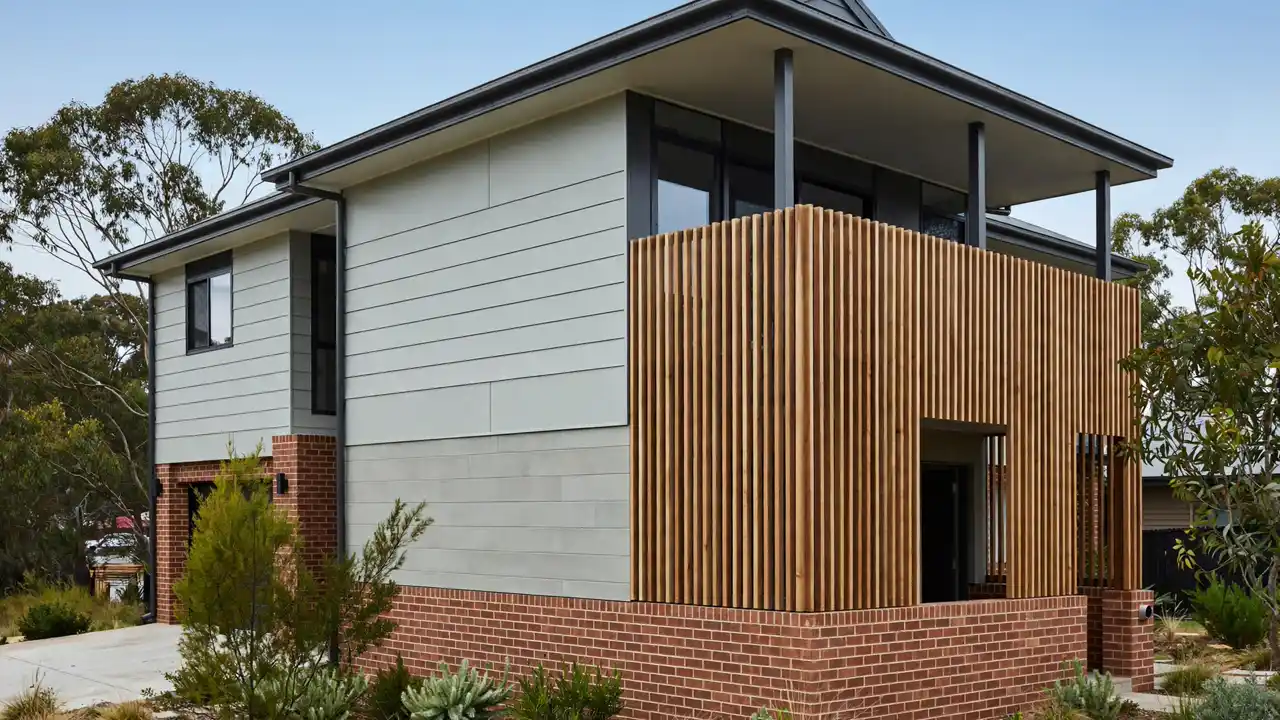
One material everywhere. A single cladding across the whole front reads flat and cheap, whatever it costs. The 60/30/10 split exists because the eye needs a secondary and an accent.
Dark colours on a hot wall. Your Home notes that lighter colours or reflective finishes are preferable in most Australian climates because dark cladding absorbs heat.
Timber where the sun and salt will kill it. Spotted gum silvers fast on the coast and needs oiling every 12 to 18 months. If the maintenance will not happen, composite timber-look is the honest choice.
Forgetting the garage door. The garage door is often a third of the facade width. Clad it to match, or at least paint it in the secondary colour. It is the cheapest upgrade in this whole guide.
Choosing the style before the block. A Hamptons gable on a narrow block with no front setback looks crowded. A flat-roof modern on a heritage street looks wrong, and it may not pass council. The block, the BAL and the street choose the shortlist — taste picks from it. Our guide to open plan living ideas shows how the facade choice flows through to the interior. Our guide to renovating a house covers the approval and sequencing steps a reclad shares with any major renovation. Budget the whole job against our renovation cost per square metre guide before you commit to a material.
Frequently Asked Questions
How much does a new facade cost in Australia?
A full reclad runs $17,000 to $40,000 in 2026 Perth pricing, and a two-storey luxury facade of about 200 square metres runs $25,000 to $100,000 or more in Sydney, depending on materials.
What is the cheapest facade material in Australia?
Acrylic render over masonry is the cheapest installed option at $65 to $95 per square metre, followed by Weathertex at $80 to $115 and fibre cement at $80 to $150 per square metre installed.
Can I use timber cladding on a bushfire-prone block?
Often not. Timber weatherboard can be ruled out by the BAL rating, and spotted gum battens are not BAL-29 compliant. Fibre cement systems can be built to BAL-FZ, and face brick, metal and stone are BAL-40 rated.
Do I need council approval to change my facade?
A repaint never needs approval, but a reclad often does, and any change to the roofline, a new gable, or a front setback change almost always needs a development application, with fees of $200 to $1,000 or more.
What is the 60/30/10 rule for facades?
It is a proportioning rule: 60 per cent main cladding, 30 per cent contrasting secondary material, and 10 per cent textural accent. It gives a facade depth without visual clutter, and it controls cost because the expensive material stays at 10 per cent.
How long does fibre cement cladding last?
Fibre cement cladding lasts 25 to 50 years, with repainting every 12 to 15 years. It is resistant to fire, termites and moisture, and it holds its shape in coastal salt air.
Finally, start with the BAL and the street. Then pick three materials in a 60/30/10 split and price them installed, not product-only. The facade design ideas australia homeowners regret are almost never the expensive ones. They are the ones priced on the boards alone, with the membrane, the scaffold and the DA discovered afterwards. So get those seven quote lines in writing. Then the facade you love will be the facade you can actually afford.