
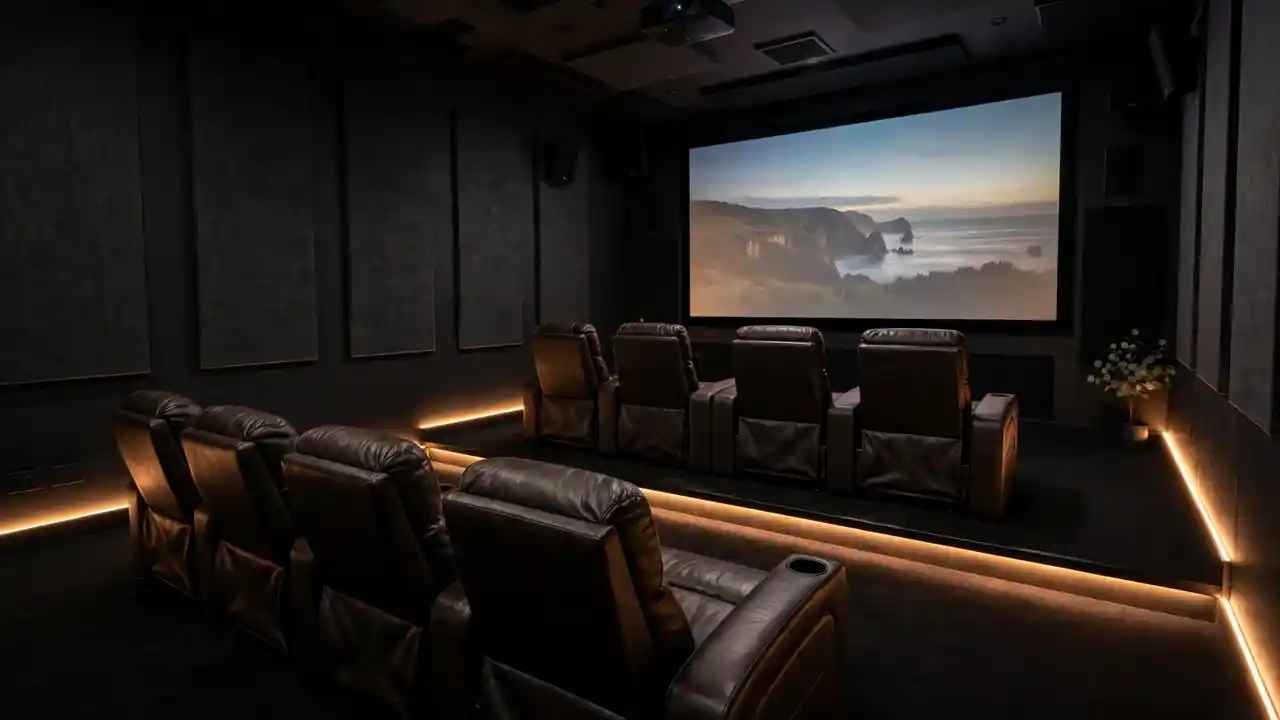
A theatre room is the one room where the walls matter more than the screen. The best theatre room ideas Australia has to offer in 2026 start from the room’s dimensions. Three things matter, not the catalogue: how long the room is, how far you sit, and how much sound escapes. This guide gives you the screen-size maths, seating and acoustic choices, and the 2026 costs. Five Australian sources reconciled those costs.
Theatre Room Ideas Australia in 2026: The Short Answer
For most Australian homes, the winning theatre room is a dedicated 4 to 6 metre room. It has a 4K projector on a 120 to 150 inch screen, 7.2.4 Atmos, acoustic treatment. One row of recliners on a low riser. First, budget $8,000 to $15,000 for a lounge media-room upgrade. Next, a dedicated cinema costs $45,000 to $90,000. A considered build with real sound isolation costs $90,000 to $220,000.
Room Size First: The Screen Maths Nobody Shows You
Viewing distance decides screen size, not budget. For 4K, sit about 1.5 times the screen diagonal back. So 100 inches wants 3.8 metres; 120 inches wants 4.5 metres. A room shorter than 4 metres struggles to justify projection. Instead, an 85 to 98 inch TV with 5.1.2 Atmos gives a great cinema experience there. It costs $15,000 to $28,000 in a 3 to 4 metre room.
The worst dimensions are a perfect cube, or a room where two dimensions match. Both create standing waves no speaker tuning can fix. Rooms with dimensions in ratios like 1 to 1.4 to 1.9 sound best. For example, 3 by 4.2 by 5.7 metres works well. Measure the room before anything else. If the room is a cube, change it: a false wall, a bulkhead or a riser breaks the symmetry. Theatre room ideas Australia wide start with a tape measure, not a shopping list.
TV or Projector: The Honest Split
Projectors give a cinema-scale image at a lower cost per inch. Premium OLED and QLED TVs give a brighter image in rooms with ambient light. That is the whole decision. If you can control the light, a projector wins. If the room must work as a living space with daylight, a TV wins. A projector there will always look washed out.
A good 4K laser projector costs around $10,000, and a 120-inch screen starts at around $2,000. An acoustically transparent screen costs more, but it puts the dialogue where the picture is. A TV has no screen cost, but a 98-inch TV is heavy and hard to mount. If the budget forces a choice, spend on the room and the speakers first. A $5,000 projector in a treated room beats a $10,000 projector in a bare room.
Seating: Rows, Risers and Recliners
You cannot fix seating geometry after the room is built. One row needs 4 to 6 metres. Two rows need a riser at $1,800 to $3,000. They need enough ceiling height for the back row to see over the front.
First, budget recliners start at about $500 per seat. Luxury recliners with motorised recline, cup holders and charging ports run $2,500 or more a seat. Australian custom cinema seating sits above that. Manhattan Comfort starts at $1,899 per seat, while Brooklyn Pro starts at $3,999 per seat. The maker builds both to order, with an 8 to 12 week lead time. Flat-pack theatre lounges are far cheaper. A four-seat electric recliner lounge sells for $2,999 on sale, about $750 a seat. Still, they are lounges, not cinema chairs.
Acoustics: Treatment Is Not Soundproofing
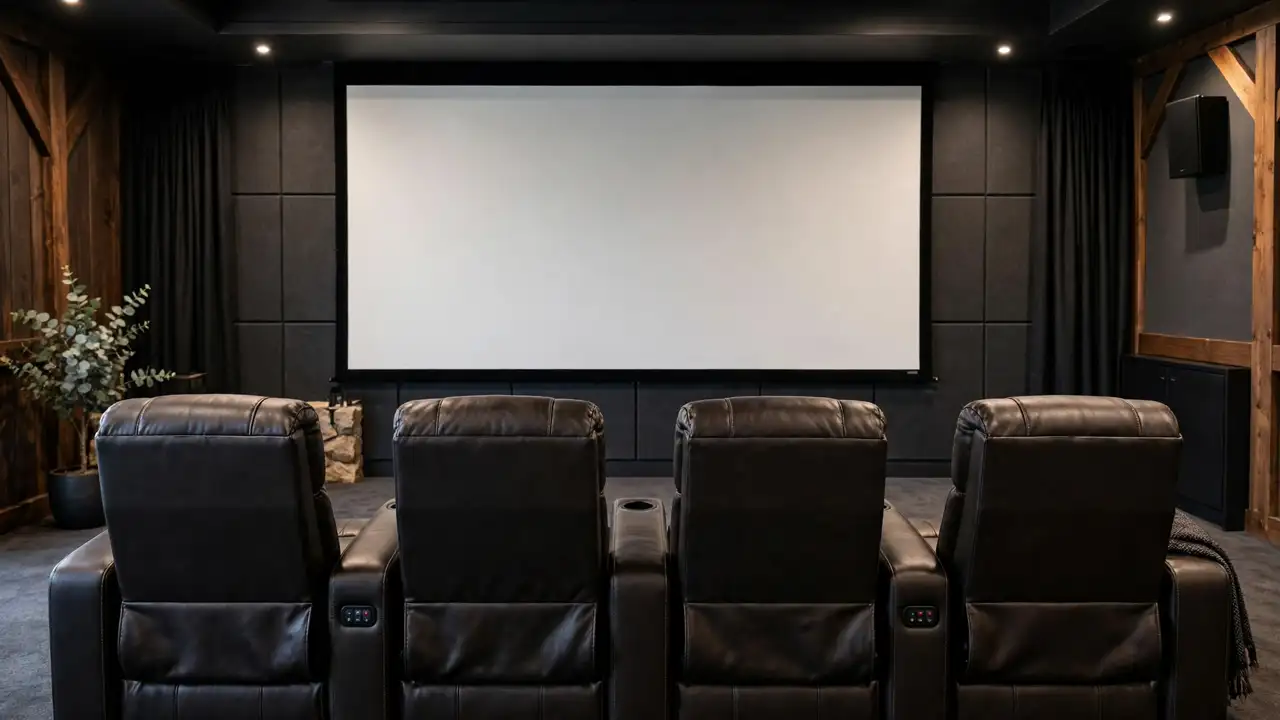
First, treatment fixes the sound inside the room. Panels and bass traps calm echo and tighten dialogue. Sound isolation, meanwhile, stops sound leaving the room. It uses isolated stud walls, resilient mounts, acoustic doors and a floating floor. Soft finishes can make a room feel calmer. Even so, YourHome notes they do not usually stop noise passing through walls, floors or ceilings.
Start with treatment, because it is cheap and it works. First, put acoustic panels on the first reflection points, bass traps in the front corners. Then add a thick rug and heavy curtains to kill the flutter echo of bare plasterboard. Price isolation only if the theatre sits beside or under a bedroom. It is the dearest part of a dedicated build. AS/NZS 2107:2016 suggests 30 to 40 dB(A) for living areas in suburban homes. That is a useful target for how quiet the room should be when the film is not playing. Theatre room ideas Australia wide that skip treatment and buy speakers first are the dearest mistake in this guide. The YourHome noise control guide explains the three separate problems. Airborne noise, impact noise and reverberation. Each one needs a different fix.
Sound, Light and the Rack That Overheats
In short, a 5.1 system is the honest minimum. It has front left, centre, front right, two surrounds and a subwoofer. Next, a 5.1.2 Atmos layout adds two height channels. For a dedicated 4 to 6 metre cinema, 7.2.4 is standard. Point the height speakers at the main seating position, not straight down. Atmos speakers aimed at the ceiling bounce sound everywhere except where you sit.
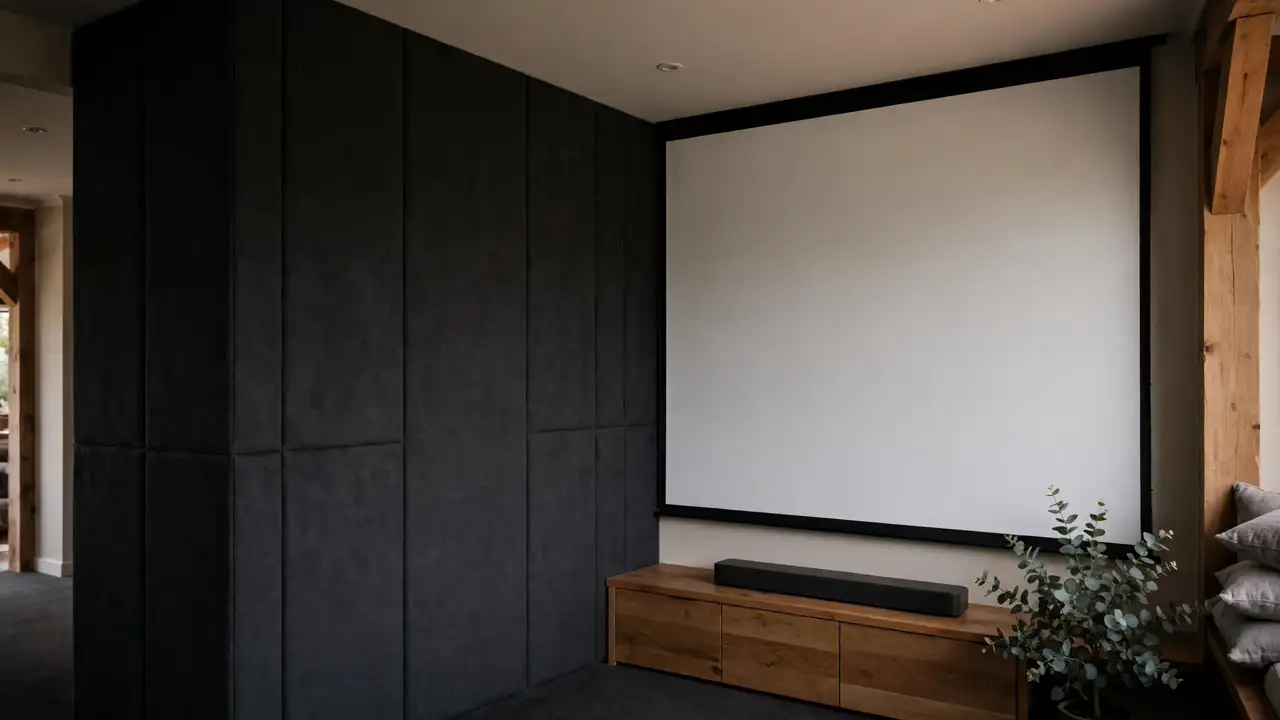
Next, paint the walls, ceiling and screen wall a dark matte colour. Bright walls reflect screen light and kill contrast. A white ceiling above a projector is the worst surface in the room. Fit blackout blinds or heavy curtains on windows. Put dimmable lighting on a scene controller. Move the AV rack to a separate ventilated cupboard. Amplifiers overheat and throttle within 18 months in a closed cabinet without airflow. A rack in the room also adds fan noise and LED glow. A licensed electrician must do all fixed wiring to AS/NZS 3000. Pre-wire during construction, because it is the cheapest money in the build.
What a Theatre Room Costs in 2026
Theatre room prices span further than any other room in the house. The sources are pricing different things. Some quote install-only tiers. Others quote equipment-plus-install packages. The rest quote full room builds with isolation and calibration. Five Australian sources agree on the shape of the ladder. First, DX Living puts a media room at $15,000 to $40,000. It puts a dedicated entry cinema at $45,000 to $90,000 and a considered build at $90,000 to $220,000. At the top, a reference cinema costs $220,000 to $600,000 or more, excluding GST and the building shell. SmartSpace in Perth puts a small media room at $12,000 to $25,000. It puts a medium dedicated cinema at $45,000 to $120,000 and a reference-grade room at $150,000 to $350,000 or more.
Next, PrimeTheatres puts entry at $10,000 to $15,000, mid-range at $20,000 to $35,000, and high-end at $50,000 or more. Palmers in Canberra puts a lounge upgrade at $8,000 to $15,000. It puts a mid-tier room at $20,000 to $45,000 and a premium cinema at $80,000 to $250,000 or more. Finally, a Melbourne installer puts entry at $2,500 to $4,500. It puts mid-range at $5,000 to $9,000 and premium at $12,000 and up. Those are install-only tiers, excluding the room build. The step that costs the most is between a media room and a dedicated cinema. Almost none of it is visible in a photograph. It is isolation, structure and calibration.
The Reconciled 2026 Price Ladder
| Build type | Typical range, 2026 | What it covers |
|---|---|---|
| Lounge media-room upgrade | $8,000–$15,000 | Large TV, 5.1 sound, blackout, lighting |
| Small dedicated room, 3–4 m | $12,000–$25,000 | 85-inch TV or projector, 5.1.2 Atmos, seating |
| Dedicated cinema, 4–6 m | $45,000–$90,000 | 4K projector, 120–150-inch screen, 7.2.4, riser, treatment |
| Considered cinema with isolation | $90,000–$220,000 | Isolation, object audio, calibration, designed seating |
| Reference-grade cinema | $220,000–$600,000+ | Room-in-room, high-end processing, custom joinery |
Also, seating and screens move inside those bands. A 120-inch screen costs from about $2,000, a 4K laser projector from about $10,000. Then, a riser costs $1,800 to $3,000. Seating runs from $500 to $1,899 to $3,999 a seat for Australian custom motorised chairs. A new home assessed under the 7-star NatHERS standard needs the windowless cinema in the energy conversation early. As a result, it changes the whole-of-home rating.
Theatre Room Ideas Australia: 3 Worked Budgets
Three budgets built only from the sourced prices above.
Budget 1 — lounge media room, $8,000–$15,000. Palmers’ lounge-upgrade band: a large TV, 5.1 surround, blackout blinds and lighting control. SmartSpace’s small-room band of $12,000 to $25,000 overlaps it at the top. In short, this is the right budget when the room still has to work as a living space.
Budget 2 — dedicated 4 to 6 metre cinema, $45,000–$90,000. DX Living’s entry dedicated tier, cross-checked against SmartSpace’s medium band of $45,000 to $120,000. A 4K projector at about $10,000, a 120 to 150 inch screen from $2,000. Add a 7.2.4 Atmos layout, acoustic treatment, a riser at $1,800 to $3,000. Then add four cinema chairs.
Budget 3 — considered cinema with sound isolation, $90,000–$220,000. DX Living’s considered tier: isolation, object-based audio, calibrated projection and integrated lighting control. The step from Budget 2 to Budget 3 is almost entirely structure and calibration. None of it shows in a photograph.
How to Read a Theatre Room Quote
Ask for the projector model and throw distance. Also ask for the screen size and material and the speaker layout in numbers. Then ask for the acoustic treatment plan, the seating model and lead time and whether the quote includes calibration. The five items most often left out are the riser, acoustic treatment, and ventilation for the AV rack. They include the electrician’s work and the calibration visit. A quote without calibration is a quote for parts, not a cinema.
First, get three quotes for the same specification, and check the installer’s licence and insurance. Custom Australian cinema chairs take 8 to 12 weeks, so order them before builders finish the room, not after. Ask what happens when something fails. With access panels and a ventilated rack, you can fix it without demolition. Our Hamptons interior guide shows the style to avoid in a theatre room. The interior painting cost guide prices the dark matte repaint. For colour and texture in low light, our Scandinavian interior guide covers the layering.
Frequently Asked Questions
How much does a theatre room cost in Australia?
A lounge media-room upgrade costs $8,000 to $15,000, a dedicated 4 to 6 metre cinema costs $45,000 to $90,000, and a considered cinema with sound isolation costs $90,000 to $220,000 in 2026. The dearest step is the move from a media room to a dedicated cinema, because that is where isolation and structure sit.
What size screen do I need for my room?
For a 4K image, sit about 1.5 times the screen diagonal back: a 100-inch screen wants seating around 3.8 metres back, and a 120-inch screen wants seating around 4.5 metres back. A room shorter than 4 metres struggles to justify projection, so a large TV is the better buy there. Measure the room first, because the room length decides the screen size, and the screen size decides the seating.
Is a projector or a TV better for a theatre room?
A projector is better in a dedicated room where you can control the light, because it gives a true cinema-scale image of 100 inches and beyond at a lower cost per inch. A TV is better in a room with daylight, because premium OLED and QLED panels stay bright where a projector washes out. A good 4K laser projector costs around $10,000, and a 120-inch screen starts at around $2,000.
Do I need soundproofing in a theatre room?
You need acoustic treatment in every theatre room, and sound isolation only when the room sits beside or under a bedroom. Treatment — panels, bass traps, rugs and curtains — fixes echo and dialogue inside the room. Isolation — separated walls, resilient mounts, acoustic doors — stops sound leaving the room, and it is the dearest part of a dedicated build. Soft finishes alone do not stop noise passing through walls, floors or ceilings.
How much do theatre room seats cost?
Budget recliners start at about $500 per seat, and luxury motorised recliners run $2,500 or more per seat. Australian custom cinema seating starts at $1,899 per seat for the Manhattan Comfort range and $3,999 per seat for the Brooklyn Pro range, both made to order with an 8 to 12 week lead time. A four-seat flat-pack electric recliner lounge sells for $2,999 on sale, or about $750 a seat.
What is the best room shape for a theatre room?
A room with dimensions in a ratio like 1 to 1.4 to 1.9, for example 3 by 4.2 by 5.7 metres, sounds best. Avoid a perfect cube or a room where two dimensions match, because both create standing waves that no speaker tuning can fix. If the room is a cube, break the symmetry with a false wall, a bulkhead or a riser before spending on equipment.
Measure the room, then buy the screen, seats and speakers — in that order. Theatre room ideas Australia wide only work when you decide the room’s length and shape before the equipment list. Put the isolation, riser and calibration in the first quote, not the second one.