
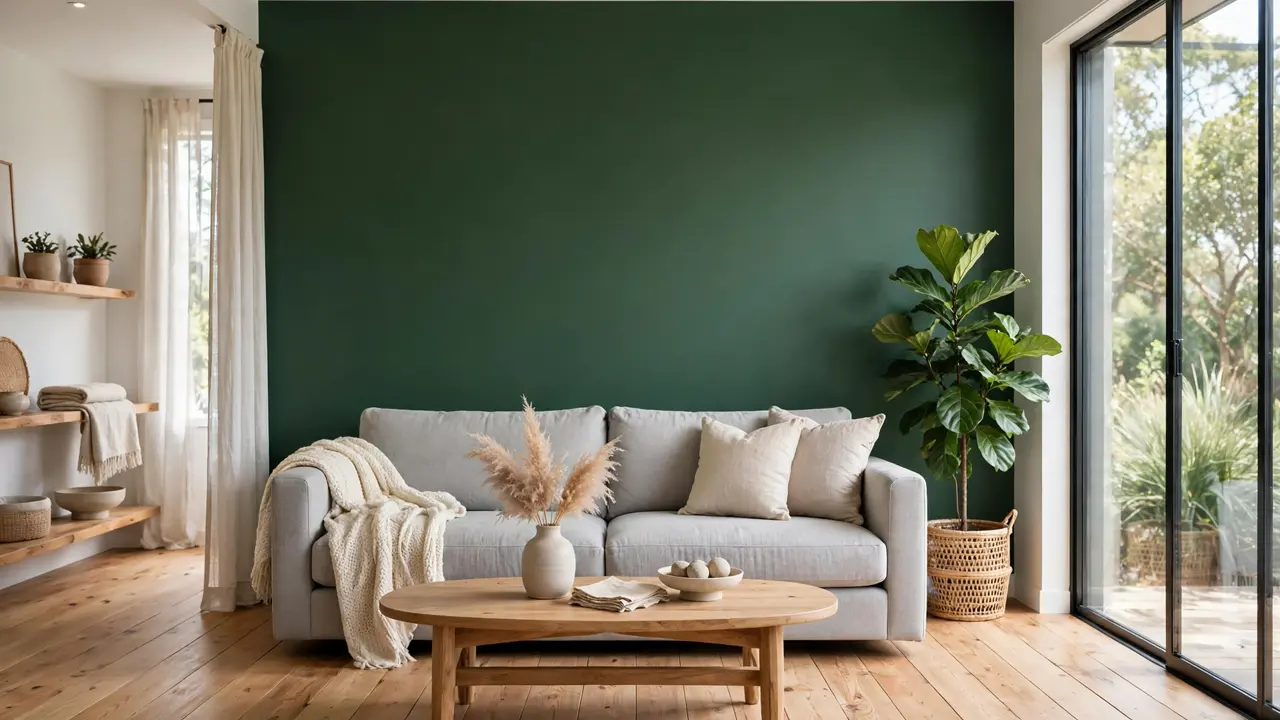
Overall, feature wall ideas Australia start at $150 to $300 for a painted 12 square metre wall. Indeed, the wall that works is the one the room already faces, not the one with the most blank space. Feature wall ideas Australia buyers choose between seven finishes. They span that $150 paint job and a $2,100 to $4,200 timber-clad wall. Moreover, the difference between a wall that lifts the room and a wall that dates in a year is the test patch, the light and the undercoat. Not the colour chart.
Certainly, paint is the cheapest and the fastest to change. Timber battens are, moreover, the most popular in 2026. Similarly, wallpaper is the easiest pattern. In addition, stone veneer is the dearest per square metre. Furthermore, this guide prices all seven. Moreover, it splits the advice room by room for the living room and the bedroom. Finally, it works three real budgets with the arithmetic shown.
Feature Wall Ideas Australia in 2026: The Short Answer
Pick the wall first and the finish second, because the wrong wall wastes the best finish. Specifically, the feature wall is the wall you see when you walk into the room. Behind the bed in a bedroom. In a living room, behind the sofa or the television. In a bathroom, behind the basin. Ultimately, one wall only, never two.
Paint suits renters and first-timers at $150 to $300 for a 12 square metre wall. Similarly, timber battens suit owners who want texture at $1,800 to $3,500 for a 15 square metre wall. Wallpaper suits pattern lovers who want a weekend job. Stone and tile suit fireplaces and television walls at $800 to $3,000 as a fixed project. Feature wall ideas Australia readers ask first about cost. However, the honest answer is that the finish decides the price, not the room. First, test the colour on a 1 square metre patch. Judge it at midday, in the evening and under lamps before you commit. A colour that looks rich on a chart can look flat on a full wall.
Choosing the Wall: The Decision Most People Get Wrong
Generally, the strongest feature walls in Australian homes sit on the wall the room is naturally oriented toward. Moreover, the most common mistake is choosing a wall because it is empty. However, an empty wall is often empty for a reason. It is the wall with the door, the hallway opening or the window. However, a feature finish there fights the traffic instead of framing the room. In a bedroom, therefore, the bedhead wall is the answer in almost every case. The bed and the linen soften even a deep green or navy. Indeed, the wall is the first thing you see from the door.
Likewise, in a living room the answer is the focal wall behind the sofa or the television. A deeper colour there helps the screen and the joinery recede instead of competing with them. Check the wall in your own light before you choose the colour. Deep greens, blues and charcoals need a tinted undercoat. Consequently, a quote that does not name the undercoat is not a complete quote. Small and dark rooms need particular care. A dark wall in a room with one small window closes the room in. Bunnings puts the rule simply in its planning guide. The wall you see first when you walk into a room is the wall to go with.
7 Feature Wall Finishes, Priced
Indeed, paint is the cheapest finish and the only one a renter can realistically do. Specifically, standard interior wall painting runs $15 to $25 per square metre in Sydney in 2026. A plain colour-change feature wall runs $20 to $40 per square metre. A 4 litre tin of Dulux Wash and Wear runs about $65 to $85. That is why a 12 square metre wall lands at $150 to $300 including paint and basic tools. Limewash is the next step up at $35 to $65 per square metre. It needs multiple thin coats and a specialist brush. Venetian or polished plaster runs $80 to $200 per square metre. Trowelling and burnishing is a specialist skill, not a roller job.
Timber, Wallpaper, Stone and Cladding
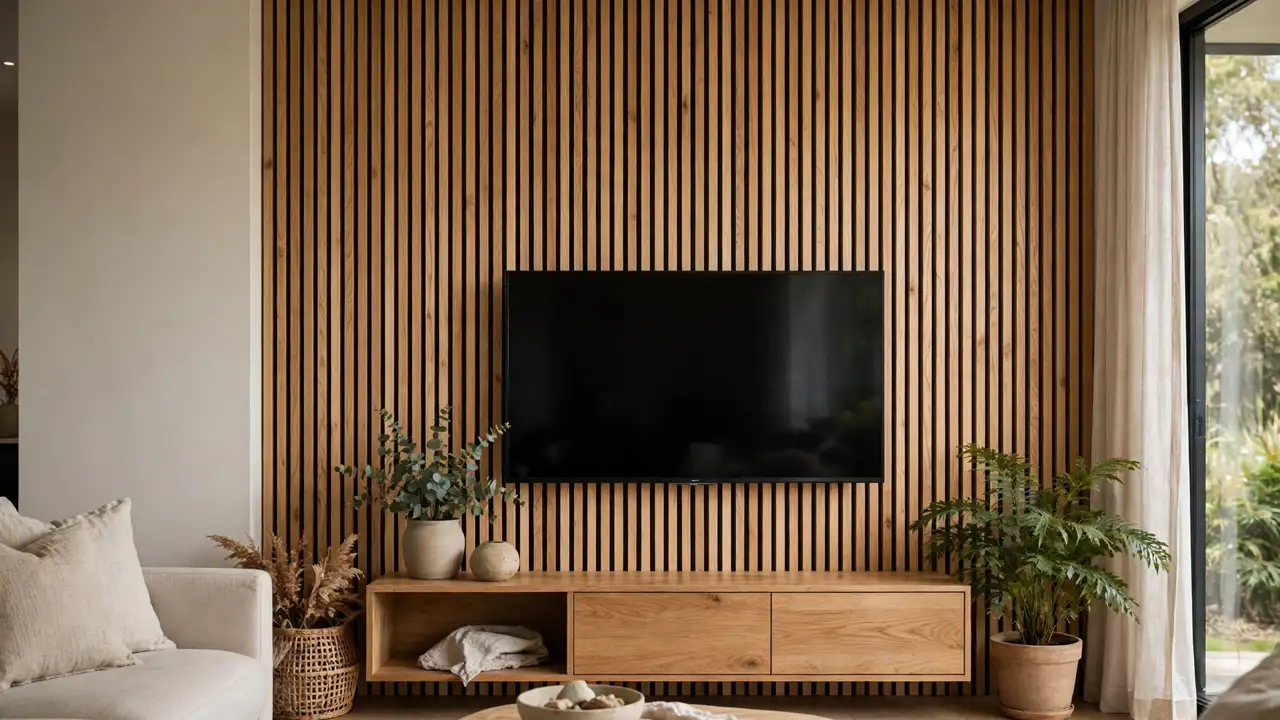
Timber battens are the 2026 favourite. Spotted gum runs $120 to $180 per square metre installed. Blackbutt runs $100 to $150, pine V-groove boards $80 to $120, and engineered timber panels $90 to $140. James Hardie VJ lining board runs about $45 to $55 per square metre before installation as the budget alternative. Wallpaper is the simplest pattern. Paste-the-wall papers go up in a day. Additionally, the cost is the paper plus $25 to $40 per square metre for a professional hang.
Similarly, stone veneer runs $110 to $220 per square metre installed. Wall tiling runs $60 to $120 per square metre for a living room wall. Fireplace and television feature walls are usually priced as a fixed project of $800 to $3,000 rather than per square metre. The tile size, the pattern and the mitred edges drive the labour more than the area does. Moulding and wainscoting are the cheapest texture: MDF moulding strips from a hardware store, painted the wall colour or a contrast colour, with wainscoting usually run to one-third of the wall height. Composite cladding, the newest option, runs $140 to $280 per square metre fully installed. That puts a 15 square metre feature wall at $2,100 to $4,200.
| Finish | Installed cost | Best for |
|---|---|---|
| Paint, colour change | $20 to $40 per m2 | Renters, first-timers, fast change |
| Limewash | $35 to $65 per m2 | Soft texture, coastal and heritage rooms |
| Venetian plaster | $80 to $200 per m2 | Luxury finish, low-traffic walls |
| Timber battens | $80 to $180 per m2 | TV walls, bedheads, warmth |
| Wallpaper | Paper plus $25 to $40 per m2 to hang | Pattern, weekend projects |
| Stone veneer / tile | $60 to $220 per m2 | Fireplaces, TV walls |
| Moulding / wainscoting | Lowest material cost | Classic rooms, entries, hallways |
Living Room Feature Walls
Indeed, the living room feature wall does two jobs at once: it anchors the seating and it hides the television. A timber batten wall behind the television is the most popular 2026 choice. The vertical lines add height, the timber warms a room full of screens, and the battens hide cables behind them. A deep painted wall behind the television works the same way for a tenth of the price. The dark colour makes the black screen recede, so the wall reads as a backdrop instead of a frame.
Stone veneer and tiling suit the fireplace wall. There the material earns its cost by surviving heat and drawing the eye to the fire rather than the television. Our interior house painting cost guide prices the whole-room job. Our coastal interior design guide shows how a feature wall works in a light, beach-toned room. Similarly, our master bedroom ideas guide carries the same thinking into the bedroom.
Bedroom Feature Walls
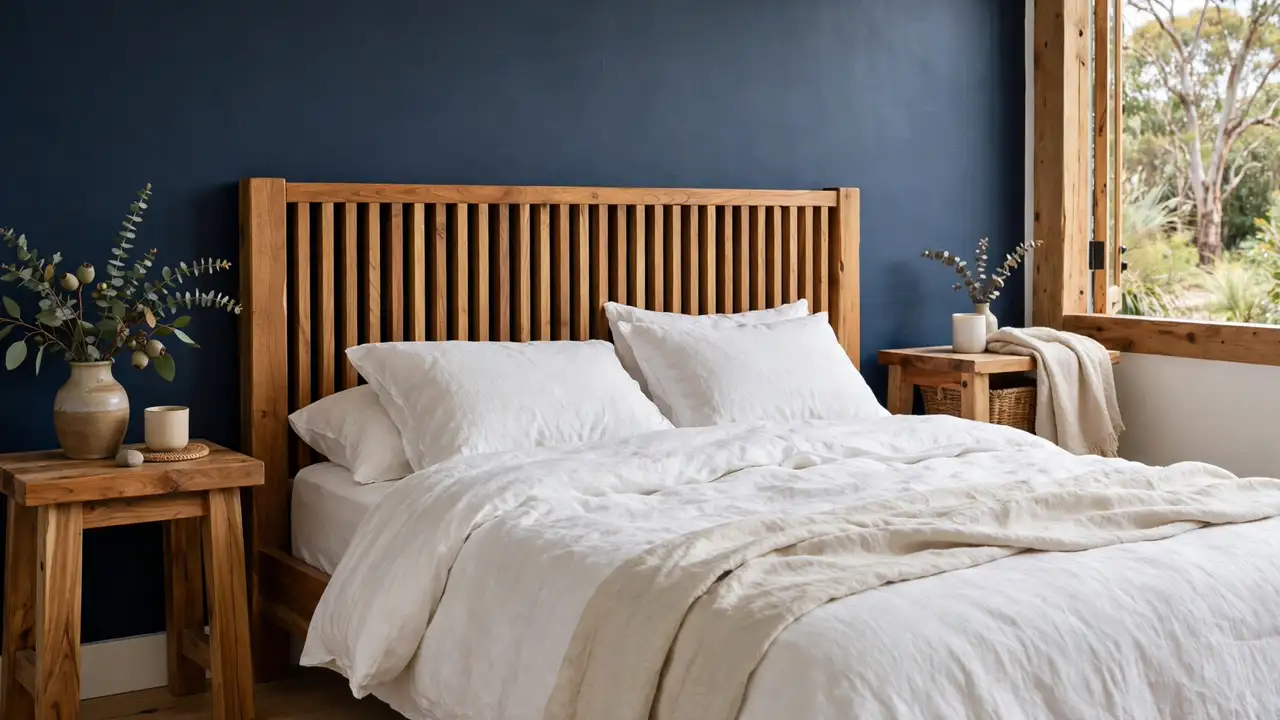
The bedroom feature wall is the bedhead wall. However, the rules are different from the living room. You judge the colour in the evening, under lamps and in early light, not at midday. Deep greens, blues and charcoals are popular behind the bed. The bed and the linen soften them. Muted tones suit smaller bedrooms where a dark wall would close the room in. Timber battens behind the bed frame the headboard and make the room feel cosy without looking crowded. Lighter wood tones keep a small room airy. Darker timber adds mood with soft lighting and neutral bedding.
Wallpaper works well behind the bed. The bed hides the bottom of the pattern, which is where a bad hang shows. Moreover, a single roll or two covers the visible area above the pillows. VJ panelling painted in a deep colour is the classic Australian bedroom feature. It adds texture and architectural interest. It installs vertically or horizontally. Likewise, it suits a coastal, classic or contemporary room depending on the colour. If the linen is patterned, the wall should be plain. If the wall is patterned, the linen should be plain.
Feature Wall Ideas Australia: 3 Worked Budgets
Three budgets built only from the sourced figures above, for the three rooms buyers actually start with.
Budget 1 — painted living room wall, 12 square metres, DIY: $150 to $300. A 4 litre tin of Dulux Wash and Wear at $65 to $85. Moreover, a roller, tray, tape and drop sheets at $50 to $100. Additionally, a second tin if the colour is dark and needs a tinted undercoat. That takes the total to $150 to $300. A professional painter would charge $20 to $40 per square metre for the same wall, or $240 to $480.
Budget 2 — timber batten living room wall, 15 square metres, professional: $1,800 to $3,500. Spotted gum or blackbutt at $100 to $180 per square metre installed. Moreover, a low timber console or floating shelf under the television. That takes the total to $1,800 to $3,500. Pine V-groove boards at $80 to $120 per square metre bring the same wall to $1,200 to $1,800. Similarly, a DIY batten wall using pine square edging from a hardware store can land under $600 in materials for a patient weekend.
Budget 3 — tiled fireplace or television wall, fixed project: $800 to $3,000. A fireplace feature wall in Melbourne typically runs $800 to $3,000 as a complete project. A television feature wall runs $900 to $2,800. The tile size, the pattern, the mitred edges and any niches drive the labour more than the wall area does. Stone veneer at $110 to $220 per square metre installed lands a 10 square metre wall at $1,100 to $2,200. That is before the hearth or the mantel.
What Quotes Leave Out
A feature wall quote is only comparable if it names the finish, the area and the preparation. However, the three lines that hide most often are the ones this section decodes. Preparation is the first. A quote that does not name sugar-soap cleaning, filling, sanding and primer is not a complete quote. Deep colours need a tinted undercoat. It is a separate line that cheap quotes omit and expensive repaints pay for. The second is the pricing unit. Paint, limewash and timber are honestly priced per square metre. Tiling and stone feature walls are honestly priced as a fixed project. Therefore, a per-square-metre tile quote that ignores the mitred edges and the niches will grow.
The third is the finish. Limewash and Venetian plaster need a specialist applicator. Nevertheless, a general painter quoting them at standard rates is quoting a job they cannot deliver. The fourth is the light test. No quote can tell you whether a colour works in your room. Consequently, judge a 1 square metre patch at midday, in the evening and under lamps. Compare quotes on those four lines, and the cheapest per-square-metre figure stops looking like a saving when the undercoat, the preparation and the specialist labour sit beside it. The Dulux feature wall guide sets out how to choose the wall and the finish. Overall, it is the practical starting point before you buy a tin of paint.
Frequently Asked Questions
How much does a feature wall cost in Australia?
A painted feature wall costs $150 to $300 for a 12 square metre wall done yourself, or $250 to $700 professionally. Timber battens run $1,800 to $3,500 for a 15 square metre wall, and a tiled fireplace or television wall runs $800 to $3,000 as a fixed project.
Which wall should be the feature wall?
The wall the room naturally faces: the bedhead wall in a bedroom, and the focal wall behind the sofa or the television in a living room. One wall only, with the other walls kept calm so the feature has something to stand against.
What is the cheapest feature wall idea?
Paint is the cheapest, at $20 to $40 per square metre professionally or $150 to $300 for a 12 square metre wall done yourself. MDF moulding strips are the cheapest texture, and a DIY pine batten wall can land under $600 in materials.
Are feature walls still popular in 2026?
Yes, and timber battens are the most popular finish in 2026, followed by deep painted walls and limewash. The trend has moved from one bold colour to texture and tone: battens, VJ panelling and limewash rather than a single bright wall.
Do I need a tinted undercoat for a dark feature wall?
Yes. Deep greens, blues and charcoals need a tinted undercoat, and a quote that does not name it is not complete. Without it the dark colour needs extra coats, and the finish looks patchy in raking light.
Can I do a feature wall myself?
Paint, wallpaper and simple pine battens are realistic weekend DIY jobs. Limewash, Venetian plaster and tiled feature walls need a specialist applicator, and a tiled wall with mitred edges or niches is a professional job.
Test the patch, name the undercoat, and price the preparation. The feature wall ideas Australia figure that holds up is the one quoted per square metre for paint and timber. Tile and stone are quoted as a fixed project.