
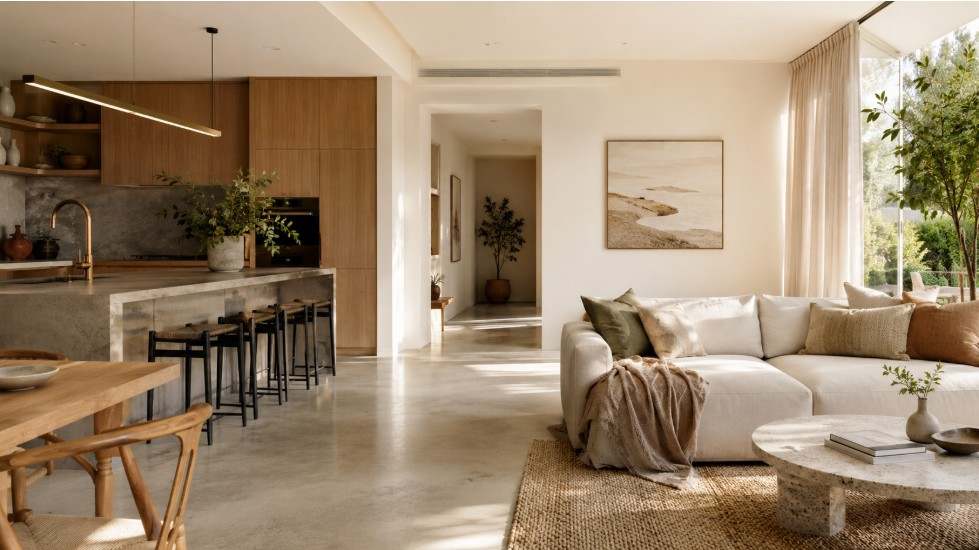
Walk into a room filled with polished concrete, stone, glass, and metal and it might look fantastic for the first few seconds. Then something feels off. The room is beautiful, sure, but it doesn’t exactly invite anyone to kick off their shoes and stay awhile.
That’s usually a balance problem.
Hard materials give a home structure. Soft details make that structure comfortable to live with. Getting the two to work together doesn’t require a strict decorating formula or an expensive redesign. It mostly comes down to knowing when a room needs another texture and when it simply needs fewer things.
Build Around the Surfaces That Have to Last
Start with the materials that would be a headache to replace. Flooring, countertops, paving, tiles, and built-in features aren’t throwaway design decisions. They’re the foundation.
Hard surfaces work best when they have some natural variation. A perfectly smooth gray floor beside a perfectly smooth gray wall can feel a little clinical. Give one of those surfaces visible grain, flecks, movement, or a matte finish and suddenly there’s something for the eye to notice.
Outdoor areas are a good example. Exposed aggregate adds visible stone and texture to driveways, pathways, patios, and pool surrounds, giving concrete more character without sacrificing the toughness people want from an exterior surface. Add leafy planting, timber furniture, and relaxed outdoor fabrics nearby and the contrast starts doing the decorating for you.
That’s often enough. No giant ornamental pot required.
Let Fabric Take the Edge Off
Fabric is one of the easiest fixes for a room that feels too hard.
Think about a living room with tiled floors, large windows, a stone coffee table, and clean-lined furniture. Nothing is necessarily wrong with it. But add a substantial rug, full-length curtains, and a sofa with a softer weave, and the mood changes almost immediately.
The trick is avoiding the “everything matches” trap.
A room doesn’t need six cushions in the exact same fabric. In fact, it usually looks better without them. Linen, wool, cotton, bouclé, and subtle woven textures can sit comfortably together when their colors make sense. Different textures create depth without needing loud patterns.
Ever noticed how a hotel bed can look inviting even when the whole room is neutral? Texture is usually doing more work than color.
Use Timber to Bridge Hard Materials and Soft Details
Wood is technically hard, but visually it has warmth that stone, glass, and metal often lack. That makes it incredibly useful when a home needs something between the two extremes.
A timber dining table can soften a tiled room. Wooden shelving warms up a white wall. Even a simple oak stool can make a concrete kitchen island look less severe.
The same principle matters when planning custom kitchen cabinets. Choosing the cabinetry specifically for the room means the finish, profile, hardware, and proportions can work with the harder materials around it instead of competing with them. Warm timber cabinetry beside pale stone, for example, tends to feel grounded without requiring much extra decoration.
Glossy surfaces can work too, but they need company. Pair too many reflective finishes and the kitchen starts edging into showroom territory.
Stop Trying to Match Everything
Perfect matching sounds sensible. In practice, it can flatten a room.
Gray floor. Gray couch. Gray curtains. Gray countertop. Give it another five minutes and someone will probably suggest a gray vase.
Contrast is much more interesting.
Put rough beside smooth. Pair something matte with a restrained amount of shine. Let dark timber sit against a pale wall. Place a rounded chair near straight architectural lines.
Curves are especially useful in modern homes because so many permanent features are rectangular. Doors, windows, cabinets, tiles, islands, and shelving all bring straight edges into a room. A round table, curved lamp, or softer armchair breaks that rhythm without demanding attention.
Make the Walls Feel Personal
Hard and soft aren’t limited to furniture and floors. Walls play a part too.
Large blank walls can make a minimalist room feel calm, but there’s a fine line between calm and unfinished. Personal pieces help cross that gap.
Arranging pictures with frames on a wall adds color, shape, and personality while introducing another material into the room. They work particularly well against simple plaster, stone, or streamlined joinery because the contrast gives both the artwork and the architecture room to stand out.
And they don’t need to hang with ruler-perfect precision.
A slightly relaxed gallery arrangement often feels more natural than one where every frame appears to have been positioned with laboratory equipment. Homes aren’t galleries. They’re allowed to look lived in.
Bring Nature Into the Mix
Before buying another decorative object, try a plant.
Seriously.
Greenery has a way of making hard rooms feel softer without looking like “decor” in the usual sense. Tall plants work especially well in corners where two hard walls meet. Smaller plants can break up long countertops or shelves.
Natural fibers do much the same thing. Cane chairs, jute rugs, woven baskets, linen curtains, and wool upholstery introduce little irregularities that manufactured surfaces often lack.
The beauty is in those imperfections. A woven basket isn’t perfectly uniform. Neither is timber grain. Neither is stone. That’s exactly why they work together.
Know When the Room Has Enough
One of the harder decorating skills has nothing to do with buying things.
It’s knowing when to stop.
If a room already has textured flooring, timber cabinetry, patterned upholstery, artwork, plants, and decorative objects, adding another “feature” probably won’t improve it. Sometimes the missing ingredient is blank space.
Let the stone be visible. Give the rug room to breathe. Don’t cover every stretch of wall simply because it’s empty.
A balanced home doesn’t need equal amounts of hard and soft materials. Some rooms naturally lean one way. Kitchens can handle more hard surfaces. Bedrooms can take much more fabric.
The goal is simpler than that. When a space starts feeling cold, soften it. When it starts feeling busy, strip something back.
And if removing two cushions fixes the whole room? Even better.