
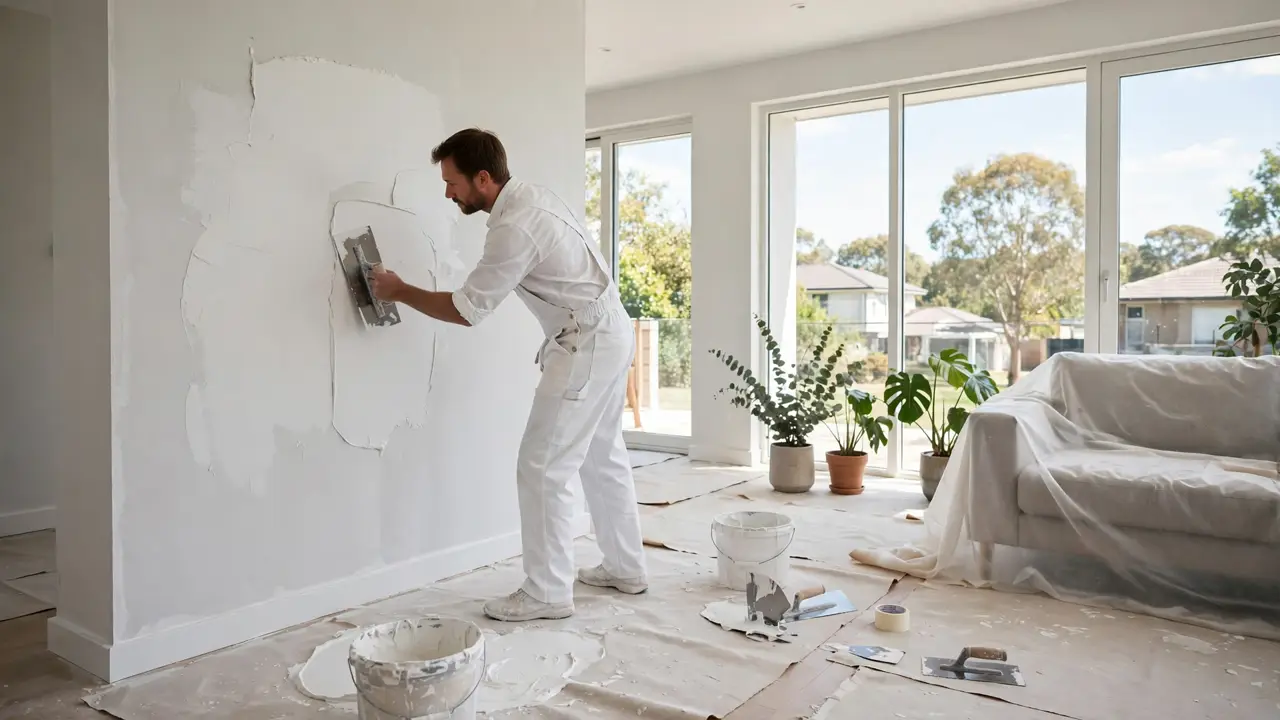
Plastering is the surface every other finish sits on: paint shows every ridge a plasterer leaves behind. Most homeowners only discover the price when a renovation is already under way. This guide answers it with real 2026 numbers: plastering cost Australia ranges from $20 to $100 per square metre, and the type of work decides where you land.
Plastering cost Australia at a glance
There is no single rate: finishing new board is quick, skimming tired walls takes more judgement, and solid plaster is slow, heavy work. The table below is the national picture for 2026, GST included.
| Type of work | Typical cost per m² | Where it is used |
|---|---|---|
| Set and finish only, boards already hung | $20–$35 | New builds and extensions |
| Supply, hang and set plasterboard | $40–$90 | Renovations and relines |
| Skim coat over existing walls | $30–$60 | Damaged or patched walls |
| Set coat over sound render | $30–$55 | Masonry walls |
| Two-coat solid plaster on brick or block | $50–$100 | Double brick homes |
| Lime plaster for heritage work | $80–$160 | Period and damp-affected homes |
| Polished or Venetian plaster | $120–$300 | Feature walls |
The ranges assume standard-height walls and a single-storey home. Ceilings cost a little more, and small jobs carry minimum charges of $250 to $400.
Set and finish: what the cheapest job covers
When the boards are already hung, the plasterer’s job is to make the joints, screw heads and corners disappear: tape each joint, then three coats of compound — a base coat to bed the tape, a second coat to fill, and a topping coat feathered out thin. Corner beads go on every external corner.
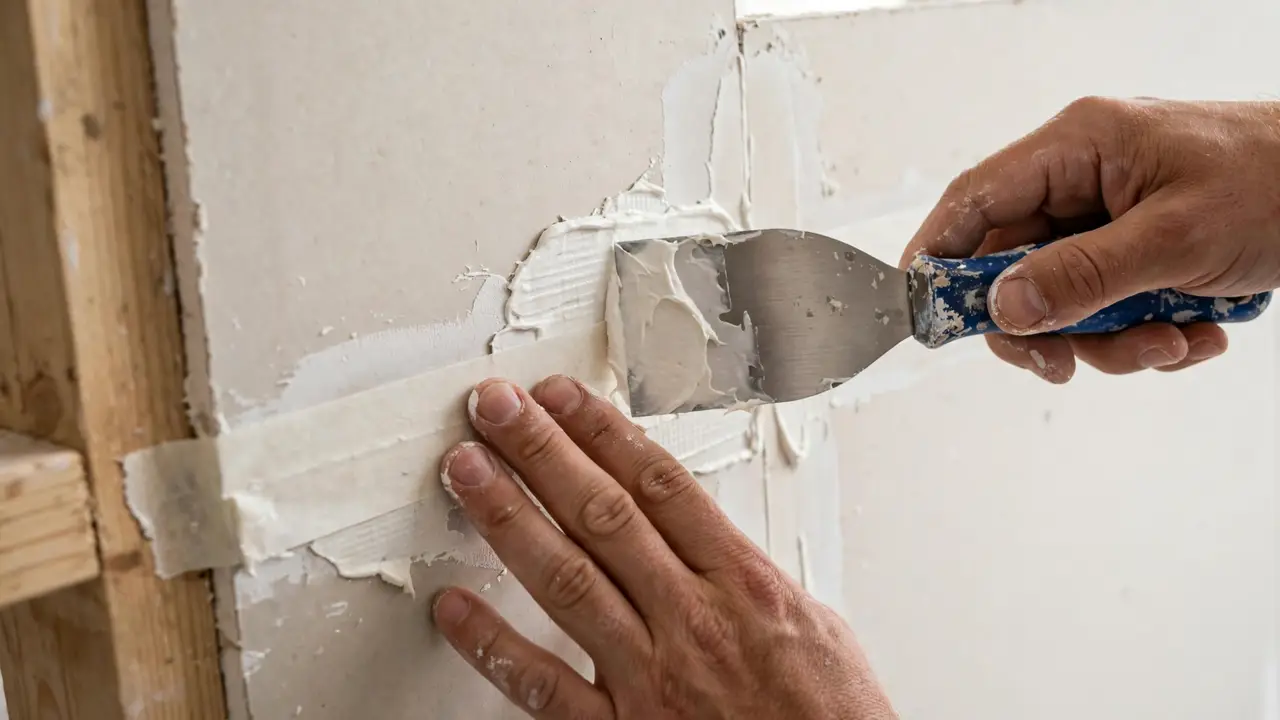
Each coat has to dry before the next, so a plasterer typically visits three or four times across several days. That is why setting a small room can cost almost as much as a large one. The normal target is a Level 4 finish under AS/NZS 2589, which suits flat and low-sheen paints. Check the work in raking light before the painter starts.
Materials are only a few dollars per square metre here, so 80 percent or more of the price is the plasterer’s time. A quote far cheaper than the others usually means fewer coats or less sanding.
Supply, hang and set: the full plasterboard price
When the plasterer supplies the board, the price covers fixing the sheets, taping the joints, three coats of compound, corner beads and sanding — the whole job, ready for paint. Standard 10 mm board on walls runs $40 to $70 per square metre supplied, hung and set; 13 mm ceilings $50 to $90; wet-area board $50 to $85; fire-rated board $60 to $100.
The board itself is the cheap part. A standard 10 mm sheet (2400 × 1200 mm) costs $16 to $28 at retail, or about $6 to $10 per square metre, and adhesives, screws, tape and compounds add roughly $4 to $8. Labour is 60 to 75 percent of the installed price, which is why the rate moves so much between cities. Removing old linings is usually extra, at $15 to $30 per square metre.
Bathrooms and laundries need moisture-resistant board, and areas that will be tiled only need the joints set flat, which keeps the cost down.
Skim coating old walls: when a thin coat wins
A skim coat is a thin layer of compound spread over the entire wall, then sanded. It turns a patchwork of old repairs, torn paper and dents into one even surface. It is the usual answer after wallpaper removal, when the paper face of the board often tears. Expect $30 to $60 per square metre, depending on the wall’s condition and whether one or two coats are needed.
Torn paper must be sealed first, or moisture in the compound raises bubbles. Gloss-painted walls need sanding or a bonding primer so the coat grips.
Skim coating makes sense when the wall is sound and mostly flat. Relining wins when the board is soft, water damaged or badly cracked.
Solid plaster on brick and block
Solid plastering is applied directly to masonry. A typical system is a sand and cement render coat of 10 to 15 mm, straightened with a long screed, followed by a thin hard set coat trowelled smooth — slower, heavier work than plasterboard, which is why it costs more.
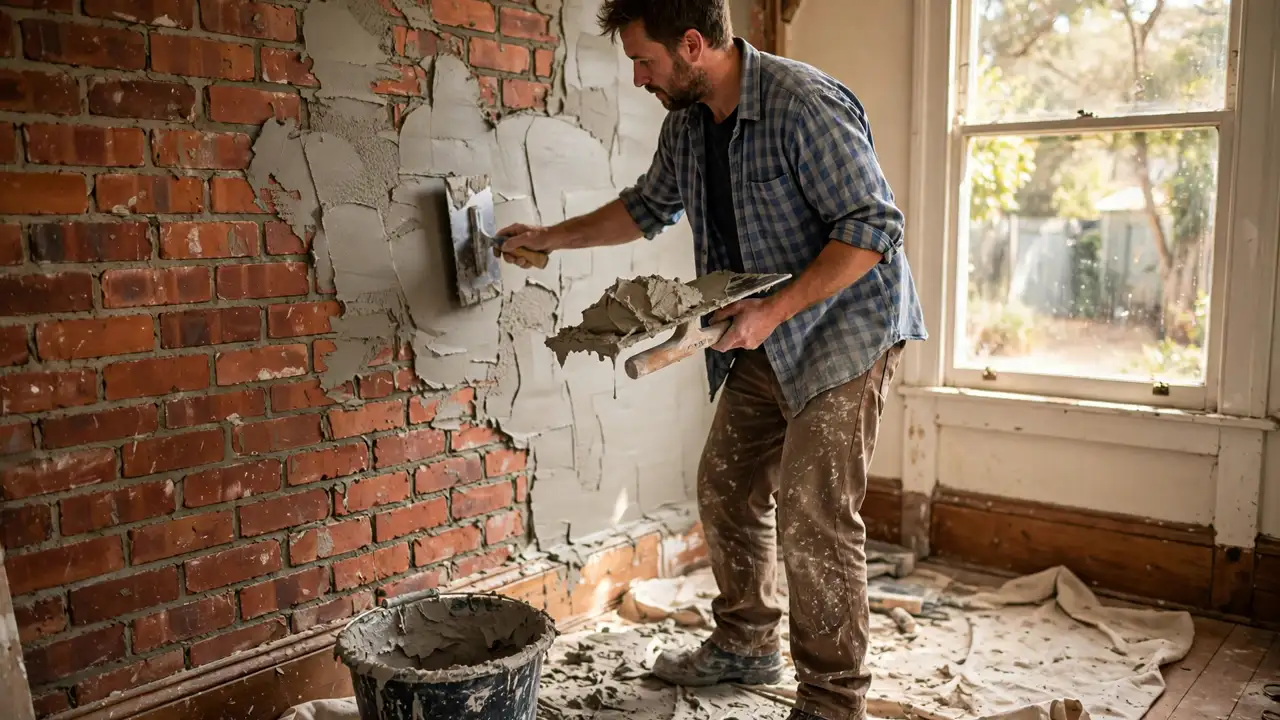
It is the standard finish inside double brick homes in Perth and in many older homes elsewhere. It also comes up when a new internal brick wall is built, when an electrician chases cables into brick walls, or when old plaster has blown and drummy patches need replacing. In a framed home, a stud wall lined with plasterboard is cheaper and faster. In a double brick home, owners often want solid plaster so the new work sounds and feels like the rest of the house — at a noticeably higher price.
Heritage homes with solid masonry walls and no damp course often suit lime plaster better than cement, because lime lets moisture escape. Solid plaster also needs time: the render coat must cure before the set coat, and the finished plaster needs to dry before painting, which can take a few weeks in cool weather.
Plastering cost Australia by city
Labour is most of the price, so the city matters. The table below gives typical hourly and day rates for an experienced plasterer in 2026.
| City or area | Hourly rate | Day rate |
|---|---|---|
| Sydney | $70–$100 | $600–$850 |
| Melbourne | $65–$95 | $550–$800 |
| Brisbane | $60–$90 | $500–$750 |
| Perth | $65–$95 | $550–$800 |
| Adelaide | $55–$85 | $480–$700 |
| Hobart | $55–$85 | $480–$720 |
| Canberra | $65–$95 | $560–$820 |
| Darwin | $75–$105 | $620–$900 |
| Regional areas | $55–$90 | $450–$750 |
In Sydney, hanging and setting new plasterboard runs about $29 to $75 per square metre for labour, with a skim coat at $17 to $57. In Perth the same labour runs $26 to $68, and in Hobart $22 to $58.
Cornices, square set and decorative plaster
Cornices hide the joint where wall meets ceiling, and the choice between cove and square set changes both the look and the price. A standard 75 to 90 mm cove cornice costs $12 to $25 per linear metre installed. Larger contemporary profiles run $20 to $40, and ornate period cornice made new costs $40 to $120 per linear metre.
Square set — no cornice at all, with a clean, sharp corner made using a stopping bead — adds $15 to $30 per linear metre over a cove cornice, because the junction has to be finished to a much higher standard. A ceiling rose costs $150 to $600 fitted, and restoring damaged ornate cornice in place runs $150 to $400 per linear metre.
Polished or Venetian plaster turns a feature wall into the finish itself, at $120 to $300 per square metre. A Level 5 finish — a full skim over set joints for walls in harsh light — adds $10 to $20 per square metre, and it is money well spent on walls facing large windows or downlights.
Three worked budgets
The three budgets below use only the plastering cost Australia ranges in the tables above. All totals include GST.
Set and finish in a new extension, Sydney
A rear extension with about 120 square metres of plasterboard hung by the builder’s crew. Set and finish at $28 per square metre comes to $3,360. Cove cornice over 45 linear metres at $15 comes to $675, and sundries add $120. The total is $4,155, or about $35 per square metre including cornice.
Skim coat after wallpaper removal, Adelaide
Two bedrooms and a hallway, about 85 square metres of wall, where the paper face of the board tore when the wallpaper came off. Sealing the torn paper and filling dents at $6 per square metre comes to $510; the skim coat at $40 comes to $3,400; dust protection and clean-up add $250. The total is $4,160 — relining would have cost roughly $4,500 to $6,500.
Reline a whole three-bedroom house
Supplying, hanging and setting plasterboard across 380 to 450 square metres of walls and ceilings at $40 to $90 per square metre puts the job at $16,000 to $35,000. A whole-house reline often takes two to three weeks. Budget for painting on top. Our guide to house painting cost in Australia prices the next step.
What pushes the price up — and how to read a quote
Seven things move a quote: height above 2.7 metres, bad board hanging, small areas, cold damp weather, poor access, a Level 5 finish, and heritage work.
These seven lines should all be in the quote, with a number beside each one: the type of work and finish level; the measured area; board supply and thickness; cornice or square set per linear metre; preparation; protection and clean-up; and drying time and return visits.
Once you can read those seven lines, a plastering cost Australia quote stops being a single scary number and becomes a list you can compare line by line. Two quotes for the same scope should land within about 15 percent of each other. If one is far below the rest, it is almost always missing coats, sanding time or preparation.
Licences, safety and the asbestos check
Plastering is licensed trade work in several states once it passes a dollar threshold. In NSW a contractor licence is needed for residential work over $5,000 in labour and materials including GST. Fines for unlicensed work run to $22,000 for an individual and $110,000 for a company. Check the current rules on the NSW Government wet plastering licence page before you hire. Queensland requires a QBCC licence over $3,300, and Victoria generally needs a registered practitioner over $10,000.
Safety comes before sanding. In homes built before 1990, test old linings and fibre cement sheets for asbestos before anyone sands or demolishes them. Our guide to asbestos removal cost in Australia explains what testing and removal cost when the result comes back positive. Old paint in homes built before about 1970 may contain lead, and sanding compound creates a lot of fine dust — good plasterers use vacuum sanders and dust sheets.
How to get a fair quote
Get at least three written quotes for the same scope: the same rooms, finish level, cornice decision and preparation. A quote that leaves preparation out will always look cheaper and cost more by the end. The lowest plastering cost Australia figure is rarely the best value — it is usually the quote with the fewest coats, the least sanding, or the shortest drying time.
You can cut the bill without touching the setting: empty the rooms, strip wallpaper, remove hooks and curtain tracks, finish electrical and plumbing rough-in first, and arrange a mix and wash-out spot with water and power nearby.
Plastering comes after framing, rough-in and insulation, and before painting and floors. Set and finish on a few rooms takes three to five days; a skim coat takes two to four days; solid plaster needs weeks to dry in cool weather. In an apartment the same logic applies, with strata approval and lift bookings added — see our guide to apartment renovation cost in Australia. DIY setting suits a garage or shed; in a living room, uneven joints show for years under paint.
Frequently asked questions
How much does it cost to plaster a room?
A standard bedroom of about 38 square metres of walls and ceiling usually costs $1,700 to $3,300 to line with new plasterboard, ready for paint. A skim coat on a similar room runs $690 to $2,875.
Is skim coating cheaper than relining a wall?
Usually, yes, when the wall is sound. A skim coat runs $30 to $60 per square metre, while supplying, hanging and setting new board runs $40 to $90, plus $15 to $30 per square metre to remove the old linings. Relining wins when the board is soft, water damaged or badly cracked.
How long does plastering take to dry before painting?
Painters can usually start a few days after a plasterboard job, once the compound is dry. A skim coat needs two to four days for a couple of rooms. Solid plaster needs a few weeks to dry in cool weather.
Do I need a licence for plastering work in Australia?
It depends on the state and the job value. In NSW a contractor licence is needed for residential plastering work over $5,000 in labour and materials including GST. In Queensland the QBCC requires a licence for building work over $3,300, and in Victoria domestic building work over $10,000 generally needs a registered practitioner.
Can I plaster over old paint or wallpaper?
Not without preparation. Wallpaper should come off first, and torn paper must be sealed or the moisture in the compound raises bubbles. Gloss-painted walls need sanding or a bonding primer so the skim coat grips. Skimming straight over wallpaper or gloss paint will not last.
Should old plaster be tested for asbestos before sanding?
Yes. In homes built before 1990, old linings, textured ceilings and fibre cement sheets should be tested for asbestos before anyone sands or demolishes them. Old paint in homes built before about 1970 may also contain lead. Never sand or demolish old plaster of unknown age to save time.