
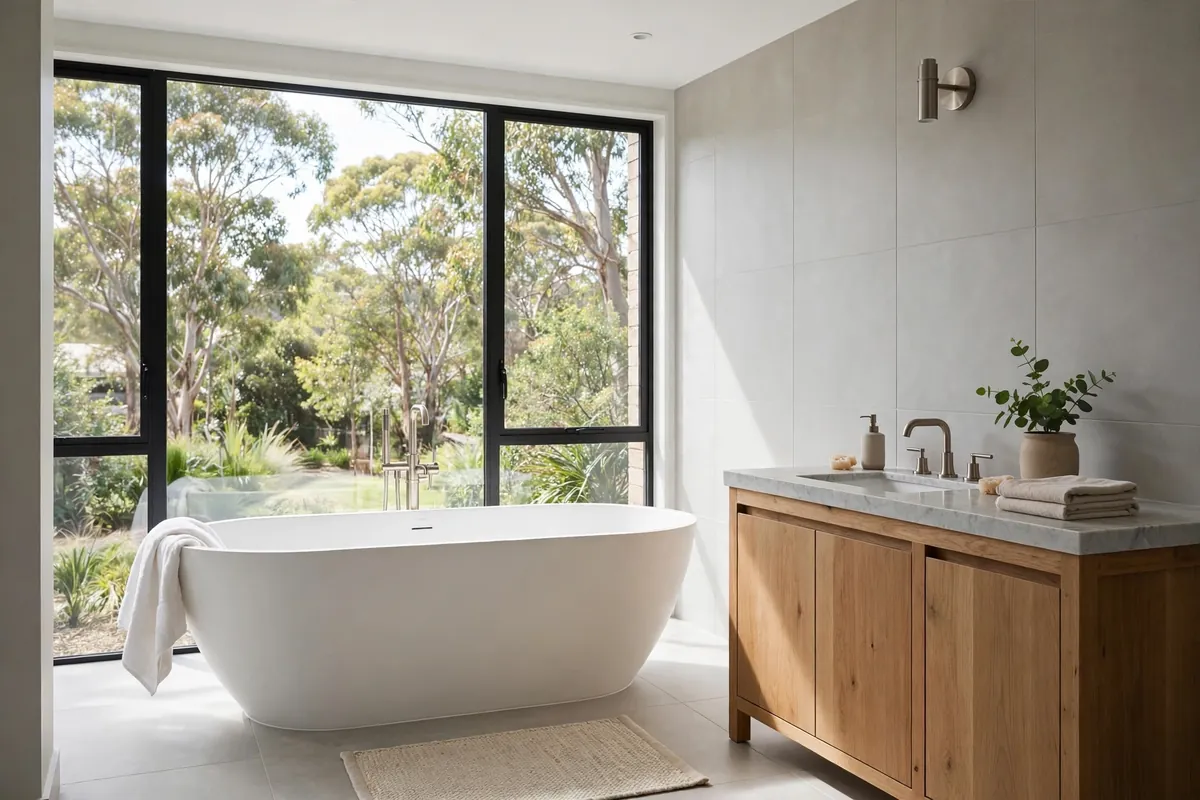
A freestanding bath is the single fastest way to make an Australian bathroom feel like a day spa. But with prices ranging from under $800 to well over $5,000 — and installation quirks that catch renovators off guard — choosing the right one takes more than picking the prettiest shape. This guide covers sizes, styles, materials and real installation costs so you can buy with confidence in 2026.
What Is a Freestanding Bath?
Unlike an inset or alcove bath that’s built into a tiled hob or framed against walls, a freestanding bath stands alone. All four sides are finished, so it can sit anywhere in the room — against a wall, under a window, or as a sculptural centrepiece in the middle of the floor. The waste and tapware are the only connections to the house.
This independence is both the appeal and the challenge. You get a striking focal point and design freedom, but you also need to plan plumbing, floor strength and waterproofing more carefully than with a standard inset bath. Get these fundamentals right and the result is worth every bit of extra planning.
Freestanding Bath Sizes: What Fits Your Bathroom?
Size is the first decision, and it’s dictated by your room — not your wish list. Here’s what the Australian market offers:
- Compact (1400–1500mm long): suits smaller bathrooms and ensuites. A 1500 x 750mm bath is the most popular size in Australia — big enough for a comfortable soak, small enough for most renovations.
- Standard (1600–1700mm long): the sweet spot for family bathrooms. A 1700 x 750mm or 1700 x 800mm bath gives most adults room to stretch out.
- Generous (1800mm+): true luxury sizing. Needs a large bathroom (at least 3 x 3.5 metres of clear floor space around it) and check your hot water capacity — these can hold 300+ litres.
Depth matters as much as length. Standard depth is around 580–600mm; deeper soaking tubs run 650mm+. Measure your doorways too — a freestanding bath arrives in one piece, and a 1700mm bath won’t fit through a standard 820mm internal door without planning.
How Much Floor Space Do You Need?
Allow at least 100mm clearance on all sides for cleaning access, plus room for the tapware. As a rule of thumb, add 300mm to the bath’s length and 200mm to its width when planning the footprint. For a 1700 x 800mm bath, plan for roughly 2000 x 1000mm of floor space.
Styles: From Oval Minimalist to Clawfoot Classic
- Oval/egg: the most popular freestanding shape in Australia. Soft curves suit modern and coastal bathrooms.
- Rectangular with soft edges: a contemporary look that pairs well with minimalist tapware.
- Back-to-wall: one flat side sits against the wall, hiding pipework. Easier plumbing, still looks freestanding from the front.
- Clawfoot/roll-top: traditional Victorian style on feet. Beautiful, but harder to clean around and under.
- Fluted/textured: the 2025–2026 trend — vertical grooves or hammered finishes that catch the light.
Materials Compared
- Acrylic ($800–$2,500): the most common choice. Lightweight (20–30kg empty), warm to touch, easy to install, huge range of shapes. Can scratch, but minor marks buff out. Look for sanitary-grade acrylic at least 4–5mm thick with fibreglass reinforcement.
- Stone composite ($2,500–$5,000+): crushed stone mixed with resin. Matte, solid feel, excellent heat retention — the water stays warm longer. Heavy (80–150kg+), so check floor loading, especially upstairs.
- Cast iron ($3,000–$8,000+): the traditional luxury option, usually with enamel coating. Virtually indestructible and keeps heat brilliantly. Extremely heavy (150kg+) — structural assessment is essential.
Freestanding Bath Installation Costs in Australia
Expect to pay $250–$550 for a straightforward like-for-like installation by a licensed plumber. But freestanding baths often involve extras:
- Plumbing relocation: $1,000–$2,000+ if the waste or water points need to move
- Floor waste/tiling adjustments: $500–$1,500 for re-tiling around the new footprint
- Freestanding tapware: $400–$1,500 for the mixer itself, plus $300–$600 installation
- Old bath removal: $200–$500 including disposal
- Floor reinforcement: $500–$2,000+ for heavy stone or cast iron baths, especially on timber floors upstairs
All plumbing work in Australia must be done by a licensed plumber, and a compliance certificate is required in most states.
Tapware: What Works With a Freestanding Bath?
You have three main options: a freestanding floor-mounted mixer (the classic look, $400–$1,500), wall-mounted tapware (needs the bath close to a wall, $300–$900), or a bath-mounted mixer drilled through the bath rim (only on some models). Floor-mounted mixers need the water pipes run through the floor before tiling — get your plumber involved early.
Pros and Cons at a Glance
Pros: stunning focal point; design flexibility; easier to replace later (no tiling to disturb); adds perceived value for resale.
Cons: needs more floor space; plumbing is more complex; can be harder to clean around; heavier models need structural checks; generally pricier than inset baths.
Where to Buy in Australia
You’ll find freestanding baths at bathroom specialists (Reece, Tradelink, Beaumont Tiles), hardware chains (Bunnings, Mitre 10) and online retailers. Specialist stores tend to stock better-known brands with stronger warranties, while online sellers often compete hard on price — just check freight costs, which can add $150–$400 for a bulky bath, and confirm the returns policy before ordering. Wherever you buy, check that the bath complies with Australian Standards (AS 2023) and comes with a Watermark licence — both are mandatory for plumbing products sold in Australia.
Buying Checklist
- Measure your bathroom, doorways and hallway access
- Check floor strength (critical for stone/cast iron, especially upstairs)
- Confirm hot water system capacity (a deep soak uses 200–300L)
- Choose tapware type before rough-in plumbing starts
- Check warranty (10+ years is standard for quality acrylic)
- Confirm the waste position matches your plumbing (or budget to move it)
If you’re planning a full renovation, our small bathroom design ideas show how to fit a freestanding bath into compact spaces, and our ensuite design guide covers luxury layouts where a freestanding bath shines.
Frequently Asked Questions
Are freestanding baths hard to clean around?
They need a bit more effort than an inset bath — you’ll be mopping or wiping the floor around all four sides. Allow at least 100mm clearance and choose a bath with a smooth base (no fiddly feet) to make cleaning easier. Most owners say it’s a minor trade-off for the look.
Can I put a freestanding bath on a timber floor upstairs?
An acrylic freestanding bath (20–30kg empty, ~250kg filled with water and a person) is usually fine on a standard timber floor, but get a builder or engineer to confirm. Stone or cast iron baths (80–150kg+ empty) almost always need reinforcement upstairs.
Do freestanding baths need special waterproofing?
The waterproofing requirements are the same as any bathroom — the membrane goes under the tiles across the whole wet area. The difference is that plumbing penetrations through the floor (for the waste and floor-mounted mixer) need careful sealing. Your waterproofer and plumber should coordinate.
How much does a freestanding bath cost installed in Australia?
Budget $1,050–$3,000 all-in for a mid-range acrylic freestanding bath including straightforward installation. Premium stone baths with plumbing relocation and freestanding tapware can run $5,000–$10,000+.
What’s the most popular freestanding bath size in Australia?
The 1500 x 750mm oval is the bestseller — it fits most Australian bathrooms while still giving a proper soak. The 1700 x 800mm is the go-to for larger family bathrooms.