
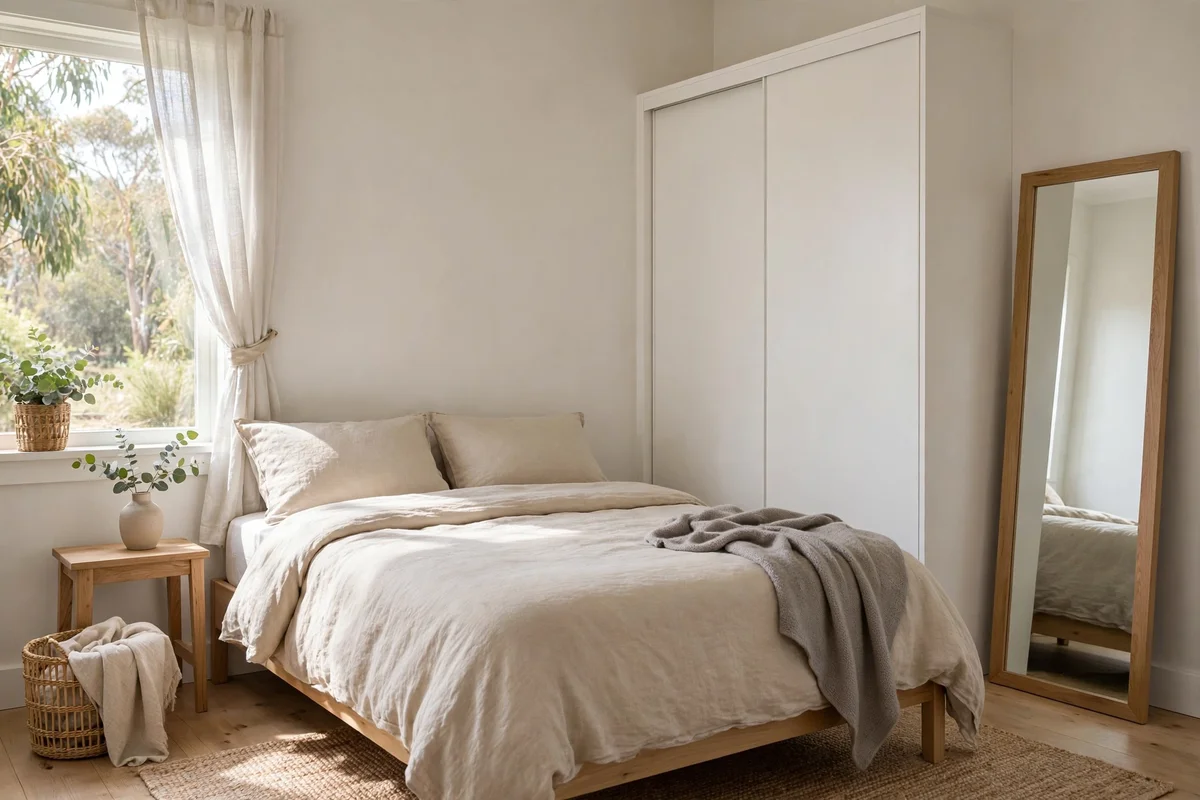
A small bedroom doesn’t have to feel cramped. With the right layout, colour palette and storage strategy, even a compact 3m x 3m room can feel comfortable, calm and genuinely restful. The trick isn’t to fight the size — it’s to make every square metre work harder.
Australian homes are getting smaller on average, and spare bedrooms, kids’ rooms and apartment bedrooms all demand smarter design thinking. This guide covers practical layouts, storage ideas and styling tricks that make small bedrooms feel bigger than they are.
How Small Is Too Small?
Here’s something most people don’t realise: the National Construction Code (NCC) doesn’t set a minimum bedroom size for houses. What it requires for habitable rooms is a 2.4m ceiling height, natural light and ventilation. A room can meet all three and still feel poky.
Practical minimums that actually work:
- Main bedroom: 3.5m x 3.3m comfortably fits a queen bed, robes and side tables
- Second bedroom: 3.0m x 3.0m fits a double bed and a wardrobe
- Kids’ room / study: 2.7m x 3.0m works for a single bed and desk
For apartments, some states set firmer rules — Victoria’s Better Apartments standards require 10.2m² for main bedrooms and 9.0m² for others. But for most Australian houses, it’s market expectations rather than code that sets the floor.
Layout: The Foundation of a Small Bedroom
Bed placement matters most
The bed is the biggest item in the room, so its position dictates everything else. In a small bedroom:
- Push the bed against the longest wall to free up floor space
- In very narrow rooms, placing the bedhead against the window wall can work — just ensure curtains still operate
- Avoid blocking the door swing; if space is tight, consider a cavity sliding door
- Leave at least 600mm on one side for getting in and out comfortably
Think vertical
Floor space is limited, but wall space usually isn’t. Floor-to-ceiling wardrobes, high shelves above the bedhead, and wall-mounted bedside lights all free up precious square metres.
Storage Ideas That Actually Work
Built-in wardrobes
A built-in robe with sliding doors is the single best investment for a small bedroom. Sliding doors need no clearance, and going floor-to-ceiling maximises every centimetre. Budget $1,500–$4,000 for a quality built-in depending on size and internals.
Under-bed storage
Drawers on castors, vacuum-sealed bags for seasonal clothes, or a lift-up ottoman bed base. A bed with built-in storage can replace an entire chest of drawers.
Multifunctional furniture
- Ottoman at the foot of the bed: seating + hidden storage
- Wall-mounted desk: folds away when not in use
- Bedside caddies: hang on the bed frame instead of a table
- Over-door hooks: for robes, bags and tomorrow’s clothes
Colour and Light: Making It Feel Bigger
Colour palette
Light, warm neutrals are the safest choice — soft whites, warm greys, pale eucalyptus. They reflect light and recede visually. That doesn’t mean boring: add depth with texture (linen bedding, a wool throw, timber accents) rather than dark colours.
If you love colour, try it on one element — a feature wall behind the bed, colourful cushions, or artwork. Keep the bones of the room light.
Lighting layers
Small bedrooms suffer most from a single harsh ceiling light. Instead:
- Wall-mounted sconces beside the bed free up bedside table space
- LED strip behind the bedhead creates a soft glow
- A pendant on a dimmer adds ambience without taking floor space
Mirrors
A large mirror opposite or beside the window doubles the sense of light and space. A full-length mirror on a wardrobe door is both practical and space-enhancing.
Styling a Small Bedroom
Bedding
Keep it simple. A textured quilt or duvet in a light tone, two sleeping pillows and one or two cushions. Avoid piling on pillows — they eat visual space and end up on the floor every night.
Window treatments
Hang curtains high and wide — ceiling to floor, extending past the window frame. This makes the window (and the room) feel larger. Sheers let in light while maintaining privacy, ideal for bedrooms facing neighbours.
Flooring
Continuous flooring running under the bed makes the room feel unified. If you have different flooring in the hallway, a rug that extends beyond the bed softens the transition. Choose a low-pile rug for easy cleaning.
Declutter ruthlessly
The fastest way to make a small bedroom feel bigger costs nothing: remove everything that doesn’t belong. Surfaces should be mostly clear. If you haven’t used it in six months, it probably doesn’t need to live in the bedroom.
Small Bedroom Ideas for Kids
Kids’ rooms need to handle sleep, study and play in minimal space:
- Loft bed: frees up floor space underneath for a desk or play area
- Bunk beds: the classic space-saver for shared rooms
- Wall-mounted desk: homework station that folds away
- Colourful bedding: lets kids express personality without painting walls
Style Directions for Small Bedrooms
If you’re designing a larger main bedroom, our master bedroom design ideas cover layouts for more generous spaces. For compact rooms, these styles work best:
Scandi minimal
Pale timber, white walls, simple linen bedding. The Scandinavian approach is practically designed for small spaces — every item earns its place. Add warmth with a sheepskin throw or timber bedside stool.
Japandi calm
Low-profile bed frame, natural materials, muted earth tones. Japandi’s emphasis on simplicity and craftsmanship makes small rooms feel intentional rather than cramped. A single piece of art and quality bedding is all you need.
Coastal fresh
Whitewashed timber, soft blues, natural textures. Coastal style suits Australian bedrooms perfectly — it’s light, breezy and relaxed. Keep the palette to three colours maximum for a cohesive feel.
Modern luxe
Upholstered bedhead, velvet cushions, brushed brass lighting. Even a small bedroom can feel luxurious with the right textures. The key is restraint — choose two or three luxe elements rather than filling every surface.
Mistakes That Make Small Bedrooms Feel Smaller
- Oversized furniture: A king bed in a 3m x 3m room leaves no space to move. Scale furniture to the room, not your aspirations.
- Too many small items: Lots of tiny décor pieces create visual clutter. Fewer, larger items look calmer.
- Blocking natural light: Heavy curtains, furniture in front of windows, dark window frames — all shrink the feel of the room.
- Ignoring the ceiling: A white ceiling is fine, but a very pale tint of the wall colour can make the room feel taller. Avoid heavy pendant lights that hang into the space.
- No bedhead: A bedhead anchors the bed visually and makes the room feel designed rather than temporary. Even a simple timber panel works.
Frequently Asked Questions
What is the minimum bedroom size in Australia?
The NCC doesn’t set a minimum floor area for bedrooms in houses — it requires 2.4m ceilings, natural light and ventilation. Practically, 3.0m x 3.0m is the smallest comfortable size for a double bedroom. Some states set minimums for apartments (e.g. 9–10m² in Victoria).
How can I make a small bedroom look bigger?
Use light colours, hang curtains high and wide, add a large mirror, keep surfaces decluttered, and choose furniture that fits the scale of the room. Vertical storage and wall-mounted lighting free up floor space.
What bed size suits a small bedroom?
A double (137cm wide) fits comfortably in a 3.0m x 3.0m room. A queen (153cm) needs at least 3.3m width to allow bedside access. In very small rooms, consider a double instead of a queen — the 16cm difference is barely noticeable for sleep but significant for floor space.
Should I use built-in or freestanding wardrobes in a small bedroom?
Built-in wardrobes with sliding doors are almost always better in small rooms. They use every centimetre of wall space, need no door clearance, and look streamlined. Freestanding wardrobes waste space around the edges and on top.
What colours make a small bedroom feel larger?
Warm whites, pale greys, soft eucalyptus and light timber tones. Avoid stark white (can feel clinical) and very dark colours on all walls. If you want drama, use dark colour on one wall only — preferably behind the bed.