
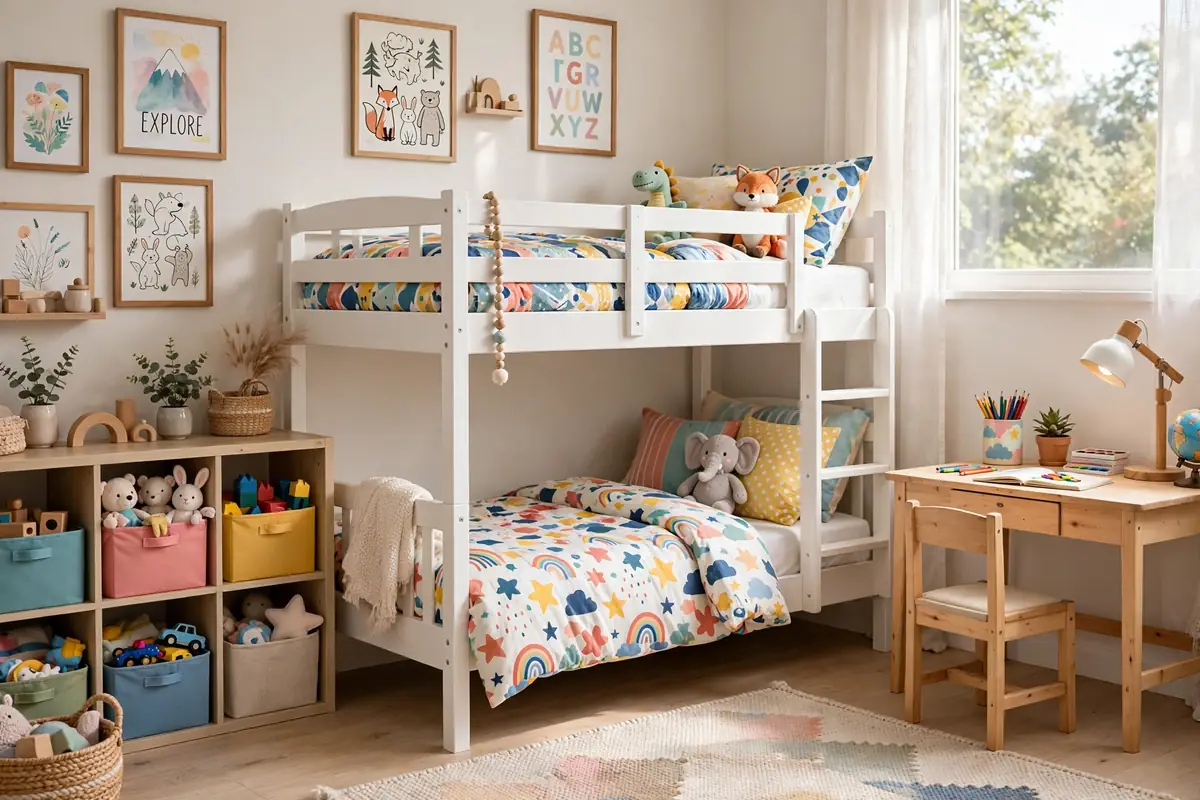
Designing a Kids Bedroom That Grows With Them
Kids bedrooms are the hardest rooms to get right. They need to handle sleep, play, homework, and storage — often in the smallest bedroom in the house — while surviving everything from toddler tantrums to teenage moods. And whatever you do will be “babyish” within three years.
The secret is designing in layers: permanent bones (paint, flooring, storage) that last a decade, plus easily swapped personality (bedding, art, accessories) that can change with each phase. Get the bones right once, and the room evolves cheaply instead of needing a full redo every few years.
Kids Bedroom Layouts by Age
Toddlers and Preschoolers (1–5)
Safety and simplicity rule. Keep furniture low and stable — anchor every bookcase and dresser to the wall. A floor bed or low single bed removes fall anxiety. Leave generous open floor space for play; you need less furniture than you think at this age. Toy storage should be open bins at kid height, not complicated systems they’ll never use.
Primary School (6–12)
This is the golden age of the kids bedroom — old enough for a proper bed and desk, young enough to still love themed fun. Add a real study desk (even a small one) because homework is coming. Reading nooks — a beanbag, a bookshelf, good light — get more use than any toy. This is also when small bedroom strategies matter most, as kids accumulate so much stuff.
Teenagers (13+)
Teens want two things: privacy and somewhere to hang out with friends that isn’t the living room. A double bed (if space allows), a proper desk with good lighting, and seating beyond the bed — a papasan chair, floor cushions, or a small armchair. Let them choose the colours; a teen who picked the palette won’t complain about the room.
Choosing Kids Beds: What’s Worth the Money
The bed is the biggest investment in a kids room. Australian price guide for 2026:
- Single bed frame: $200–$600 flat-pack; $600–$1,500 solid timber
- Bunk beds: $400–$900 basic; $900–$2,500 solid timber with storage or trundle (brands like Temple & Webster, Dick Smith, and local furniture stores)
- Loft beds: $700–$1,500 — brilliant for small rooms, with desk or play space underneath
- Trundle beds: $500–$1,200 — a single that hides a second mattress for sleepovers
Safety note: Australian standards recommend the top bunk only for children aged 9+. Guard rails on both sides are non-negotiable, and the mattress should sit at least 16cm below the top of the rail.
Storage: The Real Battle
Kids own an astonishing volume of stuff. The storage systems that actually get used share three traits: they’re at kid height, they’re simple (open bins beat complex drawer dividers), and every category has a labelled home.
- Under-bed drawers: The most underused space in any bedroom. Rolling drawers handle out-of-season clothes, spare bedding, or toy overflow.
- Cube shelving: IKEA Kallax-style units are the workhorse of kids rooms — sturdy, cheap, and reconfigurable. Add fabric bins for the messy categories.
- Wardrobe zones: Double-hang the rail (kids’ clothes are short) to double capacity. A well-planned wardrobe beats a bigger room.
- The one-in-one-out rule: For every new toy that arrives, one leaves. Enforce it at birthdays and Christmas or drown.
Kids Bedroom Themes That Don’t Date in a Year
Themed rooms (pirate ships, princess castles) photograph beautifully and age terribly. Instead, pick a vibe expressed through swappable elements:
- Walls stay neutral: Warm white, soft grey, or pale sage. The theme lives in bedding, art, and accessories.
- Bedding is the theme: Dinosaur doona today, skateboard doona next year — $80 swaps instead of $800 repaints.
- Art with Blu-Tack: Gallery walls of the kid’s own art, posters, and photos. Free, personal, endlessly changeable.
- One hero piece: A cool pendant light, a teepee reading corner, or a wall decal. One statement beats ten small themed items.
Study Spaces That Kids Actually Use
Homework happens where the kid wants to be, not where the desk is — but a good desk still helps. What works:
- Position: Near natural light, facing the room (not the wall) if possible. Nobody concentrates staring at plaster.
- Size: Minimum 100cm wide for a laptop plus books. Depth 50–60cm.
- Chair: The most skimped item and the one that matters most. An adjustable chair ($150–$400) beats a stylish-but-rigid one.
- Lighting: A desk lamp with warm-white light. Overhead room lighting creates screen glare.
- For small rooms: A wall-mounted fold-down desk or a desk integrated into wardrobe joinery.
Shared Kids Bedrooms
Two kids, one room — the ultimate design challenge. What works in Australian homes:
- Bunks or lofts free half the floor for play and desks.
- Divide visually: A bookshelf as a room divider, different bedding colours, or a curtain on a ceiling track gives each child a sense of territory.
- Duplicate the essentials: Each child needs their own bedside surface, light, and storage zone. Sharing these causes 90% of sibling fights.
- Noise: A white noise machine or soft furnishings (rug, curtains) help when bedtimes differ.
How Much Does a Kids Bedroom Makeover Cost?
- Refresh (paint, bedding, art, storage bins): $500–$2,000
- Mid-range (new bed, desk, wardrobe fit-out, lighting): $3,000–$8,000
- Full fit-out (custom joinery, built-in desk and wardrobe, new flooring): $8,000–$20,000+
FAQs
What age can a child sleep in a top bunk?
Australian safety standards recommend the top bunk only for children aged 9 and over. Guard rails on both sides are essential, and the mattress top should sit at least 16cm below the top of the guard rail.
How do I maximise storage in a small kids bedroom?
Use vertical space (tall bookshelves, wall hooks), under-bed rolling drawers, and double-hang wardrobe rails since kids’ clothes are short. Cube shelving with labelled bins keeps categories sorted, and the one-in-one-out rule prevents accumulation.
What colours work best for kids bedrooms?
Keep walls neutral — warm white, soft grey, or pale sage — and add colour through bedding, art, and accessories that are cheap to swap. This lets the room evolve from toddler to teen without repainting.
How much should I budget for a kids bedroom makeover in Australia?
A cosmetic refresh runs $500–$2,000, a mid-range update with new bed and desk $3,000–$8,000, and a full custom fit-out $8,000–$20,000+. Bunk beds range $400–$2,500 depending on quality and features.
How do I design a shared bedroom for two kids?
Use bunks or lofts to free floor space, divide the room visually with a bookshelf or curtain, and give each child their own bedside surface, light, and storage zone. Duplicating these essentials prevents most sibling conflicts.