
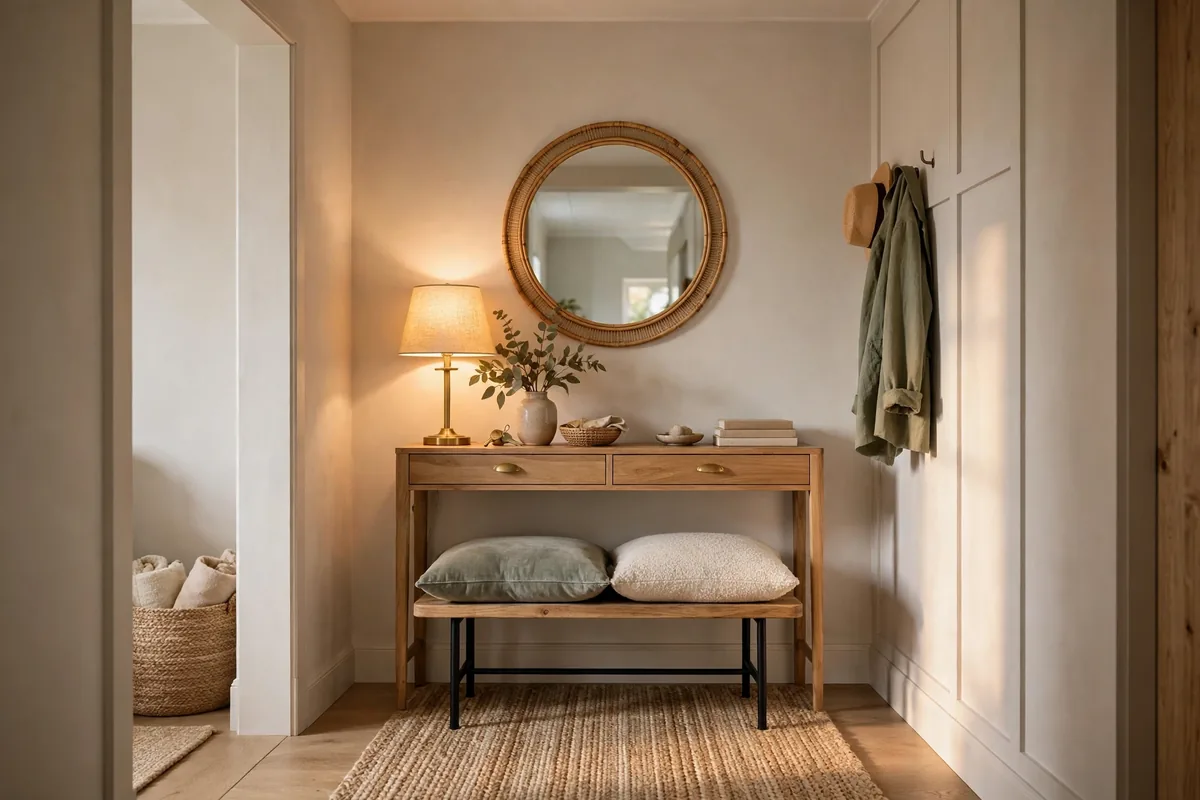
Why Your Entryway Matters More Than You Think
The entryway is the handshake of your home — the first thing guests see and the last thing you touch every day. Yet in most Australian homes it’s an afterthought: a dumping ground for shoes, keys, and school bags with no plan and no style.
It doesn’t take much to change that. An entryway needs just four things to work beautifully: somewhere to sit (or at least perch), somewhere to put keys and mail, somewhere for shoes, and a mirror. Add good lighting and one piece of personality, and you’ve got a space that welcomes you home instead of stressing you out.
Entryway Layouts for Australian Homes
The Classic Hallway Entry
Many Australian homes — especially period terraces and post-war brick houses — open into a hallway. The golden rule: keep one side clear. A narrow console table (25–30cm deep) on one wall, a mirror or art above it, and a runner rug is all you need. Resist the urge to fill both walls; hallways need to breathe.
The Open-Plan Entry (No Foyer)
Modern homes often open straight into the living area with no defined entry. Create one with furniture: a console table or low bookshelf placed perpendicular to the front door carves out an entry zone without blocking light or flow. A rug underfoot marks the boundary — practical for catching dirt before it reaches the living room.
The Mudroom Entry
If you have the space — a laundry-adjacent nook, a wide hallway, or a converted corner of the garage — a mudroom-style entry is life-changing for families. Hooks at kid height, a bench with shoe storage underneath, and baskets for hats, sports gear, and school bags. Everything has a home, so nothing ends up on the floor.
Entryway Furniture: What You Actually Need
- Console table: 25–35cm deep, 80–90cm high. Slim enough for hallways, substantial enough to anchor the space. Budget $150–$600; solid timber $600–$1,500.
- Mirror: Round mirrors soften hard hallway lines; arched mirrors are the current Australian favourite. Hang so the centre sits at eye level (~150cm from the floor).
- Seating: A small bench or ottoman makes putting on shoes civilised. Storage benches ($200–$800) hide the shoe chaos.
- Hooks: Wall hooks beat a coat stand in tight spaces. Mount a row at 150cm for adults and a lower row at 100cm for kids.
- Shoe storage: A closed cabinet keeps the entry looking calm. Open racks are fine in a mudroom but look messy in a formal entry.
Entryway Storage Ideas That Actually Work
Entryway clutter has one cause: no designated spot for the stuff that arrives daily. Solve it with zones:
- The drop zone: A tray or small bowl on the console for keys, sunglasses, and wallets. One per adult — no sharing, no searching.
- The mail station: A wall-mounted sorter or a single in-tray. Process it weekly; recycle junk immediately.
- Shoe rule: One pair per person in the entry. The rest live in bedrooms. Enforce it and the entry stays clear.
- Seasonal swap: In winter, add a basket for scarves and beanies near the door. In summer, swap it for hats and sunscreen.
Entryway Lighting
Entries are often the darkest part of the house — no windows, internal walls. Layer the light:
- A ceiling fixture for general light (flush-mount in low hallways, pendant if you have height).
- A table lamp on the console for warmth — the single most transformative entryway upgrade.
- If there’s art, a picture light makes the entry feel like a gallery rather than a corridor.
Warm bulbs (2700K–3000K) make the entry feel welcoming. And put it on a sensor or timer if you can — coming home to a lit entry instead of fumbling in the dark is a small daily joy.
Styling an Entryway With Personality
The entry is the one place where bold choices are low-risk — you pass through in seconds, so a strong colour or pattern never overwhelms. Ideas that work in Australian homes:
- Feature wall: One wall in deep green, navy, or terracotta makes a plain hallway memorable.
- Gallery wall: A tight cluster of framed prints or family photos turns a corridor into a destination.
- Statement mirror: An oversized arch mirror is both functional and sculptural.
- Natural texture: A jute runner, a timber bench, or a vase of eucalyptus branches brings warmth without clutter.
- Scent: A candle or diffuser by the door means your home smells intentional from the first step.
For broader styling inspiration, our Hamptons style guide has coastal-entry ideas that suit Australian homes beautifully.
Small Entryway Ideas
No foyer? No problem. Even the tiniest entry — a wall beside the front door — can work hard:
- A floating shelf instead of a console table saves 25cm of floor space.
- Hooks on the back of the front door use dead space.
- A slim shoe cabinet (under 20cm deep) fits where nothing else will.
- A round mirror makes a narrow entry feel twice as wide.
- Paint the front door a bold colour — it’s the cheapest statement in the house.
How Much Does an Entryway Makeover Cost?
- Budget refresh (paint, hooks, mirror, rug): $300–$1,000
- Mid-range (console, bench with storage, lighting, styling): $1,500–$4,000
- Full fit-out (custom joinery, mudroom build, new flooring): $5,000–$15,000+
FAQs
What furniture do I need in an entryway?
At minimum: a console table or shelf for keys, a mirror, hooks for coats and bags, and shoe storage. A bench is a bonus that makes daily life easier, especially for families with young kids.
How do I style a small entryway?
Go vertical — hooks, floating shelves, and a tall mirror use wall space instead of floor space. Keep the palette light, choose one statement piece (a bold mirror or artwork), and ruthlessly limit what lives there to daily essentials.
What is the best lighting for an entryway?
Layered lighting: a ceiling fixture for general light plus a table lamp on the console for warmth. Warm bulbs (2700K–3000K) feel welcoming. A motion sensor means you never come home to a dark entry.
How do I keep my entryway clutter-free?
Give everything a designated spot: a tray for keys, hooks for bags, closed storage for shoes, and a one-pair-per-person shoe rule. Process mail weekly. The entry only stays clear if every item has a home.
What colour should I paint my entryway?
Entries handle bold colour well because you experience them briefly. Deep greens, navy, and warm terracottas all work. In dark hallways without natural light, lighter warm neutrals keep the space feeling open.