
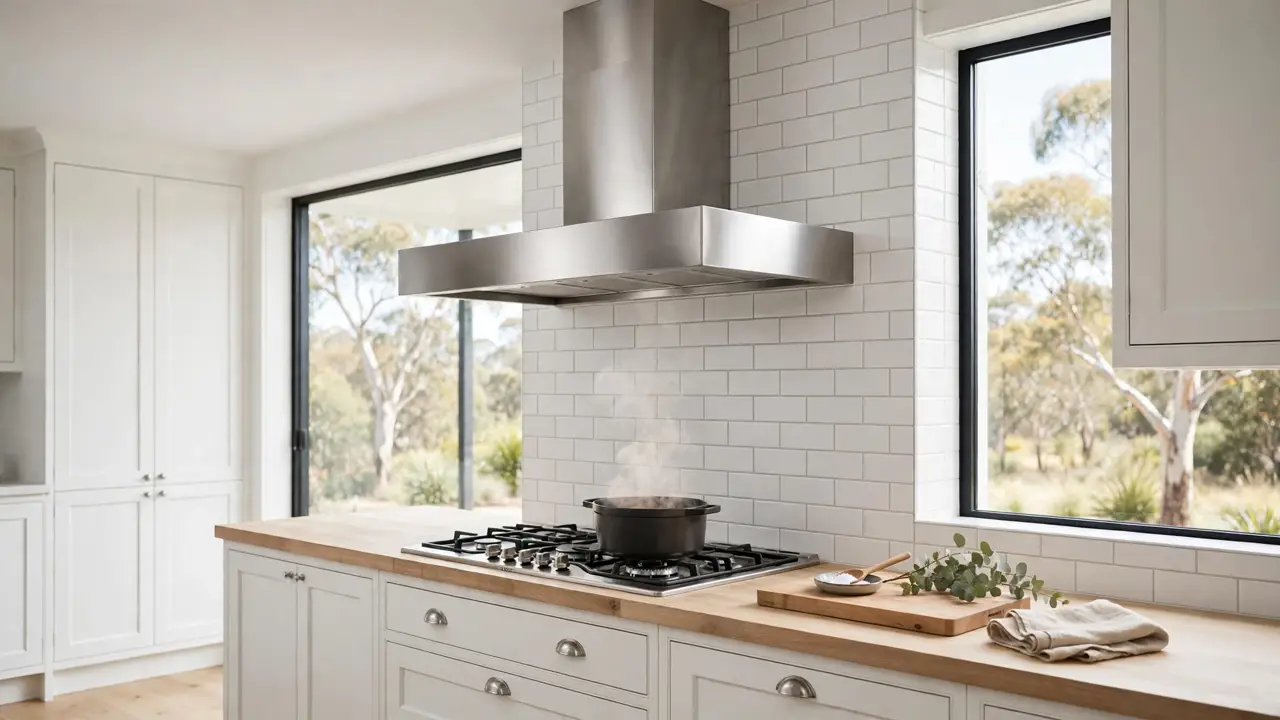
A rangehood is the least glamorous appliance in the kitchen and the one whose absence you pay for everywhere else. Yet most Australians price only the box on the showroom shelf. The real number adds fitting, ducting and licensed electrical work — and that second half is where quotes double. This guide puts the whole job together, so you can see the rangehood cost Australia wide for what it is in 2026.
The short version: a basic slide-out or fixed hood, supplied and fitted as a like-for-like swap, $300–$700; a standard ducted wall canopy with a new duct run, $900–$2,500; an island canopy, $2,500–$6,000 or more.
Rangehood Cost Australia in 2026: The Short Answer
Hipages puts a rangehood with installation at $300–$2,000 or more. The table splits the job the way a good quote should.
| Job | Typical range (2026) | What it covers |
|---|---|---|
| Appliance, budget slide-out/fixed | $130–$400 | Compact 60 cm unit |
| Appliance, mid-range undermount/canopy | $400–$1,200 | 600–900 mm, 600+ m³/h |
| Appliance, premium/designer canopy | $1,200–$3,000+ | Designer, island, downdraft |
| Like-for-like install (labour only) | $150–$400 | Existing duct and power |
| New duct run | $400–$1,200 | Wall, eave or roof, flashed |
| Island canopy install (labour only) | $800–$2,500 | Ceiling structure, long duct run |
| New electrical point | $150–$400 | Licensed electrician |
| Cabinetry modifications | $200–$800 | Width changes, trim work |
Two lines matter most: the like-for-like swap at $150–$400, the cheapest job because the duct and power point already exist, and the new duct run at $400–$1,200, where a recirculating kitchen becomes ducted.
The Appliance: What the Hood Itself Costs
Retail prices span an enormous range. The Good Guys lists models from around $130 for compact fixed and slide-out units to around $9,000 for premium designer pieces, with undermount and canopy models typically $250–$2,000. CHOICE found its tested models ranged from around $250 to almost $6,000 — and notes the near-$6,000 model is one to avoid.
What you pay for is extraction rate, width and motor design. Extraction is quoted in cubic metres per hour: 500–600 m³/h is typical, 600+ m³/h counts as powerful, and heavy or wok cooking calls for 700 m³/h or more. A hood should at least match its cooktop; CHOICE’s kitchen expert advises going larger where you cook across several zones at once.
Live November 2026 listings show the bands: a Sirius 520 mm undermount at $899, an AEG 90 cm integrated undermount (950 m³/h) at $1,888, and a Smeg 110 cm Victoria canopy at $3,140. Price alone does not predict performance: in CHOICE’s lab tests, some of the cheapest undermounts scored in the low 50s out of 100 while the best wall canopies scored 85%.
Installation: The Swap, the Duct Run and the Trades
Installation is where quotes diverge: the job can be one trade for one hour or three trades for a full day. Hipages breaks the labour down by type: around $150 for a fixed rangehood, $160–$250 for a slide-out, and $300 or more for a canopy, with ducting and electrical connections charged separately and able to add $1,000 or more. A like-for-like replacement takes 2–4 hours. Real 2026 Airtasker jobs: Sydney typically $162–$227, New South Wales $120–$280.
The trades layer by the work. A plug-in swap is a mounting and ducting job a handyperson or appliance installer can handle. Anything hardwired — a new circuit, a relocated point, a hardwired unit — belongs to a licensed electrician; unlicensed fixed wiring is illegal in Australia and can void the warranty and your home insurance. Cabinetry changes belong to a carpenter. A quote that names each trade is one you can trust.
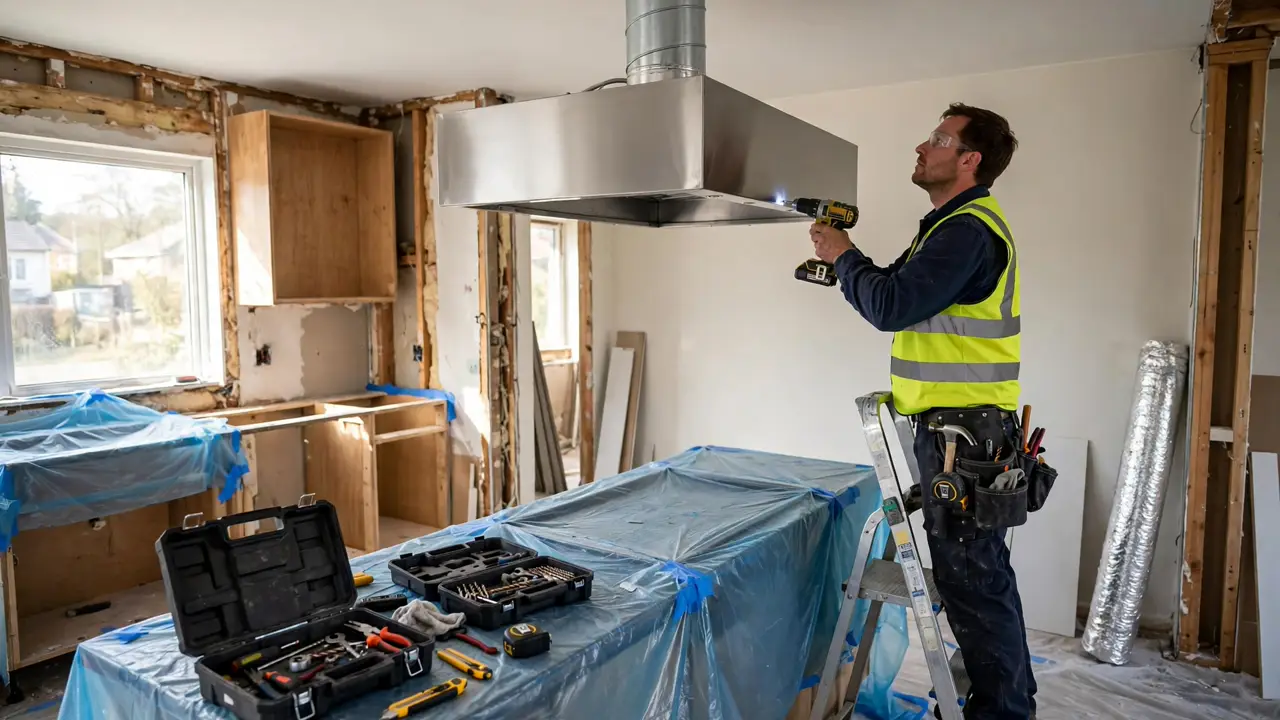
One timing trick is worth knowing: if you are replacing a benchtop, do the hood at the same time, while the cabinetry is open and the duct route is visible. Our kitchen benchtop replacement cost guide prices that job, and bundling the two scopes shares the trades and the disruption.
Ducted or Recirculating: The Decision That Sets the Price
Settle this question before comparing models — it decides the installation price more than any brand does. A ducted rangehood sends cooking air outside through a metal duct; a recirculating rangehood filters the air and returns it to the room. Ducted costs more and performs better, removing steam, heat, grease and smell together; recirculation traps some grease and odour and returns all the moisture and heat to the kitchen.
CHOICE’s lab testing backs the ducted case. FreshDuct puts it plainly: a recirculating hood is cheaper to install because it needs no ducting, but it removes no moisture or heat, only some odour and grease. AS 1668.2 sets a minimum of 40 litres per second — about 144 m³/h — a compliance floor, not a cooking target.
Recirculation still has its place: apartments with no compliant duct route, heritage constraints, and rentals where the owner will not approve a penetration. Run properly, its carbon filters are replaced on schedule, not on smell, and its grease filters are washed more often. Converting to ducted where a route exists is one of the best-value jobs in the category: many hoods ship ready to run either way, so it is an installation job at $400–$1,200 for the duct run, not a new appliance purchase.
Rangehood Cost Australia: What Pushes the Price Up or Down
Five things move a quote more than the brand on the box. First, the duct run: short and straight through the wall is cheap; a long run across the roof space with bends is not, since every metre and elbow costs airflow and hours. Second, the discharge point: the duct must end outside the building, through a wall, an eave or a roof penetration with a proper cowl. Venting into the roof cavity is the most common fault in older Australian kitchens — years of steam and grease soak the insulation and feed mould — and fixing it is a half-day job that protects the whole roof space.
Third, height and clearance: at least 65 cm above a gas cooktop and 60 cm above an electric cooktop; Schweigen recommends 650 mm for gas and electric, 700 mm minimum above induction. Too low is a hazard; too high and the hood misses the plume. Fourth, the splashback and cabinetry: changing width from 600 mm to 900 mm adds the $200–$800 cabinetry line — which is why the splashback decision and the hood decision belong together, as our kitchen splashback ideas guide shows. Fifth, the building: apartments need body corporate approval for penetrations, and pre-1980s houses may hide asbestos behind old splashbacks.
Island Canopies and Alfresco Hoods: The Premium Jobs
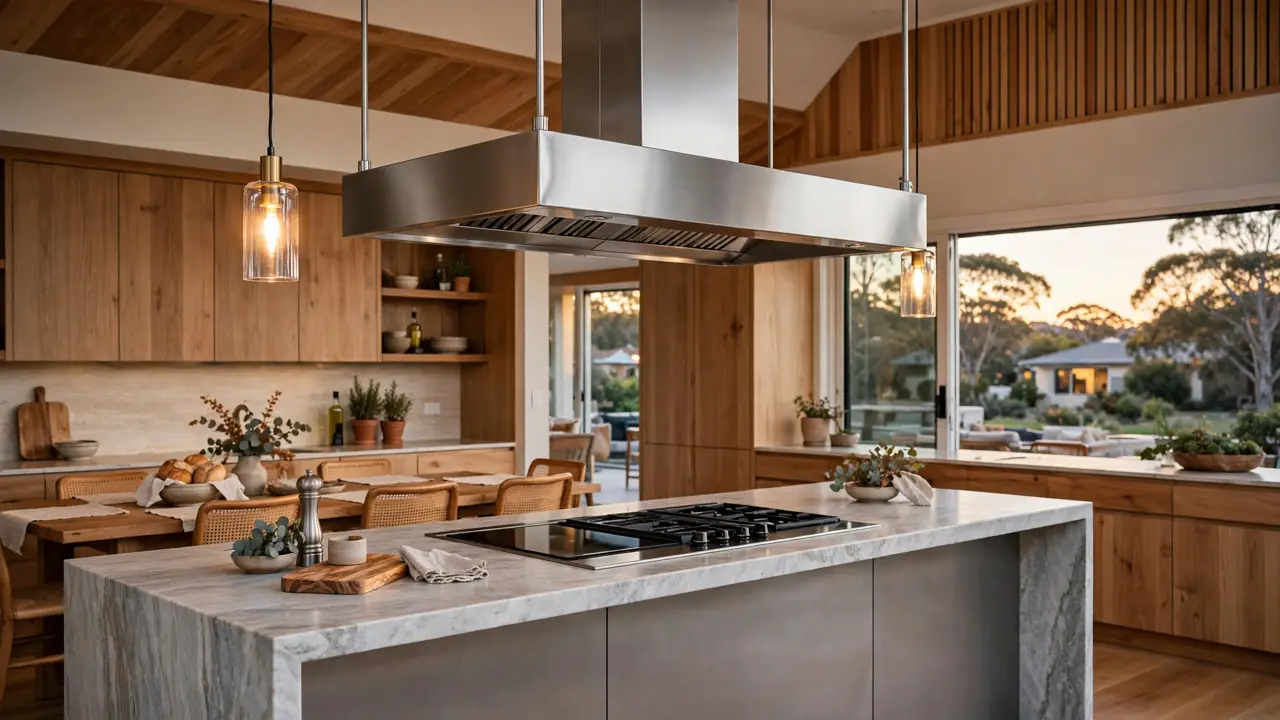
An island canopy is the most expensive scope in this category, and the reasons are structural: the hood hangs from the ceiling over an island cooktop with no wall to help, so the ceiling needs structure to carry its weight, a duct run to a penetration, power brought to a point that rarely exists, and a chase finished to ceiling height. Installation alone runs $800–$2,500 before the appliance, and the job belongs in the design phase.
Downdraft units answer the same island problem from below, rising from the benchtop beside the cooktop. They are the most expensive and least effective type CHOICE tested: the two downdraft models in its 2026 review cost $4,350–$5,999 and both scored lower than every wall canopy model — a trade-off to know before paying for the look. Alfresco hoods sit in the same premium band: outdoor-rated, marine-grade finishes for salt and humidity, ducted up through the patio roof at $600–$2,000 installed. A domestic kitchen hood should never be used over a barbecue: it cannot exhaust the smoke or handle the heat.
Three Worked Budgets
These budgets are arithmetic from the components priced above, not quotes — they show how the rangehood cost Australia households face stacks up once appliance, install, ducting and electrical are all counted.
| Budget | Scope | Typical total (2026) |
|---|---|---|
| Budget swap | Slide-out $150–$300 + like-for-like install $150–$250 | $300–$650 |
| Family ducted canopy | 900 mm canopy $600–$1,200 + install $300 + duct run $400–$800 + power point $150–$400 | $1,500–$2,700 |
| Island showpiece | Island canopy $1,500–$3,000 + install $800–$2,500 + duct and finishing $500–$1,000 | $3,000–$6,500+ |
The budget swap suits a rental or an otherwise fine kitchen: a $299–$349 slide-out or fixed unit from a mainstream brand, fitted onto the existing duct in an afternoon. The family canopy is the sweet spot for most owner-occupiers — a 900 mm ducted canopy with 600+ m³/h extraction, a proper rigid duct to the outside, and a new power point where none existed. The island showpiece is a design-phase decision, and its total climbs past $6,500 the moment the appliance moves into designer territory or the ceiling needs structural work. If you are costing a whole kitchen too, our IKEA kitchen cost guide shows where the hood sits inside a flat-pack budget.
How to Read a Rangehood Quote
A useful quote answers five questions before you ask them: where does the duct discharge — accept only an outside answer; what is the run built from, how long, and how many bends; how is the penetration flashed, and is the terminal screened; is the connection plug-in or hardwired, with the licensed electrical work included and certified; and what is the mounting height, confirmed against the manufacturer’s window and the gas rules. The quote that talks about the duct before the brochure is the one to trust.
Two red flags: a cheap quote that recirculates where the kitchen could duct, terminates the duct in the roof space, or leaves the electrical line for you to discover — each is a cost moved, not saved. And a spec-sheet maximum quoted as everyday performance: compare extraction at the speeds you will actually live with, and ask about noise too, because a hood too loud for an open-plan room gets run too low to work. Keep the invoice, the electrical certificate and the manufacturer’s documents together — the warranty assumes correct installation, and the paperwork proves it.
Repair or Replace?
Rangehoods fail at switches, lamps, capacitors and fan motors, and the repair-or-replace maths is blunt: a dead $300 slide-out is a swap, not a repair, because a technician’s visit plus parts costs more than the replacement. Premium canopies and integrated units justify diagnosis. Before spending on either, check the false failure first: a hood that runs but no longer clears is usually a saturated grease filter or a collapsed flexible duct, both checked in minutes for free. A well-maintained rangehood lasts around 15 years — which is the other half of the rangehood cost Australia equation: a clean filter, a real duct and a sensible mounting height will carry it there.
Frequently Asked Questions
How much does a rangehood cost in Australia?
A rangehood cost Australia wide typically lands between $300 and $2,500 supplied and installed in 2026: $300–$700 for a basic slide-out or fixed unit fitted as a like-for-like swap, $900–$2,500 for a standard ducted wall canopy with a new duct run, and $2,500–$6,000 or more for an island canopy. The appliance alone ranges from around $130 to around $9,000.
Is it cheaper to install a ducted or a recirculating rangehood?
A recirculating rangehood is cheaper to install because it needs no ducting — a like-for-like swap runs $150–$400 in labour. A ducted installation costs more, with a new duct run adding $400–$1,200, but it performs better, removing steam, heat, grease and smell, while recirculation returns all the moisture and heat to the kitchen. Ducted is the better spend wherever a route exists.
How much does it cost to install a rangehood if I already own one?
Labour only, a like-for-like swap onto an existing duct and power point costs $150–$400: a fixed unit around $150, a slide-out $160–$250, a canopy $300 or more. A new duct run adds $400–$1,200, a new electrical point $150–$400, and cabinetry changes $200–$800. Real 2026 Airtasker jobs typically ran $120–$380 in Sydney and Melbourne.
What size rangehood do I need for a 900 mm cooktop?
Choose a 900 mm rangehood at minimum, and consider going wider: CHOICE’s kitchen expert advises the hood should be larger than the cooktop, especially when you cook across several zones at once, because a narrow hood misses the outer burners. Depth matters too — a shallow hood leaves the front pots uncovered. For extraction, look for 600 m³/h or more, and 700 m³/h or more for wok cooking.
Can I install a rangehood myself?
Mounting a plug-in unit onto an existing duct is work a competent handyperson can do, but any hardwiring or new power point must by law be carried out by a licensed electrician in Australia. A poorly mounted hood can come loose, drip grease or push steam into the ceiling cavity. A ducted installation also needs a proper external discharge — never into the roof cavity. For most households, a licensed installer is the right call.
How long does a rangehood last?
A well-maintained rangehood lasts around 15 years, with 10–15 years the usual expectation. Wash metal grease filters monthly in a busy kitchen, replace carbon filters on schedule in recirculating units, and keep the duct rigid, short and discharging outside. A hood that stops clearing is usually a saturated filter or a collapsed duct, not a tired fan.