
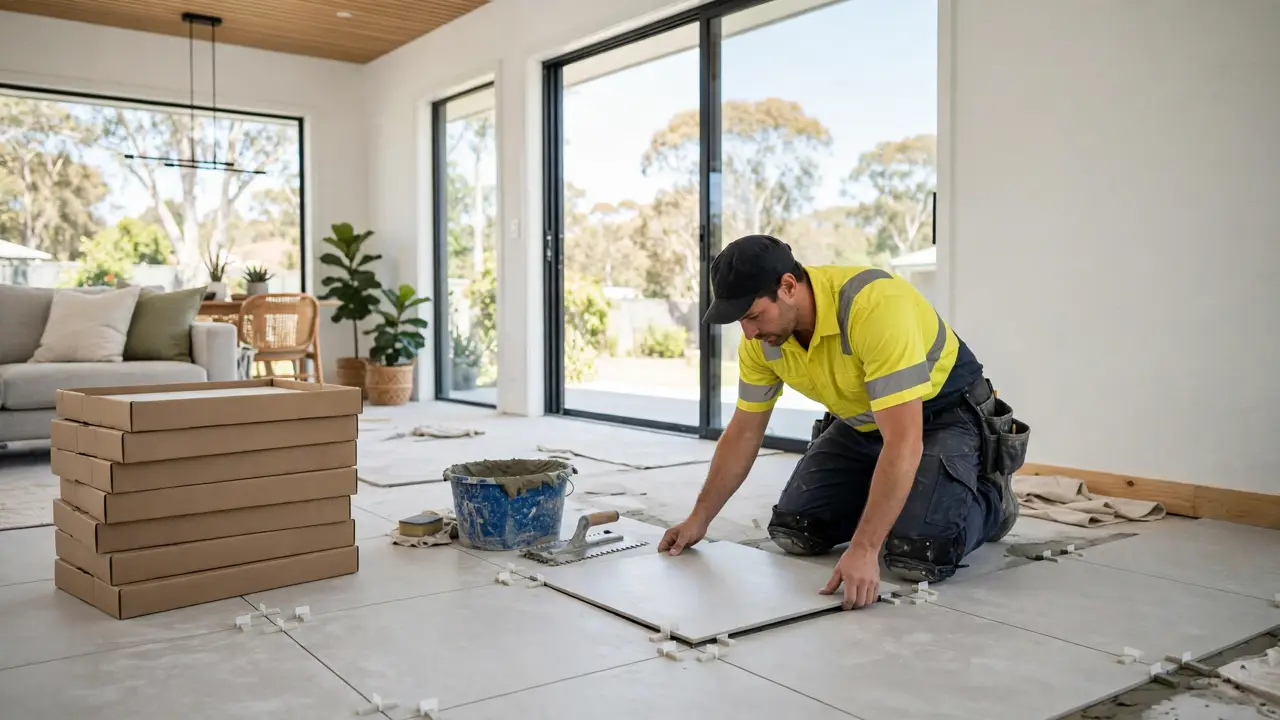
Floor tiling cost Australia homeowners actually pay in 2026 runs $50–$150 per square metre installed for standard work. The tile you choose moves the final number more than anything else: a 15-square-metre laundry in budget ceramic can land under $2,500 all in, while the same area in natural stone can pass $4,000. The gap is material, labour, preparation and pattern.
Floor Tiling Cost Australia: The Short Answer
For a standard floor tiling job in Australia in 2026, expect $50–$150 per square metre fully installed. Ceramic floors sit at the bottom of that band at $50–$100 installed, porcelain runs $70–$150, and natural stone climbs to $130–$280. Labour alone is $40–$120 per square metre, averaging near $65.
Those bands assume a prepared, level substrate and a straight grid layout. They exclude removing old tiles, levelling a slab out of tolerance, and waterproofing a wet area — the three items where most budgets come unstuck. A whole-house job of 100–150 square metres typically lands between $7,000 and $18,000.
Floor Tiling Cost by Tile Type
Tile material is the single biggest variable in your quote. The table below gives 2026 material-only and fully installed prices per square metre.
| Tile type | Materials only (per m²) | Fully installed (per m²) | Best for |
|---|---|---|---|
| Ceramic | $25–$60 | $50–$100 | Bathrooms, laundries, budget floors |
| Porcelain | $40–$100 | $70–$150 | High-traffic floors, kitchens |
| Natural stone (marble, travertine, granite) | $80–$200 | $130–$280 | Feature floors, premium bathrooms |
| Large-format (600 × 600 mm and above) | $50–$120 | $80–$170 | Open-plan living |
| Mosaic | $60–$150 | $100–$250 | Feature strips, splashbacks |
| Subway / metro | $30–$70 | $60–$120 | Splashbacks, bathroom walls |
Ceramic is the workhorse of cheap tiling: a softer fired clay than porcelain, it cuts easily and goes down fast, which keeps labour down. Entry-level 300 × 300 mm ceramics are the cheapest format to install: no lippage clips, and they forgive a slab slightly out of flat. Bunnings lists ceramic floor tiles from around $20–$45 per square metre.
Porcelain costs more than ceramic but is not as expensive as people assume: entry-level rectified porcelain runs $25–$45 per square metre, and Beaumont Tiles lists a 600 × 600 mm polished porcelain from $58 including GST. Porcelain is denser and harder and absorbs far less water. Natural stone costs more because every piece is unique and needs sealing.
What Tilers Charge: Labour Rates Explained
Tilers charge per square metre or per hour. Most quote by the square metre on open floors, and by the hour or a fixed price on small jobs, where setting up and cleaning takes as long as the tiling itself.
Published 2026 guides put tiling labour at $40–$120 per square metre, averaging near $65, and hourly rates at $45–$120, averaging about $70 an hour. Marketplace figures sit in the same range: ServiceTasker averages $60 an hour for indoor work, Airtasker lists $45–$85 an hour for bathroom tiling, and Airtasker’s floor tiling median is $72 per square metre.
Location moves the rate. Sydney and Melbourne tilers typically charge 15–25 per cent more than regional areas, while Perth and Brisbane sit in the middle and Hipages puts South Australian tiling labour at $35–$40 per square metre. Most tilers carry a minimum call-out charge of $300–$500. Complex patterns such as herringbone or chevron add roughly 20–30 per cent to labour.
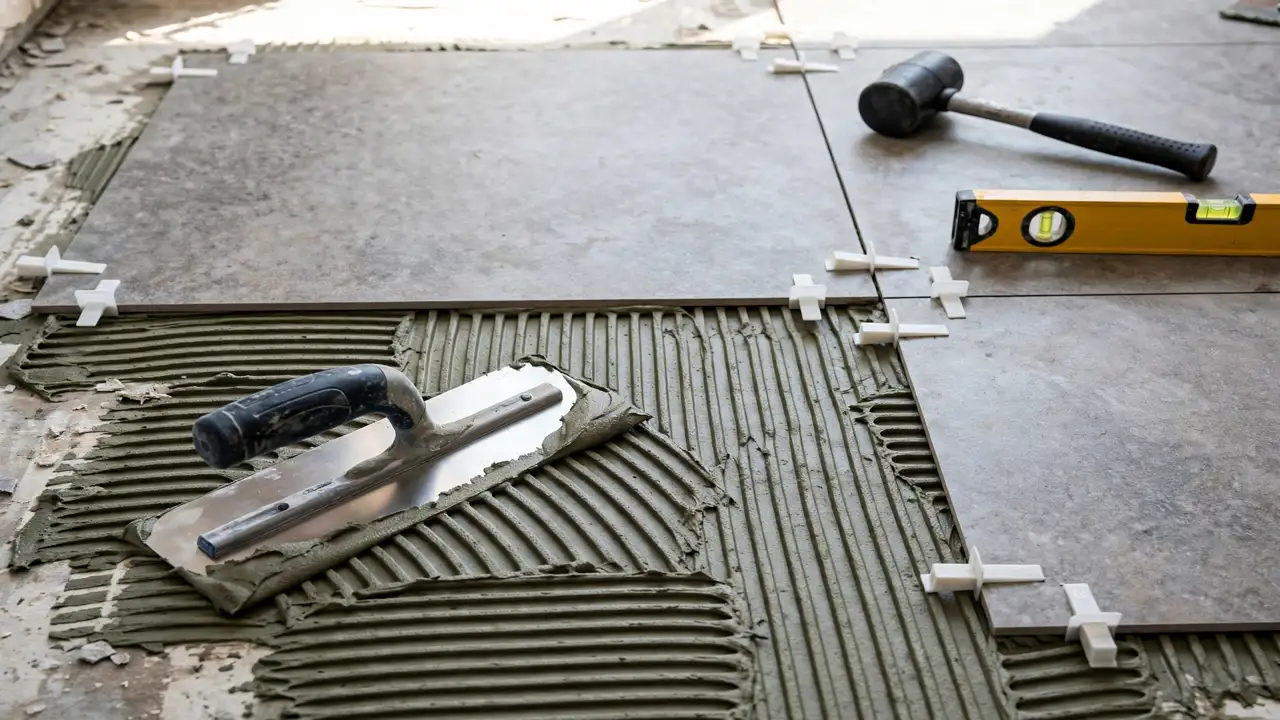
Floor Tiling Cost Australia by Room
The room changes the price as much as the tile does. A single room of 15–20 square metres costs $1,000–$3,000 to tile, an open-plan living area of 40–60 square metres runs $3,200–$8,000, and a whole house of 100–150 square metres lands at $7,000–$18,000.
Bathroom tiling costs more per square metre than any other room because it involves waterproofing, tiling around fixtures and working in a confined space. A small ensuite of around 15 square metres costs $1,500–$3,500, a standard family bathroom of around 25 square metres costs $3,000–$7,000, and a large bathroom of 35 square metres or more runs $6,000–$12,000 or more. Waterproofing adds $500–$1,200 per room and is legally required in wet areas. Our bathroom renovation cost guide prices the whole room, not just the tiles.
Kitchen tiling is cheaper per metre than bathroom tiling because the floor is open and the cuts are simpler: a 15–20 square metre kitchen floor runs $1,200–$3,500, a splashback of 3–5 square metres costs $400–$1,200, and a full kitchen floor plus splashback lands at $1,800–$5,000. Outdoor tiling costs 20–40 per cent more than indoor work. A patio of 20–30 square metres runs $2,500–$6,000 and a pool surround costs $3,000–$7,000.
The Hidden Extras: Prep, Removal and Waterproofing
The per-metre rate on a quote is only honest if you know what it leaves out. Removing old tiles costs $25–$50 per square metre, including carting the waste away, and it is the most common hidden cost in a retiling job. Substrate preparation and levelling runs $15–$40 per square metre.
Waterproofing in wet areas costs $500–$1,200 per room and must be carried out by a licensed waterproofer before tiles go down, under AS 3740. The membrane must be inspected and certified before any tiles are laid. Grout and adhesive add $10–$25 per square metre, and tile cutting on complex shapes is either included in labour or $5–$15 per square metre extra. Order 10–15 per cent extra tiles for cuts and waste.
Tiling over existing tiles looks like a saving because you skip the removal bill, but grinding, priming and levelling still add $15–$30 per square metre, and the floor gains 15–25 mm in height. It only pays when the old tiles are sound, level and well bonded. Skip it when they are drummy, cracked or lifting, or when the room is a wet area with old waterproofing underneath.
Three Worked Budgets: Small, Medium and Whole House
These three budgets use the component prices above, with a 10 per cent tile waste allowance for cuts.
| Budget | Scope | Components | Total |
|---|---|---|---|
| Small — laundry floor | 15 m², ceramic | Tiles $375–$900 · labour $600–$975 · adhesive/grout $150–$375 · waste $40–$90 | $1,200–$2,400 |
| Medium — open-plan living | 50 m², porcelain | Tiles $2,000–$5,000 · labour $2,000–$4,000 · levelling $750–$2,000 · waste $200–$500 | $5,000–$11,500 |
| Whole house — mixed | 120 m², porcelain living areas plus ceramic wet areas | Blended $85–$150/m² × 120 m² | $10,000–$18,000 |
Small: a 15-square-metre laundry floor in ceramic. Tiles $375–$900, labour $600–$975, adhesive and grout $150–$375, waste $40–$90. Total: $1,200–$2,400, inside the published $1,000–$3,000 band for a single room.
Medium: a 50-square-metre open-plan living area in porcelain. Tiles $2,000–$5,000, labour $2,000–$4,000, levelling $750–$2,000, waste $200–$500. Total: $5,000–$11,500.
Whole house: 120 square metres of mixed tiling, porcelain in the living areas and ceramic in the wet areas. At a blended installed rate of $85–$150 per square metre, the total is $10,000–$18,000. These three budgets show floor tiling cost Australia-wide at three sizes: the tile and the substrate move the number far more than the room count does.
Floor Tiling vs Other Flooring: When Tiles Win
Tiles are not the cheapest floor you can buy, and they are not the warmest underfoot. They win on durability and water resistance where those things matter, and lose on comfort in bedrooms, where a softer floor is often better.
Carpet costs $45–$180 per square metre installed, which overlaps the bottom of the tiling band, but carpet needs replacing far sooner in high-traffic areas. If you are weighing the two for a living area, our carpet cost guide prices the softer option properly. Against engineered timber, tiles are usually cheaper installed and far more forgiving of water, pets and dropped objects, but timber feels warmer and suits bedrooms better. Our engineered timber flooring cost guide covers that comparison in detail.
Choose by room, not by trend. Tile the kitchen, laundry, bathroom and entry, where water and grit are daily facts, and consider timber or carpet in bedrooms, where comfort matters more than washability. For a straight comparison, floor tiling cost Australia homeowners pay for porcelain sits above carpet and near timber, so the decision is about the room, not the cheapest metre rate.
DIY or Hire a Professional Tiler?
Floor tiling in a simple rectangular room with standard ceramic tiles is one of the more achievable DIY projects, and the materials for a DIY job run roughly $30–$60 per square metre. Hiring a professional adds $40–$120 per square metre in labour but gives you a warranty on the workmanship.
You can tile it yourself if the area is a dry zone, the substrate is flat and prepared, you are using standard-format tiles in a straight layout, and you have a tile cutter, a notched trowel, spacers and a level. Hire a licensed tiler for wet areas, natural stone, large-format tiles, complex patterns, poor substrates, or any area where finish quality matters.
Saving $40–$65 per square metre in labour on a 15-square-metre laundry is $600–$975, which is real money. But a first-time tiler works slowly, wastes more tiles than the 10 per cent allowance, and has no warranty if a tile lifts in six months. For a small dry-zone floor, DIY is a fair bet. For a bathroom or a large-format porcelain floor, the professional’s rate buys you the finish as much as the labour.
How to Read a Tiling Quote — and Spot the Traps
A tiling quote is only comparable with another quote when both cover the same scope. The traps are quotes that leave different things out, so the cheaper number wins on paper and loses on site.
First, check whether the per-metre rate includes the tiles or is labour only. A $70 labour-only figure and a $70 supply-and-install figure are not the same price. Second, ask what preparation is included: removal, levelling, adhesive, grout, silicone and cleanup should each be named. Hidden extras can add 20–40 per cent to the final bill.
Third, check the tile allowance. A quote that prices $25 per square metre ceramic when you have chosen $90 per square metre porcelain is not a bargain; it is a variation waiting to happen. Fourth, confirm the pattern rate: herringbone and chevron cost 20–30 per cent more in labour. Fifth, get three written quotes covering the same scope, and supply your own tiles if you can: buying direct can save 20–40 per cent on materials. That is the only honest way to compare floor tiling cost Australia-wide: same scope, same tile, same preparation, three quotes.
Licences and Waterproofing Rules You Cannot Skip
Tiling licence rules differ across Australian states, and an unlicensed job can void your warranty and insurance. Queensland has the strictest regime: every tiler performing residential or commercial work must hold a current QBCC licence, covering ceramic, glass, marble, slate, stone and terracotta tiles as well as waterproofing. The QBCC wall and floor tiling licence page sets out the scope and eligibility requirements, and in Queensland a licence is required for tiling work valued over $3,300.
In New South Wales, a contractor licence is required when the total cost exceeds $5,000. Victoria requires registration for domestic building work, Western Australia requires a building contractor licence for larger jobs, and the other states and territories each have their own thresholds. Always verify your tiler’s licence with your state regulator before signing a contract.
Under AS 3740, all shower recesses, bathroom floors and laundry areas must be waterproofed by a licensed waterproofer before tiling begins, and the membrane must be inspected and certified before any tiles are laid. A tiler who offers to waterproof as an unlicensed extra is creating a defect that will surface as a leak, a lifted tile or a failed insurance claim. Get the waterproofing certificate in writing, and keep it with the tiling warranty.
Frequently Asked Questions
How much does floor tiling cost per square metre in Australia?
Standard floor tiling costs $50–$150 per square metre fully installed in 2026. Ceramic runs $50–$100, porcelain $70–$150, and natural stone $130–$280. Labour alone is $40–$120 per square metre, averaging near $65.
How much do tilers charge per hour?
Tilers charge $45–$120 per hour, averaging about $70 an hour. Most tiling is quoted per square metre rather than per hour. Perth tilers charge $52–$105 an hour, typically around $74.
Is it cheaper to tile over existing tiles?
It can be, but the saving is smaller than people expect. Skipping removal saves $25–$50 per square metre, but grinding, priming and levelling add $15–$30. It only works when the old tiles are sound, level and well bonded.
How much does it cost to remove old tiles?
Removing old tiles costs $25–$50 per square metre, including carting the waste away. Some tilers include removal in their quote and some do not, so ask before you accept anything.
Can I tile my own floor, or should I hire a professional?
You can tile your own floor in a dry zone with a flat, prepared substrate and standard-format tiles in a straight layout, with materials costing roughly $30–$60 per square metre. Hire a licensed tiler for wet areas, natural stone, large-format tiles, or complex patterns.
Do I need a licensed tiler?
It depends on your state. Queensland requires a QBCC licence for all tiling work, and New South Wales requires a contractor licence when the total cost exceeds $5,000. Waterproofing must always be done by a licensed waterproofer under AS 3740.