
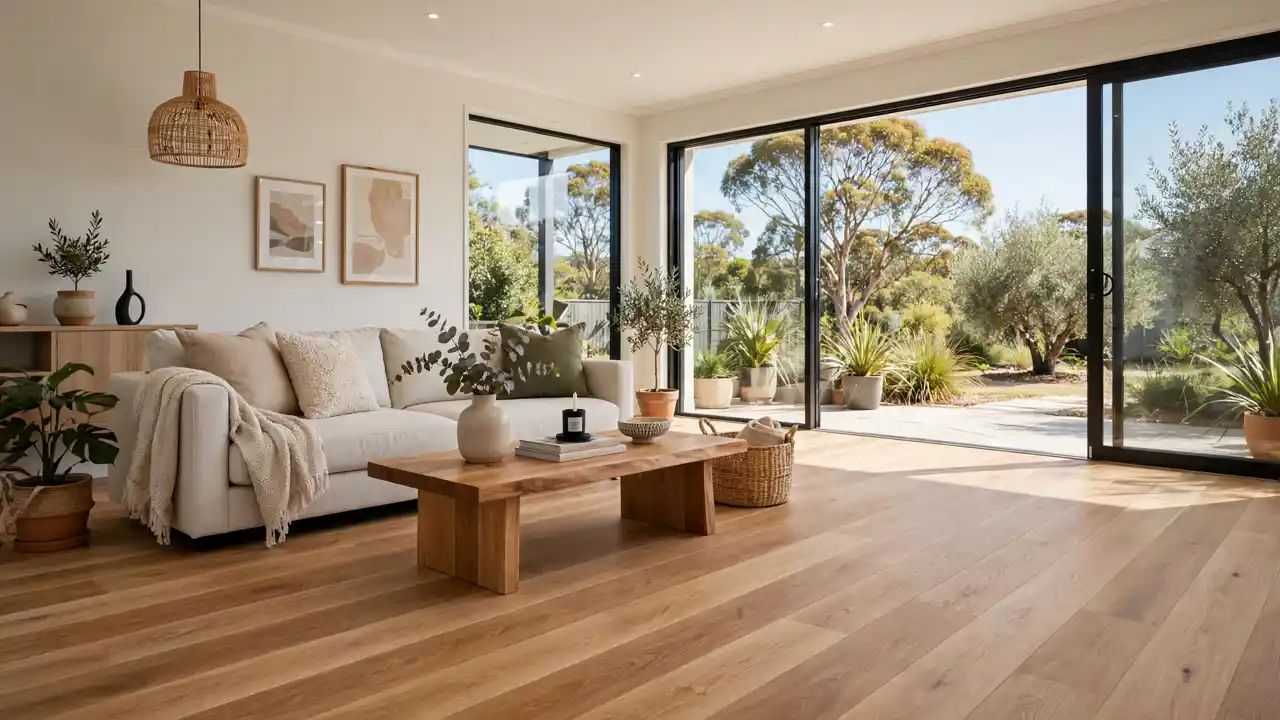
If you are pricing a new timber floor, the first thing to know is that the headline figure most retailers quote is only the middle of the real cost. An engineered timber flooring cost australia search returns supply prices, installed prices, and per-room totals that can sit $100 per square metre apart — and all of them can be right for a different board, install method, and subfloor. Split the job into its parts — board, veneer, install method, pattern, and preparation — and the figures settle into a clear pattern.
This guide prices engineered timber the way a careful flooring installer does — board, veneer, labour, and prep each on its own line — with every figure from 2026 Australian sources.
Engineered Timber Flooring Cost Australia at a Glance
For a standard living area over a flat subfloor, plan on these bands:
| Band | Supply only | Installed | What it buys |
|---|---|---|---|
| Entry | $60–$70/m² | $100–$150/m² | Thin veneer, straight-laid, floated |
| Mid-range | $70–$100/m² | $150–$200/m² | 3–4mm veneer, wide planks |
| Premium | $100–$150/m² | $200–$250+/m² | 4–6mm veneer European oak |
The two lines most guides leave out are the install method and the subfloor preparation. Floating an entry board over a flat floor lands near $105 to $140 per square metre installed, while direct-sticking a premium board over a slab that needs levelling can pass $250.
What Engineered Timber Flooring Actually Is
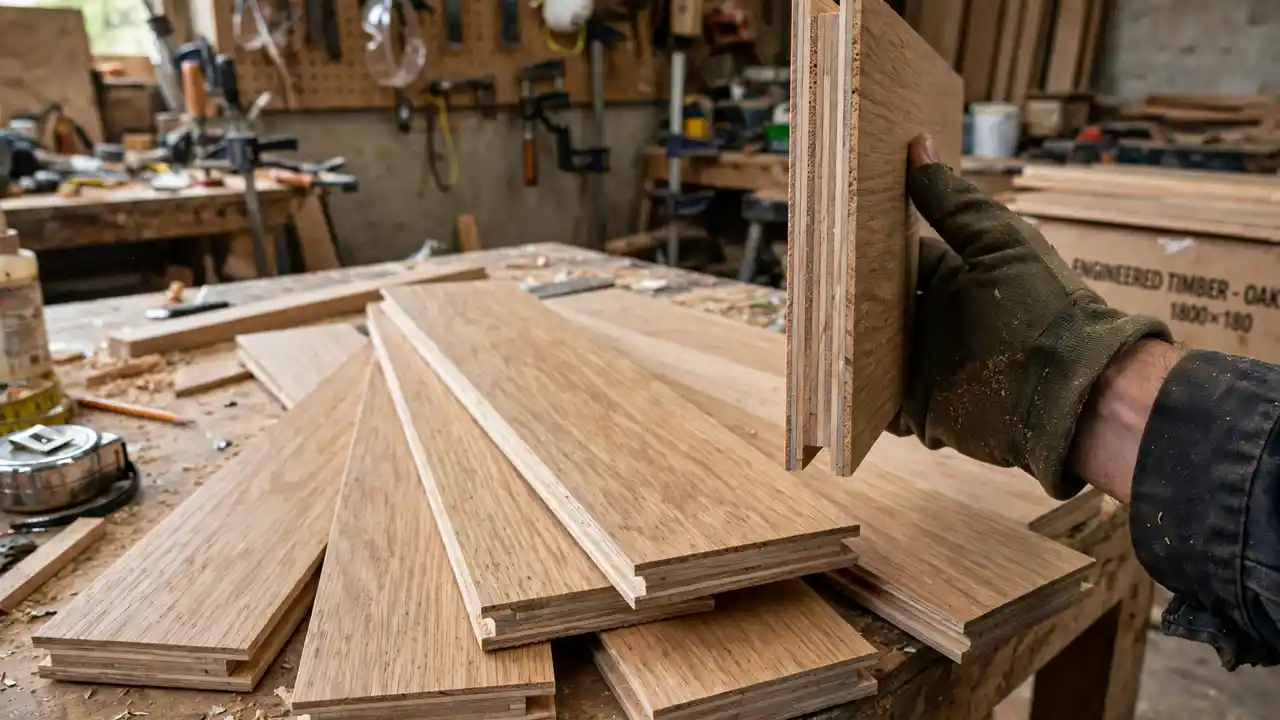
An engineered timber board is a thin layer of real hardwood — the lamella or veneer — bonded over a multi-layer plywood or HDF core. The top is genuine timber, so it looks, feels, and sounds like solid timber underfoot. The core underneath is cross-layered, which stops the board moving with humidity the way a solid plank does — the reason engineered timber suits concrete slabs and apartments.
The construction matters because only one layer wears: the core never gets sanded or refinished, and never shows. Everything about the board’s working life — how many times it can be sanded, how long it lasts, and a large part of the engineered timber flooring cost australia figure — comes down to the thickness of that top veneer, which runs from 0.6mm to 6mm.
Veneer Thickness: The 0.6–6mm Range That Sets the Price
Retailers talk about overall plank thickness — 14mm, 15mm, 20mm — because it sounds solid. The number that decides value is the veneer: a 20mm board with a 0.6mm veneer has less real timber on its face than a 14mm board with a 4mm veneer, and the thin one cannot be sanded at all. Always ask for the wear-layer thickness in millimetres, and get it on the quote.
| Veneer thickness | Supply | Sanding and refinishing | Best for |
|---|---|---|---|
| 0.6–1mm | $60–$70/m² | Cannot be sanded; replace damaged boards | Low-traffic rooms, rentals |
| 2mm | $60–$70/m² | One careful refinish, usually screen and recoat | Bedrooms, light use |
| 3mm | $70–$100/m² | One to two full refinishes | Main living areas |
| 4–6mm | $100–$150/m² | Two to three refinishes | Forever homes, high traffic |
The maths is simple: a 4mm-veneer floor that lasts 35 years often works out cheaper than a budget board replaced twice. A thin veneer is not a bad product, but its lifespan is roughly 20 to 30 years — and it should be priced like one.
Floating vs Direct-Stick: The Install Choice That Moves the Bill
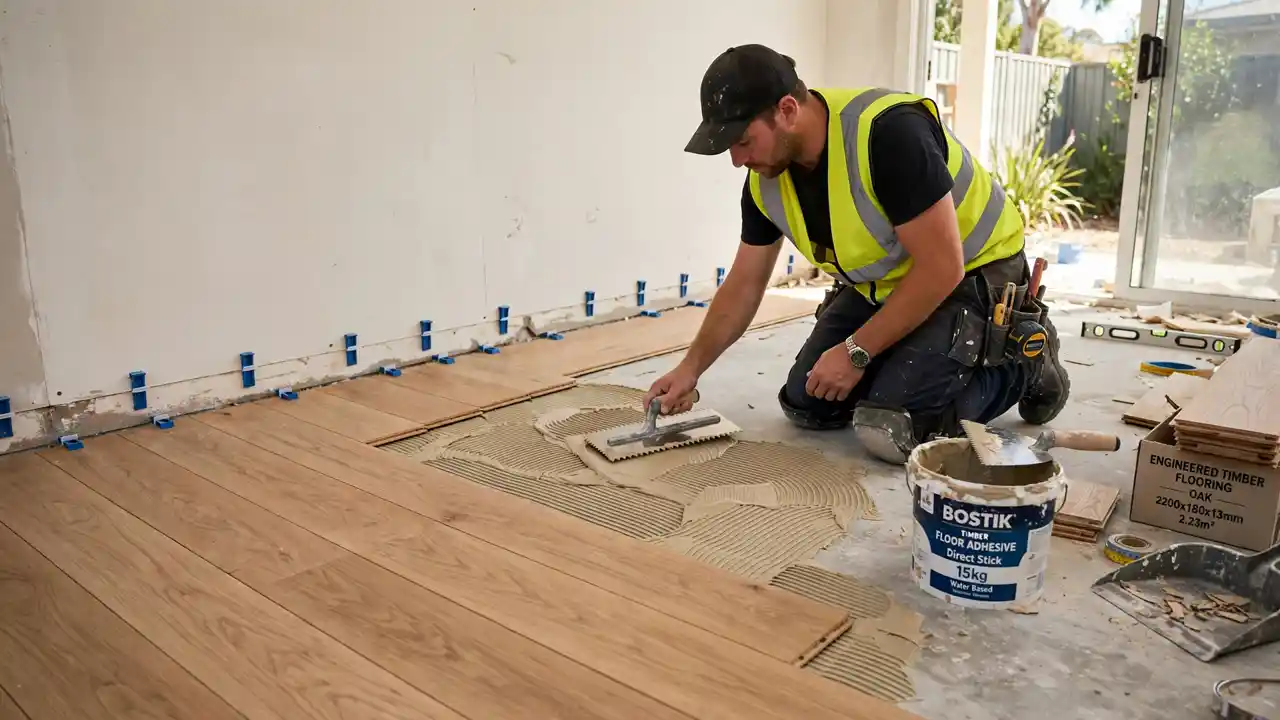
Most engineered boards can be laid either way, and the subfloor usually decides. A floating floor clicks together over an underlay; a direct-stick floor is bonded to the subfloor with flexible adhesive, set board by board. The same board, laid two ways, can differ by $20 to $40 per square metre.
| Method | Labour | Installed total | Feel and fit |
|---|---|---|---|
| Floating | $25–$55/m² | $105–$140/m² | Faster and cheaper; can sound hollow |
| Direct-stick | $55–$80/m² | $130–$200/m² | Solid and quiet; best on slabs and in apartments |
Direct-stick costs more because the work is slower — every board is set into wet adhesive — and the adhesive adds $8 to $15 per square metre. It also needs a flatter, drier, primed subfloor. Floating needs underlay instead, at $3 to $30 per square metre, or $12 to $20 combined with a moisture barrier.
Choose floating when the budget matters most and the subfloor is suspended timber in good shape. Choose direct-stick for a concrete slab, an apartment where acoustics matter, or any board you expect to sand later.
Engineered Timber Flooring Cost by Species
Species sets the supply price before anything else. European oak dominates the premium end with wide planks and pale, even grain. Australian species cost less to freight, and their harder timbers take knocks better in busy family rooms.
| Species | Supply | Character |
|---|---|---|
| European oak | $85–$145/m² | Pale, even grain; wide planks |
| Spotted gum | $65–$130/m² | Warm brown, wavy grain; very hard |
| Blackbutt | ~$130/m² | Pale cream to light brown; hard and even |
| Tasmanian oak | ~$130/m² | Light, warm blonde; suits coastal rooms |
Two cautions. The spotted gum range is wide because sources disagree — budget import grades sit near $65 per square metre, Australian retail near $130 — so grade and board width matter more than the species name. And hardness is quoted for the lamella, not the whole board: a 6mm oak veneer is no harder than a 2mm one.
Herringbone and Chevron: The Pattern Premium
A herringbone or chevron floor is the same timber laid in a pattern, and the pattern is what you pay for: shorter boards, angled cuts, set-out twice as long, and direct-stick only. Expect $20 to $30 per square metre on top of the direct-stick base — a mid-spec European oak herringbone lands at $160 to $235 per square metre installed.
Wastage climbs with the pattern too. Straight-laid planks need about 10% extra for cutting and offcuts; herringbone needs more, so confirm the allowance on the quote. The premium is worth it where the floor is the feature — and hard to justify in a hallway nobody photographs.
Subfloor Preparation: The Cost Retailers Understate
Engineered timber needs a flat, dry, clean subfloor, and most existing slabs do not meet that standard. The working tolerance is about 3mm under a 3-metre straight edge; a floor laid over a subfloor that fails it will creak, bounce, and show every dip.
| Preparation item | Typical cost | When it applies |
|---|---|---|
| Self-levelling compound | $25–$45/m² | Minor dips; major work up to $80/m² |
| Moisture barrier or epoxy DPM | $5–$50/m² | Thin membrane low; epoxy membrane high |
| Moisture testing | $150–$300 per job | Essential on slabs under 12 months old |
| Old floor removal | $8–$25/m² | Pulling up carpet, vinyl, or old boards |
Budget $20 to $40 per square metre for preparation, as a separate line on the quote — not a footnote. On a 60-square-metre floor that is $1,200 to $2,400, which is exactly the amount by which a cheap quote can look cheaper than an honest one.
Engineered Timber vs Solid Timber — and vs Vinyl Plank
Solid timber is the dearer floor: $150 to $350 or more per square metre installed, against $100 to $250 or more for engineered. What it buys is time — a 19mm solid board can be sanded four to six times across a 50-to-100-year life, while even a 4–6mm-veneer engineered board manages two to three. Solid timber also moves more with humidity, so it suits suspended timber subfloors in older homes and struggles on new slabs.
Vinyl plank is the cheaper comparison: installed vinyl runs $50 to $140 per square metre in 2026 — roughly half the price of mid-range engineered timber — and vinyl is waterproof, quiet, and easy to replace board by board. What it cannot do is feel like timber underfoot or add the same resale pull. If the rooms that matter are bedrooms, our carpet cost guide prices the softer option, and our best flooring for Australian homes guide compares every type side by side.
Engineered Timber Flooring Cost Australia: Three Worked Budgets
These three engineered timber flooring cost australia budgets use only figures from the sources above, with the working shown:
| Budget | What it includes | All-in range |
|---|---|---|
| 40m² entry oak, floated | Engineered oak, floated, skirting refitted | ~$6,000 before prep |
| 60m² mid-range, direct-stick | 60m² at $130–$200/m² installed | $7,800–$12,000; $9,000–$14,400 with prep |
| 25m² herringbone, premium oak | 25m² at $160–$235/m² installed | $4,000–$5,875, plus prep if needed |
The first budget is a published retailer example — 40 square metres of engineered oak, floated, at about $6,000 before preparation. The second shows why preparation matters: $7,800 to $12,000 installed becomes $9,000 to $14,400 once $1,200 to $2,400 of preparation is added. The third shows the pattern premium in isolation — a small herringbone entry costs as much as a much larger straight-laid floor.
One more line belongs in every budget: stairs. Timber stairs and nosings run $80 to $140 per step, and a staircase can add more than a whole room to the bill. Our staircase renovation cost guide prices the full job, including the nosings and balustrade work flooring quotes leave out.
Reading an Engineered Timber Quote Line by Line
A good quote has seven lines. Ask for each by name before you sign:
- Board, species, and veneer — make, species, and veneer thickness in millimetres, priced per square metre.
- Install method — floating or direct-stick, labour and underlay or adhesive priced separately.
- Subfloor preparation — flatness and moisture readings, levelling, and membrane, each priced — not “to be assessed”.
- Pattern and wastage — straight, herringbone, or chevron, with the wastage allowance stated.
- Removal and disposal — old flooring pulled up and taken away, priced per square metre.
- Trims, skirting, and stairs — skirting, door bars, and nosings per step.
- Warranty and standards — product and installation warranty, and confirmation the install follows the maker’s instructions.
The red flags are the same as in every trade quote. A single lump sum with no lines cannot be compared with anything. An unstated veneer thickness is a thin veneer until proven otherwise. A quote far cheaper than the others has usually left out the preparation, the adhesive, or the removal. And a floor with no expansion allowance will buckle — the Australasian Timber Flooring Association owner-expectations sheet sets out what a finished floor should look like, including the movement joints that stop peaking and buckling.
How much does engineered timber flooring cost per square metre?
Engineered timber flooring costs $100 to $250 or more per square metre installed in Australia in 2026. Supply-only prices run $60 to $150 per square metre, floating installs land at $105 to $140 per square metre, and direct-stick installs at $130 to $200 per square metre. Entry boards install at $100 to $150, mid-range at $150 to $200, and premium European oak at $200 to $250 or more, before subfloor preparation at $20 to $40 per square metre.
Floating vs glue-down engineered timber — which is better?
Floating is better when budget and speed matter: it costs $25 to $55 per square metre in labour, goes down fast over an underlay, and suits renovations and suspended timber subfloors. Direct-stick is better for concrete slabs, apartments, and any floor you plan to sand later: it feels solid, sounds quieter, and costs $55 to $80 per square metre in labour plus $8 to $15 for adhesive. Herringbone and chevron must be direct-stuck and cannot be floated.
Can engineered timber flooring be sanded and refinished?
It depends on the veneer thickness. A 0.6–1mm veneer cannot be sanded at all, and damaged boards have to be replaced. A 2mm veneer allows one careful refinish, usually a screen and recoat rather than a full sand. A 3mm veneer allows one to two full refinishes, and a 4–6mm veneer allows two to three. Very few engineered floors are ever re-sanded in practice, because modern factory finishes last well — but the veneer thickness still sets the floor’s working life.
How much does it cost to install engineered timber flooring?
Installation labour costs $25 to $55 per square metre for a floating install and $55 to $80 per square metre for direct-stick, with complex glue-down work reaching $80 to $140. Add $8 to $15 per square metre for adhesive on a direct-stick job, $3 to $30 for underlay on a floating job, and $20 to $40 per square metre for subfloor preparation if the slab needs levelling or a moisture barrier. Stairs add $80 to $140 per step.
Engineered timber vs solid timber — which costs more?
Solid timber costs more: $150 to $350 or more per square metre installed, against $100 to $250 or more for engineered timber. Solid timber also lasts longer — a 19mm solid board can be sanded and refinished four to six times over 50 to 100 years, while engineered timber manages zero to three refinishes depending on veneer thickness. Engineered timber wins on stability over concrete slabs and in apartments, where solid timber’s movement with humidity is a problem.
How much does subfloor preparation cost for engineered timber flooring?
Budget $20 to $40 per square metre for subfloor preparation on a typical job. Self-levelling compound costs $25 to $45 per square metre for minor work and up to $80 for major levelling, a moisture barrier or epoxy damp-proof membrane costs $5 to $50 per square metre depending on type, and moisture testing costs $150 to $300 per job. On a 60-square-metre floor, preparation adds $1,200 to $2,400 — the line most often missing from the cheapest quote.