
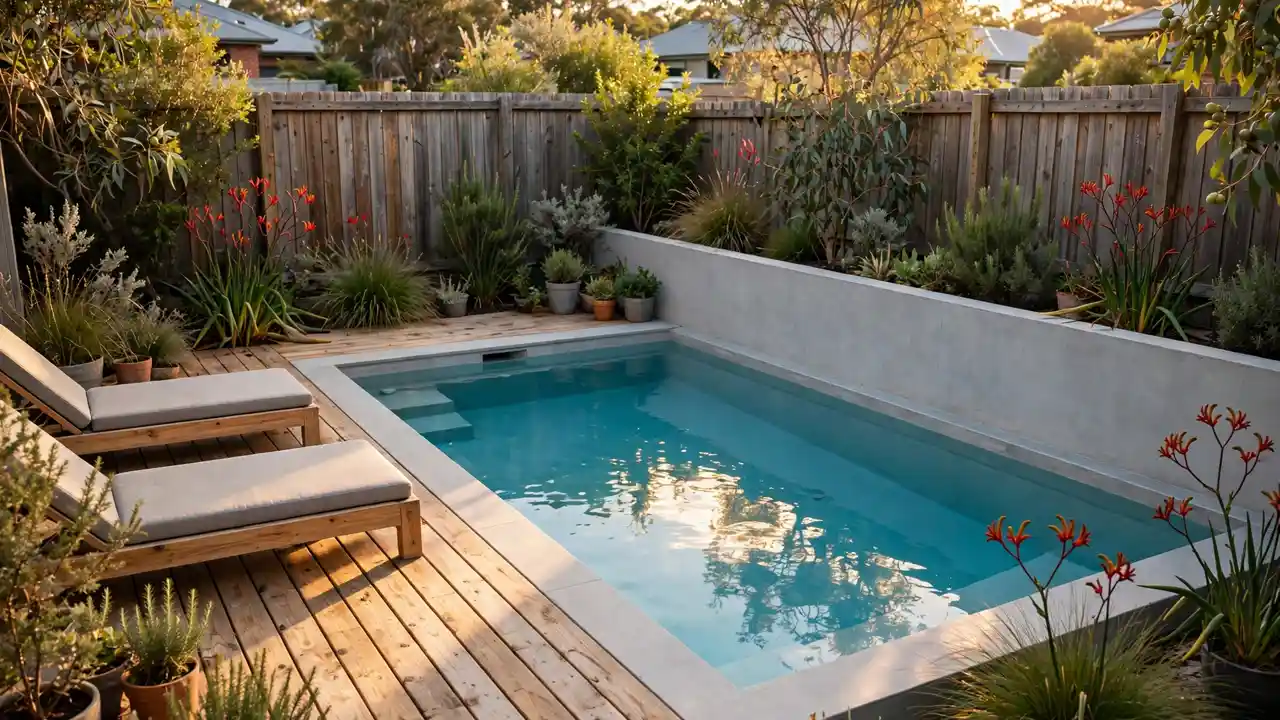
A plunge pool suits a block too small for a full-size pool — and the price is the first thing most guides get wrong. For example, a plunge pool cost australia search mixes shell prices, installed prices, and Sydney prices together, thousands of dollars apart. However, once you separate the shell from the installation, and the pool from the fencing and approval it legally needs, the figures settle into a clear pattern.
This guide prices a plunge pool the way a careful builder does — shell, site work, equipment, fencing, and approval, each on its own line — with every figure from 2026 Australian sources. In fact, a plunge pool is typically 2.5 to 5 metres long and holds 3,500 to 14,000 litres: deep enough to cool off in, too short for laps, and small enough for a courtyard.
Plunge Pool Cost Australia at a Glance
For a standard suburban block, plan on these bands — steel is a supply price, fibreglass and concrete are installed ranges before decking or landscaping:
| Type | Typical range | Best for |
|---|---|---|
| Steel above-ground | From $14,390 | Small blocks, sloping sites |
| Fibreglass plunge (installed) | $20,000–$35,000 | Fast install, standard shapes |
| Fibreglass plunge (premium) | $30,000–$50,000 | Larger shells |
| Precast concrete (installed) | $28,000–$45,000 | Concrete feel, quick placement |
| Custom concrete plunge | $35,000–$60,000 | Awkward corners |
The fencing and approval lines are where most plunge pool cost australia confusion comes from. In addition, every pool deeper than 300 mm needs acompliant safety barrier and, in most council areas, a development application or complying development certificate. As a result, budget $2,000 to $5,000 for the barrier and $700 to $2,500 for approval fees.
Fibreglass Plunge Pools: $20,000–$50,000 Installed
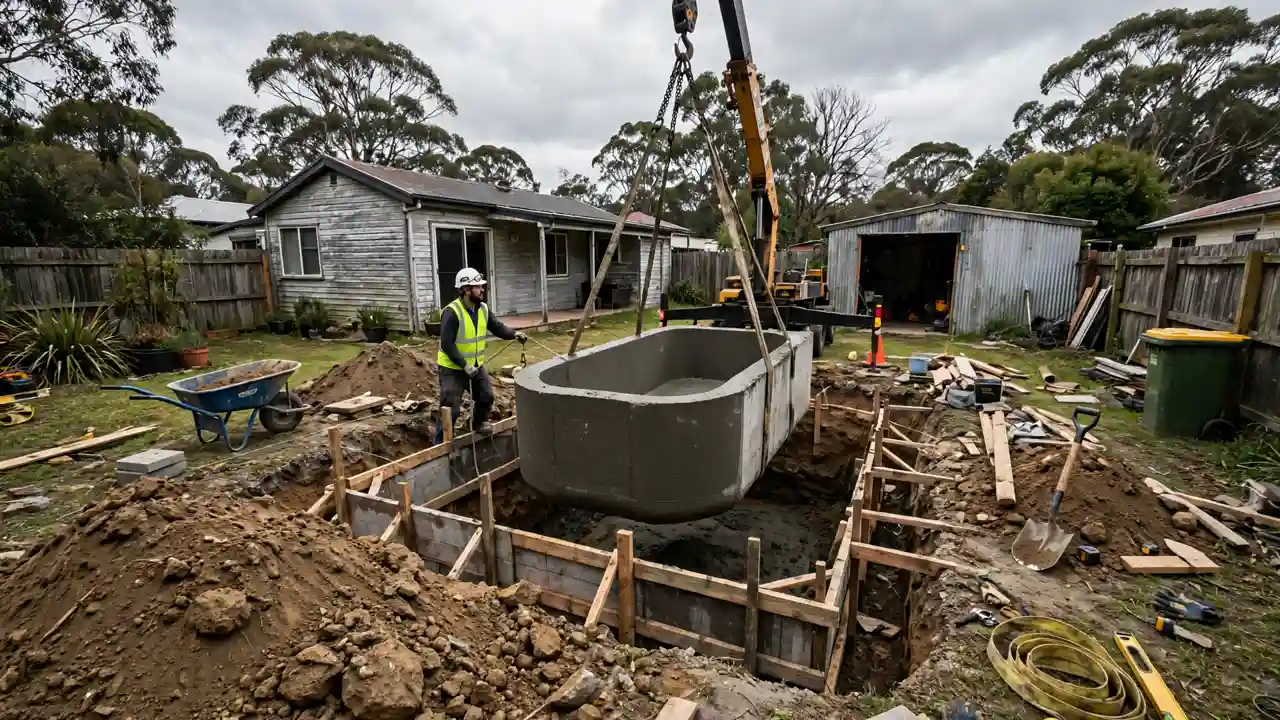
A fibreglass plunge pool arrives as a single moulded shell. A crane lowers it into a prepared hole, and the installer plumbs and fills it. For example, TradieVerify’s 2026 guide puts a standard fibreglass plunge at $20,000 to $35,000 installed, and a premium one at $30,000 to $50,000.
The shell itself is the cheap part. TradieVerify puts a fibreglass shell on its own at $8,000 to $20,000. In addition, installation adds $15,000 to $40,000 on top. Similarly, hipages agrees: a basic shell runs $8,000 to $15,000, and a do-it-yourself kit runs $15,000 to $25,000. A fully installed fibreglass plunge costs $35,000 to $60,000 once everything is counted.
Concrete Plunge Pools: $35,000–$70,000 and Up
Concrete is the custom path. For instance, a sprayed or poured shell is built in place to any shape and finish, so it fits the awkward corner a catalogue shell cannot. In contrast, TradieVerify puts a concrete plunge at $35,000 to $60,000 installed. Sydney builders quote $35,000 to $70,000 and up for a custom build in the city.
Precast concrete sits between the two. In contrast, the factory casts, tests, and finishes the shell before it leaves the gate, then a crane places it in one lift. For example, Plunge Pools Direct lists precast supply from $18,283 for its smallest model, and a typical installed total of $28,000 to $45,000 including site preparation, crane delivery, and plumbing. Similarly, Plungie gives the same shape: $37,000 to $68,000 and up fully installed.
However, concrete takes longer — eight to sixteen weeks for a poured build against a day of on-site placement for a precast shell — and a pebble interior needs resurfacing every 12 to 20 years. In addition, Plungie quotes 50 to 75 years for a precast shell kept in good order.
Steel Above-Ground Plunge Pools: From $14,390
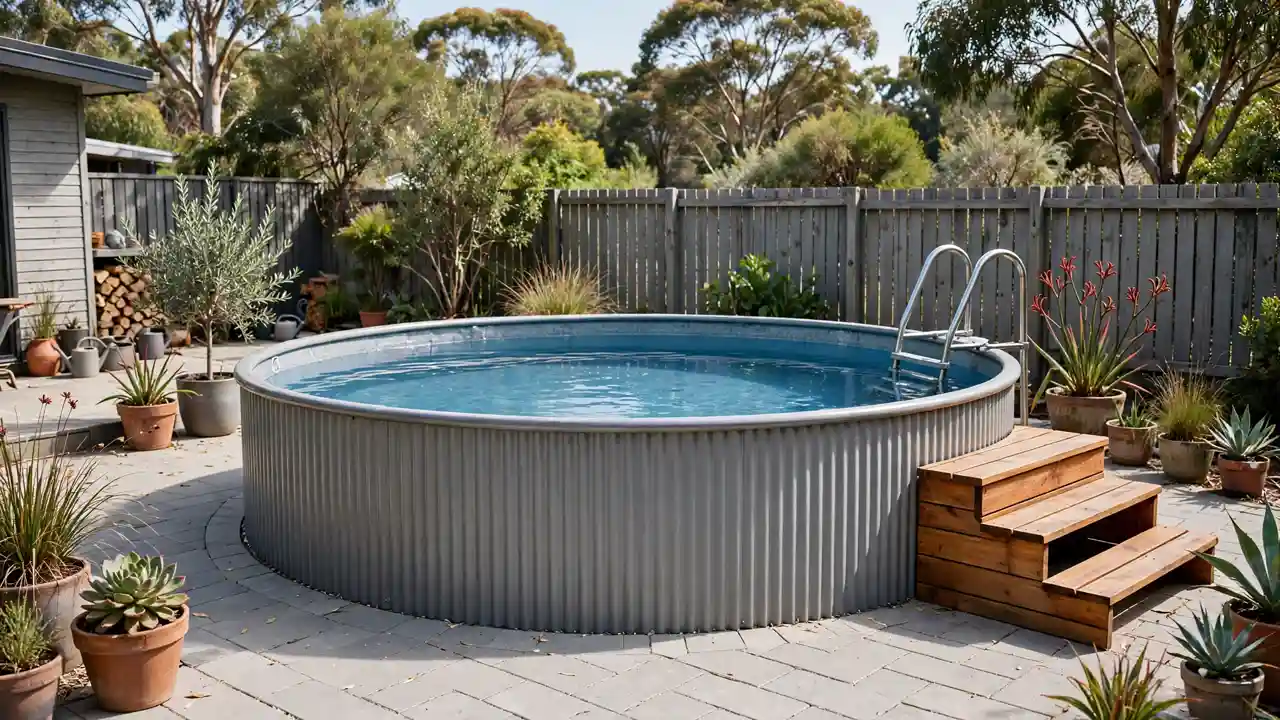
Steel is the cheapest way into a plunge pool, and the only format that needs no digging at all. For example, Outback, Australia’s best-known steel plunge-pool maker, lists its OB Lite from $14,390 and its OB Classic from $19,140. In addition, the pools are made in Australia from 316 marine-grade stainless steel or COLORBOND steel. They arrive fully pre-plumbed, ready to swim in as little as one day.
The low headline needs reading carefully. However, that $14,390 is the pool itself. Delivery, a level pad, the pump and filter package, decking, and the fencing are separate lines. A high-spec pool with jets, lighting, and seating runs to around $25,000 with extras.
Steel suits blocks where digging is impossible: sloping sites, rental properties, and courtyards with no machinery access. On the other hand, the trade-off is presence — a steel pool stands above the ground at full height, so it needs decking, screening, or a pergola over part of the pool zone to look like part of the backyard. For example, decking alone runs $3,000 for a basic timber surround to $15,000 or more for a full wraparound design.
What the Shell Price Leaves Out
In fact, the shell is roughly half the project:
- Excavation and site work — $5,000 to $12,000 in Sydney, more for rock or tight access.
- Crane hire — $3,000 to $14,000 or more.
- Equipment, plumbing, and electrical — $3,000 to $8,000 for the pump, filter, chlorinator, and lights.
- Fencing and barrier — $2,000 to $5,000 for a typical plunge-pool barrier.
- Approval fees — $700 to $2,500 for a development application or complying development certificate.
- Freight — $1,100 to $6,600 depending on distance and access.
- Surrounds — paving, coping, and decking are priced separately by every maker.
Running Costs: $600–$1,200 a Year
A plunge pool is cheaper to run than a full-size pool because it holds a quarter of the water — 3,500 to 14,000 litres against 50,000 litres — but it still needs the same systems. For example, Plunge Pools Direct puts running costs at $600 to $1,200 a year; hipages gives $600 to $1,500. That is the unheated, do-it-yourself figure: chemicals, pump power, and a weekly clean.
The pump is the biggest single running line. For example, a variable-speed pump costs $8 to $18 a month at 33 cents per kilowatt-hour. An old single-speed pump costs $35 to $83 a month, per Energy Australia’s October 2026 figures.
Heating is where the monthly figure moves. In addition, for a plunge pool, budget roughly $15 to $80 a month: solar at the low end, an electric heat pump in the middle, and gas at the top. In contrast, Finder’s often-quoted $50 to $170 a month heat-pump figure is modelled on a 50,000-litre pool. Finally, a thermal cover is the cheapest heating of all: it cuts evaporation by up to 97 percent.
Approval and Fencing: the Lines You Cannot Skip
A plunge pool is a swimming pool in the eyes of the law, whatever its size. In addition, any pool capable of holding more than 300 mm of water needs a compliant child-resistant barrier built to Australian Standard AS 1926.1, and in most council areas a development application or complying development certificate. For example, the Coolamon Shire Council pool requirements state it plainly: plunge pools need a full safety barrier, and the lockable-lid exemption for some spa pools does not apply to plunge pools.
The barrier itself is specific: at least 1,200 mm high, a 900 mm non-climbable zone, and a self-closing, self-latching gate that opens away from the pool. In addition, temporary fencing is acceptable during construction if it meets the same standard. In addition, in Queensland the pool must also be registered and hold a pool safety certificate; in Victoria it must be registered with the council.
Plunge Pool Cost Australia: Three Worked Budgets
Each budget includes fencing and approval — the two lines a shell price never shows:
| Budget | What it includes | All-in range |
|---|---|---|
| Steel above-ground | OB Lite pool, pad, equipment, barrier, approval | $19,000–$28,000 |
| Fibreglass inground | Standard shell, excavation, crane, equipment, barrier, approval | $28,000–$45,000 |
| Precast or custom concrete | Precast shell or custom build, site work, crane | $40,000–$70,000+ |
The steel budget starts at the $14,390 pool and adds the pad, the pump and filter package, a $2,000 to $5,000 barrier, and $700 to $2,500 in approval fees — which is why it lands near $19,000 before decking. In contrast, the fibreglass budget runs from a $20,000 installed shell on a straightforward block to $45,000 with excavation and crane. Finally, the concrete budget starts at precast installed totals, $28,000 to $45,000, and runs to $70,000 and beyond for a custom Sydney build.
However, none of the three includes decking, paving, landscaping, or heating — add $4,500 or more for a heat pump, and $3,000 to $15,000 for decking.
Reading a Plunge Pool Quote Line by Line
Ask for these seven lines by name before you sign:
- Shell — make, model, size, and litres, with delivery named separately.
- Site work — excavation, soil removal, and drainage, with rock and dewatering as provisional sums.
- Crane and access — crane or hiab, named, with a figure.
- Equipment — pump, filter, chlorinator, lights, and heater.
- Barrier and certification — fencing, gate hardware, and the safety certificate.
- Approval — DA or CDC fees and who lodges them.
- Surrounds — coping, paving, and decking, priced per the drawing.
The red flags are the same as in every trade quote, and they are where plunge pool cost australia comparisons fall apart. For example, a single lump sum with no lines cannot be compared with anything. In addition, a shell-only price quoted as an installed price is the oldest trick in the pool trade. Similarly, an “allowance” with no figure is a price rise waiting for the second invoice. Finally, a quote with no fencing or approval line is not a complete project.
Plunge Pool vs Full-Size Pool: Which Fits Your Block?
The choice is usually made by the block, not the budget. For example, a plunge pool fits a courtyard, a narrow side yard, or a townhouse block under 600 square metres, where a full-size pool cannot physically go. In contrast, a full-size pool needs a 7 to 9 metre run; a plunge pool needs a 2.5 to 5 metre rectangle and, for steel, no digging at all.
Use decides the rest. However, a plunge pool is for cooling off, sitting in, and hydrotherapy — it is not for laps, and it is not for a family of six swimming at once. As a result, if the household wants laps, the plunge pool will disappoint no matter how well it is built, and our swimming pool cost guide prices the full-size alternative honestly, including the fencing and site work.
On value: a plunge pool rarely pays for itself at sale. In contrast, what it does is change how the backyard is used — the same presentation thinking behind our kerb appeal guide applies to the pool zone: a tidy, finished plunge pool presents far better than a bare shell on a dirt patch.
How much does a plunge pool cost in Australia?
A plunge pool costs $14,390 to $70,000 or more in Australia in 2026. Steel starts from $14,390, standard fibreglass runs $20,000 to $35,000 installed, premium fibreglass $30,000 to $50,000, precast concrete $28,000 to $45,000 installed, custom concrete $35,000 to $60,000, and a plunge pool with spa jets $40,000 to $70,000. Add $2,000 to $5,000 for fencing and $700 to $2,500 for approval fees.
Is a plunge pool worth it?
Yes, if you want a pool for cooling off on a small block — and no, if you want laps or a pool that pays for itself at sale. A plunge pool fits where a full-size pool cannot, costs about half as much to install, and runs at $600 to $1,200 a year against $1,200 to $2,500 for a standard pool. Buy it for the summers you will use it, not as an investment.
How much does a plunge pool cost to run per month?
An unheated plunge pool costs roughly $50 to $100 a month — $600 to $1,200 a year for chemicals, pump power, and maintenance. Heating adds about $15 to $80 a month: solar at the low end, an electric heat pump in the middle, and gas at the top. A variable-speed pump costs $8 to $18 a month; an old single-speed pump costs $35 to $83 a month. A thermal cover cuts evaporation by up to 97 percent.
Do I need council approval for a plunge pool?
Yes, in most council areas. Any pool capable of holding more than 300 mm of water needs a development application or complying development certificate, and a compliant child-resistant barrier built to Australian Standard AS 1926.1 — at least 1,200 mm high, with a 900 mm non-climbable zone and a self-closing, self-latching gate. In Queensland the pool must also be registered with a pool safety certificate, and in Victoria with the council. The lockable-lid exemption for some spa pools does not apply to plunge pools. Check your own council before you buy.
How much does a plunge pool cost installed?
A fully installed plunge pool costs $28,000 to $45,000 for a typical precast concrete model, $20,000 to $35,000 for a standard fibreglass model, and $35,000 to $70,000 or more for a custom concrete build in Sydney. The installed figure includes the shell, excavation, crane, equipment, fencing, and approval fees — a shell-only price of $8,000 to $20,000 is not an installed price, and the gap between the two is where most budgets blow out. Ask for a total turnkey quote before comparing builders.
Fibreglass vs concrete plunge pool — which is cheaper?
Fibreglass is cheaper — roughly 20 percent cheaper than concrete for the same size, according to hipages. A standard fibreglass plunge installs at $20,000 to $35,000, while a custom concrete plunge runs $35,000 to $60,000. Precast concrete narrows the gap at $28,000 to $45,000 installed, with a concrete feel and a faster install. Choose fibreglass for speed and price; choose concrete when the pool has to fit an exact spot, and accept the longer build and the eventual resurface.