
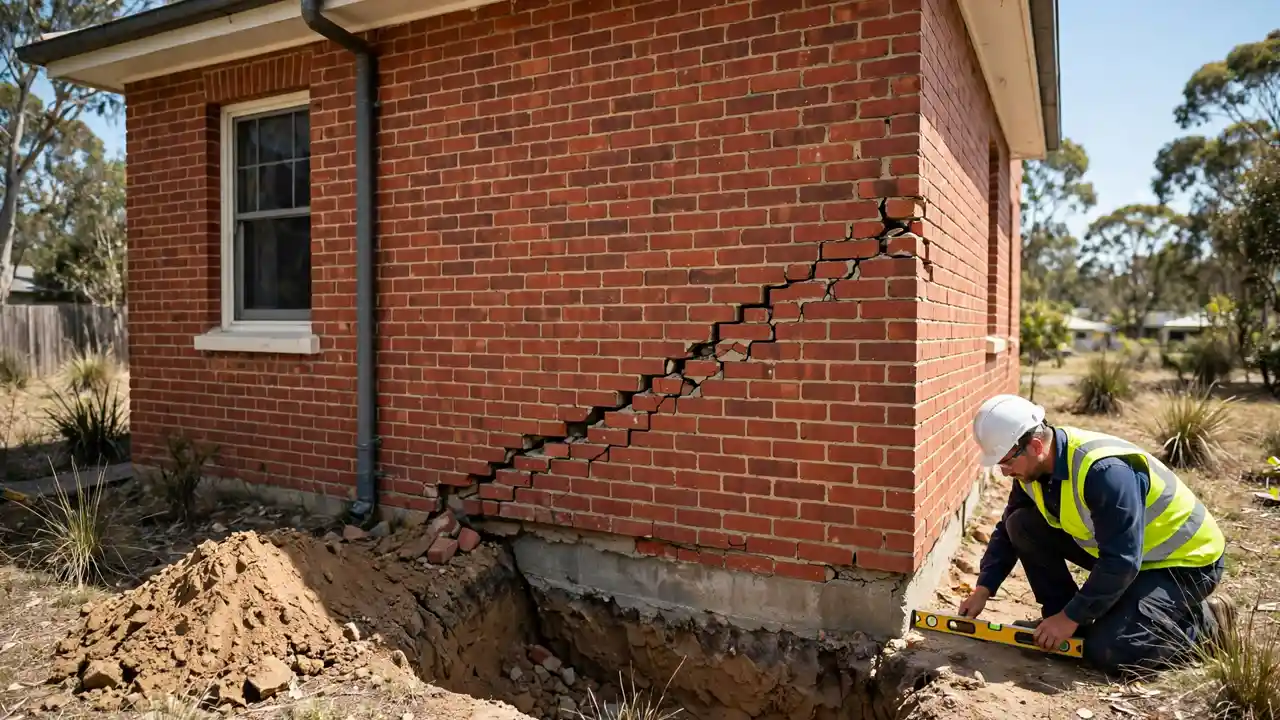
A stepped crack up a brick wall, a door that suddenly sticks, a floor sloping toward one corner — these send homeowners searching for the house underpinning cost australia. No guide can price your house: it depends on the house, the soil, and the method, once a structural engineer has found out why the ground moved.
In addition, every figure below is an indicative range from 2026 Australian sources, not a quote. Get a structural engineer inspection first, before you accept any method or price.
House Underpinning Cost Australia at a Glance
Most sources quote $3,000 to $25,000 for a typical job, averaging around $9,000 (ServiceTasker); severe jobs run $10,000 to $100,000-plus (Groundfix).
| Method | Typical range | Best for |
|---|---|---|
| Mass concrete | $1,000–$3,000 per metre | Simple footing movement |
| Mass concrete piers | $1,500–$3,500 each | One corner |
| Beam and base | $1,500–$3,500 per metre | Weak footings |
| Screw piles / helical piers | $1,500–$5,000 per pier | Reactive clay |
| Resin injection | $4,000–$15,000 a job | Minor settlement |
| Full perimeter | $50,000–$100,000+ | Severe movement |
In short, the house underpinning cost australia spread is the point. Method, metres, and depth to firm ground decide where your house lands.
What Underpinning Is — and the Signs a House Needs It
Underpinning strengthens or extends an existing foundation so the load reaches ground that can carry it. The crew digs beside or beneath the footing and builds new, deeper support, then transfers the house’s weight onto it. It is structural work — not a homeowner job.
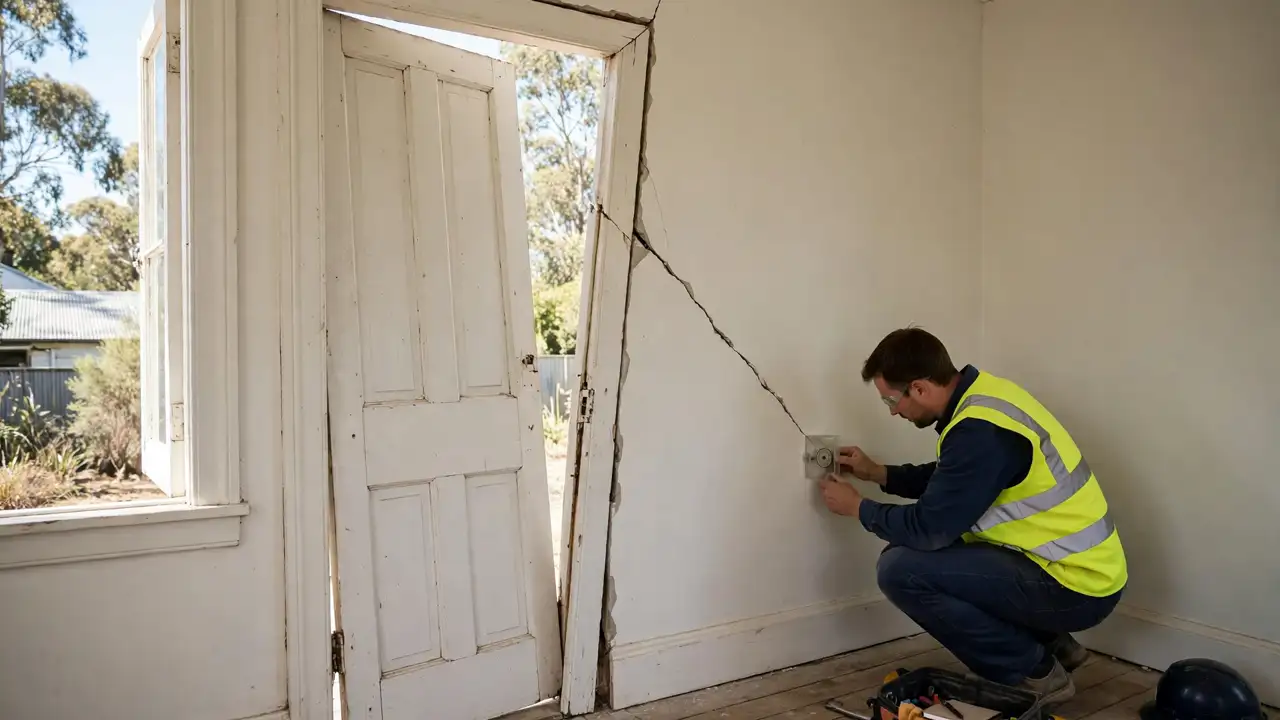
For example, the signs show part of the building moving differently from the rest: stepped cracks following the mortar joints in brickwork, diagonal cracks from the corners of doors and windows, doors and windows that stick or no longer sit square, floors that slope, and gaps around window frames. However, one hairline crack is normal; a crack that keeps growing is not.
In fact, the QBCC guide to subsidence draws the line plainly: wall cracks under 5 mm count as acceptable movement, while wall cracks over 5 mm, bulging walls, and floor cracks wider than 2 mm need an engineer’s assessment. Australian Standard AS 2870 governs footing design.
House Underpinning Cost Australia by Method
Australian sources quote three methods, and they are not interchangeable — each suits a different cause, soil, and budget.
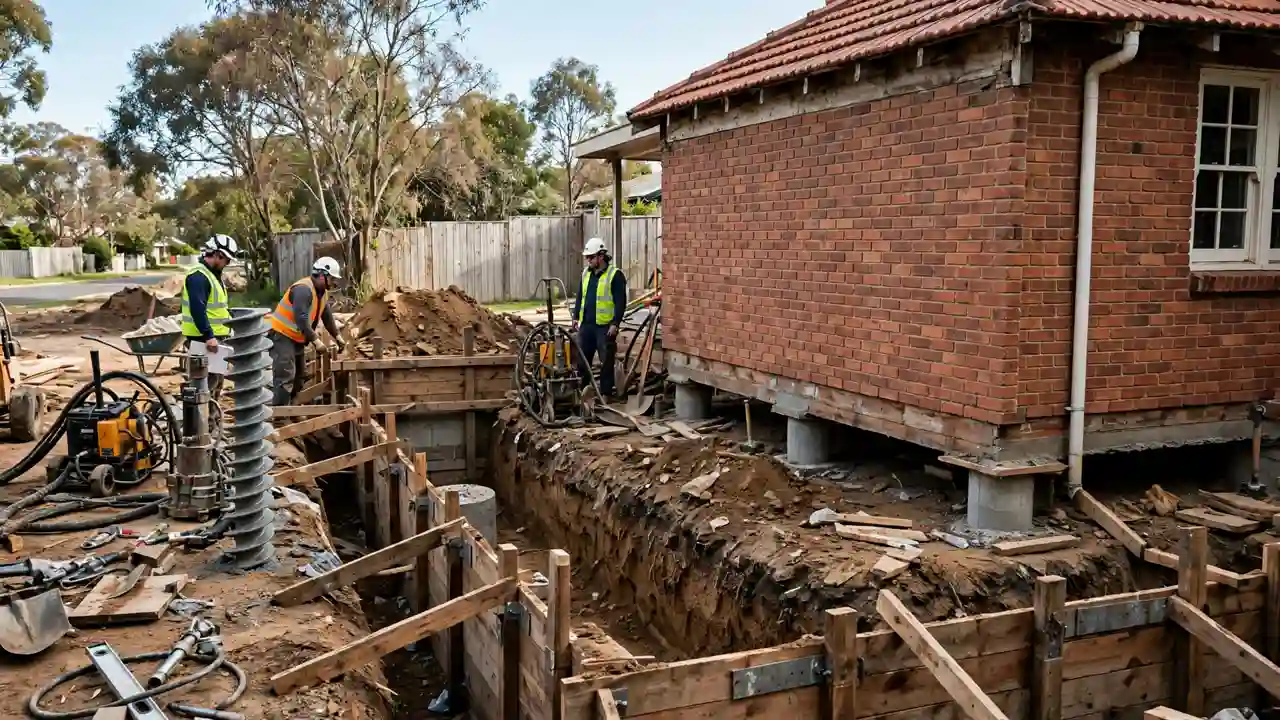
Mass concrete underpinning is the traditional method: the crew excavates sections beneath the footing in sequence and fills them with concrete, extending the footing down to firmer ground. Mainmark, Groundfix, and Airtasker put it at $1,000 to $3,000 per linear metre; Builtly prices piers at $1,500 to $3,500 each. However, it is usually the cheapest option, and the slowest — hand excavation, curing time, and a dug-up garden for weeks. One corner typically takes four to eight piers; a full perimeter job can take twenty or more.
Screw piles and helical piers are steel piles: crews screw or drive them through weak soil to a layer that can carry the load, then bracket them to the footing. The Quote Yard’s 2026 Queensland figures put screw piles at $1,500 to $4,000 per pier and helical piles at $2,500 to $5,500; Groundfix puts screw piling at $3,000 to $5,000-plus per pier — a reconciled band of $1,500 to $5,000. Moreover, piles suit reactive clay and tight sites with no curing time — but contractors price them per pier, so a job needing many piles climbs fast.
Resin injection pumps an expanding polyurethane resin beneath the footing to fill voids and compact the soil, lifting and stabilising the foundation with almost no excavation. Mainmark puts the average resin job at $4,000 to $15,000, Airtasker at $3,500 to $12,000 per house, and Mainmark’s Queensland pages at $1,100 to $1,400 per linear metre. As a result, it is the fastest method — crews often finish a job in days, with the garden intact. The limit is the cause: resin suits minor settlement and small homes, not a footing that has lost bearing capacity.
Underpinning vs Restumping: What Is the Difference?
The difference decides which trade you need. Restumping (reblocking in Victoria) replaces the stumps under a suspended timber floor. Underpinning extends or strengthens the footings beneath a slab, a strip footing, or a masonry base. For example, a house with a subfloor you can crawl into is almost certainly restumping; one on a slab or solid masonry base is underpinning, with greater engineering involvement.
| Restumping | Underpinning | |
|---|---|---|
| House type | Timber floor on stumps | Slab, strip footing, masonry base |
| What is replaced | The stumps themselves | Footing extended deeper |
| Typical cost | $60–$120 per stump; $5,000–$20,000 full job | $3,000–$25,000; $10,000–$100,000+ severe |
| Typical time | 1–2 weeks | 2–4 weeks |
In fact, Builtly’s 2026 figures put restumping at $60 to $120 per stump, with most full jobs landing between $5,000 and $20,000.
What Else Belongs in the Budget
The underpinning price is rarely the whole bill. First, an inspection and report costs from around $1,500, and a full engineered design runs $2,500 to $8,000 depending on complexity. In addition, a soil report costs $500 to $3,000. The design is what the certifier approves and the contractor builds to.
Second, the approval. In addition, underpinning typically needs building approval and a certifier. The Quote Yard puts Queensland approval fees at $1,000 to $3,000 — check with your council or a registered building surveyor before work starts. Similarly, an extension changes the load on the footings too: our house extension cost guide treats an engineering assessment as part of the extension budget.
Third, the make-good. However, underpinning fixes the footing, not the cracked plaster, re-pointed brickwork, re-laid tiles, or doors that need re-hanging once the house is level. Therefore, budget for plastering, painting, and joinery repairs after the structural work.
Fourth, the cause. Finally, if a leaking pipe or broken drain caused the movement, the plumbing repair is a separate bill — and if it is not fixed, the ground will move again.
Three Worked Budgets
In addition, these three budgets use only figures from the sources above, and each starts with the engineer. The method price is one line, not the total — our renovation cost per square metre guide shows the same thinking.
| Budget | What it includes | All-in range |
|---|---|---|
| Localised corner repair | Report + 4–8 concrete piers | $7,500–$29,500 |
| Resin lift, small home | Report + resin injection job | $5,500–$16,500 |
| Full perimeter, older brick home | Design + approval + full underpin | $53,500–$111,000+ |
For example, the corner repair is the common case: a report from around $1,500 plus four to eight piers at $1,500 to $3,500 each. Similarly, the resin budget runs $5,500 to $16,500 all-in for a small home. Finally, the full perimeter budget: a $2,500 to $8,000 design, $1,000 to $3,000 in approvals, and a $50,000 to $100,000-plus underpin. In the third budget, the engineer report is the best $1,500 you will ever spend.
Is Underpinning Covered by Home Insurance in Australia?
Usually no — and this is the answer most homeowners least expect. For example, most policies exclude damage caused by gradual movement, settlement, poor maintenance, or long-term subsidence — exactly what most underpinning is for. In fact, Resinject puts it plainly: you usually cannot claim underpinning, because the movement happened gradually. However, the exception is movement set off by a sudden, insured event — a burst pipe, a storm, or a flood — which insurers sometimes cover.
In short, the distinction is the cause, not the crack: a burst water main washing soil from under a footing in a week may fall under an insured event; ten years of reactive clay movement will not. Therefore, read your Product Disclosure Statement, call your insurer before any work starts, and do not start the repair first and ask later. Finally, if an insurer knocks back a claim, the Australian Financial Complaints Authority handles insurance disputes — the engineer’s report and the fixed-price quote are what an insurer asks for.
How Long Does Underpinning Take?
A typical underpinning job takes two to four weeks on site, and restumping usually takes one to two weeks. In addition, allow extra weeks beforehand for inspection, design, and approval, and time afterwards for re-levelling and monitoring — a contractor promising a full underpin in a week is skipping the steps that make the repair last. The method and the metres of footing set the time: mass concrete proceeds in sections, each excavated, poured, and cured before the next begins. Moreover, screw piles are faster per pier, and crews often finish a small resin job in days.
Reading an Underpinning Quote Line by Line
A good quote has seven lines. Ask for each by name, and compare quotes line by line — the house underpinning cost australia figures here only help if the quotes contain the same work.
- Engineer inspection and design — named engineer, report, and design fee.
- Method and scope — mass concrete, screw piles, or resin, with metres or pier count stated, not a lump sum.
- Soil and access — what the price assumes, and what happens if the crew hits rock or deeper weak ground.
- Building approval and certifier — who lodges it, what it costs, and which inspections it includes.
- Re-levelling and monitoring — whether the house is lifted back to level and follow-up checks are included.
- Make-good — what is restored, and what is left for your own trades.
- Warranty — in writing, and whether it covers further movement or only the work itself.
However, you cannot compare a single lump sum with anything, and a far cheaper quote has usually left out the engineer, the approval, or the make-good. As a result, skipping the engineer and the approval is the classic expensive shortcut — our renovation mistakes to avoid guide lists it among the errors that cost homeowners the most.
The Engineer-First Rule
Underpinning is the most expensive repair most homeowners will ever authorise. Therefore, the only protection against paying for it twice is the order: engineer first, method second, price third. First, the engineer inspects the cracks, takes floor levels, finds the cause, and specifies the method. After that, the contractor prices that specification. Finally, none of the figures in this guide is a quote, and none replaces a site inspection — the cheapest underpinning job is the one done once, for the right cause, by the right method.
How much does underpinning cost in Australia?
A typical house underpinning job in Australia costs $3,000 to $25,000. Mass concrete runs $1,000 to $3,000 per linear metre, screw piles $1,500 to $5,000 per pier, and resin injection $4,000 to $15,000 a job. Larger or severe jobs run $10,000 to $100,000-plus. Add an engineer report from around $1,500, a soil report at $500 to $3,000 if needed, and building approval at $1,000 to $3,000.
How much does underpinning cost per metre?
Mass concrete underpinning costs $1,000 to $3,000 per linear metre, and beam and base work costs $1,500 to $3,500 per metre. Resin injection runs $1,100 to $1,400 per linear metre of footing in Queensland. Screw piles and helical piers are usually priced per pier — $1,500 to $5,000 each — so ask for the pier count as well as the metre rate, because the pier count is what sets the total.
Is underpinning covered by home insurance in Australia?
Usually no. Most Australian home insurance policies exclude damage caused by gradual movement, settlement, or long-term subsidence, which is what most underpinning is for. Cover is sometimes available if the damage was caused by a sudden, insured event such as a burst pipe, a storm, or a flood. Read your Product Disclosure Statement and call your insurer before any work starts.
How long does underpinning take?
A typical underpinning job takes two to four weeks on site. Mass concrete work proceeds in sections with curing time between them, so it cannot be rushed by adding labour. Screw piles are faster per pier with no curing time, and a small resin job is often finished in days. Allow extra weeks beforehand for inspection, design, and approval, and time afterwards for re-levelling and make-good.
What are the signs a house needs underpinning?
The signs are stepped cracks in brickwork, diagonal cracks from the corners of doors and windows, doors and windows that stick or sit out of square, floors that slope or feel springy, and gaps around window frames. The QBCC treats wall cracks under 5 mm as acceptable movement, but wall cracks over 5 mm, bulging walls, and floor cracks wider than 2 mm need an engineer’s assessment.
Underpinning vs restumping — what is the difference?
Restumping (reblocking in Victoria) replaces the stumps under a suspended timber floor. Underpinning extends or strengthens the footings beneath a slab, a strip footing, or a masonry base. If the house has a subfloor you can crawl into, it is almost certainly a restumping job, costing $60 to $120 per stump or $5,000 to $20,000 for a full job. If the house sits on a slab or solid masonry base, it is an underpinning job, typically $3,000 to $25,000, and the engineering involvement is greater.