
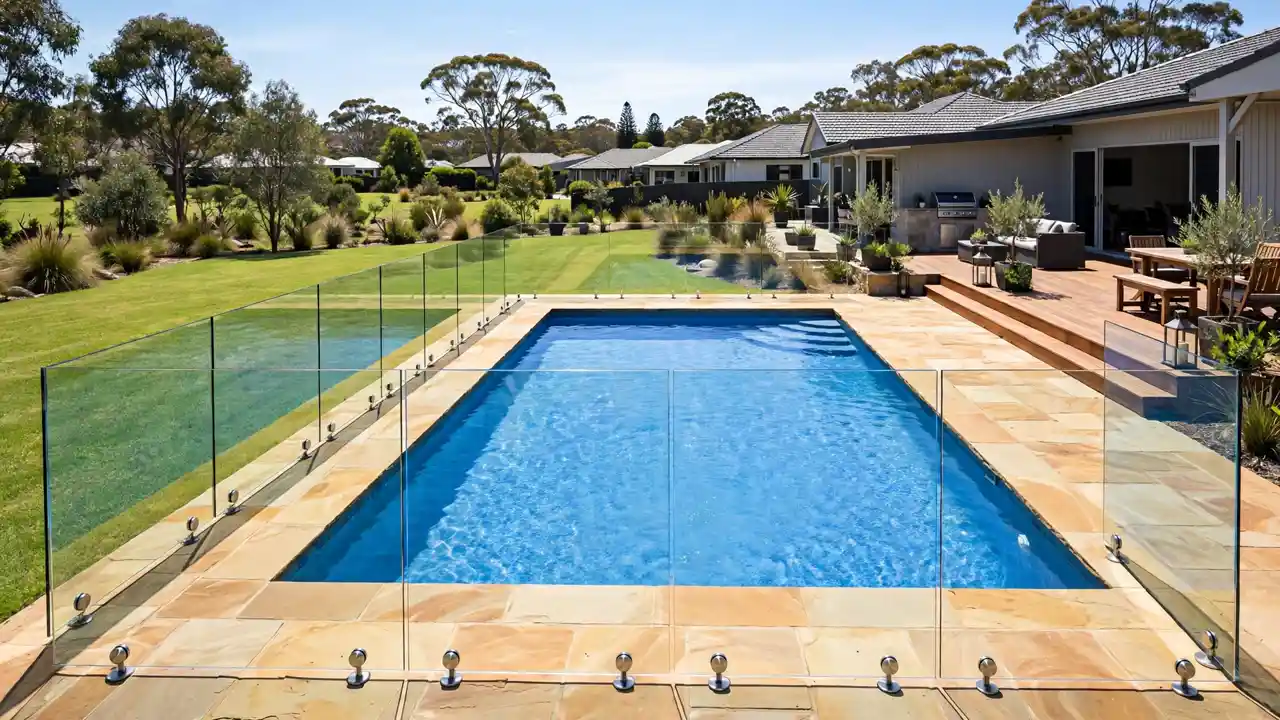
The per-metre figure most guides quote is only the middle line of the real cost. A glass pool fencing cost australia search returns $200 to $600 a metre and stops there. However, the fence that passes inspection is priced by its parts. Those parts are glass, spigots or posts, the gate, and the certificate.
Overall, this guide prices glass pool fencing the way an inspector thinks about it — barrier first, hardware second, paperwork last — with every figure from 2026 Australian sources.
Glass Pool Fencing Cost Australia at a Glance
For a standard suburban pool, plan on these bands — installed, including labour, before gates, certification, or removal of an old fence:
| Type | Typical range | Best for |
|---|---|---|
| Semi-frameless glass | $200–$275 per metre | Glass look, smaller budget |
| Frameless glass (spigot-fixed) | $275–$600 per metre | Uninterrupted views |
| Pin-fixed frameless | $350–$400 per metre | No floor brackets |
| Supply only (no install) | $300–$600 per metre | Owner-builder supply |
| Glass gate, compliant hardware | $400–$900 each | Every pool needs one |
| Certification and inspection | $175–$375 | Makes it legal |
Most guides leave out two lines: the gate and the certification. That omission is where most glass pool fencing cost australia confusion comes from. A gate with proper hinges and a magnetic latch runs $400 to $900. Inspection and certification add $175 to $375 depending on your state.
Frameless vs Semi-Frameless: What the Price Buys
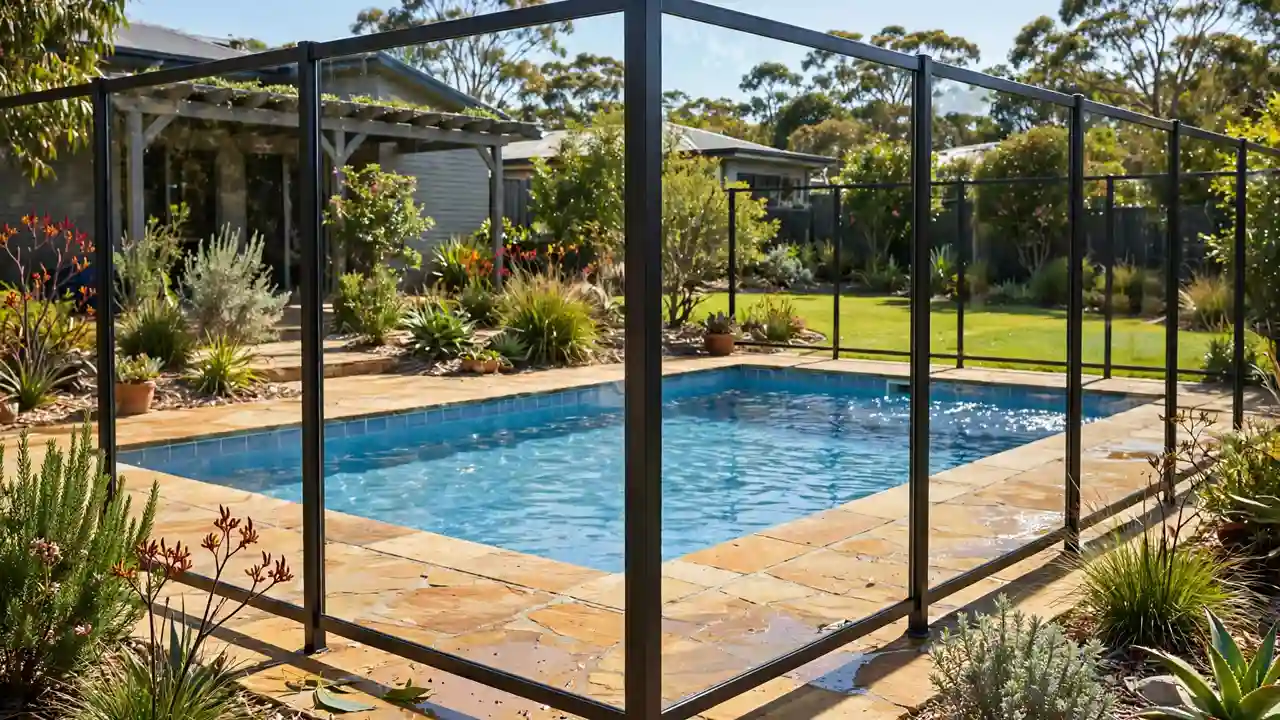
The difference is what holds the glass up. Frameless fencing uses clear panels fixed by stainless steel spigots or channels at the base, with nothing between panels. Semi-frameless fencing uses the same glass held between slim posts, so you see the posts but pay less.
Three sources agree on the bands. Hipages, Yellow Pages, and Pool Advisor put semi-frameless at $200 to $275 a metre installed. They put frameless at $275 to $600. Aqua Vista Glass, a Brisbane specialist, quotes pin-fixed and frameless at $350 to $400 a metre.
One source sits higher. Service.com.au puts semi-frameless at $300 to $430 a metre. It prices glass and hardware separately from installation. As a result, a quote above $275 a metre is not automatically dear — ask what hardware grade sits behind it. ArchiPro’s top end is $400 to $800 a metre installed for channel-fixed systems.
Choose by how visible the fence is. If the pool is the centre of the backyard, frameless earns its premium. Down a side boundary nobody looks through, semi-frameless gives the same glass and the same compliance for roughly a third less. Finally, both pass inspection equally well when specified properly.
Glass Thickness: 10mm vs 12mm
Pool glass is Grade A toughened safety glass under AS 1288. Twelve millimetre glass is the usual frameless specification. The panel has no posts to share the load, so the glass carries it. Ten millimetre glass is common for semi-frameless panels, where the posts take part of the load.
Thicker glass costs more per panel and needs heavier spigots to hold it. A quote that does not name the thickness cannot be compared with one that does. An inspector checks the glass stamp, not the sales brochure. Ask for the thickness in writing. Also, ask whether the glass is heat-soaked — the factory process forces rare nickel sulphide failures before installation, instead of months after.
Spigots, Posts and Hardware: The Hidden Lines
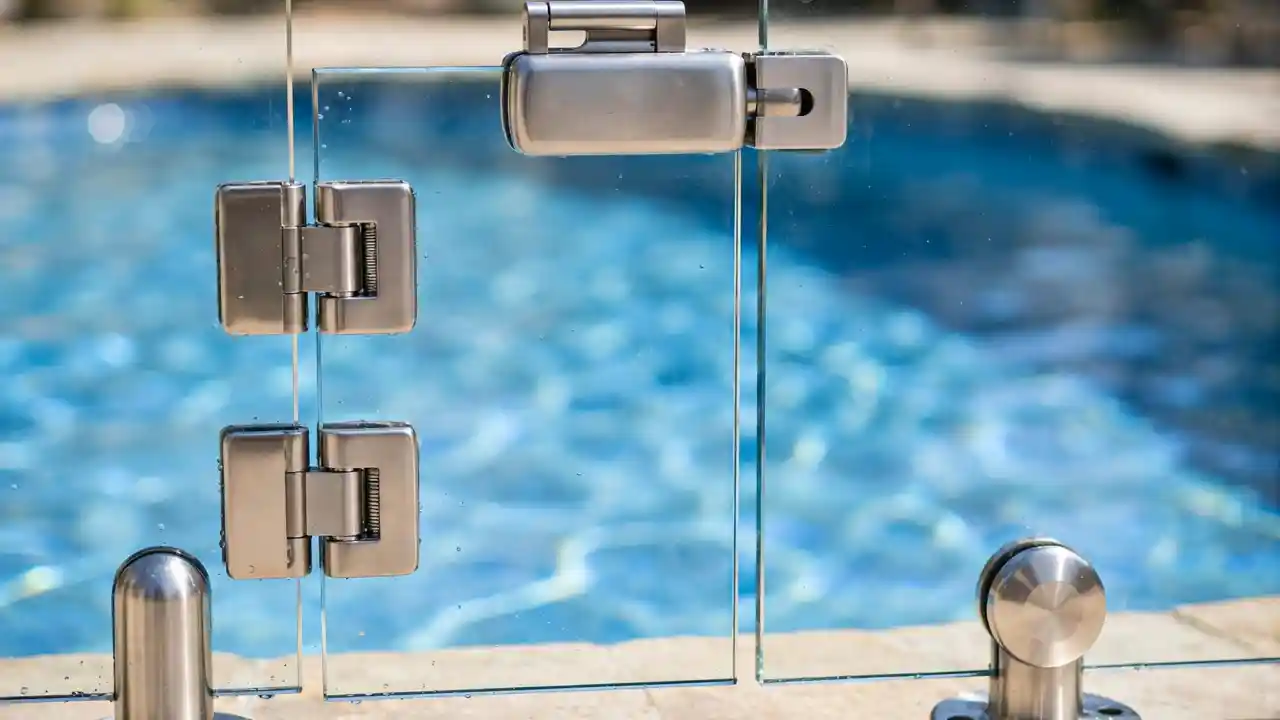
The spigots matter more than the glass. In a frameless fence they carry the whole panel in a wet, chlorinated, often salty environment. They fail first when the grade is wrong. Use 316 marine-grade stainless near the coast and saltwater pools. By contrast, 304 grade costs less and corrodes sooner. A single spigot costs around $50. A run needs one every panel or two — the hardware line is the easiest place for a cheap quote to hide a saving.
Semi-frameless posts are simpler and cheaper: powder-coated aluminium for most backyards, stainless for coastal sites. The fixings should be stainless. The base fixings should suit the surface — core-drilled into concrete, or bolted to a proper footing on pavers. Glass fixed to a moving paver will crack the panel or work the fixing loose.
The Gate: The Part That Fails Certification
The gate is the cheapest part of the fence and the part that fails inspection most often. Under AS 1926.1 it must self-close from any position and self-latch every time. It must also swing away from the pool, with the latch release at least 1500mm above the ground. A gate that swings the wrong way, or a latch a child can reach, will fail the whole barrier. The glass can be perfect and the certificate still refused.
Gate prices move with the hardware, which is why the sources disagree. Pool Advisor quotes $200 to $400 per gate installed. Service.com.au quotes $400 to $900 for a glass gate. A Melbourne guide quotes $800 to $1,200 for a single 900mm glass gate. In short, an aluminium gate sits at the cheap end, while a glass gate with compliant hinges and a magnetic latch sits at $400 to $900. A premium frameless glass gate can reach $1,200. Do not accept a gate quoted without named hinges and a named latch.
The failures inspectors see most are small and preventable. Often, installers never adjusted the hinges after the gate settled. Sometimes, a latch needs a lift to catch. In other cases, installers set the gate level on ground that later moved. The fix is usually an adjustment, not a replacement — replacement hardware runs $120 to $400 fitted. Test it yourself: release the gate from every position and check that it closes and latches on its own every time.
Glass Pool Fencing Cost Australia: Three Worked Budgets
These three budgets use only figures from the sources above:
| Budget | What it includes | All-in range |
|---|---|---|
| 20m semi-frameless + 1 gate | 20m semi-frameless glass, one gate | $4,200–$5,900 |
| 20m frameless + 1 gate | 20m frameless glass, one gate | $5,700–$12,000 |
| 10m frameless + 1 gate | 10m frameless glass, one gate | $4,700–$6,900 |
The 20-metre budgets come from Pool Advisor. For 20 metres of semi-frameless at $200 to $275, the cost is $4,000 to $5,500. Add a $200 to $400 gate, and the total lands on $4,200 to $5,900. The 10-metre budget comes from Service.com.au — 10 metres at $430 to $600 plus a $400 to $900 gate. Certification is extra: add $175 to $375.
Two things move a real quote away from these budgets. Sloping ground needs stepped panels so the gap underneath never exceeds 100mm. A deck or paver base needs proper footings rather than a bolt into a loose paver. A second gate adds $400 to $900. Get the length measured on site — a metre miscounted at $600 is a $600 error.
Reading a Glass Pool Fencing Quote Line by Line
A good quote has seven lines. Ask for each by name before you sign:
- Glass panels — thickness (10mm or 12mm), Grade A toughened to AS 1288, heat-soaked or not.
- Fixings — spigots or posts, stainless grade (316 near the coast), fixing method for your surface.
- Gate and hardware — gate type, self-closing hinges, magnetic latch, latch height, priced as one line.
- Installation — core drilling or footings, stepping for slopes, gap under the fence.
- Earthing and extras — earthing at $20 to $30 a metre, removal of the old fence as a named figure.
- Certification — inspection and certificate, or who books the inspector and what it costs.
- Compliance check — confirmation the barrier was measured against AS 1926.1: 1200mm height, 900mm non-climbable zone.
The red flags are the same as in every trade quote, and they are where glass pool fencing cost australia comparisons usually fall apart. Without separate lines, a single lump sum cannot be compared with anything. Similarly, a quote that does not name the glass thickness has left out the specification the inspector checks. Finally, a quote far cheaper than the others has usually left out the gate hardware, the earthing, or the certification.
AS 1926.1 Rules Before You Book the Installer
Price the fence, then check the rules — they decide whether the pool can be used. Under AS 1926.1, the fence must be at least 1200mm high from the finished ground level on the outside. It must have no more than 100mm under it and no gaps over 100mm between members. The 900mm non-climbable zone is an arc from the top of the fence. Keep it clear of anything a child could climb on — no pot plants, pool pumps, or tree branches inside it. A boundary fence used as part of the barrier generally needs to be 1800mm high on the pool side.
The rules apply to any pool or spa holding more than 300mm of water, including portable and inflatable pools. The edition matters. The current National Construction Code references AS 1926.1:2012. A 2024 edition applies only where state legislation has adopted it. Confirm the edition with your council or inspector before you build.
Certification is where the states part ways. In Queensland, a licensed inspector issues a Form 23 pool safety certificate, needed whenever you sell or lease. Victoria works differently: inspectors check the barrier every four years and lodge a certificate with the council. In New South Wales, the Penrith City Council pool and spa safety page shows the local shape of it. A Certificate of Compliance costs $150, and extra inspections cost $100 each. The certificate is valid for three years. A $550 fine applies if a pool is not fully surrounded by a compliant fence. Budget $175 to $375 in most states. Ask what a re-inspection costs before the first visit — $100 to $150. Passing first time is the cheapest line in the whole project.
The same thinking applies to the rest of the pool area. A deck changes the finished ground level the 1200mm is measured from. So, read our timber deck cost guide before installers measure the fence, not after. Our outdoor lighting ideas cover the pool area at night. Similarly, our courtyard garden design ideas show how the fence, the planting, and the non-climbable zone share a tight space.
How much does glass pool fencing cost per metre in Australia?
Semi-frameless glass pool fencing costs $200 to $275 per metre installed, and frameless glass pool fencing costs $275 to $600 per metre installed. Pin-fixed frameless sits at $350 to $400 per metre, and premium channel-fixed or coastal-grade frameless can reach $800 per metre. Add $400 to $900 for a glass gate with compliant hardware and $175 to $375 for inspection and certification.
What is the difference between frameless and semi-frameless glass pool fencing?
Frameless fencing holds clear glass panels with stainless steel spigots or channels at the base and nothing between the panels, so the view is unbroken. Semi-frameless fencing holds the same glass between slim posts with top and bottom rails, so you see the posts but pay roughly a third less. Both use Grade A toughened safety glass and both pass inspection equally well when specified properly; the price buys appearance, not safety.
What are the pool fence rules in Australia?
Pool fences must comply with Australian Standard AS 1926.1: the barrier must be at least 1200mm high from the finished ground level outside the fence, with no more than 100mm under the fence and no gaps over 100mm between members. A 900mm non-climbable zone measured as an arc from the top must be kept clear, the gate must self-close from any position, self-latch, and swing away from the pool, with the latch release at least 1500mm above the ground. The rules apply to any pool or spa deeper than 300mm, and the exact certificate and inspection regime varies by state.
How much does pool fence certification cost in Australia?
Budget $175 to $375 for inspection and certification, depending on your state and provider. A Queensland third-party inspector charges around $199 including certificate fees, a residential inspection generally runs $175 to $200 with the certificate at $30 to $35, and a Victorian council charges $373.20 including one inspection and the certificate. A failed first inspection costs $100 to $150 for a re-inspection, so passing first time is the cheapest outcome.
Is glass pool fencing worth the extra cost?
It is worth it when the pool is visible from the house and the entertaining area, because the view is what you are paying for — frameless glass keeps the outlook open where aluminium or timber would block it. It is not worth it on a side boundary nobody looks through, where semi-frameless glass or a cheaper compliant barrier gives the same legal protection for far less. Glass also needs regular cleaning to stay clear, and a replacement panel costs more than a replacement aluminium panel, so budget cleaning time as well as money.
How thick should glass pool fencing be — 10mm or 12mm?
Use 12mm toughened glass for frameless panels, because the panel has no posts to share the load and 12mm is the usual frameless specification under AS 1288 Grade A safety glass. Use 10mm glass for semi-frameless panels, where the posts take part of the load. Whichever thickness you choose, ask for it in writing, check the panels are stamped to confirm they meet the standard, and ask whether the glass is heat-soaked.