
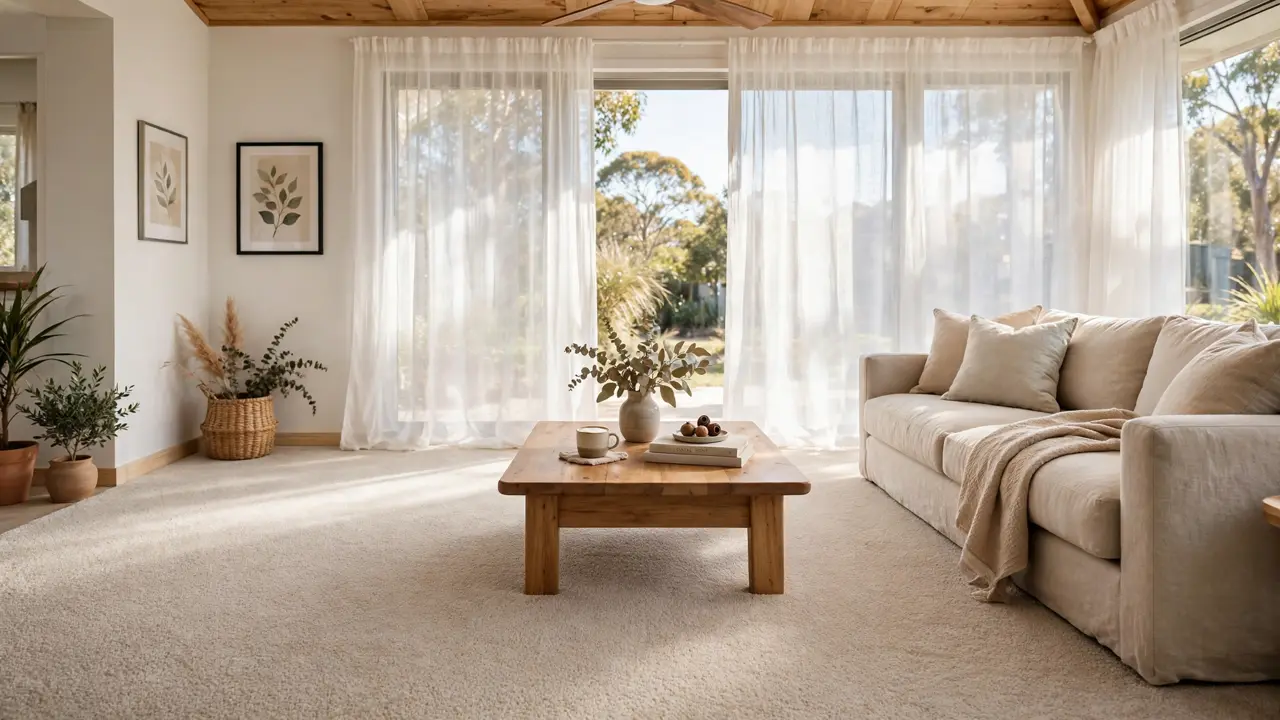
If you are pricing new carpet, the first thing to know is that the headline per-metre figure most guides quote is only one of four lines on a real invoice. Carpet cost australia guides disagree with each other for a simple reason: some quote the carpet alone, some bundle carpet and laying, and some leave underlay, removal and stairs off entirely. Once you split a quote into its four parts, the numbers settle into a clear pattern, and you can compare installers fairly instead of guessing which quote is actually cheaper.
This guide prices carpet the way a careful installer does: carpet, underlay, laying, and the extras, each on its own line. Every figure comes from 2026 Australian sources collected before writing.
Carpet Cost Australia at a Glance
For a standard home, plan on these all-in bands per square metre, covering carpet, underlay and laying, before removal, stairs or floor repairs:
| Band | All-in per m² | Typical choice |
|---|---|---|
| Budget | $45–$75 | Polyester or polypropylene in bedrooms and rentals |
| Mid-range | $70–$110 | Solution-dyed nylon for family living areas |
| Premium | $110–$180 | Wool or wool blend for main rooms and stairs |
A 12 m² bedroom in mid-range nylon lands near $900 to $1,100 all-in, while the same room in premium wool runs closer to $1,300 to $2,100.
What a Carpet Quote Actually Contains
A complete carpet quote has four parts. First, the carpet itself, priced per square metre supplied. Second, underlay, also per square metre. Third, laying labour, charged per square metre. Fourth, the extras: removal and disposal of old carpet, stairs, furniture moving, floor levelling and door trimming.
The trap is that two quotes can show the same per-metre figure and mean different things. One installer quotes $65 per square metre for carpet and laying together, while another quotes $65 for the carpet alone with laying still to come. Always ask each installer to quote the same scope: carpet, underlay, removal of the old carpet, stairs and furniture moving. That single check resolves most carpet cost australia confusion, because the cheapest-looking quote is usually just the least complete one.
One more unit warning matters. Some carpet is priced by the broadloom metre, one running metre of a standard roll about 3.66 metres wide, not one square metre. Confirm whether each price is per square metre or per broadloom metre before comparing suppliers.
Carpet Prices by Fibre
Fibre choice moves the carpet line more than any other single decision. Polyester and polypropylene sit at the cheap end: entry-level polypropylene runs $20 to $30 per square metre for the carpet alone, and service.com.au puts polyester at $25 to $80 per square metre depending on weight and pile. These fibres resist stains well, which suits rentals and kids rooms, but they wear faster in hallways.
Nylon is the workhorse for family homes. Basic nylon starts near $30 per square metre, thicker plush nylon runs $40 to $60, and service.com.au puts the nylon range at $40 to $120 per square metre once heavier and patterned ranges are included. Solution-dyed nylon, where the colour runs through the fibre rather than sitting on top, is the pick for rooms that get sun and spills, because it resists fading and most stains. CarpetAce lists mid-range solution-dyed nylon at $43.50 per square metre supply only, with high-end nylon at $68.30, both including GST.
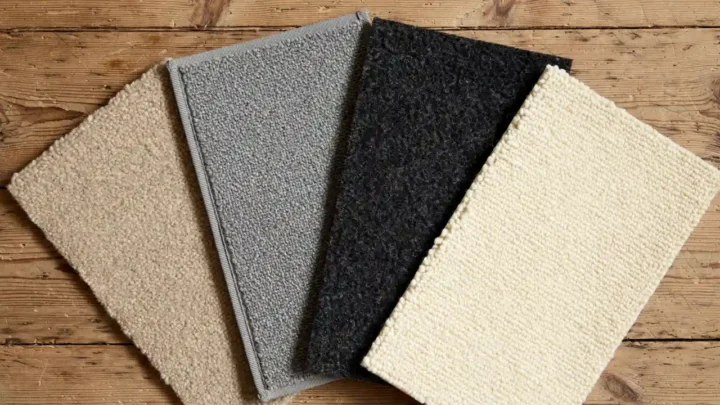
Wool is the premium natural option. Wool commonly runs $60 to $150 per square metre, with premium wool near $110 and patterned designer wool near $123. Wool holds its shape under heavy foot traffic and insulates well, but it absorbs moisture, so stains must be dealt with promptly. Wool blends, typically 80% wool to 20% nylon, sit between the two worlds at $50 to $100 per square metre.
For most homes, the sensible spread is simple: budget synthetics in bedrooms and rentals, solution-dyed nylon in living areas, and wool or a wool blend where you will feel it every day.
Installation, Underlay and Stairs
Laying labour is where published figures diverge most, and the divergence is honest once you read the fine print. Hipages puts carpet laying at $55 to $75 per square metre, a figure its own replacement guide also expresses as an average $65 per square metre for carpet and labour together. Service.com.au, which prices laying on top of the carpet, puts it at $20 to $70 per square metre depending on fibre, with synthetics at the lower end and wool and plant fibres at the top. Yellow Pages puts installation alone from $35 per square metre. These are not contradictions; they are different bundles, and any honest carpet cost australia comparison must name the bundle before it names the figure.
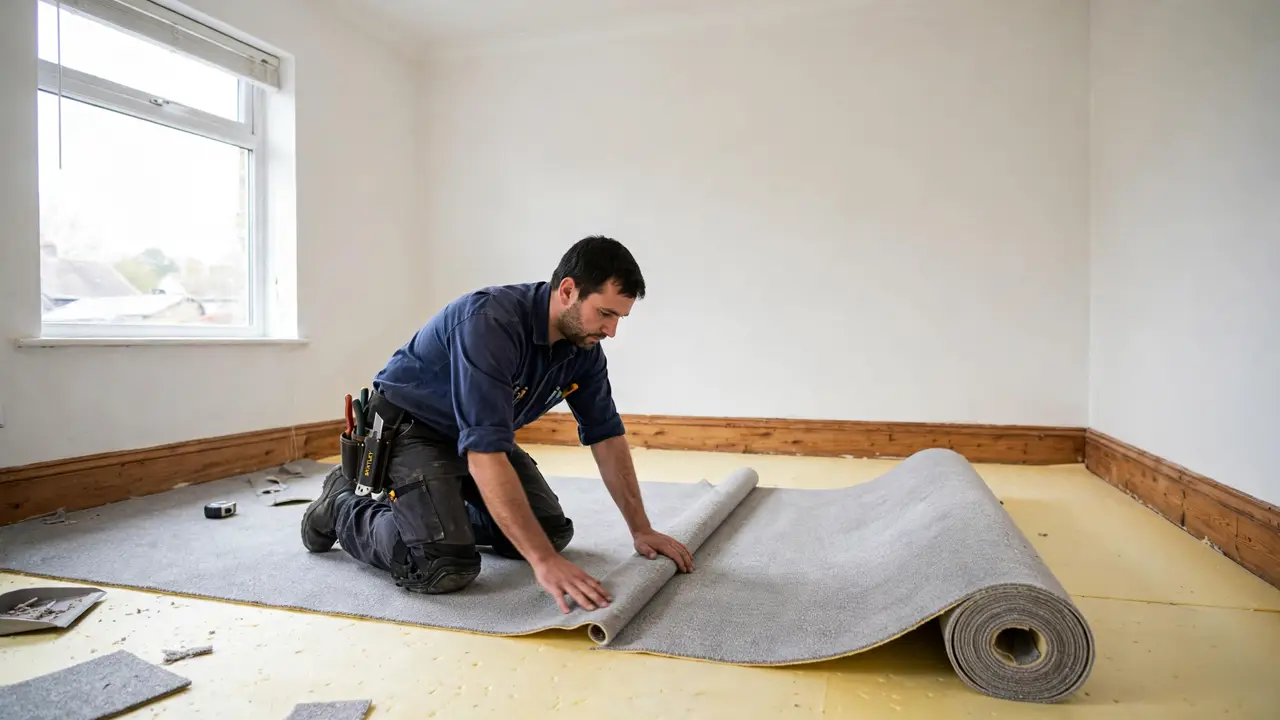
Underlay deserves its own line because it decides how long the carpet lasts and how it feels. Basic foam underlay runs $2 to $10 per square metre, a good 10 mm underlay runs $6 to $10, and premium rubber underlay runs $15 to $20 or more. Good underlay improves comfort, cuts noise between rooms, and can add years to the carpet by cushioning the pile against the subfloor.
Stairs are priced separately almost everywhere. Allow $10 to $20 per step for extra fitting labour on top of the carpet, and confirm whether the staircase total carries a minimum charge. The remaining extras are smaller but they add up: removal and disposal of old carpet runs $10 to $25 per square metre, a moisture barrier for a damp slab runs $5 to $10, floor levelling or subfloor repairs run $10 to $30, and custom cutting around fireplaces and built-ins runs $150 to $300 per room.
Carpet Cost Australia by Room: Worked Budgets
These budgets are built from the component figures above, and each shows its maths so you can swap in your own room size or fibre. They exclude removal, stairs and furniture moving.
Small bedroom, 12 m², mid-range solution-dyed nylon. Carpet at $43.50 per square metre is $522. Underlay at $8 per square metre is $96. Laying at $25 per square metre is $300. Total: $918. That sits inside the mid-range band.
Three bedrooms, about 40 m², mid-range nylon. CarpetAce works this exact job at $3,230 to $3,500 supplied and installed with new underlay, which matches the component maths above once a lower per-metre laying rate for a larger job is allowed for.
Main living areas, 30 m², premium wool blend. Carpet at $85 per square metre is $2,550. Underlay at $12 per square metre is $360. Laying at $35 per square metre is $1,050. Total: $3,960, before removal. If the same 30 m² were done in budget polyester at $25 per square metre for carpet, $6 for underlay and $20 for laying, the total would be $1,530. That $2,430 gap is the real decision: whether the rooms earn the upgrade.
Whole house, about 190 m². Published totals for a full house range from roughly $6,000 to $12,000, and the spread is a bundling story, not an error. The lower end reflects cheaper carpet and a retailer supply-and-install bundle; the upper end reflects mid-range carpet with independent laying and new underlay throughout.
Carpet vs Hard Floors: Where Carpet Still Wins
Carpet has lost ground to hard floors across Australian living areas, but it still wins clearly in three places: bedrooms, stairs, and any room where warmth and quiet matter more than wipe-clean convenience. On stairs, carpet grips, quiets footfall and softens a fall, which is why stairs stay carpeted in homes that have gone hard everywhere else.
The honest comparison is with the hard-floor options on this site. If your living areas take heavy traffic, pets and spills, our vinyl plank flooring cost guide shows a surface that handles those rooms for $50 to $140 per square metre installed, and our bamboo flooring cost guide covers a harder natural surface in a similar band. If you are still choosing between hard surfaces, our hybrid flooring versus laminate comparison sets out where each wins.
The Quote Decoder: Seven Lines to Check
Before signing, run down these seven lines and get each one in writing. One, carpet price per square metre and whether it is per square metre or per broadloom metre. Two, underlay type, thickness and price per square metre. Three, laying labour per square metre and whether it includes gripper rods, trims and door bars. Four, removal and disposal of old carpet and underlay, priced separately. Five, stairs priced per step, including any minimum charge and pattern-matching allowance. Six, furniture moving, including whether beds and wardrobes must be emptied first. Seven, floor preparation: levelling, moisture barrier and subfloor repairs, each priced or explicitly excluded.
Two more checks protect the total. Ask what happens to offcuts and whether waste is charged, because patterned carpet and awkward rooms can waste 10% or more of the roll. A quote that answers all seven lines clearly is usually the honest one, even when it is not the cheapest.
Mistakes That Push the Price Up
The dearest mistake is measuring wrong. Carpet is sold off a roll about 3.66 metres wide, so a room that is 3.8 metres wide needs either a join or a second drop, and joins in the middle of a room show. Measure the longest length and width, note doorways and wardrobes, and let the installer measure before you commit to a figure.
The second mistake is laying new carpet over old underlay, which flattens the new pile within months and voids the feel you paid for. The third is choosing a pale plush pile for a hallway or entry, where it will track and crush within a year; hard-wearing loop or twist pile belongs in traffic, plush pile belongs in bedrooms. The fourth is forgetting doors: new carpet plus thick underlay can stop a door closing, and trimming runs $60 or more per door. None of these mistakes shows up in the headline rate, which is why they keep catching people, and why a careful carpet cost australia budget always leaves room for the lines the headline leaves out.
How to Brief Your Carpet Layer
A good brief starts with the rooms, the fibre and the budget band, in that order. Tell the installer which rooms are bedrooms, which are living areas, whether there are stairs, and whether pets or allergies matter, because those four facts narrow the fibre choice faster than any showroom wander.
Ask about the installer’s experience with your fibre, especially wool and patterned carpet, which punish sloppy joins and pattern drift. Ask what guarantee covers the laying itself, separate from the manufacturer’s carpet warranty, and what happens if a join opens or a seam shows within the first year. The Carpet Institute of Australia is the industry body for the sector, and its member listings are a useful starting point when you are shortlisting installers rather than picking the first quote that arrives.
Frequently Asked Questions
How much does it cost to carpet a bedroom in Australia?
A 12 m² bedroom in mid-range solution-dyed nylon costs about $918 all-in: $522 for carpet at $43.50 per square metre, $96 for underlay at $8 per square metre, and $300 for laying at $25 per square metre, before removal or stairs. Budget polyester brings the same room closer to $600, while premium wool pushes it past $1,300.
Is underlay included in a carpet quote?
Sometimes, and that is exactly why you must ask. Some quotes fold underlay into the laying line, some list it separately at $2 to $20 per square metre depending on quality, and some leave it out entirely. Always get the underlay type, thickness and price as its own line, because new underlay is what makes new carpet feel new.
How long does new carpet last?
Budget synthetics last around 5 to 8 years in busy rooms, good nylon lasts 10 to 15 years with regular vacuuming and cleaning, and wool lasts 15 years or more when it is kept dry and cleaned properly. Hallways and stairs wear first, so expect those areas to age faster than bedrooms regardless of fibre.
Can new carpet go straight over old carpet?
No. Old carpet and old underlay must come out first, and removal and disposal usually costs $10 to $25 per square metre as a separate line. Laying over old carpet leaves an uneven, spongy floor, and laying over worn underlay flattens the new pile within months.
Is carpet or carpet tile cheaper for a large room?
Broadloom carpet is usually cheaper per square metre for a home, with supply from about $20.50 per square metre, while carpet tiles suit offices and busy commercial floors because a damaged tile can be swapped instead of replacing a whole section. For a home, broadloom wins on price and feel; tiles win only where single-tile replacement matters.
How do I measure a room for carpet?
Measure the longest length and width of each room, including doorways and wardrobe recesses, and note the direction of the roll, because carpet is sold off a roll about 3.66 metres wide. Let the installer confirm the measurements before ordering, since joins, pattern matching and waste can add 5 to 10% to the raw floor area.