
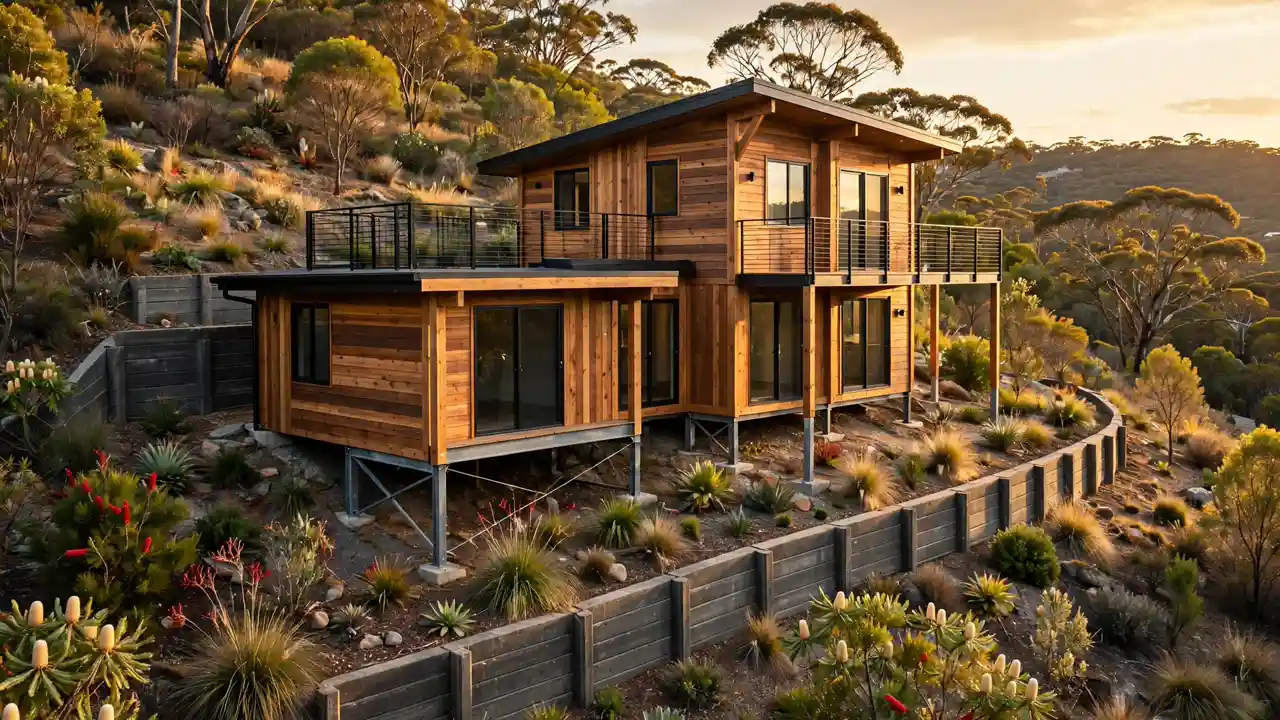
Cheapest home sloping block Australia wide starts at about $95,000 for the home itself. That buys a small 36 m² modular home on steel stumps, before site costs. On a gentle slope, the all-in build runs about $110,000 to $155,000 for a two-bedroom home. A suspended floor skips the cut and fill a slab demands. The cheapest two bedroom home on sloping land Australia wide is a small modular or kit home on stumps. Keep it under 120 m², on the flattest part of the block, with the slope under 15 degrees. This guide ranks the cheapest build types. It prices the slope premium by gradient. And it works out three complete two-bedroom budgets you can check line by line.
Cheapest Home Sloping Block Australia in 2026: The Short Answer
The cheapest build on a slope is the one that moves the least dirt. A suspended floor on steel stumps or poles follows the land, so the earthworks bill stays small. A slab needs the site levelled first, and levelling is where the money goes. Jonathan Homes, writing for Sydney sloping blocks, puts it plainly. The cheapest result comes from a suspended floor plus a split-level design plus minimal cut and fill. A near-$300,000 custom build needs a home under 120 m², a suspended subfloor and a slope under 15 degrees. The table below ranks the options for a two-bedroom home.
| Build type | 2-bed cost, 2026 | Slope limit | The catch |
|---|---|---|---|
| Small modular / kit on steel stumps | $95,000–$125,000 (36 m²) | Up to about 15° | Check turnkey inclusions; delivery and crane extra |
| Compact modular on stumps | $115,000–$135,000 (48 m²) | Up to about 20° | Needs truck access for delivery |
| Split-level kit or custom | From about $180,000 (90 m²) | Up to about 30° | Design costs $15,000–$35,000 |
| Custom home, slab cut-and-fill | From about $250,000 (100 m²) | Any gradient | Cut, fill and retaining dominate the bill |
Modular prices are advertised build prices, not turnkey totals. Ecoflow’s small 36 m² home is $95,000 to $125,000. Its compact 48 m² home is $115,000 to $135,000. Both run at $2,300 to $4,600 per m², so read the inclusions list before comparing them with a custom quote. A barndominium kit is another low-cost shell worth pricing against a modular home. Our barndominiums guide covers the format.
How Much Extra Does the Slope Cost?
The slope premium is the gap between building the same home on flat ground and building it on your block. Three Australian sources price it differently because they measure different things. Builtly’s bands cover the whole premium: earthworks plus retaining plus engineering. Gentle, up to 10 per cent gradient, costs $10,000 to $30,000. Moderate, 10 to 20 per cent, costs $30,000 to $80,000. Steep, 20 to 33 per cent, costs $80,000 to $150,000 or more. Very steep, over 33 per cent, costs $150,000 to $300,000 or more.
Jonathan Homes, pricing Sydney cut and fill only, is lower. Mild, 4 to 10 degrees, costs $10,000 to $20,000. Moderate, 11 to 20 degrees, costs $20,000 to $40,000. Steep, 21 to 30 degrees or more, costs $50,000 or more. Senka, pricing earthworks only, sits between them. A 1 m fall costs $8,000 to $15,000 in earthworks. A 2 to 3 m fall costs $25,000 to $40,000. Retaining adds $10,000 to $30,000 on outer-suburban blocks, or $50,000 or more on steep ones. As a rule of thumb, PropCompare puts the premium at roughly $10,000 to $15,000 per metre of fall. Hipages notes a slope of up to 1 m adds about 20 per cent to the build. Anything over 1 m can add $50,000 or more.
The practical reading is simple. Under 1 m of fall, the premium is a line item. Over 2 m, it becomes a second project. A soil test costs $450 to $3,000. Engineering on a sloping site can add $2,000 to $5,000. Both are worth paying for before the design is drawn. The slope class on paper is what the quote is built on.
Stumps vs Slab: The Maths
Capsul’s granny flat figures give the cleanest comparison. A concrete slab costs $8,000 to $15,000, while steel piers cost $5,000 to $12,000. The suspended floor starts $3,000 cheaper, and the gap widens as the fall grows. The reason is the dirt. Cutting a level pad costs $50 to $120 per m³. Compacting fill costs $40 to $90 per m³. Exporting spoil costs $80 to $150 per m³. Importing fill costs $60 to $120 per m³, according to Builtly. MRN Excavations in New South Wales charges $50 to $150 per m³. An excavator and operator costs $120 to $220 an hour.
A 1 m fall across a 10 m wide home means roughly 50 m³ of cut and fill. That is what it takes to level a slab pad. That is about $2,500 to $6,000 for the cut alone, before compaction and export. The retaining wall that holds the cut face up is extra. That is why the cheapest home sloping block Australia builders quote is almost always a stumps build. The piers carry the floor over the fall instead of removing the fall.
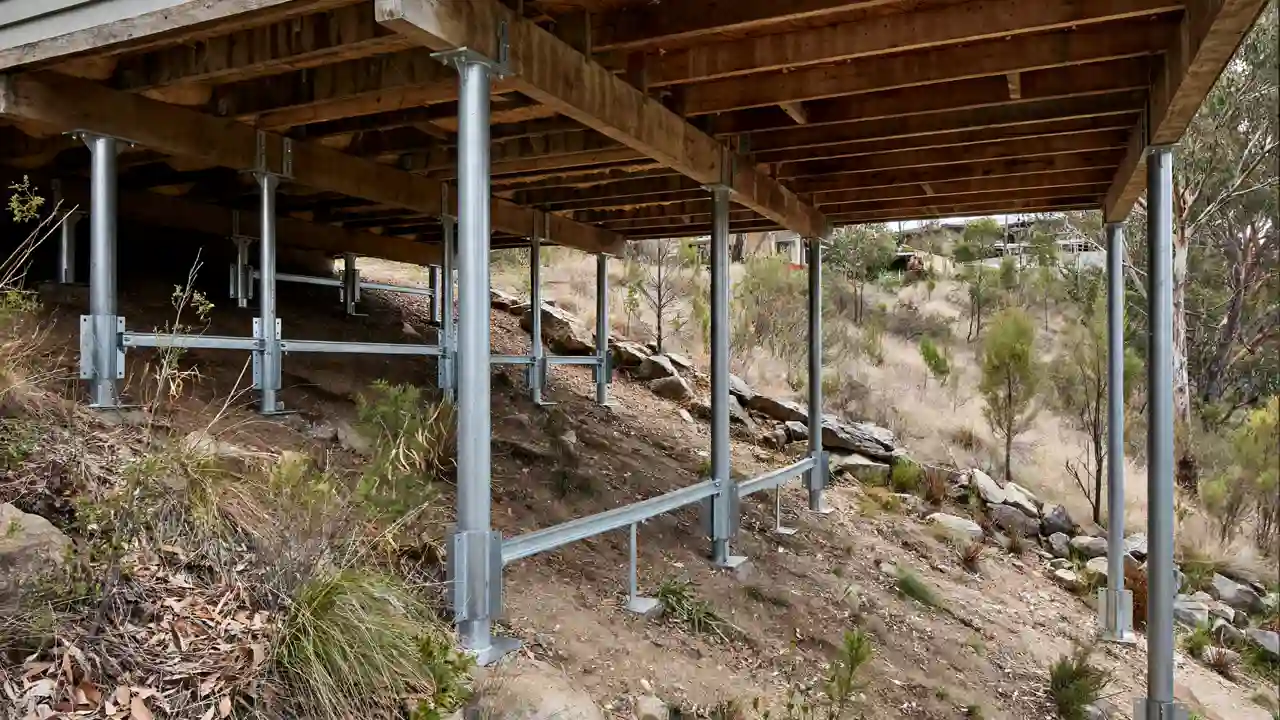
A slab still wins on flat ground and on very small footprints. The pier saving is too small to matter there. It also wins where the soil is reactive clay that moves with the seasons. On a slope over 1 m, though, the suspended floor is cheaper in almost every quote. It also keeps the home’s floor level above the natural drainage line, which matters when the block sheds water fast.
Split-Level vs Single Level on a Slope
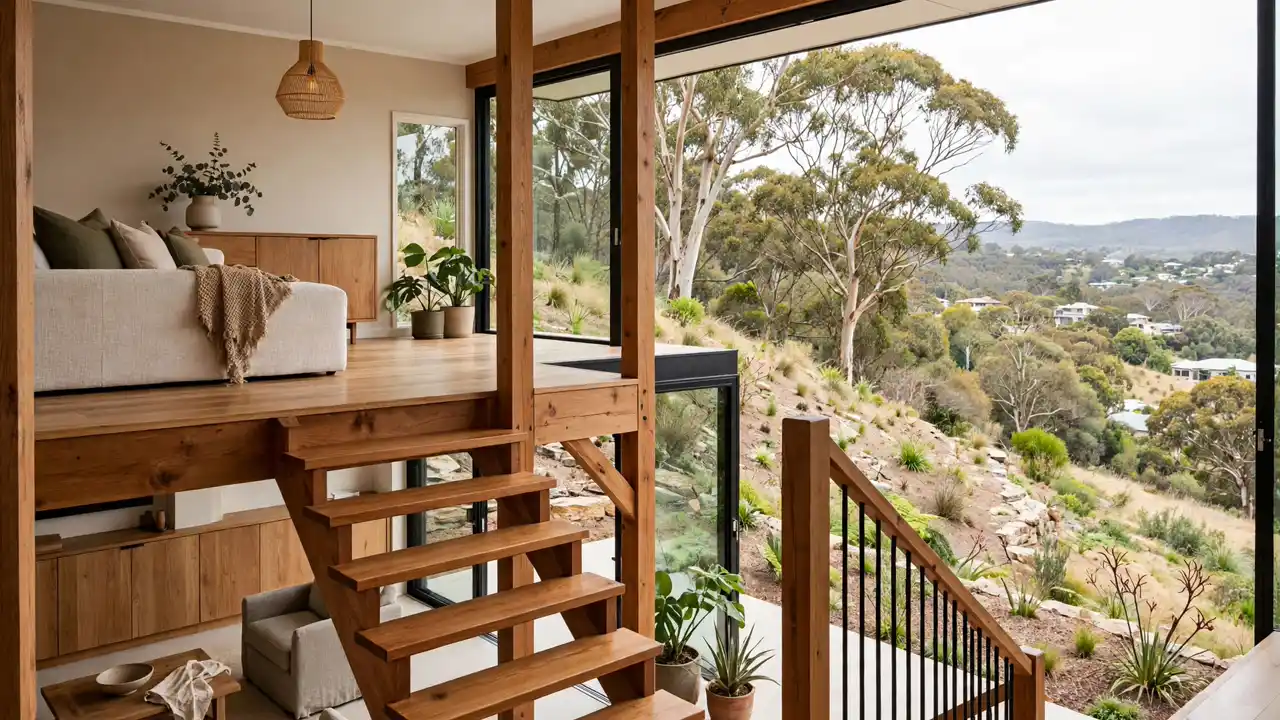
A split-level home steps down with the land instead of fighting it. It cuts less, fills less and needs less retaining than a single-level home on the same block. The trade-off is design. Yorcon puts sloping-block design at $15,000 to $35,000 in Melbourne. A custom sloping-block home runs at $1,800 to $5,000 or more per m². Site costs add 15 to 25 per cent on top. The Victorian Building Authority treats a block as sloping when the gradient exceeds 2.5 degrees over an 8 m cross-section. The maximum building height on a sloping block is 10 m, against 9 m on flat ground. That is exactly the extra height a split-level design uses. A garage tucked under the lower level is common on split-level builds. If the block already has a garage, our garage conversion cost guide prices turning it into a bedroom.
Retaining Walls: The Hidden Cost
Retaining is the line that turns a cheapest home sloping block Australia budget from $110,000 into $200,000. It is priced per square metre of wall face, and a steep block needs a lot of face. Yakka’s 2026 figures are $250 to $1,000 per m² of face. Timber sleepers run $250 to $450. Concrete sleepers run $350 to $650. Besser blocks run $550 to $1,000. A wall 20 m long and 1.5 m high is 30 m² of face. In concrete sleepers, that is $10,500 to $19,500 before engineering. Senka adds $2,000 to $5,000 for the engineering alone.
Timber is cheapest but shortest-lived. Concrete sleepers are the usual middle ground. Besser blocks suit walls over 1 m high, where most councils require an engineer’s design and a permit. The cheapest retaining wall is the one you do not build. That is another reason to put the home on the flattest part of the block. Let the rest of the slope stay as garden.
Cheapest Home Sloping Block Australia: 3 Worked Budgets
Three two-bedroom budgets built only from the sourced prices above, before land.
Budget 1 — 2-bed modular, gentle slope under 15°, 36 m²: $110,000–$155,000. Home $95,000 to $125,000. Steel piers $5,000 to $12,000. Gentle slope premium $10,000 to $18,000 for earthworks and drainage. That is in line with Senka’s $8,000 to $15,000 for earthworks on a 1 m fall. Total: $110,000 at the low end, $155,000 at the high end. This is the cheapest honest two-bedroom build on a sloping block. It only holds if the inclusions list covers delivery, crane and connection of services.
Budget 2 — 2-bed compact modular, moderate slope, 48 m²: $150,000–$227,000. Home $115,000 to $135,000. Steel piers $5,000 to $12,000. Moderate slope premium $30,000 to $80,000 for earthworks, retaining and engineering. That is the full Builtly moderate band. Total: $150,000 at the low end, $227,000 at the high end. The range is wide because a 10 per cent slope and a 20 per cent slope are different jobs.
Budget 3 — 2-bed custom split-level, steep slope, 100 m²: $330,000–$400,000. Base build $2,500 per m² times 100 m² is $250,000, plus the Builtly steep premium of $80,000 to $150,000. Total: $330,000 at the low end, $400,000 at the high end. The base rate is a mid-range custom rate, so a high-end finish or a very steep site pushes past $400,000.
Five Ways to Keep the Price Down
First, build small. Jonathan Homes’ near-$300,000 custom build needs a home under 120 m². Every extra square metre on a slope costs more than the same metre on flat ground. It needs more cut, more fill and more wall. Second, keep the slope under 15 degrees, where the premium is $10,000 to $30,000 instead of $80,000 or more. Third, choose a suspended floor over a slab, which skips the levelling bill entirely.
Fourth, put the home on the flattest part of the block and leave the steep part as garden. The cheapest retaining wall is the one never built. Fifth, get the soil test and the surveyor’s opinion before buying the block, not after. A $450 to $3,000 soil test is the cheapest money in the whole project. It is what the quote is built on. Sloping blocks shed water fast, so budget a tank from the start. Our rainwater tank cost guide prices it. Before signing a building contract, Consumer Affairs Victoria’s building and renovating hub explains your rights. It covers what the builder must give you before work starts.
Frequently Asked Questions
What is the cheapest home to build on a sloping block?
The cheapest two bedroom home to build on sloping land Australia wide is a small modular home on steel stumps: a 36 m² two-bedroom home from $95,000, plus $10,000 to $18,000 in slope costs on a gentle slope, for an all-in build of about $110,000 to $155,000 before land. Keep it under 120 m² and the slope under 15 degrees.
How much extra does a sloping block cost?
Builtly’s bands are $10,000 to $30,000 on a gentle slope up to 10 per cent, $30,000 to $80,000 on a moderate slope, $80,000 to $150,000 or more on a steep slope, and $150,000 to $300,000 or more on a very steep slope. As a rule of thumb, allow roughly $10,000 to $15,000 per metre of fall.
Are stumps or a slab cheaper on a slope?
Stumps, in almost every case. Steel piers cost $5,000 to $12,000 against $8,000 to $15,000 for a slab, and the gap widens as the fall grows, because a slab needs the site levelled first at $50 to $120 per m³ for cutting. On a slope over 1 m, the suspended floor is cheaper in almost every quote.
Is a split-level home cheaper on a slope?
Usually yes, because it steps down with the land and needs less cut, fill and retaining than a single-level home on the same block. The trade-off is design at $15,000 to $35,000, and the Victorian Building Authority treats a block as sloping above 2.5 degrees over an 8 m cross-section.
How much does a retaining wall cost?
From $250 to $1,000 per m² of wall face: timber sleepers $250 to $450, concrete sleepers $350 to $650, and Besser blocks $550 to $1,000. A 20 m by 1.5 m wall in concrete sleepers costs $10,500 to $19,500 before engineering, which adds $2,000 to $5,000.
What slope is too steep to build on?
There is no legal maximum gradient, but the cost decides it: a very steep slope over 33 per cent adds $150,000 to $300,000 or more, and Jonathan Homes notes a near-$300,000 custom build needs a slope under 15 degrees. Get a soil test and a geotechnical report before buying a steep block.
The cheapest home sloping block Australia build is a small modular home on stumps. Put it on a gentle slope, on the flattest part of the block. Price the slope before the home, and the budget holds.