
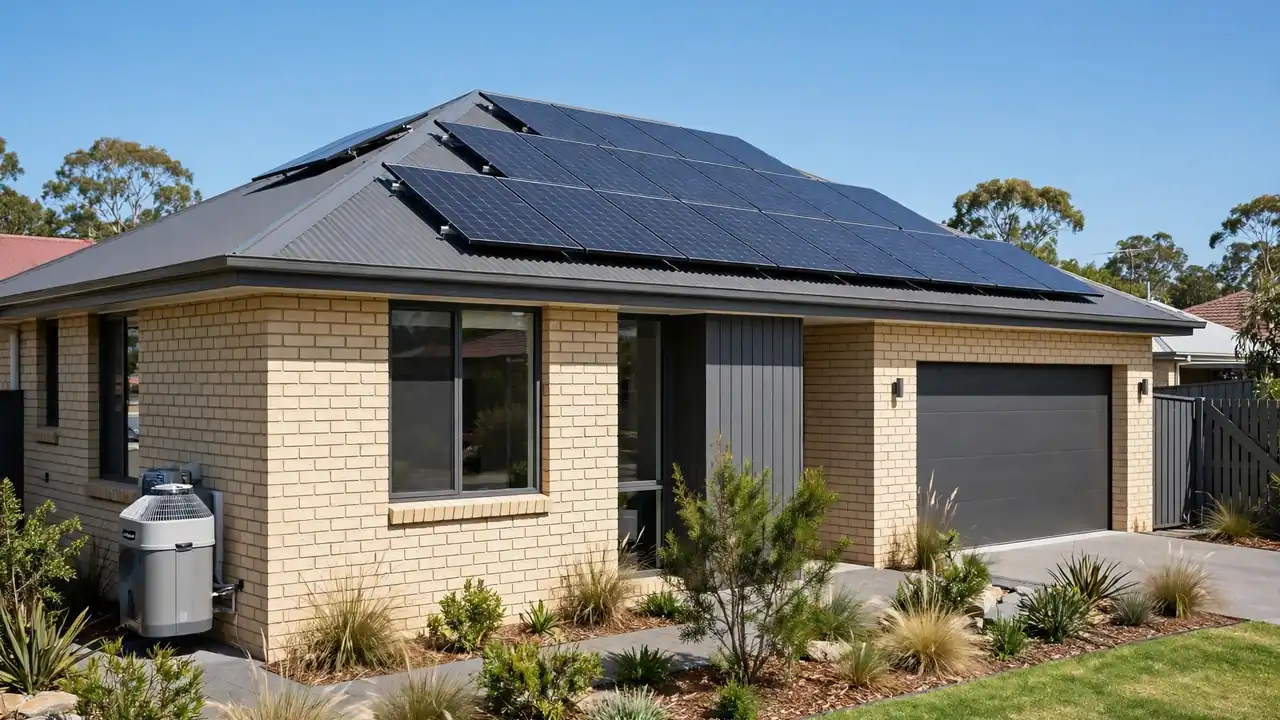
A hot water system is one of those purchases you only think about twice. Once when it goes in, and once when it fails on a cold morning. Getting the price right matters, because the cheapest unit to buy is usually the dearest to run. This guide works through what a hot water system cost australia households actually pay in 2026. That covers the unit, the installation, ten years of running costs, and the rebates that take money off the top. So you can compare systems on their full cost, not just the sticker.
Hot Water System Cost Australia: The Short Answer
For a straight like-for-like replacement in 2026, budget $800 to $2,500 installed for electric storage. Gas storage is $1,200 to $3,500, and gas continuous flow is $1,500 to $4,000. A heat pump runs $3,500 to $6,000 installed before rebates. Solar hot water is $4,000 to $9,000 before rebates. Those bands come from several 2026 Australian guides checked in November 2026. In short, they agree on the order: cheapest to dearest is electric storage, gas, heat pump, then solar. However, what flips the order is the running cost. Over ten years, a heat pump or solar system usually ends up cheaper overall than the electric tank. That tank cost a third as much to buy.
Hot Water System Cost Australia by System Type
The installed ranges below cover supply and installation for a standard replacement. The unit-only column is the hardware alone. That is why some guides look cheaper than others at first glance.
| System type | Installed (2026) | Unit only | Typical lifespan |
|---|---|---|---|
| Electric storage | $800–$2,500 | $525–$2,000 | 10–15 years |
| Electric instantaneous | $600–$2,000 | $750–$1,500 | 10–15 years |
| Gas storage | $1,200–$3,500 | $880–$1,525 | 10–15 years |
| Gas continuous flow | $1,500–$4,000 | $785–$1,625 | 12–20 years |
| Heat pump | $3,500–$6,000 before rebates | $3,000–$4,000 | 10–15 years |
| Solar hot water | $4,000–$9,000 before rebates | $3,650–$6,560+ | 15–20 years |
In particular, two things in that table need explaining. First, the gap between unit-only and installed prices is the installation itself. Yellow Pages lists labour at $500 to $800 for an electric replacement. Gas is $300 to $700, and a new heat pump install is $1,000 to $2,600. Those figures are before valves, tempering, pipework changes, disposal and compliance certificates. A quote that looks high against a unit-only figure is usually pricing a different scope. It is not overcharging.
Second, the heat pump range is the widest because the product range is the widest. One 2026 price guide lists a 270 to 315 litre heat pump — the standard family size — at $3,800 to $5,200 installed. Others stretch to $6,800 for larger or premium models. The Victorian Government’s buyers guide, updated 14 October 2026, puts installed water heaters generally at $2,500 to $7,500 before incentives. As a result, the range is wide because the jobs are different.
Third, solar has two prices. Before rebates, a system is $4,000 to $9,000 installed. After small-scale technology certificates and state incentives, the same system often lands at $3,000 to $6,000. Always ask which figure a guide or a quote is using before comparing it with another.

Running Costs Over 10 Years: The Real Comparison
In fact, water heating is the second largest slice of household energy use in Australia, at 15 to 30 per cent, according to energy.gov.au. It is also the largest source of greenhouse gas emissions from an average home, up to 25 per cent. That is why the running cost matters more than the purchase price. The full hot water system cost australia buyers should compare is the ten-year figure, not the day-one price. The table below uses annual running costs for a family of four. They come from a 2026 Australian plumbing guide, cross-checked against Sustainability Victoria modelling. The figures are worked through ten years at each range’s mid-point.
| System type | Running cost per year (family of four) | 10-year worked total* |
|---|---|---|
| Electric storage | $700–$900 | $9,650 |
| Gas storage / continuous flow | $300–$550 | $6,600–$7,000 |
| Heat pump | $150–$350 | $6,710 |
| Solar hot water | $100–$250 | $6,250 |
*Worked totals: mid-point installed price plus ten years at the mid-point running cost. The heat pump total is after about $540 in STCs. The solar total uses the mid-point of the after-rebate range ($4,500). Tariffs, household size and climate move these figures.
What the Ten-Year Table Shows
The pattern is clear. The electric storage tank costs about $1,650 to install and roughly $800 a year to run. After ten years it is the most expensive system on the list at about $9,650, despite being the cheapest to buy. Gas sits in the middle. It costs about $2,350 to $2,750 installed and $300 to $550 a year to run. That is around $6,600 to $7,000 over ten years. The heat pump costs the most upfront at about $4,750. After roughly $540 in STCs and at about $250 a year to run, its ten-year total is about $6,710. That is level with gas. Solar is the same story at a larger scale. It is dearest to buy and cheapest to run. Its ten-year total is about $6,250 after rebates.
What Sustainability Victoria’s Modelling Adds
Similarly, Sustainability Victoria’s modelling tells the same story with slightly different numbers. Electric storage is $770 a year on off-peak and $1,015 on a peak tariff. Gas continuous flow is $555, a heat pump is $275, and gas-boosted solar is $230. The sources disagree on the exact dollars, because tariffs and household sizes differ. However, they agree on the order, and the order is what decides the purchase. A heat pump also pairs well with rooftop solar. Energy.gov.au notes it uses about 30 per cent of the energy of a conventional electric system. A daytime timer can push the running cost lower still. Our energy-efficient home design guide covers how the hot water choice fits into a whole-house efficiency plan.
Rebates and STCs: What Comes Off the Price
In practice, rebates are where the hot water system cost australia households pay for a heat pump or solar system stops looking expensive. They are also where quotes get confusing, because federal and state schemes stack differently in each state. The federal scheme is the Small-scale Renewable Energy Scheme. Solar and heat pump water heaters earn small-scale technology certificates (STCs). The installer usually claims them as a point-of-sale discount. For a 250 to 315 litre heat pump, that is 10 to 17 certificates. They are worth about $400 to $680 at around $40 per certificate as at October 2026. STCs are available in every state until 31 December 2030; the count depends on the model and your climate zone.
The states run their own schemes on top. In New South Wales, eligible households replacing an older water heater with an air-source heat pump can receive up to $640. That applies when replacing an electric system. Replacing gas brings up to $330. In Victoria, an eligible owner-occupier replacing gas with a heat pump can get up to $1,000 from Solar Homes. For example, a locally made product brings up to $1,400. Victorian Energy Upgrades adds about $560, as at October 2026. The scheme has a minimum customer contribution of $200 including GST.
Two warnings first. First, eligibility is narrow. The NSW discounts apply to replacing an older water heater, not to a new build. The Victorian figures are for eligible owner-occupiers. Second, rebates change. Confirm the current figure with your installer before you sign, and get the discount shown as its own line on the quote. The Australian Government’s hot water systems guide on energy.gov.au lists the federal STC position. It links through to the state schemes.

What Moves the Quote
Five things move a quote more than the brand on the box. The first is a change of fuel. Switching between gas and electric means new pipework, a new power supply or a flue. As a result, that adds hundreds to over a thousand dollars. The second is access. A unit tucked behind a retaining wall costs more to swap than one sitting in the open. The third is the condition of what is already there. Corroded pipework, a failed tempering valve or a non-compliant overflow drain all get fixed while the plumber is there, as extras. The fourth is the electrical work a heat pump can need, such as a dedicated circuit. The fifth is timing. An emergency replacement leaves no room to compare quotes, and it shows in the price. If your system is over ten years old, get a quote while it still works.
Repair or Replace?
For example, most hot water failures are small: a thermostat, an element, a relief valve. A repair in the low hundreds is worth it on a unit under eight years old. In other words, it needs no rust and no history of trouble. The maths changes when the tank itself is rusting. It also changes when the unit is past twelve years, or when the repair costs more than about a third of a replacement. At that point you are paying to keep a system that will fail again. Every year with an old electric storage tank is another year of the highest running costs on the list.
One more factor for Victorian households: from 1 March 2027, the rules require an electric alternative when a gas system fails. If you live in Victoria and your gas unit is ageing, plan around that date rather than discovering it on the day it fails. For the wet areas the new system serves, our bathroom renovation cost guide and laundry renovation cost guide cover the plumbing budgets. Those budgets usually sit alongside a replacement.
Frequently Asked Questions
How much does a hot water system cost in Australia in 2026?
In 2026, a like-for-like replacement runs $800 to $2,500 installed for electric storage, $1,200 to $3,500 for gas storage, $1,500 to $4,000 for gas continuous flow, $3,500 to $6,000 for a heat pump before rebates, and $4,000 to $9,000 for solar hot water before rebates. Installation, access and fuel changes move the final figure.
Which hot water system is cheapest to run?
Solar hot water is cheapest to run at about $100 to $250 a year for a family of four, followed by a heat pump at $150 to $350. Gas costs $300 to $550 a year, and electric storage is dearest at $700 to $900. Over ten years, heat pump and solar systems usually end up cheaper overall than electric storage despite costing more upfront.
What rebates are available for a heat pump hot water system?
Federal small-scale technology certificates are worth about $400 to $680 for a 250 to 315 litre heat pump, until 31 December 2030. New South Wales offers up to $640 when replacing an electric system with a heat pump, or up to $330 when replacing gas. Victoria offers up to $1,000 from Solar Homes plus about $560 from Victorian Energy Upgrades for eligible owner-occupiers. Confirm eligibility before you buy.
How long does a hot water system last?
Electric storage and heat pump systems typically last 10 to 15 years, gas continuous flow 12 to 20 years, and solar hot water 15 to 20 years. Lifespan depends on water quality, maintenance and climate — hard water and coastal air both shorten it. A system past twelve years with rust or repeated faults is usually better replaced.
Can I replace a gas hot water system with a heat pump?
Yes, and it is the most common fuel switch in 2026. A heat pump uses about 30 per cent of the energy of a conventional electric system, and the switch can attract both federal STCs and state discounts. The job needs a licensed plumber and usually an electrician for a dedicated circuit, and the gas line needs capping. In Victoria, from 1 March 2027 a failed gas system must be replaced with an electric alternative.
Buy the system on its ten-year cost, not its day-one price. An electric tank is the cheapest way into hot water and the dearest way to stay in it. A heat pump or solar system costs more at the start. Overall, it pays the difference back in running costs. Get three itemised quotes and check the rebate as its own line. Size for the household you will have in five years, not just the one you have today.