
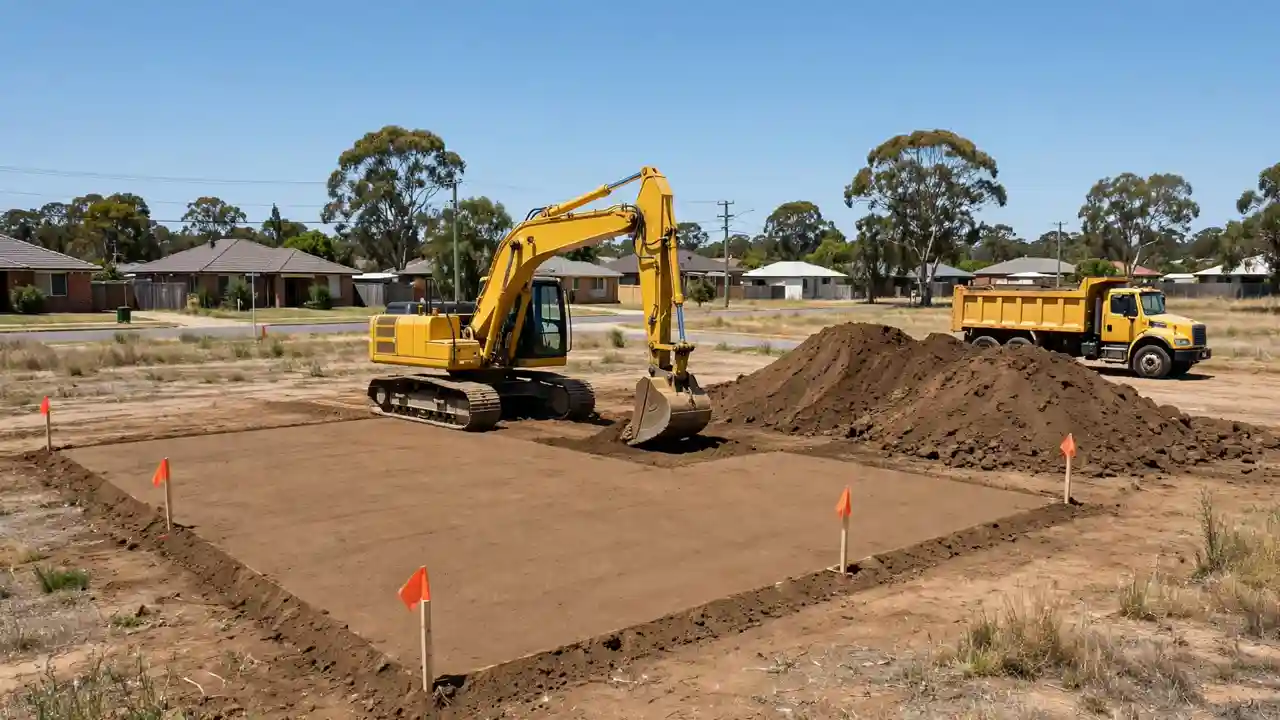
Site preparation for building construction turns a block of land into a place a house can stand: soil testing, clearing, cut and fill, retaining walls, and connecting power, water, sewer and gas. It is also where budgets go wrong most often — none of it appears in the base house price. In Melbourne’s growth corridors a standard lot runs $15,000 to $45,000 in site costs. However, a complex site with slope, reactive soil or rock can pass $70,000. This guide prices each part from 2026 Australian sources, with three worked budgets.
Site Preparation for Building Construction: The Short Answer
Budget $15,000 to $45,000 for site preparation on a standard flat lot; $30,000 to $70,000 or more on a sloping block or reactive soil. First, the money goes to a soil test ($450 to $3,500); a site cut and fill ($3,000 to $30,000); retaining walls ($250 to $1,000 per square metre of wall face); and service connections ($8,000 to $20,000). The soil test matters most. Above all, it decides the slab and footing design. In Victoria, the builder must have the foundation data before you sign. First, get the soil test and survey done before you commit. Finally, get every site cost itemised — not as a single allowance.
The Soil Test Comes First — and the Law Backs You Up
Before anyone designs a slab, an engineer classifies the site under Australian Standard AS 2870. Classes run from A to E. A means stable sand or rock. S and M sit between. H1, H2 and E mean highly to extremely reactive clay. Finally, P covers problem sites with fill, soft soils or erosion. The class decides the slab and footing system and is the single biggest driver of site cost. For example, Senka notes an M-class block in Cranbourne might need $15,000 in site preparation. However, an H2 block in Melton needs $35,000 or more for the same house. A standard classification in Melbourne costs $450 to $1,400. However, a full geotechnical investigation for a complex or previously disturbed site runs $1,500 to $3,000 or more. Senka puts the geotechnical report at $1,500 to $3,500.
Consumer Affairs Victoria is clear. The builder must get foundation data — a report based on soil tests — before you sign. In particular, you should not pay extra later for problems such as rock the builder should have identified from that data. The Consumer Affairs Victoria foundations guide sets out exactly what the builder must obtain and when. Also, a proper allowance covers the contour survey, clearing, earthworks, piering, drainage and stormwater, temporary fencing and sediment controls. In addition, authority fees for planning and stormwater connections usually sit outside the build contract.
Cut and Fill: The Earthworks Bill
Cut and fill reshapes a sloping site. Then, it excavates the high side and uses suitable material to build up the low side, creating a level platform. Site preparation for building construction on a flat block needs little of it; on a slope it is the largest single cost. Next, the machine rates tell the story.
In Western Australia, a bobcat with operator runs $90 to $150 an hour; a mini excavator $110 to $180; a mid-size excavator $150 to $250; tipper cartage $80 to $150 an hour or per load. In Queensland, a mini excavator runs $90 to $150 an hour; a larger one $120 to $220; a bobcat $100 to $160; a full-day rate commonly $800 to $1,500; spoil cartage $150 to $400 a load plus tip fees. A house pad cut and fill runs $3,000 to $30,000 in WA and $3,000 to $15,000 or more in Queensland. Overall, both depend on slope and volume.
Builtly’s 2026 guide puts excavation at $50 to $120 per cubic metre. Rock costs significantly more. Fill compaction runs $40 to $90 including testing. Rock breaking runs $150 to $300 an hour in Queensland. Senka puts rock removal at $5,000 for minor rock to $25,000 or more where basalt or sandstone runs deep. The state difference is mostly soil. For example, Melbourne’s west and north sit on highly reactive basalt clays. Perth sits largely on sand. Brisbane mixes reactive clays with steep blocks. So the same house costs far more to prepare in Melton than in Cranbourne.
| Site cost item | Melbourne 2026 | Perth / WA 2026 | Brisbane / QLD 2026 |
|---|---|---|---|
| Soil test / classification | $450–$3,500 | — | — |
| House pad / site cut | $3,000–$30,000+ | $3,000–$30,000 | $3,000–$15,000+ |
| Service connections | $8,000–$20,000 | Power $3,000–$10,000+ | Water + sewer $5,000–$15,000+ |
Retaining Walls: The Cost That Hides in the Slope
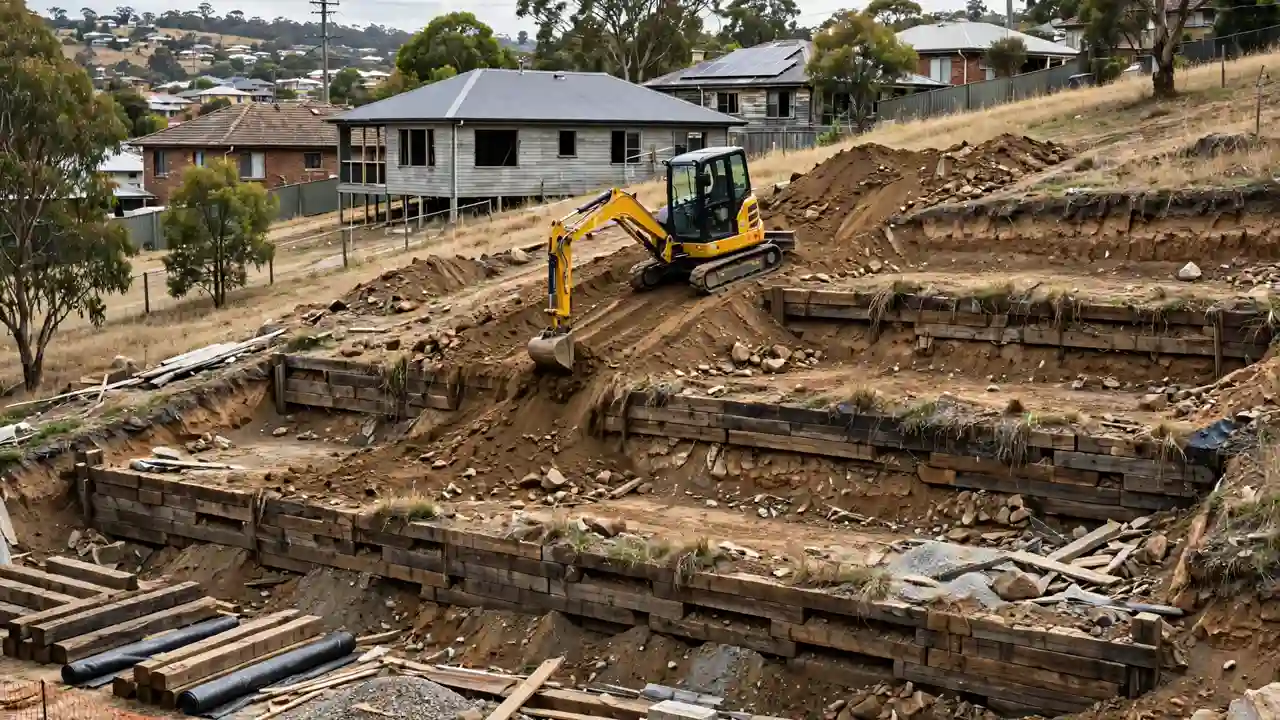
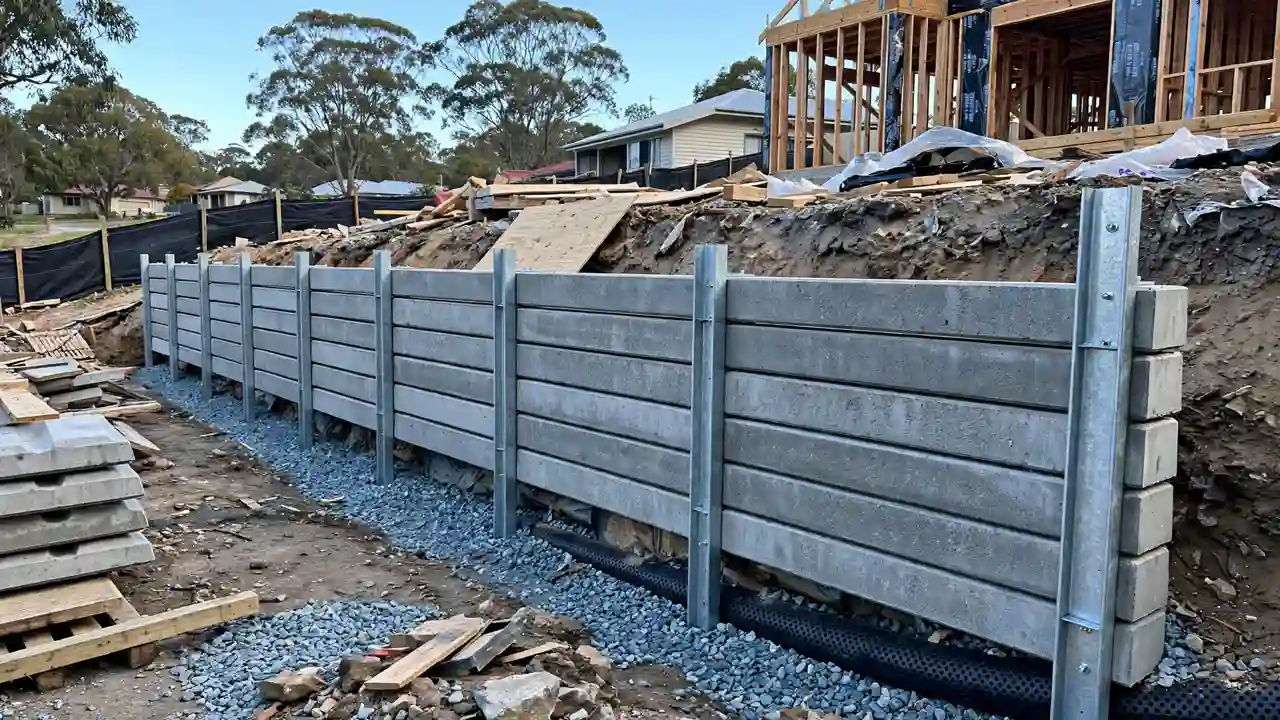
Where cut and fill creates a level change, a retaining wall holds it. Walls are often the largest single site cost. The price is per square metre of wall face — length times exposed height — not per metre of boundary. Yakka Labour’s 2026 guide puts walls at $250 to $1,000 per square metre of face installed: treated pine $250 to $450; hardwood $350 to $550; concrete sleepers with steel posts $350 to $650; core-filled block $550 to $1,000. A 10 metre long, 600 mm high treated pine wall might cost $2,500 to $3,500. However, a 1.5 metre engineered block wall along a sloping boundary can easily pass $20,000.
Melbourne rates from Evergreen, updated 25 October 2026, run $255 a metre for a 400 mm timber wall. A 1 metre wall: $425. In contrast, plain concrete sleepers run $290 and $550. Notably, the 800 mm and 1 metre concrete sleeper rates include ag pipe and scoria drainage. Drainage is not optional: $40 to $100 per linear metre covers ag pipe, gravel and outlet. Add more if a plumber must connect it to stormwater. An engineer’s design usually costs $800 to $3,000. Council approval runs $500 to $2,500 or more. In Victoria, a wall 1 metre or more high needs a building permit.
Service Connections: Power, Water, Sewer and Gas
First, every house needs water, sewer, stormwater, electricity, gas and telecommunications connected. However, the cost depends almost entirely on distance. Senka budgets $8,000 to $20,000 for all service connections. Typically, in a new estate, services already reach each lot boundary.
On an established block where the sewer runs along the back, or power must cross the road, costs climb fast. For example, a sewer extension or a new power dome can each add thousands. Perth subdivision figures put underground power at $3,000 to $10,000 or more. Water and sewer run $5,000 to $15,000 or more. Water Corporation’s published 2026–27 fees show the fixed charges underneath. A 20 mm water service costs $1,876.92. Sewer junction cut-ins run $1,062.93 (100 mm) and $1,292.07 (150 mm). However, those are authority fees only — plumbing and trenching sit on top. Our rainwater tank cost guide prices the tank side of that job. Similarly, our fence cost guide prices the boundary fencing that often forms part of the same site works.
Site Preparation for Building Construction: 3 Worked Budgets
Three budgets from the sourced prices above. Each prices the items the sources price, and names what sits outside them.
Budget 1 — flat M-class block, Melbourne: $12,500–$14,500 for the three priced items. Geotechnical report $1,500 to $3,500 (Senka). Gentle site cut $3,000 (Senka). Service connections $8,000 (Senka low end). Total: $12,500 to $14,500. Senka’s whole-job band for a standard block is $15,000 to $25,000. The gap is fencing, the crossover, slab preparation and drainage. This is the cheapest honest case: flat ground, moderate soil, services at the boundary.
Budget 2 — reactive H2 soil on a slope, Melbourne: $64,500 for the priced items. Geotechnical report $3,500 (Senka top). Site cut and fill $30,000 (Senka top). 20 linear metres of 1 metre concrete sleeper retaining at $550 a metre including GST (Evergreen) totals $11,000. Service connections $20,000 (Senka top). Total: $64,500. Senka’s band for reactive soil with slope is $30,000 to $70,000 or more. This budget sits at the top of it. Notably, it prices the retaining wall most guides leave out. Engineering and approval for the wall sit on top: $800 to $3,000 for the design and $500 to $2,500 for approval.
Steep Block by Volume
Budget 3 — $23,000–$89,000. Excavation of 100 cubic metres at $50 to $120 (Builtly) totals $5,000 to $12,000. Fill compaction of 100 cubic metres at $40 to $90 including testing totals $4,000 to $9,000. 20 linear metres of retaining at $300 to $1,500 totals $6,000 to $30,000. Drainage runs $5,000 to $30,000. Geotechnical investigation runs $3,000 to $8,000. Total: $23,000 to $89,000. Overall, the range is wide because the wall and drainage dominate it. Cross-check: Yorcon puts the extra cost at $40,000 to $60,000 or more. That covers rocky, sloping or access-constrained Melbourne blocks above a flat block. Our building your home in Hawthorn guide shows the same slope and soil problems on an established inner-Melbourne block.
How to Read a Site-Preparation Quote
Comparing site preparation for building construction quotes without a common scope is guesswork. Above all, get three quotes on the same soil report and survey. Hunt for the exclusions: rock removal, retaining walls, drainage and stormwater, and service extensions. Also: temporary fencing and sediment controls, spoil removal and tip fees, and council and authority fees. Clearing is the cheapest line and the easiest to underestimate. Land preparation runs from $20 per square metre in Melbourne. Demolition of an old house runs $0 to $25,000 or more.
Watch the provisional sum most of all. It covers work with a cost nobody knows at signing. Consumer Affairs Victoria warns excavation costs can rise substantially if the soil report missed rock. In short, ask for quantities and unit rates, not a single lump allowance. A quote that lists “site costs $25,000” with no breakdown gives you no fixed price. It is an allowance waiting to grow.
Frequently Asked Questions
What is site preparation for building a house?
Site preparation is all the work done to the land so a house can be built on it: soil testing and classification, a contour survey, clearing, cut and fill, retaining walls, drainage and stormwater, and connecting power, water, sewer, gas and telecommunications. It sits outside the standard building contract price and varies from one block to the next.
How much does site preparation cost in Australia?
On a standard flat lot, $15,000 to $45,000 covers the whole job in Melbourne’s growth corridors; a complex site with slope, reactive soil or rock can pass $70,000. The main items are a soil test at $450 to $3,500, a site cut and fill at $3,000 to $30,000, retaining walls at $250 to $1,000 per square metre of face, and service connections at $8,000 to $20,000. The same house can cost twice as much to prepare on reactive clay as on sand.
What is cut and fill in construction?
Cut and fill reshapes a sloping site by excavating the high side and using suitable material to build up the low side, creating a level platform. Excavation runs $50 to $120 per cubic metre, fill compaction $40 to $90 including testing, and rock costs significantly more. On a gentle block the whole cut and fill might be $15,000; on a steep or complex site it can run into several hundred thousand dollars with retaining and drainage included.
Do I need a soil test before building?
Yes. The soil test classifies your site under Australian Standard AS 2870, from A for stable sand or rock to H2 and E for highly reactive clay, and the class decides your slab and footing design. In Victoria the builder must obtain foundation data from soil tests before you sign, and you should not pay extra later for problems the builder should have identified. A standard classification costs $450 to $1,400 in Melbourne; a full geotechnical investigation costs $1,500 to $3,000 or more.
How much does a retaining wall cost in Australia?
Retaining walls cost $250 to $1,000 per square metre of wall face installed in 2026, depending on material and height. Treated pine runs $250 to $450 per square metre, concrete sleepers with steel posts $350 to $650, and core-filled block $550 to $1,000. A 10 metre long, 600 mm high treated pine wall might cost $2,500 to $3,500, while a 1.5 metre engineered block wall can pass $20,000. Drainage, engineering and council approval sit on top.
What site costs are not included in a builder’s base price?
The base price usually excludes most of the items above — soil test and survey, earthworks, rock removal, retaining walls, drainage, services and council fees. These are often held as provisional sums — allowances that can grow once the ground is opened up. Ask for every item priced separately with quantities and unit rates, and check the soil class and cut and fill volumes before you sign.
Price the ground before you price the house. Finally, get the soil test, get the survey, and get every site item in writing with quantities. Then the site preparation for building construction figure you sign will be the one you actually pay.