
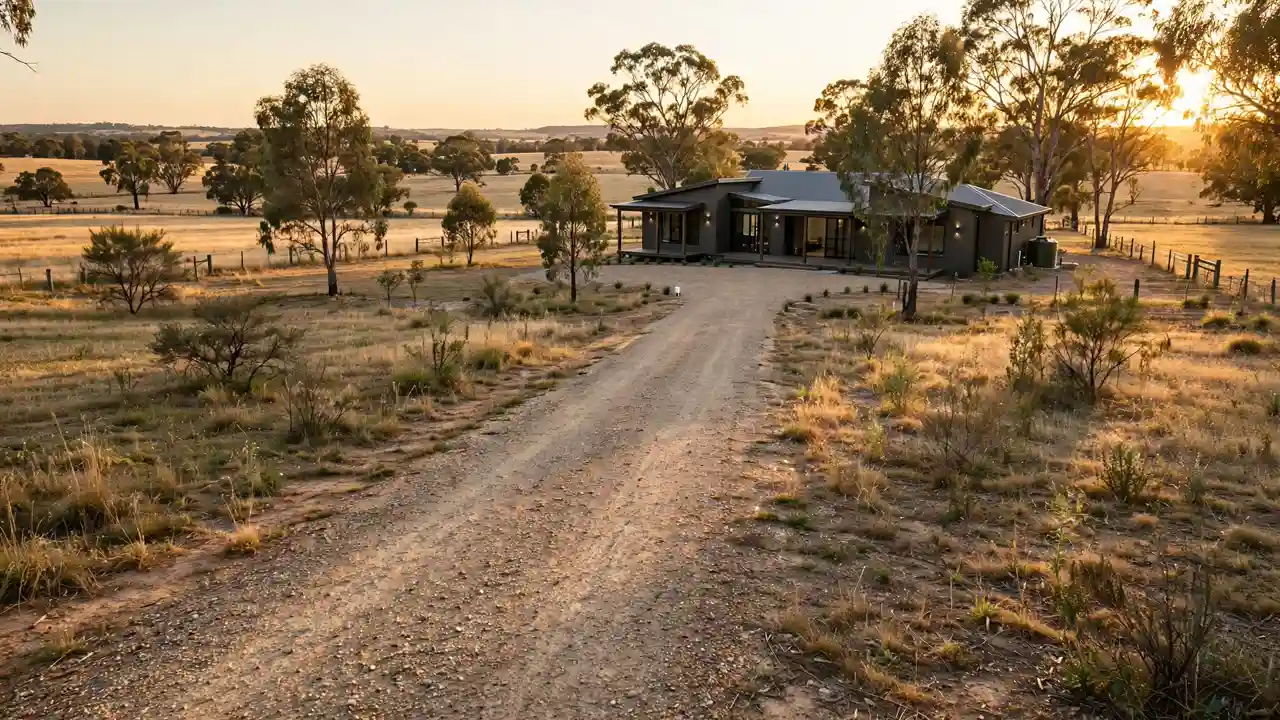
$80,000 to $200,000. That is what the block itself adds to an acreage home designs australia project before the slab is poured. Two independent 2026 Australian guides list the same items: driveway, power, rainwater tanks, on-site wastewater and bushfire construction. A suburban build carries none of them. In fact, the house costs about the same per square metre as it does in the city. In contrast, the block is what makes acreage expensive, and it is also what makes acreage design different.
Acreage Home Designs Australia in 2026: The Short Answer
Budget $2,500 to $4,200 per square metre for the house itself in 2026, at standard to mid-range finish. Then add $80,000 to $200,000 or more for acreage-only site costs. Acreage designs commonly run 270 to 730 square metres. As a result, a typical build lands between roughly $750,000 and well past $2 million before land. Three numbers decide your total: house size, driveway and services length, and the bushfire rating.
What an Acreage Home Costs: House, Block and the Gap Between Them
National 2026 build rates put the house itself at $1,900 to $2,800 per square metre for a volume-builder project home. A mid-range or semi-custom home runs $2,800 to $4,200, and a custom build $4,200 to $6,500 or more. Sydney guides quote $2,500 to $4,200 for standard to mid-range homes. The gap between the two sources is not a disagreement. In practice, Sydney prices run higher than regional rates. A custom home costs more per square metre than a project home of the same size. Both sources agree on one thing: the rate is the same on acreage as in the suburbs. That said, the difference is size.
| Budget line | Indicative range, 2026 | Why it applies on acreage |
|---|---|---|
| House construction | $2,500–$4,200/m² (Sydney); $1,900–$6,500/m² (national) | Same rate as a suburban build; acreage homes are larger, 270–730 m² |
| Acreage-only site costs | $80,000–$200,000+ | Driveway, power, tanks, wastewater, bushfire uplift, reports |
| Driveway | $100–$300 per linear metre gravel; $250–$500+ concrete | A 150 m run from the road is common |
| Rainwater storage | $10,000–$30,000 | 100,000 litres or more, pump and filtration, sometimes a firefighting reserve |
| On-site wastewater | $15,000–$35,000 | Septic or aerated system, designed to a soil report, council approved |
| Service connections | $10,000–$35,000 | Water, sewer, stormwater, power, gas, NBN; long runs cost more |
Regional rates run lower than Sydney on the house: $2,200 to $2,800 per square metre on the Bass Coast. However, site costs do not follow the same pattern, so budget the block first and the house second.
Start With the Site: Orientation Is Free on Acreage, So Use It
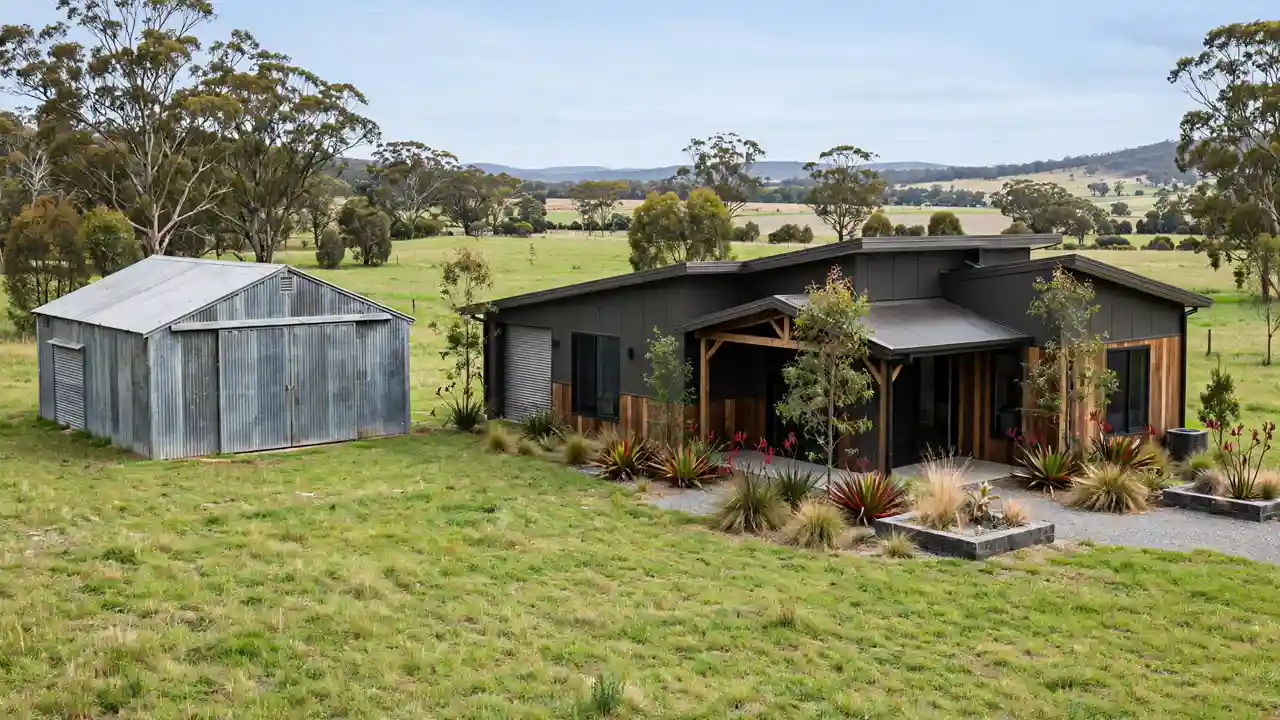
On a suburban block the street decides which way the house faces. On acreage you choose, and that choice is worth more than any upgrade in the specification. The Australian Government’s Your Home guide puts the target plainly. For example, living areas within 15 degrees west and 20 degrees east of solar north give good passive sun. North-facing glass lets low winter sun in, while eaves keep high summer sun out. Since 1 October 2023, every new home in New South Wales has had to reach 7 NatHERS stars. BASIX sets that standard. On acreage, where you can put the house wherever you like, that standard is easier to meet than anywhere else.
Put living areas and the main outdoor room on the north side. Put bedrooms to the south or east, and garages and laundries on the west as a heat buffer. As a result, a plan that ignores this and relies on air conditioning instead costs more to run, every year of its life. Our sloping block build cost guide prices the earthworks and retaining a sloped acreage site usually needs. Above all, check it before the slab goes down.
Zoning and Setbacks: Check Before You Exchange, Not After
An acre is 4,047 square metres, roughly seven to nine times a standard Sydney block. In short, an acreage property is any lot at that scale or above. Zoning decides whether you can build a house on it at all, not the size of the lot. For example, R5 large lot residential land almost always permits a dwelling. RU1, RU2 and RU4 rural land often only permits one. In practice, the lot must meet the council’s minimum lot size or carry a dwelling entitlement. In practice, the document that settles it is the Section 10.7 planning certificate from the council. Above all, read it before you exchange contracts, not after.
Setbacks matter more on acreage than in the suburbs because they interact with the bushfire rules. The cleared Asset Protection Zone between the house and the vegetation is part of the plan, not landscaping. For example, moving the house fifteen metres can drop the BAL a level. As a result, that saves more in construction than the extra driveway costs.
Bushfire Ratings: The BAL Ladder and What Each Level Costs You
Most acreage around Australian cities is bush fire prone land. The Bushfire Attack Level set for the site dictates the materials and details builders must use. The scale runs BAL-LOW, BAL-12.5, BAL-19, BAL-29, BAL-40 and BAL-FZ (Flame Zone). Assessors work from vegetation type, distance, slope and fire danger index under Australian Standard AS 3959. Most acreage near Brisbane and Sydney sits at BAL-12.5 or BAL-19, where ember attack is the main concern. At BAL-29 and above, non-combustible cladding, sealed gaps and tested glazing become mandatory.
For example, at BAL-12.5 the changes are modest: metal mesh on vents, sealed gaps, careful detailing around windows and doors. Timber cladding may be off the table at BAL-19 unless treated and detailed correctly. At BAL-29 and BAL-40 the uplift is substantial. For instance, some builders quote $4,000 to $5,000 per square metre for the strictest compliance. The cheapest way to lower a BAL is distance. In practice, a bigger setback and a managed cleared zone can drop the rating a level before material selection. That is why acreage home designs australia guides put the BAL assessment before material selection. The Your Home orientation guide explains how solar north and climate zone shape the same siting decision.
Water: Tanks, Pumps and the Firefighting Reserve
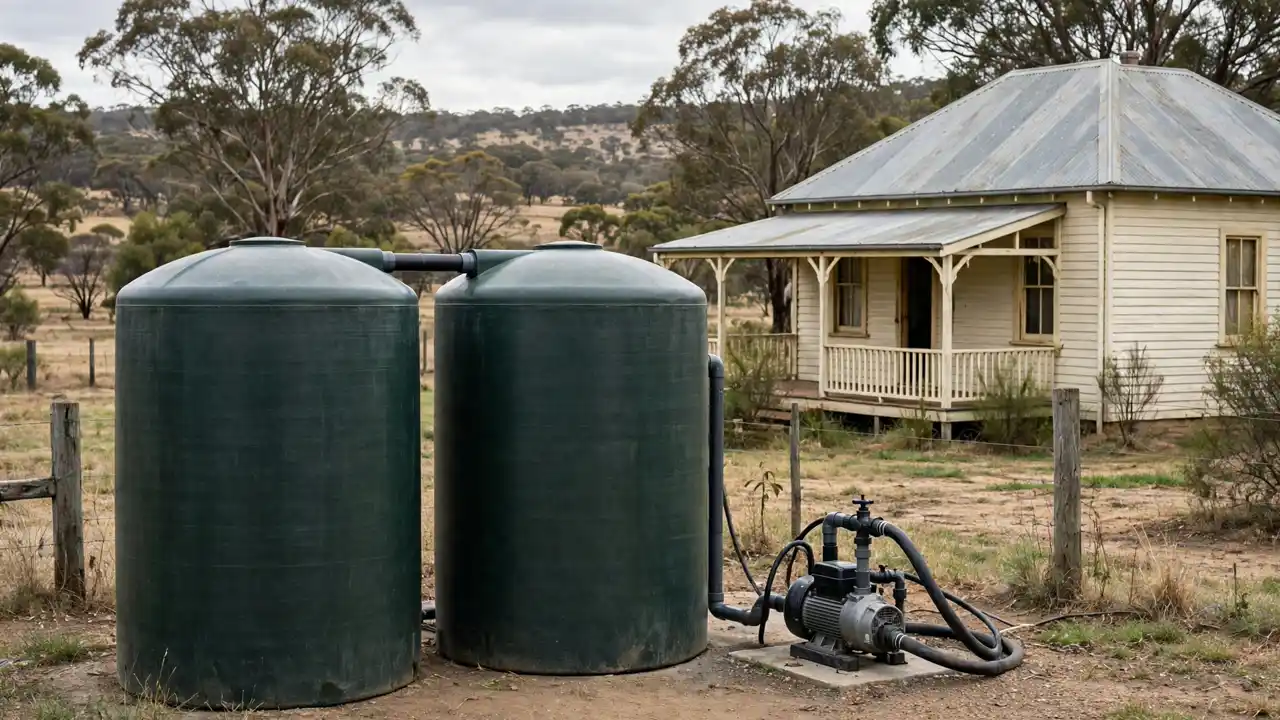
Where town water does not reach the block, the house makes its own. Rainwater storage for an acreage home usually means 100,000 litres or more of tanks, plus a pump and filtration. The price is $10,000 to $30,000. Some councils also require a dedicated firefighting reserve: a tank set aside for firefighting, not for household use. In Victoria, a compliant rural water system runs $8,000 to $20,000 depending on capacity and Country Fire Authority requirements.
Wastewater and Power: The Approvals Nobody Budgets Time For
No town sewer means a council approval for the wastewater system. Installing and operating a septic or aerated system needs a separate Section 68 approval. In New South Wales, the local council issues it. Similarly, other states have an equivalent approval. For example, a septic or aerated system with an irrigation area costs $15,000 to $35,000 near Sydney. In Victoria, a standard septic system costs $10,000 to $16,000 installed. However, coastal or sensitive-catchment sites needing secondary or aerobic treatment run $18,000 to $22,000 or more.
Power is the other long lead. A connection from the road can mean poles, a transformer or a long underground run. As a result, the cost rises with every metre. That said, solar changes the equation but does not remove it. A large array, and often a battery, belong on the site plan from the start. Price the connection and the solar together. Get the quote in writing before the slab, because a power bill that arrives after lock-up is a variation, not a surprise.
Sheds, Driveways and the Long Run From the Road
Almost every acreage home needs a shed. Put it on the plan from the start, with its own pad, access and setbacks. Apply the same BAL thinking as the house, and run services in the same trench as the house where the ground allows. A cheap kit shed becomes a real building once you add the slab, power, water and lighting. However, a shed at the bottom of a slope becomes a drainage problem.
Builders underestimate the driveway more than any other line in the whole project. A 150 metre run from the road is common. For example, at $100 to $300 per linear metre for gravel, that run alone is $15,000 to $45,000. In contrast, concrete runs $250 to $500 and above per linear metre, so the same run is $37,500 to $75,000. That is before culverts, crossings and drainage. For example, in bushfire-prone areas driveways must suit fire service vehicles, with 3.5 to 4 metre widths, turning circles and passing bays. Get the driveway engineered with the house, not after it. In practice, the same cut that levels the house pad usually supplies the driveway base.
Acreage Home Designs Australia: 3 Worked Budgets
Three budgets built only from the sourced prices above, for a 300 square metre home unless stated.
Budget 1 — 300 m² mid-range home, easy block, 50 m driveway: $930,000–$1,460,000 before land. House at $2,800–$4,200 per square metre is $840,000–$1,260,000. Acreage-only costs: 50 m gravel driveway $5,000–$15,000, rainwater $10,000–$30,000, septic $15,000–$35,000, power and connections $10,000–$35,000, BAL-12.5 uplift and reports $20,000–$40,000. Site costs $60,000–$155,000, stated as $930,000–$1,460,000 with an 8 to 12 per cent contingency.
Budget 2 — 300 m² home, 150 m driveway, no town water or sewer: $1,030,000–$1,610,000 before land. House $840,000–$1,260,000 as above. Driveway 150 m gravel $15,000–$45,000, rainwater with firefighting reserve $15,000–$30,000, and aerated wastewater $20,000–$35,000. Power connection $15,000–$35,000, BAL-19 uplift and reports $30,000–$60,000, and shed pad and services $15,000–$30,000. Site costs $110,000–$235,000, stated as $1,030,000–$1,610,000 with contingency at 8 to 12 per cent.
Budget 3 — 450 m² custom home, steep block, BAL-29: $1,950,000–$3,100,000 before land. House at $4,200–$6,500 per square metre is $1,890,000–$2,925,000. Site costs: 200 m driveway to fire-truck standard $48,000–$80,000, rainwater and reserve $20,000–$30,000, and engineered wastewater $25,000–$35,000. Power $25,000–$50,000, BAL-29 uplift and engineering $60,000–$120,000, and earthworks and retaining $40,000–$100,000. Site costs $218,000–$415,000, stated as $1,950,000–$3,100,000 after allowing that not every line hits its top at once.
How to Read an Acreage Quote — and the Red Flags
An acreage quote is only comparable if it names the same things. Ask for the house rate per square metre and the inclusions list. Get the driveway length and surface, and the tank capacity and pump specification. Also ask for the wastewater system type and the council approval. Get the power connection scope, and the BAL rating and the construction uplift it carries. Ask for the reports included too — soil, survey, BAL assessment, flood and bushfire. Comparing acreage home designs australia figures without those lines is guesswork. Our hidden costs of building a house guide covers the site works and variations. In practice, they catch first-time builders on any block.
Watch for the exclusions that sink budgets. Rock excavation, retaining walls, culverts and crossings, old-structure removal, fencing and landscaping all count. So do the firefighting reserve, the BAL uplift, and the cost of running power and NBN down a long driveway. Finally, check the warranty in writing. That said, the cheapest quote is only cheap if it names the same job as the others. Our granny flat cost guide prices the second dwelling many acreage owners add later. Read it before you lock the site plan: the flat needs its own services, setbacks and approval.
Frequently Asked Questions
How much does it cost to build on acreage in Australia?
Budget $2,500 to $4,200 per square metre for the house in 2026, plus $80,000 to $200,000 or more for acreage-only site costs.
What is a BAL rating and why does it matter for acreage homes?
A Bushfire Attack Level is an assessment of bushfire risk under Australian Standard AS 3959, running from BAL-LOW to BAL-FZ. Most acreage near Australian cities sits at BAL-12.5 or BAL-19.
Do I need council approval for a septic system on acreage?
Yes. Installing and operating a septic or aerated system needs a separate council approval — a Section 68 approval in New South Wales, with equivalents in other states. A standard system costs $10,000 to $16,000 installed in Victoria, and an aerated system $18,000 to $35,000.
How big should rainwater tanks be on an acreage block?
Plan for 100,000 litres or more of storage, plus pump and filtration, at $10,000 to $30,000.
Can I build a house on rural zoned land?
Often, but not always. R5 large lot residential land almost always permits a dwelling, while RU1, RU2 and RU4 rural land often only permits one if the lot meets the council’s minimum lot size or carries a dwelling entitlement. The Section 10.7 planning certificate states the zone, the minimum lot size, whether the land is bush fire prone or flood affected, and any other controls — read it before you exchange contracts.
How long should a driveway be on an acreage block?
There is no standard length — a 150 metre run from the road is common, and 200 metres is not unusual. Gravel costs $100 to $300 per linear metre and concrete $250 to $500 and above.
Price the block first and the house second. The acreage home designs australia figure you accept will be the one you actually pay. The site decides the budget, the BAL the materials, and the driveway how much of both you can afford. Finally, get the Section 10.7 certificate, the soil report and the BAL assessment before you sign anything.