
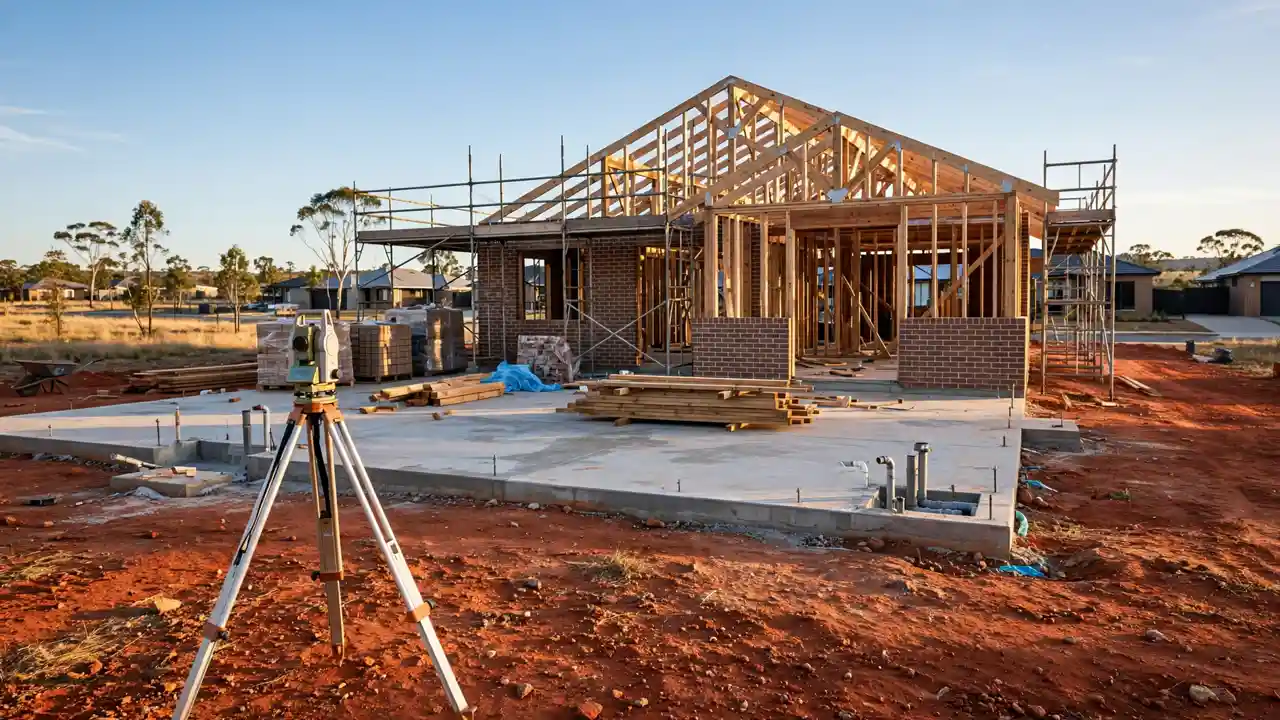
In fact, the display home price is not the house price. That is the first thing to understand about the hidden costs building house australia buyers keep tripping over: the sign covers the house itself, while the block, the council, the bank and the driveway each add their own bill — often another $50,000 to $150,000.
This guide lists the traps one by one, with a dollar range on each. Print it, take it to the builder meeting, and ask the builder to price every line in writing.
Hidden Costs Building House Australia at a Glance
Twelve traps, each with its typical range:
| Trap | Typical range |
|---|---|
| Site works | $10,000–$70,000 |
| Soil test + survey | $500–$4,000 |
| Council fees + contributions | $2,000–$55,000+ |
| BASIX + NatHERS | $1,000–$3,000 |
| Design + engineering | $11,000–$31,000 |
| Provisional sums | Open-ended |
| Turnkey gaps | $15,000–$90,000 |
| Service connections | $10,000–$30,000 |
| LMI at 95% LVR | $15,000–$25,000 |
| Stamp duty on the land | Varies by state |
| Driveway + fencing + landscaping | $25,000–$90,000 |
| Contingency | 10–20% of build |
None of these is a scam — honest builders show most of them on the tender. The trouble starts when a quote shows none of them.
1. Site Costs — the Block Decides the Bill
Site costs prepare your block: clearing, cut and fill, retaining, drainage, slab upgrade, service trenches. For example, on a flat, clear block, builders allow $10,000 to $25,000; on a sloping block, $25,000 to $50,000 or more — every metre of fall adds roughly $6,000 (loans.com.au). Builders quote rock only after the geotechnical report; reactive clay needs engineered footings at $12,000 to $22,000. Nationally, site costs run $10,000 to $70,000.
2. Soil Tests and Surveys Before You Sign
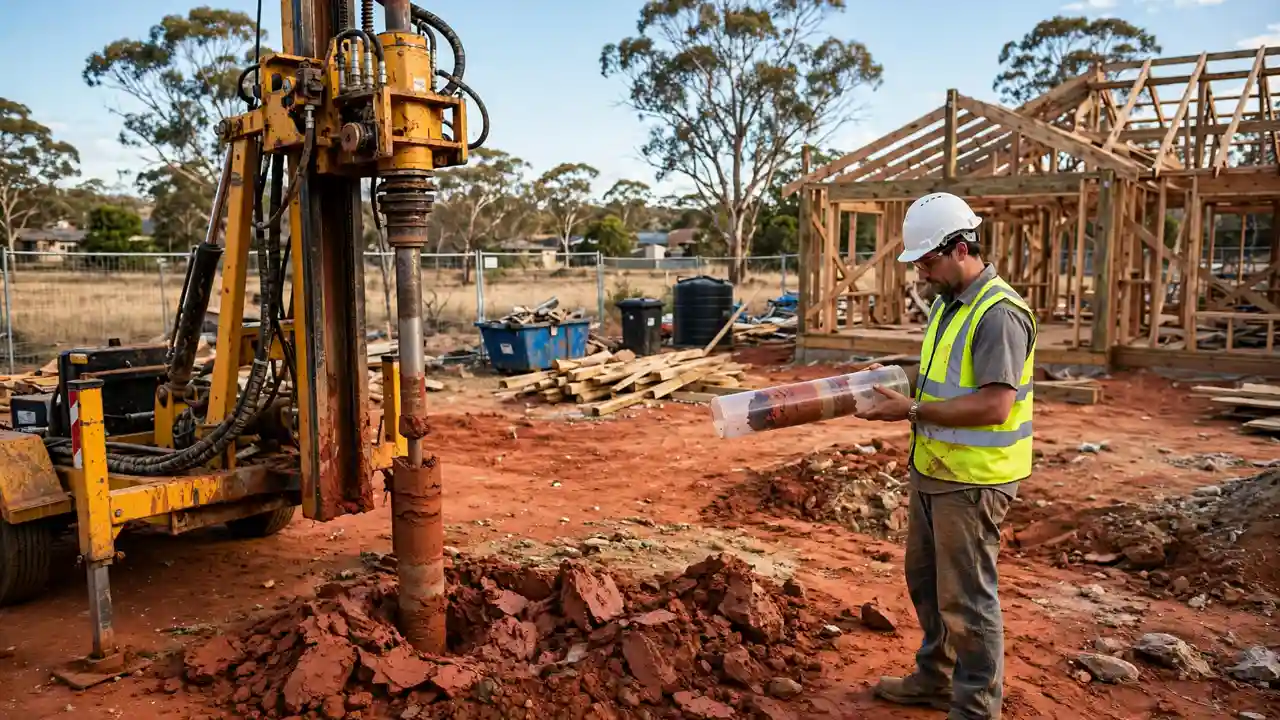
First, spend the cheapest money before signing. A basic soil test and contour survey runs $500 to $2,000. A full geotechnical report — rock, clay or sand — runs $1,500 to $3,000. A detailed survey runs $2,000 to $4,000. Without them, site works go in as a provisional sum, and any rise lands on you.
3. Council Fees, Contributions and BASIX
The DA fee alone runs $2,000 to $5,000; all-in lodgement — DA or CDC, certifier and consultant reports — runs $5,000 to $15,000. NSW councils also charge section 7.11 or 7.12 contributions — $20,000 to $55,000 in growth areas — to fund local roads, parks and drainage. In addition, every new NSW home needs a BASIX certificate; the BASIX and NatHERS assessment runs $1,000 to $3,000, plus a 0.25% levy on work costing $250,000 or more. Our passive house cost guide prices a high-performance shell.
4. Design and Engineering Before the Slab
In fact, a project home includes a standard design; any change — bigger kitchen, different facade, second storey — starts a design bill. Design plans run $8,000 to $25,000; structural engineering runs $3,000 to $6,000. With survey, soil report and BASIX assessment, pre-construction totals $30,000 to $70,000 before the builder pours the slab. None of this is in the sales office’s per-square-metre price — ask for the design lines separately.
5. Provisional Sums and Prime Cost Items
A provisional sum is an estimate for work the builder cannot price exactly at signing, usually site works. The builder does not fix it: if the work costs more than the allowance, you pay the difference; if less, you get a credit. A prime cost item is an allowance for a fixture you choose after signing — tapware, tiles, carpet — and if your selection costs more, you pay the difference. The QBCC states both rules plainly — ask how the builder worked out each allowance, and push to fix site costs once the soil test and survey are in.
6. The Turnkey Gap — What the Display Home Does Not Show
“Turnkey” sounds like a promise. It is not one — a sales description, not a legal standard — so two packages can include very different things. What you get is what the inclusions list and contract say — nothing more. Builders most often leave out the items the display home shows for free: driveway and paths, fencing, landscaping, window coverings, floor coverings, letterbox, clothesline, and TV aerial or NBN work. If the package includes none of it, budget $15,000 to $40,000 for driveway and fencing, $10,000 to $50,000+ for landscaping. If an item is not in the inclusions list, assume the builder excluded it.
7. Service Connections
You pay for water, sewer, power, gas and internet separately, and on a new estate the connection can be far from the house. Connections typically run $10,000 to $30,000 all up, and climb when the block is far from the mains, the sewer needs a pump, or the power needs a three-phase upgrade. A tender that includes “standard connections” may mean the nearest pit, not your boundary — and you pay for the distance. Ask the builder to confirm the distance to each service.
8. LMI and the Small-Deposit Trap
Lenders mortgage insurance is the bill first home buyers never see coming. It protects the lender, not you, and applies whenever you borrow more than 80% of the property’s value. On a $500,000 loan with a 5% deposit, LMI typically costs $15,000 to $25,000, usually added to the loan — so you pay interest on it for thirty years. However, there is a way around it: the Australian Government 5% Deposit Scheme lets eligible first home buyers purchase with a 5% deposit and no LMI, because Housing Australia guarantees up to 15% of the property’s value to the lender. Since 1 October 2025 it has had no income caps and no limit on places; caps are $1.5m in Sydney, $950,000 in Melbourne and $900,000 in Adelaide.
9. Stamp Duty on the Land and the Loan Costs
In addition, the build price never includes the land — and the land brings its own costs. Stamp duty applies to the land value and varies by state — the single biggest government charge in the purchase — and first home buyer concessions differ by state and price, so check your state revenue office. Conveyancing and loan fees sit on top. One detail catches buyers out: you pay stamp duty on the land at settlement, months before the builder finishes the house, so the money has to be in hand early — and if the build runs late, interest on the land loan keeps running while the site sits empty.
10. The Finish Line: Driveway, Fencing and Landscaping
The builder finishes the house, the keys are in your hand, and the block is still bare dirt. This trap hits after handover, when you have fully drawn the building loan and the finance has run out. Driveway and fencing typically run $15,000 to $40,000, landscaping $10,000 to $50,000 or more — and some councils and estates require the front yard turfed and driveway finished within a set period after occupation. Price these before you sign, not after handover.
11. Living Somewhere Else While It Builds
A build takes months, and during those months you pay rent and a mortgage. The land loan draws first, then the construction loan in stages, and interest starts the moment the bank pays each draw. Meanwhile, with rent on top, the overlap can run to thousands a month — none of which appears in any builder’s quote. Knockdown rebuilds carry the same cost twice over: demolition runs $25,000 to $50,000, asbestos removal can add $5,000 to $25,000 on a pre-1980s home, and you still need somewhere to live. Our knockdown rebuild cost guide prices it in full.
12. Contingency — the Line That Saves the Build
Finally, contingency keeps a surprise from stopping the build. The homeowner rule is 10 to 20% of the build cost. Sydney builders’ 2026 guides allow 8 to 12%, but plan on 10% as the floor, 15 to 20% on sloping, clay or knockdown sites. Keep it separate; do not spend it on upgrades before the builder pours the slab. A build that runs out of contingency halfway through stalls.
Hidden Costs Building House Australia: Three Worked Budgets
These three budgets use only the figures above, and show why the hidden costs building house australia buyers face add up so fast. Each one is the extras on top of the house price:
| Budget | Includes | Extras |
|---|---|---|
| Flat block, project home | Siteworks $10,000–$25,000 + pre-construction $30,000–$70,000 + connections $10,000–$30,000 | $50,000–$125,000 |
| Sloping block | Siteworks $25,000–$50,000+ + engineered footings $12,000–$22,000 + pre-construction $30,000–$70,000 + connections $10,000–$30,000 | $77,000–$172,000+ |
| Knockdown rebuild | Demolition $25,000–$50,000 + siteworks $10,000–$25,000 + pre-construction $30,000–$70,000 + connections $10,000–$30,000 | $75,000–$175,000 |
Overall, the flat block is the honest minimum — and even it adds $50,000 or more. None of these budgets includes stamp duty, LMI, driveway, landscaping, or contingency, so the real all-in figure is higher still. Our house renovation cost per square metre guide shows the other side.
The Builder-Meeting Checklist
Take this list to the meeting — it turns the hidden costs building house australia buyers face into questions a builder has to answer.
- Are site costs fixed or a provisional sum? Ask for the soil test and survey before signing, and the site cost fixed on them.
- What is the provisional sum and prime cost total? Ask for every allowance with its figure, and what happens if the real cost is higher.
- What exactly does turnkey include? Ask for the inclusions list in writing; check driveway, fencing, landscaping, blinds, flooring, letterbox and clothesline.
- What are the connection allowances? Ask the distance to each service and whether the allowance covers it.
- What council fees and contributions apply? Ask for the DA or CDC fee, section 7.11 or 7.12 contribution, BASIX assessment and levy as separate lines.
- What is the contingency and the delay clause? Ask what the builder allows, whether it is inside or outside the contract price, and who carries the interest if the build runs six months over.
Red Flags in a Building Quote
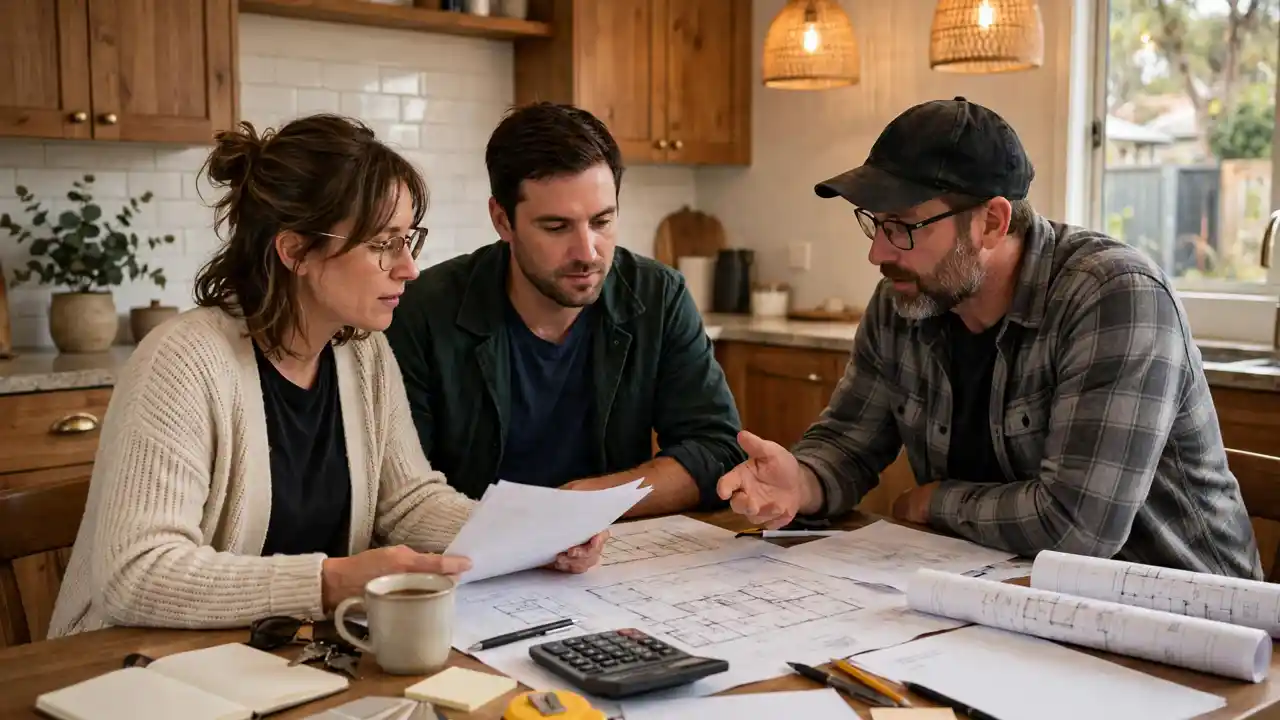
A quote that hides the traps is easy to spot. You cannot compare a single lump sum with no lines to anything — ask for the itemised version. A site-works provisional sum under $15,000 on a sloping block is almost certainly too low. A “turnkey” price with no inclusions list is a word, not a promise. A quote far cheaper than the others has usually left out the connections, council contributions, or driveway — the three lines that add up fastest. In contrast, the cheapest quote is rarely the cheapest build. The quote that names every hidden cost, with a figure beside it, is the one you can actually afford.
What are site costs when building a house?
Site costs are the cost of preparing your block for building — earthworks, retaining, drainage, the slab upgrade and service trenches. In Australia they typically run $10,000 to $70,000: $10,000 to $25,000 on a flat, clear block and $25,000 to $50,000 or more on a sloping block, before any rock or reactive-clay surprises. Get the soil test and survey done before you sign, so the figure is fixed in the contract instead of sitting in a provisional sum.
What is a provisional sum in a building contract?
A provisional sum is an estimate for work the builder cannot price exactly when the contract is signed — site works are the common one on new builds. It is not a fixed price: if the work costs more than the allowance, you pay the difference, and if it costs less you should receive a credit. Ask the builder to fix site costs after the soil test and survey, or at least to show how the allowance was worked out.
How much contingency should I budget when building?
Hold 10 to 20 percent of the build cost as contingency. Sydney builders’ 2026 guides allow 8 to 12 percent, but 10 percent is the floor most homeowners should plan on, and 15 to 20 percent is safer on a sloping block, reactive clay or a knockdown rebuild. Keep it in a separate account and do not spend it on upgrades before the slab is poured.
What is not included in a turnkey house price?
Turnkey is a sales description, not a legal standard, so what is included depends on the builder’s inclusions list. Items commonly left out are the land and its stamp duty, driveway and paths, fencing, landscaping, window coverings, the letterbox and clothesline, and sometimes floor coverings. If an item is not written in the inclusions list or the contract, assume it is not included.
What is LMI and how much does it cost?
Lenders mortgage insurance protects the lender, not you, when you borrow more than 80 percent of the property’s value. On a $500,000 loan with a 5 percent deposit, LMI typically costs $15,000 to $25,000, and it is usually added to the loan. Eligible first home buyers can avoid it entirely through the Australian Government 5% Deposit Scheme, which has had no income caps and no limit on places since 1 October 2025.
How much does it cost to build a house in Australia per square metre?
Nationally, build costs span roughly $620 to $3,900 per square metre from basic to luxury, and in Sydney a standard to mid-range home runs $2,500 to $4,000 per square metre in 2026. Those figures cover the house itself — land, site costs, council fees, connections and contingency sit on top, which is why the per-square-metre price is only the starting point.