
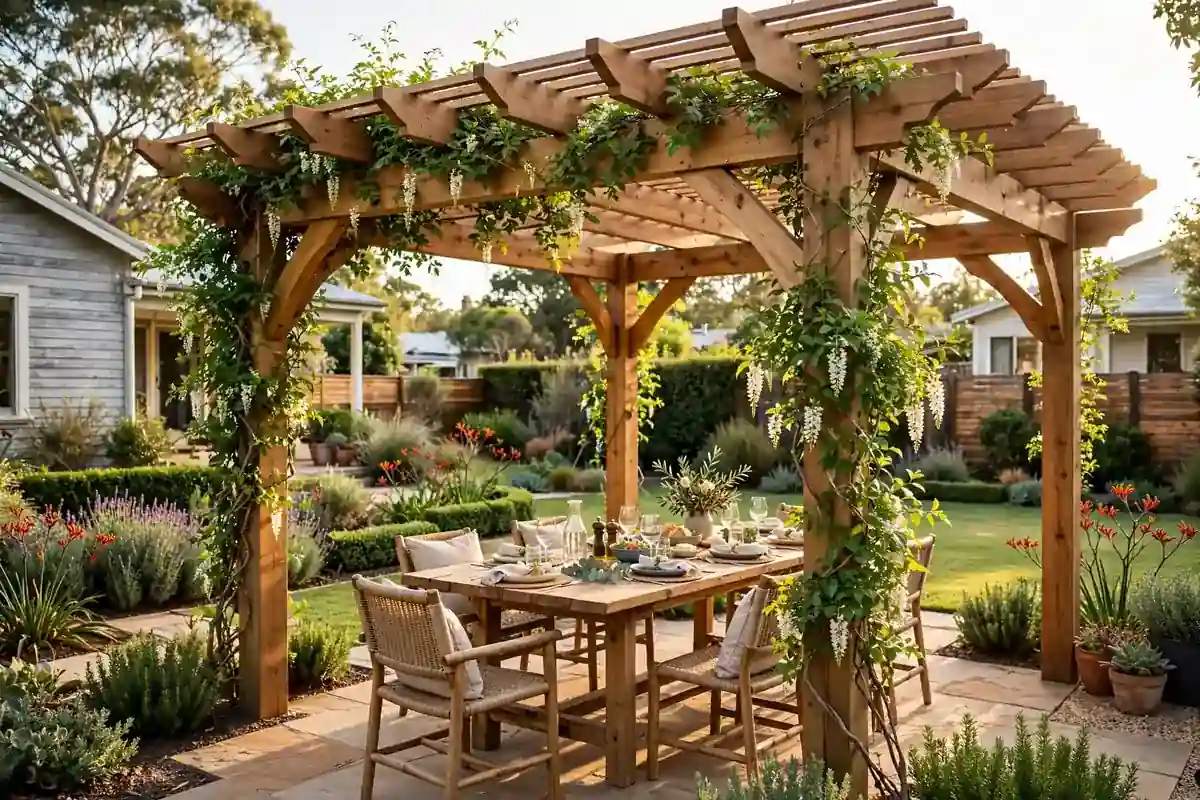
A pergola turns a sun-baked backyard into a usable outdoor room — but costs vary wildly, from a $3,000 basic timber structure to $35,000+ for a fully engineered aluminium showpiece. This guide breaks down real 2026 Australian prices by material and size, plus the design decisions that affect what you’ll pay.
How Much Does a Pergola Cost in Australia?
As a rough guide for 2026:
- Basic timber pergola (DIY kit): $3,000–$8,000 installed
- Custom timber pergola: $5,000–$12,000 installed
- Aluminium/Colorbond pergola: $8,000–$15,000+ installed
- Louvred roof pergola (motorised): $18,000–$35,000+ installed
- DIY kit (supply only): $389–$7,890 depending on size (Bunnings range)
Per square metre, expect roughly $300–$600/m² for basic timber, $600–$1,000/m² for aluminium, and $1,200–$2,200+/m² for motorised louvre systems.
Timber vs Aluminium: Which Is Right for You?
Timber Pergolas
Pros: natural warmth and character; generally cheaper upfront; easy to customise on site; suits traditional and coastal homes.
Cons: needs re-staining or oiling every 2–3 years; can warp, crack or attract termites if not maintained; shorter lifespan (15–25 years).
Best timbers: treated pine (budget), merbau and spotted gum (durability and looks), blackbutt (bushfire zones).
Cost: $3,000–$12,000 installed for a typical 20m² structure.
Aluminium Pergolas
Pros: virtually maintenance-free; won’t warp, rot or attract termites; powder-coated finishes last decades; excellent for modern homes; good in coastal/salt air.
Cons: higher upfront cost; less “warm” aesthetically; harder to modify after installation; can feel industrial if not designed well.
Cost: $8,000–$15,000+ installed for a typical 20m² structure.
The Verdict
Choose timber if budget matters most and you love the natural look (and don’t mind maintenance). Choose aluminium if you want set-and-forget durability, live near the coast, or prefer a contemporary aesthetic. Over 20 years, the total cost often evens out once timber maintenance is factored in.
What Affects the Price?
- Size: the biggest driver. A 3x3m DIY kit starts under $2,000; a 6x4m custom build can exceed $12,000.
- Roof type: open rafters (cheapest) → polycarbonate/laserlite → insulated panels → motorised louvres (priciest).
- Attached vs freestanding: attached pergolas (fixed to the house) are usually cheaper — fewer posts and footings.
- Site conditions: sloping blocks, poor soil, or difficult access add $1,000–$3,000+.
- Footings: concrete piers typically $200–$400 each; most pergolas need 4–6.
- Council approval: permit fees $500–$1,500 where required (see below).
- Extras: lighting ($500–$2,000), ceiling fans ($300–$800 each), guttering, screening, heating.
Pergola Roof Options Compared
The roof defines what your pergola can do. Here’s how the options stack up:
- Open rafters (no roof): cheapest and simplest — just shade battens or nothing at all. Great for climbing plants, useless in rain. Adds $0–$1,000 to the base structure cost.
- Polycarbonate/Laserlite: lets light through while blocking UV and rain. Needs a minimum 5° slope for drainage. Adds $1,500–$4,000. Can be noisy in heavy rain — insulated versions are quieter.
- Colorbond/insulated panels: solid roof, best weather protection, cooler underneath. Adds $3,000–$8,000. Heavier — needs a stronger structure.
- Retractable fabric: shade sails or retractable awnings over the pergola frame. Flexible but less durable; fabric needs replacing every 5–10 years. Adds $2,000–$6,000.
- Motorised louvres: the premium choice — aluminium blades that tilt open or closed at the touch of a button. Full control of sun, shade and rain. Adds $10,000–$25,000+ to the project.
For most Australian backyards, polycarbonate or insulated panels hit the sweet spot of cost vs usability. Louvres are worth it if the pergola is your main outdoor living space and the budget allows.
Do You Need Council Approval?
It depends on your state, council and the pergola’s size and height. As a general guide in Australia:
- Small, low pergolas under 10m² often don’t need approval — but check.
- Structures over 2.4m high, larger than 10–20m² (varies by council), or in heritage/bushfire zones usually need a permit.
- Anything attached to the house or with a solid roof is more likely to need approval.
Always check with your local council before building. An unapproved structure can cause headaches at sale time, and some councils issue fines or demolition orders.
DIY vs Professional Installation
DIY kits ($389–$7,890 supply-only) suit handy homeowners with a level site and basic tools. Budget a full weekend (or two) and a helper — pergola beams are heavy. You’ll still need to organise footings and possibly a permit.
Professional installation adds roughly $2,000–$5,000 in labour to the material cost, but you get proper footings, compliance, warranty and a much faster build (usually 2–5 days). For anything structural, attached to the house, or over 20m², professional is strongly recommended.
Design Ideas to Maximise Your Pergola
- Outdoor dining: the classic use — size it to fit your table plus 1m clearance all round.
- Louvred roof: adjustable blades give sun when you want it, shelter when you don’t. The premium option that genuinely extends usability.
- Combine with a deck: building both together saves on site costs. See our timber deck cost guide for the full picture.
- Outdoor kitchen zone: a pergola over a BBQ or outdoor kitchen creates a true alfresco room. Our outdoor kitchen ideas show how to plan the layout.
- Lighting: festoon lights for ambience, downlights for function. Plan wiring before the roof goes on.
- Greenery: climbing plants (jasmine, wisteria, grapevines) on open-rafter pergolas provide natural shade and beauty.
Maintenance: What to Expect
- Timber: clean annually; re-stain or oil every 2–3 years ($500–$1,500 if hiring someone). Check for loose fixings and signs of rot or termites.
- Aluminium: hose down occasionally; check powder-coating for chips. That’s about it.
- Louvre systems: keep tracks and mechanisms clean; service motors per manufacturer guidance.
Getting Quotes: What to Ask
Get at least three written quotes and make sure each one covers the same scope. Ask every builder:
- Is the quote fixed-price or an estimate? What could change it?
- Does it include footings, permits, guttering and clean-up?
- What timber species or aluminium system is specified (not just “timber” or “aluminium”)?
- What’s the warranty on workmanship and materials?
- Are they licensed? (Check your state building authority — in NSW it’s Service NSW, in VIC the VBA, in QLD the QBCC.)
- Can you see photos of recent pergola work or speak to a past client?
Be wary of quotes dramatically cheaper than the others — it usually means thinner materials, skipped footings or no allowance for permits. A pergola is a 20-year structure; the cheapest quote rarely ages well.
Frequently Asked Questions
How much does a 20m² pergola cost in Australia?
Budget $5,000–$10,000 for a basic timber pergola, $10,000–$18,000 for aluminium, and $20,000–$35,000+ for a motorised louvre system — all installed, 2026 prices. Site conditions and extras move these numbers.
Is it cheaper to build a pergola yourself?
Yes — DIY kits start from under $400 for small structures, and you’ll save $2,000–$5,000 in labour on a typical build. But factor in your time, tool hire, footings and the risk of mistakes. For structural or attached pergolas, professional installation is worth it.
Do I need council approval for a pergola in Australia?
Often yes, but it varies by council, size and height. Small pergolas under 10m² and 2.4m high are frequently exempt, but always check with your local council first — rules differ significantly between areas.
How long does a timber pergola last vs aluminium?
A well-maintained timber pergola lasts 15–25 years. Powder-coated aluminium pergolas typically last 25–40+ years with minimal maintenance. In coastal or termite-prone areas, aluminium’s advantage is even greater.
What is the cheapest pergola option?
A basic DIY timber kit (3x3m) is the cheapest path — kits from around $389–$2,000 supply-only, plus footings and your labour. Treated pine is the most affordable timber. Keep the design simple (flat roof, freestanding) to minimise costs.