
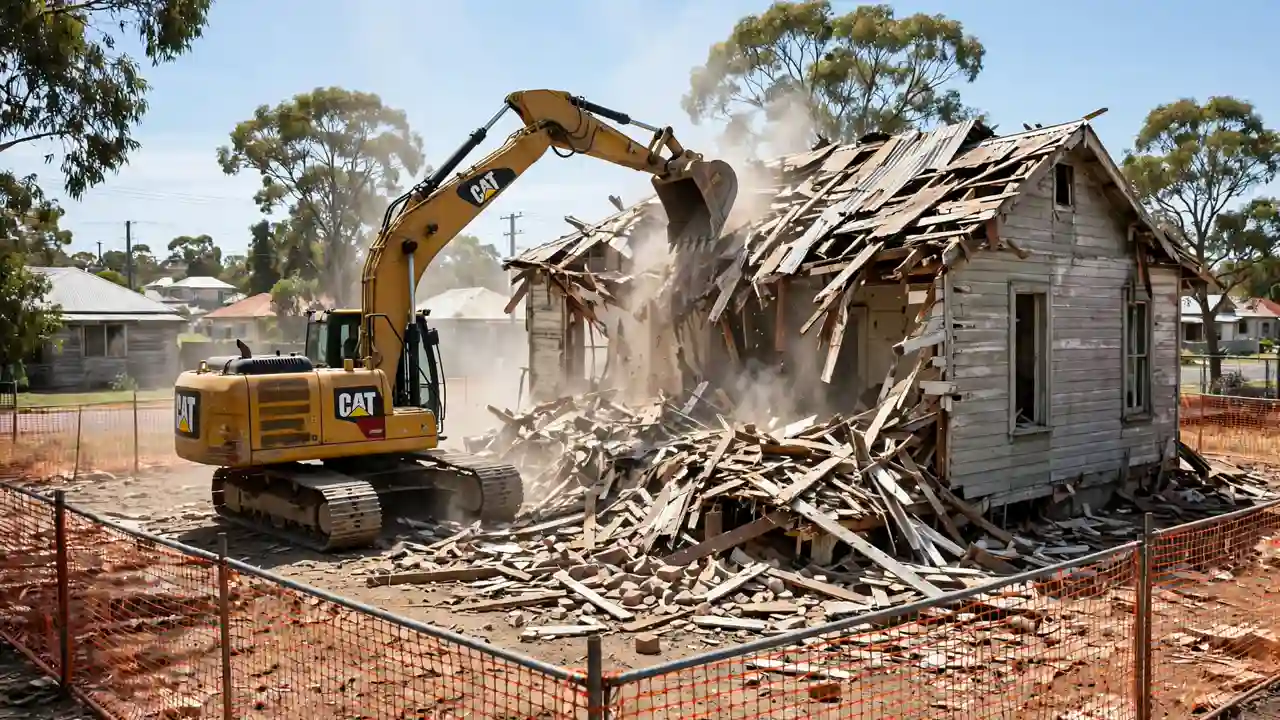
$12,000 to $50,000. That is what house demolition cost australia typically runs in 2026 for a standard detached home. The average sits around $17,000. The range is wide for a reason, not because the guides disagree. Contractors price demolition per square metre, per material and per risk. A small timber cottage on a flat block with clear access is a different job. A double-brick house with an asbestos roof on a steep site is another.
House Demolition Cost Australia in 2026: The Short Answer
For a standard house with no hazardous materials, budget $40 to $150 per square metre. The whole job runs $12,000 to $50,000. A small, simple demolition can land under $15,000. However, a large, difficult or asbestos-heavy one can pass $50,000 before the site is clear. Three numbers decide your total: the size and construction of the house, whether asbestos is present, and how easy the site is to reach.
How Much Does Demolishing a House Cost Per Square Metre?
Contractors generally quote demolition pricing per square metre. It varies with the size, construction type and accessibility of the existing house, plus whether asbestos is present. Across current 2026 Australian demolition industry pricing, standard demolition without hazardous materials typically runs $40 to $150 per square metre. For example, whole-of-project costs commonly land between $12,000 and $50,000. A second national guide puts the same whole-house range at $12,000 to $40,000. For example, strip-out work runs $50 to $150 per square metre. The two ranges overlap rather than contradict each other. In practice, the lower top end reflects simpler jobs and better access. The higher top end covers larger houses, double brick and tight access.
What Pushes a Demolition Quote Up the Price Band
What pushes a job up the per-square-metre band is easy to list and hard to argue with. Double brick costs more than timber frame because there is more mass to break and cart away. A two-storey house costs more than a single-storey one of the same footprint. A steep, narrow or poorly accessed site costs more because the machinery takes longer and the trucks make more trips. When a quote comes in at $40 per square metre, ask what it leaves out. However, when one comes in at $150, ask what it includes that the others do not.
| Job type | Indicative range, 2026 | What drives it |
|---|---|---|
| Small timber/fibro house, easy access | $12,000–$20,000 | Light structure, clear site, no asbestos |
| Standard detached house | $12,000–$50,000 (avg ~$17,000) | $40–$150/m² by size, construction, access |
| Large or double-brick house | $30,000–$50,000+ | Mass to break and cart, two storeys, tight access |
| Strip-out only | $50–$150/m² | Internal removal, hazardous materials add more |
| Asbestos add-on | $2,500–$15,000+ | Material, area, friable vs bonded |
How much does demolishing a house cost if you do part of it yourself? You save almost nothing, and the risk is not worth it. Demolition is high-risk construction work, and in most states the structural work needs a licensed demolition contractor. What you can do is the preparation. Clear the house, disconnect services through the proper authorities, and salvage what is worth saving. Above all, have the asbestos survey done early so the quote is real.
Asbestos: The Add-On That Can Double the Job
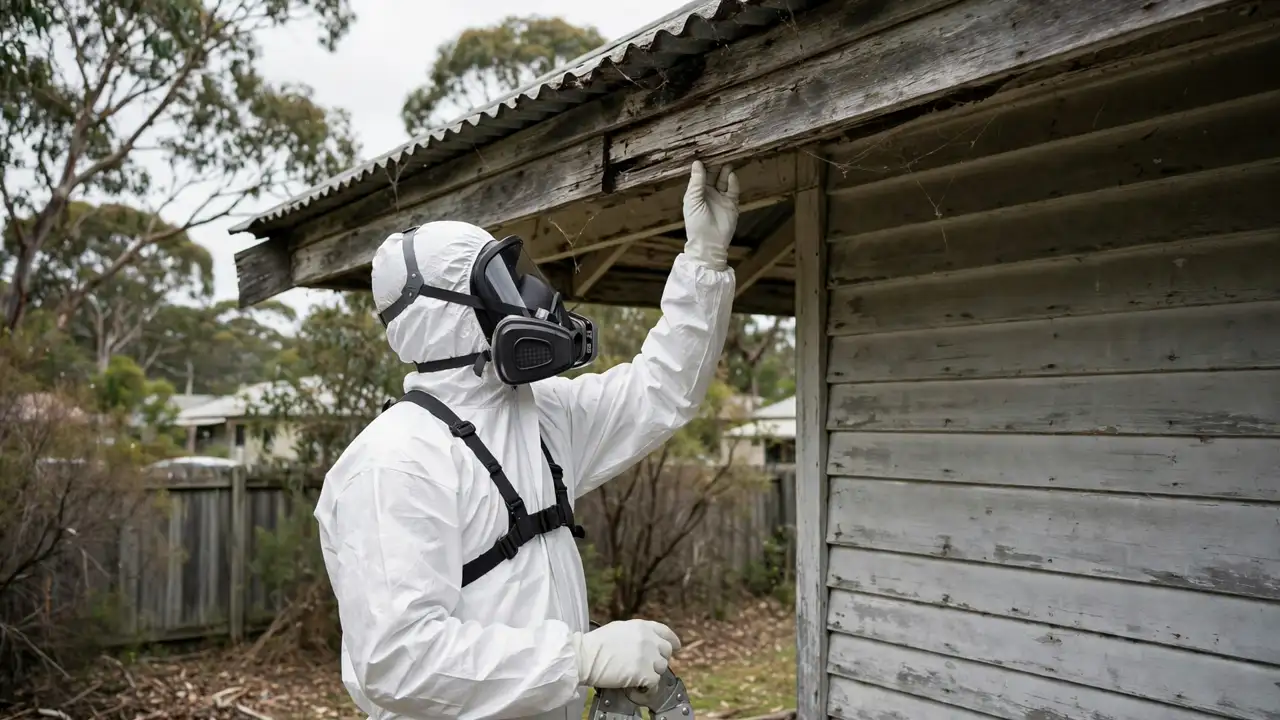
Roughly one in three Australian homes contains some form of asbestos, rising significantly in anything built before 1990. Australia phased out asbestos building products through the late 1980s, with a full national ban at the end of 2003. A home with asbestos limited to eaves or bathroom linings might add $2,500 to $8,000. However, a home with more extensive contamination — roofing, internal cladding, flooring — can run $15,000 to $25,000 or more. Professional removal typically costs $30 to $150 per square metre in Australia.
Bonded, or non-friable, asbestos — fibro sheeting, eaves, wall cladding — usually costs $40 to $90 per square metre. A licensed removalist does the work. For example, most household jobs cost between $1,200 and $6,000 all up. That covers a fibro garage, a bathroom with asbestos wall sheeting or a run of eaves. Small jobs work out dearer per square metre, often $80 to $120, once minimum charges of $800 to $1,500 apply. Only a Class A licensed removalist may remove friable asbestos, under controlled conditions. However, even a small job often costs $5,000 or more, at roughly $150 to $300 per square metre. An asbestos-cement roof is the big one, commonly $4,000 to $15,000 to remove.
Asbestos Licences, Surveys and Clearance Certificates
The licensing rules are national in shape and state in detail. More than 10 square metres of bonded asbestos requires a licensed Class B removalist. In contrast, any amount of friable asbestos requires a Class A removalist. In the Australian Capital Territory, any asbestos removal at all requires a licence, so there is no unlicensed allowance there. A hazardous materials survey with laboratory sampling costs $400 to $900. In addition, an independent clearance certificate on Class A work costs $400 to $2,000. With air monitoring, the cost runs $600 to $2,500. Get the survey before the demolition quote, not after. A contractor who quotes without knowing what is in the walls is guessing. The guess is always low. The SafeWork NSW Class B asbestos licence page sets out when you need a licence and what it takes to hold one.
Permits and Approvals: State by State
Demolition is development, and you need approval before the excavator arrives. In New South Wales, the consent or certificate for the new dwelling usually covers demolition too. A straightforward knockdown rebuild can go through a Complying Development Certificate, which a private certifier assesses. In practice, that is faster than a full Development Application through council. Sites affected by heritage, flooding or bushfire, or designs that break a standard, need a DA. A DA and construction certificate together typically take three to five months. In contrast, the CDC path takes two to four weeks of reports plus under two weeks for approval. In Western Australia, demolition needs its own permit. The local council issues a Form BA5 demolition permit, which the licensed demolition contractor lodges.
Two things stop a demolition outright. Heritage listing is the first. Councils rarely support demolition of a heritage item. In conservation areas, they control the replacement design closely, so get specialist heritage advice early. The second is the absence of the asbestos and waste plans. Demolition contractors must notify neighbours, manage waste to licensed facilities, and comply with safety requirements. That said, a contractor who skips those steps is one to walk away from. Check the demolition licence on your state’s register before you sign. Our council approval guide covers the DA and CDC pathways in detail. In addition, our knockdown rebuild cost guide prices the rebuild that usually follows.
What the Quote Usually Leaves Out — the Exclusions Decoder
No demolition quote is complete until you have read the exclusions. In practice, the exclusions are where the cheapest quote hides its saving. Asbestos removal and disposal — does the quote include it, itemise it or exclude it entirely? Most cheap quotes exclude it, and the asbestos bill arrives as a variation. Disconnection of services: the proper authorities must disconnect power, gas, water and sewer. However, some quotes leave that to the owner.
Site clearance and levelling: does the price include removing the slab, the footings and the driveway? Or only the house above ground? Waste and tip fees: contractors charge demolition waste by weight and by type. However, asbestos waste goes to a licensed facility at a different rate from general rubble. Trees and landscaping, fencing and neighbour protection can each be a separate line. So can the clearance certificate on Class A work. That is why house demolition cost australia guides put the exclusions decoder before the headline total.
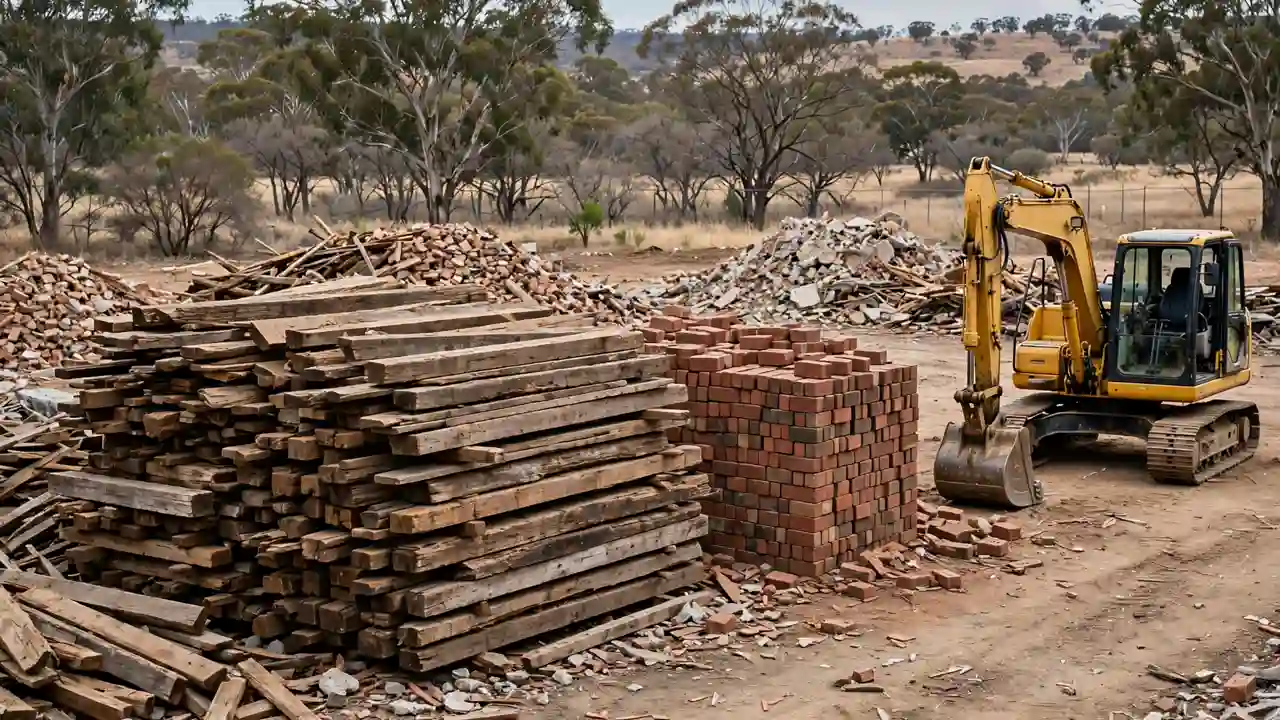
Salvage cuts the other way. You can sell or reuse good hardwood timber, bricks, roof tiles, doors and windows, kitchen and bathroom fittings and even the hot water system. In practice, the salvage value on an older home can run into the thousands. Some contractors offer a lower demolition price in exchange for the salvage; others charge full price and keep it. Either arrangement is fair once it is in writing. Ask who keeps what, and get it in the contract. Finally, photograph the house before the contractor starts so there is no argument about what was there.
House Demolition Cost Australia: 3 Worked Budgets
Three budgets built only from the sourced prices above.
Budget 1 — small single-storey fibro cottage, 120 m², no asbestos, easy access: $12,000–$20,000. Demolition at $40–$100 per square metre is $4,800–$12,000. Add disconnections $1,000–$2,000, waste and tip fees $2,000–$4,000, and site clearance and levelling $1,500–$3,000. Add a hazardous materials survey $400–$900 even where no asbestos turns up. Total $9,700–$21,900, stated as $12,000–$20,000, with salvage offsetting $1,000–$3,000 where the contractor allows it.
Budget 2 — standard 180 m² brick veneer house, asbestos eaves and bathroom: $22,000–$38,000. Demolition at $60–$120 per square metre is $10,800–$21,600. Asbestos removal for eaves and bathroom linings adds $2,500–$8,000 at bonded rates of $40–$90 per square metre, plus survey $400–$900. Disconnections $1,000–$2,000, waste and tip fees $3,000–$6,000, slab and footing removal $2,000–$4,000, site clearance $1,500–$3,000. Total $21,200–$45,500, stated as $22,000–$38,000.
Budget 3 — 220 m² double-brick house, asbestos roof, tight access: $45,000–$75,000. Demolition at $120–$150 per square metre is $26,400–$33,000, at the top of the band for mass and access. Asbestos roof removal $4,000–$15,000, plus friable material in the laundry and switchboard at Class A rates $5,000–$10,000. Survey $400–$900 and clearance certificate with air monitoring $600–$2,500. Disconnections $1,500–$2,500, waste and tip fees $5,000–$9,000, slab, pool and retaining removal $4,000–$8,000, traffic management $1,000–$3,000. Total $47,900–$83,900, stated as $45,000–$75,000. Our house extension cost guide is the alternative to read before you commit to demolishing.
How to Read a Demolition Quote — and the Red Flags
A demolition quote is only comparable if it names the same things. Ask for the demolition rate per square metre and the house area it covers. In addition, get the asbestos survey result and the removal scope by material, and the licence class of the removalist. Ask for the disconnection scope, the waste and tip fees by type, and the slab and footing scope. Get the site clearance and levelling scope, the fencing and dust control, and the clearance certificate wherever the job needs one. Comparing house demolition cost australia figures without those lines is guesswork. Get three quotes on the same scope, and be suspicious of any quote far below the others.
Five red flags mean walk away. One, no licence number, or a licence you cannot verify on the state register. Two, no asbestos survey, or a quote that says “asbestos extra” without a figure. Three, no waste plan. In practice, a contractor who cannot say where the waste goes is one who may not be taking it to a licensed facility. Four, cash-only payment or a demand for full payment upfront; staged payment against milestones is the norm. Five, no written contract with the scope, the exclusions and the salvage arrangement.
Frequently Asked Questions
How much does it cost to demolish a house in Australia?
House demolition typically costs $12,000 to $50,000 in Australia in 2026, with the average around $17,000. Standard demolition without hazardous materials runs $40 to $150 per square metre. Asbestos can add $2,500 to $15,000 or more.
How much does demolishing a house cost per square metre?
Standard demolition costs $40 to $150 per square metre in 2026, with strip-out work at $50 to $150 per square metre. Light timber and fibro houses on flat blocks sit at the low end, while double-brick, two-storey or tightly accessed houses sit at the high end.
How much extra does asbestos add to demolition?
Asbestos typically adds $2,500 to $15,000 or more to a demolition. Bonded asbestos removal costs $40 to $90 per square metre, with small jobs working out at $80 to $120 per square metre once minimum charges apply.
Do I need council approval to demolish a house?
Yes. Demolition is development, and you need approval before work starts. In New South Wales it is usually approved as part of the consent or certificate for the new dwelling, through a Complying Development Certificate or a Development Application. In Western Australia you need a Form BA5 demolition permit from the local council.
Can I demolish a house myself?
Not the structural work. Demolition of load-bearing or structurally related parts needs a licensed demolition contractor in most states, and asbestos removal needs a licensed removalist beyond the small 10 square metre allowance for bonded material — with no allowance at all in the ACT.
What happens to the materials after demolition?
Good materials are salvaged and the rest goes to waste facilities by type. Hardwood timber, bricks, roof tiles, doors, windows and fittings can be sold or reused, and on an older home the salvage value can run into the thousands. Asbestos waste must go to a licensed facility at a different rate.
Get the asbestos survey first, the licence checked second and the exclusions read third. The house demolition cost australia figure you accept will be the one you actually pay. The cheapest quote is only cheap if it names the same job as the others. Price the whole job and check the licence. Above all, never let an excavator arrive before the approval and the asbestos plan are in place.