
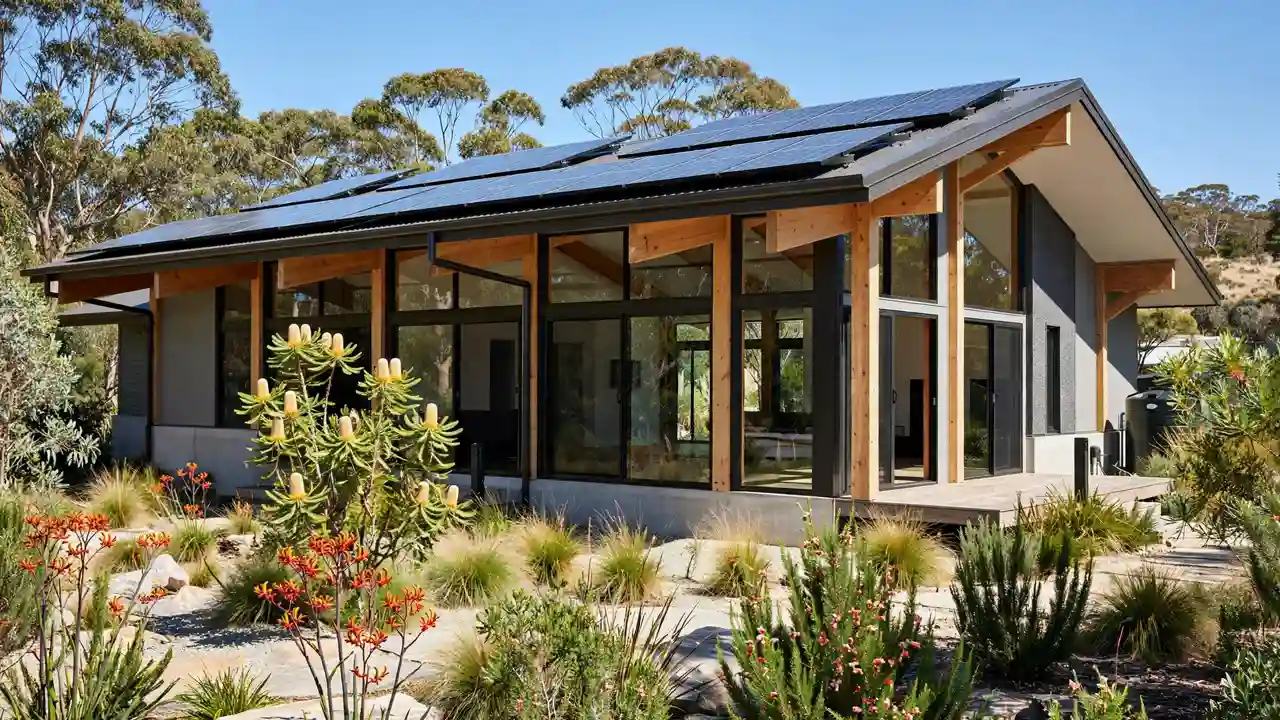
7 stars. That is the minimum thermal rating every new Australian home must now meet. It is the first number to learn about how to build a sustainable home Australia. The National Construction Code 2022 requires at least 7 stars under the Nationwide House Energy Rating Scheme (NatHERS). New houses must also score at least 60 out of 100 for Whole-of-Home. This guide explains how to get there: passive design first, then materials, then solar. It also covers what it costs and where the free help is.
How to Build a Sustainable Home Australia: The Short Answer
First, build the shell right before you buy any technology. Face living areas north. Shade the summer sun with eaves. Insulate above the minimum, seal the draughts, and fit double-glazed windows with low-E coatings. Get a NatHERS assessor involved at concept stage, not after the plans are drawn. Design to 7 stars as the floor, not the target. Then go all-electric: a heat-pump hot water system, induction cooking and a 6.6 kW solar system. That typically costs $5,000 to $8,000 installed after the federal STC discount in 2026. Also add water efficiency and durable, low-carbon materials. How to build a sustainable home Australia comes down to that order: design, envelope, electrify, then generate. However, technology added to a leaky, badly oriented house is money spent twice.
Start With the Rating: NatHERS 7 Stars and Whole of Home 60
NatHERS is Australia’s national framework for measuring how much energy a home needs for heating and cooling. An accredited assessor models the plans in approved software: AccuRate, FirstRate5 or HERO. Moreover, the home receives a thermal star rating from 0 to 10. In other words, the higher the stars, the less energy the home needs to stay comfortable year-round. Under NCC 2022, new homes must achieve a minimum 7-star NatHERS thermal rating. The Whole-of-Home rating must reach at least 60. It scores fixed appliances out of 100: heating, cooling, hot water and lighting, offset by solar. NatHERS measures only the building envelope: walls, roof, floors, windows and orientation.
In contrast, appliances, solar and batteries sit in the Whole-of-Home assessment. The states adopted the 7-star minimum on different timetables. Victoria and Queensland from 1 May 2024, New South Wales through enhanced BASIX from October 2023. A 7-star home needs about 20 to 25 per cent less heating and cooling energy than a 6-star home. Get the assessor in early: one engaged at concept stage can change the rating. One engaged after the plans are finished can only report it.
Passive Design First: Orientation, Shading and Airflow
Passive design means the house itself does the heating and cooling, using sun and wind instead of machines. In Australia, it starts with orientation. Face the main living areas north so low winter sun warms the rooms. Shade those same windows in summer, when the sun is high, with eaves, awnings or external blinds. Thermal mass — concrete, brick and stone — absorbs heat by day and releases it at night, steadying indoor temperatures. Similarly, cross-ventilation comes from windows on opposite sides, placed to catch breezes and flush warm air out.
Insulation is the backbone: batts in walls and ceilings plus reflective foil. The best results come from levels 20 to 30 per cent above the NCC 2022 minimums. Windows are the weak point of any envelope. However, double glazing with low-E coatings and thermally broken frames cuts that heat transfer sharply. It is the oldest technology in Australian housing. It is also what the star rating rewards most. How to build a sustainable home Australia starts here. That is because every star earned by orientation and shading saves buying equipment.
The 7-Star Ladder: What Each Step Up Buys You
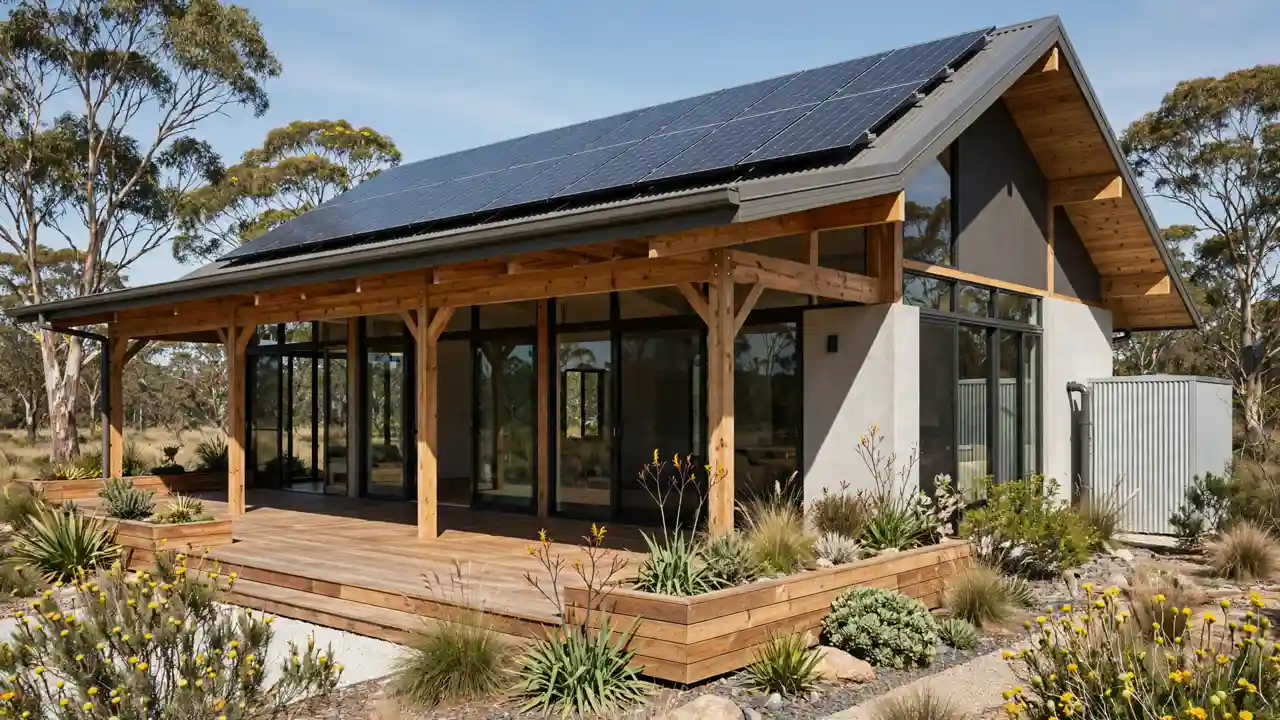
That scale is not abstract. The Australian Government’s YourHome Design For Place program publishes free house designs with predicted ratings and running costs. For example, the numbers show what each step is worth. The baseline four-bedroom Telopea house, optimised for the Melbourne climate, is predicted to achieve a 7.4-star rating. It should cost about $1,251 a year.
At 8.2 stars, the same house with the next tier of options costs only $250 a year in energy use. That saves $1,001 per year. Less than one star of improvement, about $1,000 a year back. In addition, the Design For Place plans come in five base designs with variations for different climates across Australia. Every design meets the 7-star and 60-out-of-100 minimums, with tiered options beyond them. One Northcote family home in Melbourne was built on the slab of the previous house. It uses passive solar principles and rammed earth walls. It achieved 7.9 stars: heating 27.1 and cooling 28.5 megajoules per square metre per year.
| Rating step | What changes | What it is worth |
|---|---|---|
| 7 stars (current minimum) | Smarter orientation, glazing, shading | About 20–25% less heating/cooling energy |
| 7.4 stars (Telopea, Melbourne) | Free Design For Place baseline | About $1,251/year energy use |
| 8.2 stars (Telopea, upgraded) | Next tier of design options | About $250/year — saves $1,001/year |
| 7.9 stars (Northcote, built) | Passive solar + rammed earth | 55.6 MJ/m²/year total thermal load |
Materials That Make a Sustainable Home
Materials decide two things: how the house performs and how much carbon it carries. The envelope comes first: insulation, glazing and airtightness, because a material that leaks heat wastes every other sustainable choice. Recycled and low-carbon options are worth asking about: recycled aggregates, low-carbon concrete mixes, reclaimed timber. However, ask for the evidence, not the label.
Similarly, certified sustainable timber, low-VOC paints for indoor air quality, and water-resistant materials in wet areas are the practical choices. Thermal mass is a material choice with a rating effect. Concrete slabs, brick internal walls and stone features store heat. They smooth temperature swings. Running them costs nothing. Avoid exotic materials that travel far or need specialist trades. The most sustainable material is often the durable, local, common one, installed well. Keep the footprint economical: a smaller footprint costs less to build and less to heat and cool. That is because every square metre needs heating, cooling and light.
Solar, Batteries and Going All-Electric
Once the envelope is right, electrify everything: heat-pump hot water, induction cooking and reverse-cycle heating and cooling. Solar panels can supply the electricity they run on. The 6.6 kW system is the most-installed size in Australia. That is because it pairs with a 5 kW inverter and maximises the federal STC discount. Published 2026 prices disagree by a few thousand dollars. SolarCalculatorHQ puts a 6.6 kW system at about $6,200 nationally: $5,810 in Brisbane, $6,070 in Sydney, $6,400 in Perth. Meanwhile, MrSolar quotes $5,000 to $8,000 and green.com.au $7,000 to $8,000. The spread is state, panel tier and installer. For example, premium tier-one panels cost $1,500 to $3,000 more than budget panels.
Budget $5,000 to $8,000 after the STC discount for a quality 6.6 kW system from a Clean Energy Council-accredited installer. Confirm the installer holds current CEC accreditation, required for the STC discount. The STC scheme runs through 2030. Meanwhile, the discount shrinks every January as the deeming period falls. Batteries are the next step. The federal Cheaper Home Batteries Program, launched in July 2025, cuts the cost of eligible batteries. One 2026 guide puts the reduction at about $3,367 on a single Powerwall 3. However, a battery pays only if you use the stored power. Size it to your evening use. That is the point of the Whole-of-Home rating: the score counts the appliances, and solar offsets them.
Water, Waste and the Rest of the Footprint
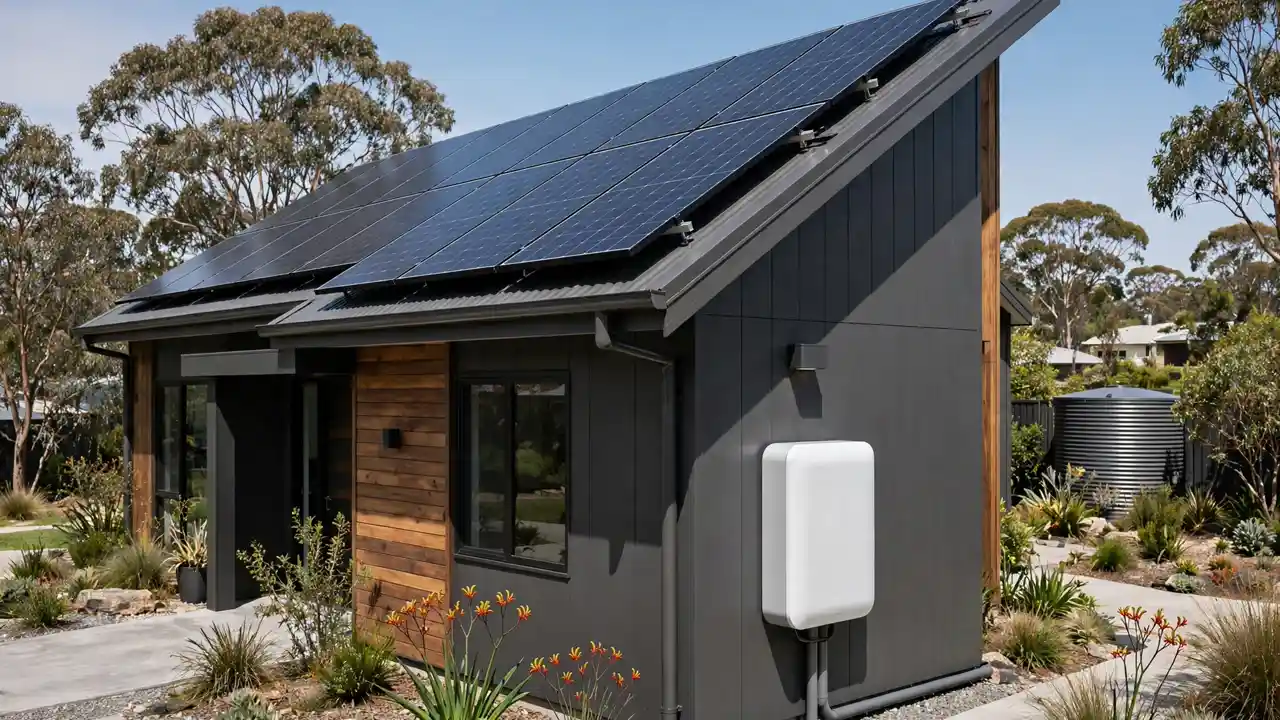
Energy is half the footprint. Water efficiency is the other half, and it is cheaper to build in than to retrofit. For example, a rainwater tank plumbed to toilets, laundry and garden cuts mains water use. Efficient fixtures — low-flow showerheads, dual-flush toilets, efficient taps — cost little at build stage and save every year. Water efficiency lives in the laundry and bathroom. Efficient machines, a tank connection and efficient fixtures do more than any single gadget.
Our laundry room design ideas cover layouts that work hard in small spaces. The same thinking applies to the bathroom. Our powder room ideas show how efficient fixtures fit a compact room. Outside, a water-wise garden with native planting and drip irrigation uses a fraction of the water of a lawn. Design for recycling and composting from the start, with space for bins and a compost area. Ask the builder about construction waste recycling. None of this needs a certificate — just decisions at design stage, when they are cheap.
What It Costs — and What It Saves
How much extra does a sustainable home cost? No reliable published percentage exists. YourHome, the Australian Government’s guide, says designing and building an energy-efficient house may not be as expensive as you think. It points to the free Design For Place plans, common construction materials and higher ratings reducing heating and cooling need. The costs sit in specific upgrades: better glazing, more insulation, airtightness, a heat pump, solar. The savings sit in running costs. A 7-star home uses 20 to 25 per cent less heating and cooling energy than a 6-star home. The Telopea example shows $1,001 a year saved by moving from 7.4 to 8.2 stars.
However, what is certain is where not to spend: on technology before the envelope. For example, solar on a leaky 6-star house saves less than insulation and glazing that lift it to 7 stars. The cheapest sustainable home is designed right the first time. Free plans are the benchmark, an assessor at concept stage, upgrades chosen for rating effect, not showroom appeal. How to build a sustainable home Australia on a budget is the same process. Spending is ordered by return: orientation costs nothing, insulation is cheap, glazing is moderate, solar comes last.
Your Step-by-Step Build Sequence
First, choose the block with orientation in mind: a long east-west axis with living areas facing north. Second, engage a designer and a NatHERS assessor together at concept stage, and set the target above 7 stars. Third, lock the passive design before any appliance or solar decision. Fourth, test the design against the free Design For Place plans for your climate. Fifth, design the all-electric systems and size solar to the home’s actual loads. Sixth, supervise the envelope details: insulation with gaps and windows with air leaks do not deliver their rated performance. Seventh, commission the systems and check the first year’s bills against the predicted running cost. Each step protects the next: orientation protects the rating, the rating protects the bills. For the layout decisions inside that sequence, our open plan living ideas cover the arrangements for an oriented, ventilated home.
Frequently Asked Questions
What is the minimum NatHERS rating for a new home in Australia?
New homes must achieve a minimum 7-star NatHERS thermal rating under the National Construction Code 2022, plus at least 60 out of 100 on the Whole-of-Home rating. NatHERS rates thermal performance from 0 to 10 stars.
How much does a 7-star home save compared to a 6-star home?
About 20 to 25 per cent less energy for heating and cooling. The YourHome Design For Place Telopea house shows the money value: a 7.4-star version is predicted to cost about $1,251 a year in energy use, while the 8.2-star version costs about $250 a year, saving $1,001 a year.
How much does solar cost for a sustainable home in Australia?
A 6.6 kW system typically costs $5,000 to $8,000 installed after the federal STC discount in 2026, from a Clean Energy Council-accredited installer. Published prices vary by state and panel tier: about $5,810 in Brisbane, $6,070 in Sydney and $6,400 in Perth.
Do I need a NatHERS assessor to build a sustainable home?
Yes, for compliance. The rating must come from an accredited assessor using approved software such as AccuRate, FirstRate5 or HERO. Engage the assessor at concept stage, not after the plans are drawn.
What is passive design in an Australian home?
Passive design uses the sun and wind to keep a home comfortable: north-facing living areas to catch winter sun, eaves and shading to block summer sun, thermal mass such as concrete and brick to steady temperatures, cross-ventilation from windows on opposite sides, and insulation and double glazing to hold the result. It is the highest-return step in a sustainable build.
Can I build a sustainable home on a budget?
Yes, by spending in order of return. Orientation costs nothing, insulation is cheap, and the Australian Government’s free Design For Place plans give you a 7-star-plus design without design fees. Spend on the envelope before technology.
How to build a sustainable home Australia is a sequence, not a shopping list. Orient the home, build the envelope, prove the rating, then electrify and generate. Start with the free Design For Place plans for your climate and get an assessor in at concept stage. Then judge every dollar by the star it buys and the bill it cuts. For the free plans and their predicted ratings, the YourHome Design For Place designs are the official starting point.